 The History Channel, taking a break from their standard formula of 70% World War II coverage, 20% Civil War, and 10% other, has been heavily promoting a new series called “Ape to Man.” The series is going to be about “The Search for the Missing Link”, which is already a bad sign, since (1) evolution is a bush, not a linear ladder, (2) there are, if anything, many “missing links” that could be found for any group, not just one, (3) in human evolution, a great many of the “links” have been found, whether or not any individual hominid fossil is from a population ancestral to modern humans, or from a closely-related side-branch (it is usually impossible to tell, although within Homo there is such a continuum of gradual changes up to modern humans in the known fossils that, IMHO, some of those fossils probably really are directly ancestral populations to Homo sapiens).
Much of the promotional material also appears to be playing off the current political controversy in the U.S. If this is just trying to get more viewers, great, but if they put clueless sops into the show for the creationists, then I plan to throw my shoe at the TV.
Hopefully the “missing link” stuff is just promotional fluff from the marketing department. The history of paleoanthropology, which is supposed to be the focus in addition to the paleontology, is indeed a topic worthy of a History Channel documentary. So, I plan to give them the benefit of the doubt to start with.
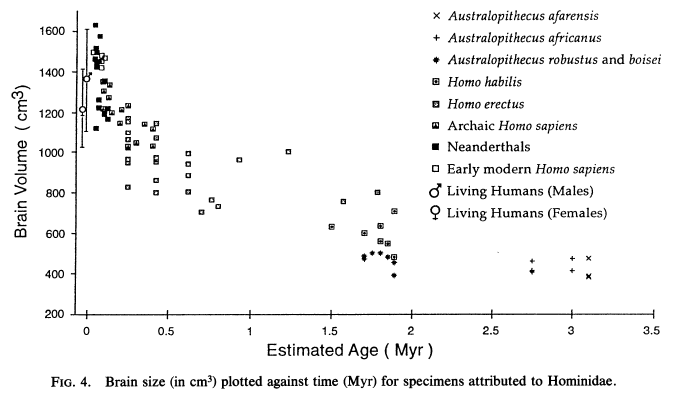
I always find these graphics useful to keep around, if you have any plans to debate the creationists who have apparently invaded the History Channel boards. With hominid evolution, creationists almost universally argue via quotes and bias arguments, and avoid images of the fossils and quantitative analyses as much as possible.
The Fossils Hominids FAQ and especially the comparison of creationist classifications of hominid skulls is a must-read.
The first show is Sunday night. If you happen to see it, post your comments here.
PS: My bet: the History Channel will find a way to insert their Hitler footage into this topic also.
38 Comments
Martin Wagner · 7 August 2005
The History Channel has pandered so often to the woo-woo crowd in the past (they have shows on ancient UFO's, for chrissake, and they can't seem to do a show about Egypt without interviewing that assclown Graham Hancock) that I can't help but be skeptical about this. I used to like the History Channel back in 1998 or so but I haven't watched them in years. I full expect them to bring on IDers and interview them for "equal time". Giving them the last word each time, too.
Call me cynical.
Jim Harrison · 7 August 2005
Interesting question of professional ethics: granted that TV producers are in the business of telling people what they want to hear, at what point, if ever, does it become morally unacceptable to play to the cheap seats? Presumably announcing a professional wrestling match with a straight face doesn't weight on anybody's soul. How about obviously false UFO stories or bits about the discovery of the remains of Noah's ark on Mt. Arafat? Or promoting ID simply because there's a market for it?
KC · 7 August 2005
mark duigon · 7 August 2005
There was an old TV show, "Lancelot Link--Secret Agent" played by a cast of chimpanzees. One of Lance's relatives was known as "the missing Link"--could this be what the History Channel show is about?
Josh Narins · 7 August 2005
That graphic is hard to read in B&W. If you have the data, I'd be happy to redo it in color for you.
Jim Harrison,
TV Producers? Ethics? I think that, when you heard they were talking about "profits" perhaps you thought you heard "prophets?" They can easily say to themselves "Well, I haven't been convinced, one way or the other, so the question is obviously still open."
Which speaks volumes about the amount of effort put forward by the scientific community to dumb down their work for the lay public. Although, if they read this, please note that the lay public would still want _links_ to the original research, so it seems just as "scientific."
Matthew · 7 August 2005
I think the stuff about "missing links" and "evolution of evolution" is just promotional fluff. The website seems to suggest that they accept evolution and hopefully will give us a good documentary about the evolution of man. That would be great.
But if they throw in some evolutionists and give them "equal time" I, like you, will be throwing my shoe at the TV.
Matthew · 7 August 2005
And yeah, the History Channel does have an so-so record in the last couple of years when it comes to reporting real history. You'd think a channel that is supposed to be about history would take pride in getting it's history right, they don't seem to see that as a concern. Actually the ratio would be about 70% WWII coverage, 20% paranormal stuff, 10% other. They regularly run marathons of shows about bigfoot, various haunted mansions, and such. They even run a lot of programs which are little more than apologetics for biblical literalism.
Matthew · 7 August 2005
Also if you go to their website and click "about the show" and then "interviewees" you can see that they are all legit scientists:
http://www.historychannel.com/apetoman/
JK · 7 August 2005
harold · 7 August 2005
The web site makes it look like a rather straight summary of mainstream thought about hominid to homo sapiens evolution.
This is based on very limited experience, but - The History Channel stuff is often surprisingly accurate, not because they necessarily care, but because a big part of their business model is to get cheap advice and interviews from real academics (who are always cheaper and easier to deal with than con artists, of course), add some low budget graphics, build a show, and sell ad space to denture cleaning product manufacturers. The crackpots who are featured are usually low key Atlantis and alien types, not creationists (ie people who don't DENY science, but merely want to add something "extra"), and they're usually "set up", with a real expert following them and gently tearing down their crackpottery. The History Channel probably doesn't pay enough for interviews, nor offer enough "legal protection", to interest the likes of Dembski.
You know, no matter what people say in "surveys", popular American culture reveals a more or less universal acceptance of the fact that modern humans descended from human-like ancestors. It's pretty ironic that evolution denial is seen in the idiot comic strip "BC". At the same time, the artist unconsciously bases his whole strip around the widespread understanding that prehistoric humans lived during a stone age, rather than the idea that "humans appeared magically 6000 years ago".
My beef is, once again, a focus on hominid fossils as the totality of "evolution". Where's the molecular biology? Also, they seem to be exaggerating the importance of the Piltdown Man.
Josh Narins · 7 August 2005
JK,
By the way, there were various origin myths, but that Atlantis story wasn't nearly as cut and dried as the narrator suggests.
Although the interviewer here seems kinda kooky, this interview with Peter Levenda seems to cover the bases (and then some).
I'm certainly no expert on such matters, so perhaps Levenda is just making it up.
JK · 7 August 2005
Josh,
I don't want to highjack this thread too much, so I'll just say I think that interview looks distinctly crankish on both sides.
However, you don't have to a conspiracy theorist to recognise that the Nazis really were into all sorts of mysticism and irrationalism, much of which the interview refers to. Himmler, in particular, was at the center of this aspect of Nazi craziness, and sent people chasing all over in pursuit of it - think Raiders of the Lost Ark.
It's very easy to find complete junk on this subject, especially if you restrict yourself to the web. If you want to pursue the topic in more depth I suggest starting with Nicholas Goodrick-Clarke's work The Occult Roots of Nazism.
ts · 7 August 2005
Geral Corasjo · 7 August 2005
It'll be intresting to watch, but I think it'll be an evolution friendly show.
Sean · 7 August 2005
Just watched this show on History Channel. I generally avoid HC due to all the woo shows they air, opting instead to watch History International and the Science Channel. Miracle Planet is an excellent series of shows on the SC.
I thought Ape to Man was exceptionally well done. Granted, I am no paleontologist and therefor cannot verify their accuracy but I thought their presentation of the theory of mans evolution and the history of hominid fossil discoveries was terrific.
No ID/Creationist input at all. What a relief.
Nick (Matzke) · 8 August 2005
Yay! They are subverting the linear "missing link" model they go with at the beginning, and switch to a family tree.
(and there was much rejoicing)
ts · 8 August 2005
The show certainly didn't suck, but it did have a number of problems, like using the word "theory" to mean "guess", and numerous dramatizations without a single explicit statement that these are artistic conceptions, not even rising to the level of speculation (this is apparently common for the History Channel, because the program on Bonnie & Clyde that followed used the same approach). This is likely to leave a lot of people wondering "how can they know it happened that way?" which is liable to spill over to the more empirical parts of the program.
For those interested in the subject, check out the Science Magazine articles at
http://www.michaelbalter.com/articles.php
especially "Becoming Human: What Made Humans Modern?" and "Paleoanthropology: What--or Who--Did In the Neandertals?"
Also of particular interest to PTers should be the recent article "Evolutionary Genetics: Are Humans Still Evolving?"
Jaime Headden · 8 August 2005
The show, amazingly enough, was a history programme of the progression from the original pre-Darwinian discovery in Neander Valley of the original Neanderthal calvarium towards the modern australopithecine theories about branching trees. This included some rather well-done but somewhat fanciful recreations of the people involved, their drives and motives, without a lot of scientific hubbub into "just the facts" man. No wonder this show was on the History Channel. Documented, especially WELL documented history is what this channel thrives on. Speculation and Atlantis and such is best left to the Discovery Channel, it's bread and butter is documentaries on ideas about history and biology -- or the Animal Planet.
Indeed, many of the very researchers were using "theory" as we would have it as a non-mathematical guessing game, because in science, especially paleontology and anthropology, theories are about making assumptions about best-fit scenarios. You can use probability math and conjecture and all that as much as you want, but until you open the box, you'll never know if the cat is alive or dead -- BUT, you'll have a pretty decent idea that, if you give your cat cyanide and wait 30 minutes, it'll be most probably dead. This is still theory backed by observation, or "guesses backed by facts." Welcome to Paleontology, which isn't Math. After all, it has a lot more letters in it's name.
Jaime Headden · 8 August 2005
BTW, the problem with using the above chart to argue against "creationists" (rather, only a subset care, not that many here make this distinction vocally enough) are that claims of "scientists disagreeing with one another" (an argument used to erode public understanding of scientific progression of hypotheses) can easily be supported. The names Australopithecus boisei and Australopithecus afarensis may refer to two so totally different taxa that the name Paranthropus is used by some for the former, while the latter is retained in a genus with A. africanus. That these are labels to convey ideas and that they are prone to change, whereas some even scientists debate over when, where, why, and how to change them is such a topic there are journals for it. Laypeople will NOT understand that taxonomy and how its represented by lumping data to fit a label or changing a label to split data up will change on how we characterize features. Yet another new A. afarensis mandible has shown up, and it demonstrates yet more human-like plasticity in structure, so that there is a comprehension many lay people and even scientists, don't grasp in clines versus clouds, and that much of human evolution, especially the idea of missing links, is to label particular frames of time, not shapes.
I.E., there is not ONE missing link, there are now something like 15 of them, each transposing a species or genus (whatever those words actually MEAN) between classic "apes" and humans. That laypeople don't grasp that the two schools of thought on "ape vs. man" is essentially semantic and without any scientific data to prove one way or another because the philosophical underpinnings of the debate are intangible, should be comprehended by those that do debate here. The other guy may not be able to "get" this without realizing that labels are prone to change with data, and you need to illustrate your ideas in a proper debate (give them visuals) or they will just not get it. This is what I have had to do with laypeople, and it seems to turn the lightbulb on for them to at least get the concept we are using in talking about animals.
So ... man is an ape in that if you use "ape" to characterize that group of Anthropoidea that aren't "monkeys" (which are non-lemur, non-ape primates, but don't form a natural group - i.e., share a common ancestor to the exclusion of apes and lemurs), but man isn't an ape because apes are chimps and gorillas and.... We get taught shape-based observations in school, how to clearly label something, and then later get taught how to question these and form our own concepts. Some people never get to stage 2 because it is excessive schooling that won't teach you how to use a drill, or drive a car, which have RULEBOOKS to define their function and operation. Taxonomy, and science in particular, have no operators' manuals, or if they did they'd be revised with every paper written. The principle of this change is what doesn't get taught, and that change is qualified in the graphic at the top of this page, where someone's label is used to plot a group of points in a feild that someone else would call something different. This would change our ideas about evolution of brain size in Australopithecus, by reducing species at the lower or upper ends, or including more into it, but seldom gets taken into account when discussing missing links with people who just don't know.
ts · 8 August 2005
Jaime Headden · 8 August 2005
Because of the context in which I mentioned Math.
ts · 8 August 2005
The context was science as a "non-mathematical guessing game". Evolutionary biology is science, it's not math, and yet evolutionary biologists still manage to use the word "theory" as something other than a guess.
Thomas R. Holtz, Jr. · 8 August 2005
Managed to watch most of the show last night (will see the remainder tonight on tape), and in general it did not suck. Some elements of the graphics (the long single column of ape-to-man morphs and the species stats, for example) were rather annoying. However, the show served pretty well for the function intended, which (as I read it, at least) was a general overview on the history of paleoanthropology.
That being said, the commercials and ad campaign did suck dog meat. However, having worked with various documentary series in the past, I know that the research and production staff have zero control over advertisement, and even the editorial staff have only limited input. Such are the ways of television...
Russell · 8 August 2005
(Hmmm... this may be a duplicate post. I'm not sure what happened to my first attempt.)
First - IDers will not be overly distressed by the show. They will equate themselves to Raymond Dart as brave, and wronged, challengers of the entrenched orthodoxy. And they will imply that somehow all of evolutionary theory is equivalent to the Piltdown hoax.
Second - and let me preface this by saying I know very little about the history of the development of ideas about hominid phylogeny - I was surprised that the naive "linear model" so dominated and distorted the thinking of the field for so long. What part of Darwin's "tree" idea did they fail to grasp? Did they really expect there would be just one lineage from last common ape ancestor to modern human? Did duBois really expect there would be exactly one "missing link", with brain size exactly midway between modern chimp and modern human? Why? Were folks really so surprised when DNA evidence showed Neandertal to be a cousin rather than a parent? Perhaps I read a lot of modern science back into it, but it seems to me that Darwins "Origin of Species" was a lot more nuanced than that!
Joe Shelby · 8 August 2005
On The History Channel (and unrelated but similar output from Discovery Channel) :
It seems as though the American "documentary" networks work quite hard to keep up with and clone much of what the BBC puts out. "Walking with Dinosaurs" was followed up rather quickly by "When Dinsoaurs Roamed America"; "Walking with [Prehistoric] Beasts" was followed up by the Americans with a variety of programs on Mammoths and Smiledons.
Discovery Channel's networks (including The Science Channel) had already done their own "caveman" series in response to BBC's "Walking with Cavemen". This is just A&E's entry into that field.
Mind you, Discovery Networks' output is in friendly competition / riding the wave, as they already broadcast the BBC's shows as it is, and continue to do so even after producing their own material.
Its similar to how, within a year after The History Channel premiered with a 6 hour American Revolution documentary, Discovery's TLC followed up with their own 6 hour documentary (now re-run on Discovery Times, as TLC has changed its focus to home improvement). PBS followed that with their own a year or two later...
Much of the material that these networks show is bought rather than produced directly. Some are from the BBC, some are independent. Much of the pseudo-scientific "schlock" is bought (but not all), and usually at a really cheap price.
As for History Channel's overemphasis on WW2? Blame copyright law for that. Changes in the law now have greatly increased the value of footage produced since 1964, making it too expensive for documentary makers to purchase and still have their investors make a profit. The DMCA has made this even worse as pretty much all material produced since the mid-90s is stored in digital formats. In some circumstances, its actually cheaper to hire actors and effects artists and "fake it" than it is to actually purchase rebroadcast rights of the original footage. Everything on WW2, on the other hand, is still practically free.
Pete Dunkelberg · 8 August 2005
John Hawks says....
Thomas R. Holtz, Jr. · 8 August 2005
In reply to Russell (#41889):
The failure of paleoanthropology to accept a bushy Darwinian view of human origins wasn't (thankfully) merely a leftover bit of pre-Darwinian Scala Natura thinking. There was at least some ecological thinking involved. Supporters of the one-hominid model postulated that two or more sympatric "hominids" (in the old sense: hominins nowadays) could be supported by the environment, given the overlapping resource requirements.
Not entirely crazy, all things considered, but still it held back a more realistic view of evolving hominin diversity.
Aagcobb · 8 August 2005
"My beef is, once again, a focus on hominid fossils as the totality of "evolution". Where's the molecular biology?"
They did mention the retrival of Neandertal dna which turned out to be significantly different then the dna of modern humans, though they didn't go into any of the details concerning the fact it was mitochondrial dna. I assume creationists will be unhappy that their "controversies" might as well not have existed as far as the show was concerned; it stuck solely to scientific controversies. ID is too incoherent to have a controversy about human evolution; they don't know if they think humans evolved or not!
Jan Theodore Galkowski · 8 August 2005
my take on the show is here.
Matthew · 8 August 2005
"My beef is, once again, a focus on hominid fossils as the totality of "evolution". Where's the molecular biology?"
Molecular biology is boring even to molecular biologists.
Jaime Headden · 9 August 2005
TS, with respect, you seem to misunderstand my context. What I wrote was "This is still theory backed by observation, or "guesses backed by facts." Welcome to Paleontology, which isn't Math."
Math obeys explicit and immediately testable statements that, when counter-checked, are immediately verified.
2 + 2 = 4 ; 4 - 2 = 2
In Paleontology, there is no constant; we observe something, and form an hypothesis to explain it, then test this by verifying our observations or the criteria in which the hypothesis is formed. What results, in paleontology, amounts to a "just so" story in as much as the theory is a collection of hypotheses. We lack a time machine to verify the conditions, but we gain probabilities using parsimony methods. If we had math in paleo, we wouldn't need implicit parsimony to frame hypotheses in.
Example:
Hypothesis: giraffes evolved their necks to reach branches above their heads.
Test: Examine the fossil record for giraffe fossils and tree heights in the same environments to see if there is a correspondent height gain that explains successful adaptation. Processes of this testing are varied, and depend even on what you want to call a "giraffe," such as okapi, Giraffa and Sivatherium; and whether you can parsimoniously exclude all other possibilities.
In explicit math, 2 = 2 in all realms except where "2" represents a value like "E" can, or "=", as in algebra. This explicit form is simply not available in math.
This leads to my statement regarding guesses with facts. Welcome to Paleontology. Each field has it's own approach to the medium of explaning to children, layfolk, and religous people alike. Given my work volunteering at a local library and setting up evolution-friendly displays, and interacting with all sorts of curious or doubting people, telling people they are wrong and we are right is NOT the approach. You don't KNOW, you only think you do, and approaching them in any other frame of mind is to cease being scientific. Yet still I allow people to ask questions and be curious. Paleontology, as a result of its subjects, is prone to more questions than how to quantify the gravitational effect on a nanoparticle in physics (especially when you are inferring the existence of that particle but can't prove it exists), verus describing the structure of light (which no one seems they can, wave or particle, affecting how light affects its environment or is affect), the relationship of quantum realities.... The problem is time and material, which disappears, and this makes objectionary creationists giddy because we are left with more questions than it seems mathematicians.
ts · 10 August 2005
Bayesian Bouffant, FCD · 10 August 2005
rdog29 · 10 August 2005
If one were to call Buttars a "clueless jackass", would that be an ad hominem attack?
'Rev Dr' Lenny Flank · 10 August 2005
Dr. Gene · 11 August 2005
If one were to call Buttars a "clueless jackass", would that be an ad hominem attack?
I don't think so, since after all the insult is to clueless jackasses!
Dr. Gene
Miah · 16 August 2005
I have a question regarding this show. Towards the latter half of the show when they got to the DNA testing of the Neaderthal bone and found out it was a "different species". Then later in the show it was mentioned that Neaderthal's were "cousins" of Sapiens.
Their reasoning (on the show) was that early Sapiens possibly eradicated them, or the Neanderthal's went extinct for reason of competition.
My question: Is it possible or has it been proven/disproven that at some point in their history that there may have been cross-breeding of the two?
Any help and/or some insite is greatly appreciated.
Thanks!
Wayne Francis · 17 August 2005