Let's derive an expectation of ratio of transitional to non-transitional fossils from what Darwin actually said, shall we? Darwin stated that natural selection would work intermittently, and often only at long intervals.
On the other hand, I do believe that natural selection will always act very slowly, often only at long intervals of time, and generally on only a very few of the inhabitants of the same region at the same time. (CR Darwin, Origin of Species, 1st ed., p.153)
— Elsberry
Given these views of Darwin, we can derive an expectation of the ratio of transitional to non-transitional fossils found. I include in the following only those factors which yield a differential expectation of discovery of transitional fossils displaying the action of natural selection.Darwin addressed geographical distribution of fossils as a factor.
In his famous section on the imperfection of the geological record, Darwin gave several further reasons to doubt that we would ever have a complete record of past life.One other consideration is worth notice: with animals and plants that can propagate rapidly and are not highly locomotive, there is reason to suspect, as we have formerly seen, that their varieties are generally at first local; and that such local varieties do not spread widely and supplant their parent-forms until they have been modified and perfected in some considerable degree. According to this view, the chance of discovering in a formation in any one country all the early stages of transition between any two forms, is small, for the successive changes are supposed to have been local or confined to some one spot. Most marine animals have a wide range; and we have seen that with plants it is those which have the widest range, that oftenest present varieties; so that with shells and other marine animals, it is probably those which have had the widest range, far exceeding the limits of the known geological formations of Europe, which have oftenest given rise, first to local varieties and ultimately to new species; and this again would greatly lessen the chance of our being able to trace the stages of transition in any one geological formation. (CR Darwin, Origin of Species, 1st ed., p.306)
— ElsberryI have attempted to show that the geological record is extremely imperfect; that only a small portion of the globe has been geologically explored with care; that only certain classes of organic beings have been largely preserved in a fossil state; that the number both of specimens and of species, preserved in our museums, is absolutely as nothing compared with the incalculable number of generations which must have passed away even during a single formation; that, owing to subsidence being necessary for the accumulation of fossiliferous deposits thick enough to resist future degradation, enormous intervals of time have elapsed between the successive formations; that there has probably been more extinction during the periods of subsidence, and more variation during the periods of elevation, and during the latter the record will have been least perfectly kept; that each single formation has not been continuously deposited; that the duration of each formation is, perhaps, short compared with the average duration of specific forms; that migration has played an important part in the first appearance of new forms in any one area and formation; that widely ranging species are those which have varied most, and have oftenest given rise to new species; and that varieties have at first often been local. All these causes taken conjointly, must have tended to make the geological record extremely imperfect, and will to a large extent explain why we do not find interminable varieties, connecting together all the extinct and existing forms of life by the finest graduated steps. (CR Darwin, Origin of Species, 1st ed., pp.340-341)
Now, we can assign some estimated numbers to the variables listed above. Because Darwin said "often only at long intervals", NSTP should be small. Let's assign a relatively large "small" value of 0.1. Since Darwin said that natural selection operates on only a very few inhabitants at a time, NSPP should be smaller still than NSTP. Let's assign a value of 0.01. For AP, the area proportion between the geographic extent of a widely ranging species and its local variety, a value of 0.1 is probably an overestimate, but let's leave it at that for the moment. For SEVR, Darwin's text would indicate a value of 0.25 or less would be reasonable. FSDP is something best estimated by a geologist, but Darwin probably felt it to be under 0.5. Replacing values, we find that EFR = 0.1 * 0.01 * 0.1 * 0.25 * 0.5 EFR = 0.0000125 = 1/80,000 David Raup has estimated the number of catalogued fossil species at 250,000. This allows us to generate an estimate for number of transitional sequences expected under Darwin's own views as: ETF = EFR * OFS = 0.0000125 * 250,000 = 3.125 Roger Cuffey's 1974 paper on paleontologic evidence listed references for at least 139 fine-grained species to species transitional sequences. According to an expectation derived from Darwin's own words and values from the real world, it can be seen that the fossils have been rather more forthcoming than one would expect, not less. In addition, creationists seem to believe that gradualism is not a feature found in the fossil records. Again, they are perhaps unfamiliar with the scientific literature in this area. Luckily, there is an excellent resource by Mark Isaak called Index to creationist claims. Don Lindsay shows some beautiful examples of gradual fossilsEFR = (NSTP * NSPP * AP * SEVR * FSDP) and ETF = EFR * OFS where EFR is the "expected fossil ratio", NSTP is the "natural selection time proportion", NSPP is the "natural selection population proportion", AP is the "area proportion", SEVR is the "subsidence vs. elevation variation ratio", FSDP is the "formation to species duration proportion", ETF is the "expected number of transitional fossils", and OFS is the number of "observed fossil species".
 a single species of snail
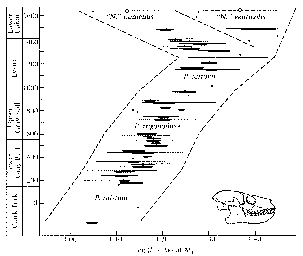 A tree dweller becomes two
Chris Cuffey provides us with a beautiful series of "Mammal like reptiles"
A tree dweller becomes two
Chris Cuffey provides us with a beautiful series of "Mammal like reptiles"
121 Comments
Necro · 3 June 2006
Looks like BarryA's effort re transitional fossils over at UD is set to cause yet another rift between the YEC IDists and whatver the rest are:
http://makeashorterlink.com/?D2243653D
steve s · 3 June 2006
John Marley · 3 June 2006
IDiots have always ignored (or dismissed as irrelevant) inconvenient evidence. Why would they change now?
Side note: I think it would be appropriate for 'IDiot' to be added to the spellchecker.
PvM · 3 June 2006
Isn't it sad how ID still embraces the ignorance of its creationist roots?
Any claims that ID is interested in teaching the controversy and 'correct science' should be taken with a significant grain of salt.
bill Farrell · 3 June 2006
Is not every fossil a transitional fossil?
I hope that I'm a transitional fossil and not an ordinary fossil. I'd hate to be just an ordinary fossil, know what I mean, Vern?
I always thought I was special.
PvM · 3 June 2006
Wikipedia shows nicely how transitionals were filled over time in for human evolution
PvM · 3 June 2006
And of course, Talkorigins has a large FAQ on vertebrate transitionals...
Why is it that it seems that so often ignorance is guiding ID creationism?
Wheels · 3 June 2006
Even after watching this sort of stuff go on for a few years now, I'm still amazed that some people (even "major players") can outright deny the veracity of any and all transitional forms. Worse still, the constant appeals to Eldridge and Gould as if it made the case for evolution itself any weaker.
I guess this is partly why I've been "enfascinated" into the whole thing. Some people are just stupifyingly interesting to watch.
Sir_Toejam · 3 June 2006
wow phillip.
it's amazing how consistently your comments look like almost pure stream of consciousness.
was there a point you were trying make here?
I'd recommend you be a try to be a bit more specific in the future.
Christian · 3 June 2006
Bruce,
After reading a bit of your website, I can only say: Wow! How incredibly, psychotically imaginitive can one get in order to attempt to prove that the bible has much to do with evolution or the genesis of this solar system?
PvM · 3 June 2006
Heywood, contribute or use the bathroom wall.
snaxalotl · 3 June 2006
toejam, I'm paraphrasing, but I think the point was "some different species are kinda samey, at least one species is kinda diverse for very artificial reasons, and therefore blah blah blah". Hope that clarifies.
Bruce Thompson GQ · 4 June 2006
Marek 14 · 4 June 2006
I wonder about this:
Today, you can have all sorts of things done to you after you die. You can be buried, burnt, shot into space, frozen, be fed to vultures...
But is there actually an option to get yourself well-fossilized so you could be found some millions of years later?
Torbjörn Larsson · 4 June 2006
If you can't come up with a fossilisation process you could consider plastination http://en.wikipedia.org/wiki/Body_Worlds .
Wheels · 4 June 2006
Last I checked, all humans are apes.
This is verified not only by all that information you liked to harp on about at the molecular level, but also by the outward manifestations of said information, i.e. morphology. This sort of classification would hold out even neglecting the accepted idea of evolutionary relatedness, as no less than Carol Linnaeus himself classified humans among the other primates, and that was before much of modern biological classification was explored and established with solid methodology. Since you seemed so dismissive of using anatomy as a classification method, it does bear repeating that all the "information" i.e. that wonderfully complex genetic code indicates that humans are a sort of ape.
This whole Creationist uproar about being "related" to apes amuses me to no end. "More like an ape than a human" indeed. My dogs do not act more like mammals than they do dogs.
Torbjörn Larsson · 4 June 2006
It is a telltale sign when a creationist speaks about cognitive dissonances. One will find he exhibits one in the very same text.
This time twice, since the UD poster both refers to explanations such as Elsberry's for the number of transitional fossils and Darwin explaining why the fossil record will not be complete without understanding what he is saying. The task of science is of course to explain the observations we can make, not asking for observations we can't make.
On Philip's comments I reacted the same as several here. He exhibits the frontloading that Charlie Wagner does on Pharyngula and the Loom.
He even adds some quantum babble for good measure. "A tree is a pre-programmed information device-the Creator's quantum style computer." What is this thing with trees and nuts? Don't tell me it's good for the species procreation.
JC · 4 June 2006
How come there is some much vicious spew against those poor uneducated or misled believers in ID or creationism?
I mean, you hate their guts.
What should be an academic matter becomes viciously personal...oh, there is the argument kids are being misinformed, etc, but our society passes all kinds of spew off on kids everyday and you don't complain.
And since the schools are doing a poor job anyway, less than a third of the kids graduating, and of those only half being able to really read and write at a high school level...it seems there is more going on here.
Yep...atheist propaganda; the atheist dare not let a "theistic foot" in the door as one atheist scientist commented, or their whole rotten humanity hating edifice could come crashing down.
Russell · 4 June 2006
'Rev Dr' Lenny Flank · 4 June 2006
K.E. · 4 June 2006
Lenny, Heywood is down to his last few marsupials in his top paddock. I expect the men in white coats will be called soon.
JC. You know you are 100% right. The sons and daughters of Cletus and Brandine Spuckler (all 26 of them) would be much better off at a decent madrasah.
wamba · 4 June 2006
Vyoma · 4 June 2006
K.E. · 4 June 2006
Vyoma..... don't waste your time .....Bruce will start talking about cats and dogs and the improbability of crows talking then move on to why Darwin died an atheist because he didn't read Mendel's papers.
Isn't that right Bruce?
Stone the crows mate, you must be busier than a one armed Sydney Cobbie with crabs throwing a technicolor yawn over evolution, a bit more choke and you would have started.
Vyoma · 4 June 2006
K.E. · 4 June 2006
Vyoma if only 'twere that easy.
I'm thinking of dropping sarcasm altogether (they just don't seem to 'get it')and moving to outrageous insults. I've come a long way quickly with these idiots (as the surprised actress said.
K.E. · 4 June 2006
insults go better without spelling checkers
Sydney Cobbie=Sydney Cabbie
Anton Mates · 4 June 2006
Stevaroni · 4 June 2006
If any of you guys are ever in Capetown, South Africa, check out the Natural History Museum (it probably has an official name, but it escapes me).
I saw perhaps the best illustration ever of transitional fossils there.
They have a long wall, and on the left end of it, they have the fossil skull of a very ancient and primitive fish. On the right end of the wall, they have a modern human skull.
And in between, they have a whole slew of intermediates, all from the right geological era.
They've also helpfully color-coded all the individual bones on each skull, so you can track what moved where and when, so you can see how those pesky gill covers became ear bones with your very own eyes.
There's a similarly convincing display of changing hominid skulls in the 3rd floor lobby of the British Museum of Natural History in London (not to mention an entire wing on Darwin).
I would hazard a guess that anyone who was truly looking for evidence of transitions with an open mind would come away from either of these displays convinced.
It's a real shame that in recent years American museums have caved to public pressure and tuned down the emphasis on evolution in new exhibits, because when you see a really good example of this type of display, it's pretty hard to honestly think anything but "Well, Duh."
(By the way, Capetown also has an excellent exhibit on regional whales which shouldn't be missed)
Bruce Thompson GQ · 4 June 2006
PaulC · 4 June 2006
Jason · 4 June 2006
Sir_Toejam · 4 June 2006
Sir_Toejam · 4 June 2006
Sir_Toejam · 4 June 2006
PvM · 4 June 2006
MrPeng · 4 June 2006
Hi,
I've been lurking here and at UD for several months, since the Dover, PA trial, and reading like crazy The Wedge, Creationism's Trojan Horse, Why Intelligent Design Fails, Darwin's Ghost, I have even slogged through Debating Design: from Darwin to DNA, and a host of other volumes, and one thing completely stumps me: Why are there a certain set of people who can look at the available data and not see what there is to see? It's as if you show an evolution denier a banana and he says, "That's an orange, and your insistance on dogmatically calling it a banana is responsible for World War Two, Hurricanes, AIDS (not that there is such a thing as AIDS), Homosexualtiy and the downfall of Western Civilization as we know it!"
There seems to be a funkadelic disconnect from reality. I don't want to blame religion, because there are plenty of religious people who 'get it.' What causes this seemingly willful obtuseness and refusal to accept what is so patently obvious? Its maddening, and I applaud those of you here who take the time to explain things - over and over and over and over again and again and again and again - to the latest ninnyhammer to arrive with his sack full of talking points from Answers in Genesis. I simply do not understand how, when shown the lovely progression from tetrapod to whale, the evo-deniers can honestly say (honsetly is key here) that they don't see what an elegant example of evolution in action it is.
Anyway, brilliant site, and I will now return to lurk mode.
Tukla in Iowa · 4 June 2006
Sir_Toejam · 4 June 2006
Pete Dunkelberg · 4 June 2006
The Transitional Fossil Existence Challenge.
steve s · 4 June 2006
Katie · 4 June 2006
This is the thing I don't understand: obviously, since there are no transitional fossils and particularly no hominid ones, every hominid must be either pure human or pure ape. Yet creationists can't even agree (sometimes even with themselves!) on which are human and which are ape. That all by itself blows the entire "no transitional fossils" straight to hell, without even looking in any detail at morphology or at any of the other lineages. It seems like a pretty perfect illustration of how intermediate those fossils really are, unless anyone can explain to me why it's not?
steve s · 4 June 2006
Yeah, I do love those moments when one creationist says 'this skeleton isn't transitional, it's a monkey' while another says 'this skeleton isn't transitional, it's a human'. those are delicious.
In a related story, over at After the Bar Closes, one creationist (AFDave) is claiming that relativity proves god exists, while another creationist (Ghost of Paley) is claiming relativity is totally wrong.
Henry J · 4 June 2006
Re "It seems like a pretty perfect illustration of how intermediate those fossils really are, unless anyone can explain to me why it's not?"
The problem is, you're using logic to evaluate the argument, when you're supposed to use your emotional reaction to the conclusion. ;)
Henry
Ed Darrell · 4 June 2006
dogscratcher · 4 June 2006
Heywood:
"when it is known and always has been known and always will be a fact that being a member of a species has mostly to do with being able to marry and have children."
Shouldn't there be a constitutional ammendment making interspecies marriage illegal? I mean it really cheapens the whole intstitution of marriage if you allow dogs and cats to marry.
Glen Davidson · 4 June 2006
I hate to complain about an anti-anti-evolution paper, but you can't really "do math" like that. The values Elsberry assigns might be reasonable, but they can't be ascribed to Darwin. Unlike Dembski, Darwin knew where he was ignorant, and walked carefully around those areas.
Then too, one cannot compare the time of Darwin with the time today. The numbers Elsberry uses may, or may not, be reasonable guesses at what Darwin might have used, but of course the numbers are very different at this time. We all know that? Of course we do, but if one truly takes account of this fact, the conclusion, "...it can be seen that the fossils have been rather more forthcoming than one would expect, not less," does not follow from the calculations, mainly because the numbers have changed since Darwin's day (even if we accept, for the sake of argument, the figures that Elsberry uses).
Why do I bother? Because of the fact that evolution may not have proceeded as Darwin expected--that is to say, the punc-eek guys might be right. The great thing about Elsberry's article is that he gets to showcase known (or at least highly suspected) gradualistic change, which is especially difficult to account for in the YEC scenario (who knows what ID "would predict" (obviously they try their best to predict nothing at all, except highly suspect post-dictions (find a complex "machine" and proclaim that it cannot evolve) of unevolvability)?). Perhaps more to the point, evolution probably did not occur according to how many neo-Darwinists assumed it would, something that Elsberry's mathematics does not change, IMO.
There's another issue, which is that more effort may have been put into documenting gradual changes where it was hoped that they would exist, than in sequences which were expected not to yield these gradual changes. Hence there may be an artifact of selection that also affects Elsberry's figures.
Having said all of that, I would also point out something that your average creationists does not know, and usually does not care to learn. Gradualism was the assumption throughout much of evolutionary theory's life, however it was not an entailed prediction. It was simply due to the conservatism of science, that one ought not to predict anything for which one does not have evidence. There is not a similar stricture in ID/creationism, of course, so that these pseudoscientists do not understand the conservatism of evolution, yet this is a necessary constraint in legitimate science.
The entailed predictions of evolution were not touched by the debates over the rate of evolution (or, the typical rates of evolution). This is why Gould and Eldredge were talking the same language and types of evidence as the gradualists, since virtually the same kinds of changes were expected with punctuated equilibrium as with gradualism, just at differing rates.
We are not even talking about the same sort of evidence with IDists/creationists, since we have no idea how life would be "front-loaded", or affected from the heavens, in the ID "scenario". The IDists want us to forget this fact, and to assume that the sort of complexity predicted by evolution (namely, derivative complexity) is also predicted by ID--or equally, that the lack of prediction by ID is fine because ID has no expectations (beyond complexity levels--which are not entailed by ID at all, considering that we have no expectations of the designer).
Glen D
http://tinyurl.com/b8ykm
the pro from dover · 4 June 2006
Attention Lurkers: If you approach this website a few monotremes short of a subclass you can expect to be attacked by the intelligent educated segment of society. Probably the best example of an IESS is the right reverend Leonardo Flanko MD pHD FOTHB. And until he aims his high powered sarcasm ray at your corpus callosum you're..well..still a lurker. Before PT i could't even spell scientist now i can use terms like "funkadelic disconnect" in some of the most erudite of social gatherings (and how it helps me pick up chicks!!!). I wonder do you have to pay royalties to George Clinton or to Bootsy Collins for that expression? An intersting side issue to the transitional fossil phenomenon can be found with modern sharks and rays. Sharks are ancient creatures with fossils dating back to what 400,000,000 years whereas rays dont appear until sometime in the cenozoic era. Today its very hard with living specimens to clearly delineate where sharks end and rays begin without applying some arbitrary definition. Although the "difference" between a Great White and a Manta is huge as you gradate from one to the other there are organisms that are truly "transitional".
steve s · 4 June 2006
Wesley R. Elsberry · 4 June 2006
'Rev Dr' Lenny Flank · 4 June 2006
Stuart Weinstein · 4 June 2006
Anton writes "So if you're hinging your species concept purely on interfertility, you cannot say that, say, humans and chimps are definitely different species. Do you think such a concept is particularly useful?"
One wonders whether or not Phillip would like to test his hypothesis.
Do it for glory Phil.
Stuart
Philip Bruce Heywood · 5 June 2006
I've been out swinging from trees. Don't forget that to prove two individuals are the same species they need to produce fertile offspring. Advanced organisms that reproduce asexually sure as shooting reproduce after their kind. We are referring here to complex organisms. The microscopic world and the world of plants follows along the same lines, although not perhaps in a clear-cut fashion. We also have to consider the matter in context. As I mentioned, human breeding programmes may be a factor in some instances (e.g., dogs). As for testing humans with, say, chimps, to see if we are the same species - don't assume it hasn't been tried. But that is a red herring. Species in the everyday sense are reproductively "islands unto themselves" as anyone who opens his eyes can see.
It is not the purpose of Science to overthrow the absurdley obvious to support a religious stance. Science utilizes facts to build theories, not vice-versa. So, species in the common, everyday layman's understanding, are genetically distinct units. Explain, then, how they were transformed one to another. Such events presumably occurred only under exceptional, special conditions, but they happened, naturally, without breaking the laws of science. "Transitional" specimens will presumably play a part in this endeavour. "Transitional" in inverted commas. People who already know how it happened need not apply.
Shirley Knott · 5 June 2006
Phil, are you seriously asserting that it is in principle impossible ever to determine whether two males are members of the same species?!?!?!
hugs,
Shirley Knott
Andrea Bottaro · 5 June 2006
SteveF · 5 June 2006
"I've been out swinging from trees."
Does that explain why you talk such shit?
Erasmus · 5 June 2006
So Heywood then all members of Lepomis (Centrarchid fishes) may be synonymized into one species? They interbreed successfully with persist despite multiple fertile outcrossings. You really should write that paper my friend with your incisive insight and wonderful bafflegab ideas, you could revolutionize the world of teleost taxonomy. Maybe you would set the entomological world on it's frontoclypeus if you were to insist that descriptions of new species be presented alongside reproductive isolation data, make these ivory tower humbugs test their assertions, plain old lock and key does not a species make.
the fact that 'anyone who opens his eyes can see 'is not so plain as you might think, check the recent cryptic complexes of lepidoptera from south america. your notion of species is emotional essentialist bullshit.
Vyoma · 5 June 2006
AD · 5 June 2006
With regard to the earlier comment about this being a scientific debate...
It's not a scientific debate until both sides have conducted and published actual research. So, um, who's holding up the scientific debate again?
Just wondering.
k.e. · 5 June 2006
Geez Bwuce, are you SURE they didn't let you out just to get rid of you?
Bestiality is a crime in most states in Australia, so why is it you have never been caught?
stevaroni · 5 June 2006
stevearoni · 5 June 2006
Anton Mates · 5 June 2006
k.e. · 5 June 2006
Glen Davidson · 5 June 2006
Mathmattx · 5 June 2006
If the aim of this website is true to its mission statement "to educate and defend" please respond...Often times these panels truly miss the point, all the vitriol aside for a moment. ID or Darwin folks get so bent out of shape trying to interpret ever changing "evidence", using ever shifting methods of collection that barely pass as science e.g., (http://www.timesonline.co.uk/article/0,,11069-2208566,00.html). Sort of the (as mentioned) playground bullying of "My PhD is bigger than yours". I think Evolutionists enjoy this game because it diverts attention from the crux of the issue (as Darwin did). So the two questions remain as I would like them answered. Let's rewind to the beginning and simplify the issues, so there is no intellectual slight of hand (on either side). If the "Big-Bang, i.e., "First there was nothing and then it exploded", 1) what did evolution first act upon to produce life when there was no life? (If we believe Pasteur, and the Universe was "hot" as science says it was, then it was basically a, ultra- sterilized Petri dish. 2) If evolution, why more than one form of life? So, we grant number 1), but why then "evolution". If the first organism evolved, it was alive and perfectly suited to its environs, it had no predators, was succeeding, etc, why such a range of diverse creatures. I suppose you can claim competition or a changing environment, but with as slow as evolution acts...the limited population would have been either eaten or starved out of existence, rendering the simple single cell "cousin" the dominate and successful organism. Any evolution beyond this defies logic...why risk expenditures of biologic energy trying to evolve when there is no environmental pressure to evolve. Again, why such a range of creatures from a simple to "ever-complex". If it is a result of competition, shouldn't we have just a few or even a single "Ultra-Complex" life form on Earth...why are "humans" here if bacteria or amoebas still flourish? To say anything beyond this, seems to me, to imply that the evolutionary process itself is "intelligent", e.g., that an evolved "eye" also had the extra sensory perception to know that a connection to the brain, to a nervous system, to fluid vessels, a lens, etc would be needed. I will leave the Christians alone at this point because, whether you agree with them or not, their position is clear and has been consistently defined since the dawn of recoded history (An uncreated God, created everything). However, Science seems to get ever more imaginative and speculative as time goes on, why (among other reasons) sciences texts from even a few years ago are "out of date".
Sir_Toejam · 5 June 2006
Sir_Toejam · 5 June 2006
steve s · 5 June 2006
DEY TOOOK ERRRR JUUUBBBBBBBBSSSSSSSSSS!
Sir_Toejam · 5 June 2006
thanks for the correction, Steve.
That's a much better phrasing.
;)
Glen Davidson · 5 June 2006
Glen Davidson · 5 June 2006
It appears as if the figure "139" for fine-grained species successions is incorrect. I don't even know how anyone got that figure from Cuffey's article, though I will hazard a guess.
What Cuffey does in his article is to list tables of various transitions recorded in the fossil record. The first two tables involve documented species to species transitions. There are only 22 taxa listed--and there is significant overlap between the two tables. While there may be more than one example of succession between species in some of the mentioned taxa, we are not told if there are.
He mentions four "particularly convincing examples" in the text. Hominids are not one of them, though they do appear in table 2 (as I said before, I have doubts that the vertebrates he mentions fit the usual sense of "fine-grained" species transitions used in these discussions (we see "more modern" H. erectus, but not a really good fossil midway between older H. erectus and H. sapiens).
I counted slightly over 139 references in the first three tables (perhaps I counted wrong), which is the only surmise I have for explaining where the figure "139" comes from. If that is the explanation, I have to note that there is no reason to think that each reference is to a different species-succession.
Beyond that, I would say that either someone has to demonstrate where it is that Coffey did mention 139 species-to-species sequences, or it is time to retire that figure. I believe I've seen it before, didn't believe it then either.
Glen D
http://tinyurl.com/b8ykm
Glen Davidson · 5 June 2006
I found what I believe is the Coffey article (in Ashley Montagu's Science and Creationism). Nowhere do I see or count a figure of 139 for documented species to species transitions. There are two tables (pp. 258-259) of species-to-species transitions documented in the fossil record, but even with the considerable overlap in the two, there are only 22 taxa listed.
There may be more than one species succession in some of the taxa, however we are not told that there are.
I think that I've seen the figure "139" before, and could not fathom where they got it. As best as I can tell, someone counted up the number of references in the first three tables (close to 139, but not exactly). But there is no reason to suppose that each reference is for a different speciation sequence in the case of any of the taxa.
Either a good reference for the figure "139" attributed to Cuffey needs to be found, or it is time to retire that figure.
Glen D
http://tinyurl.com/b8ykm
Russell · 5 June 2006
Wheels · 5 June 2006
Raging Bee · 5 June 2006
Don't forget that to prove two individuals are the same species they need to produce fertile offspring.
You mean I've been a species-of-one, totally apart from the rest of humanity, ever since I got my vasectomy? Damn, I knew I was special, but I didn't know I was THAT special...
fnxtr · 5 June 2006
Sir_Toejam · 5 June 2006
Wesley R. Elsberry · 5 June 2006
'Rev Dr' Lenny Flank · 5 June 2006
Stuart Weinstein · 5 June 2006
Mathmttx writes "
So the two questions remain as I would like them answered. Let's rewind to the beginning and simplify the issues, so there is no intellectual slight of hand (on either side). If the "Big-Bang, i.e., "First there was nothing and then it exploded",
I'm sorry. I'm not familair with that version of the Big Bang theory. Can you please provide references to the peer-reviewed professional literature which makes that claim? And no, Science Digest doesn't count.
By the way Big Bang is not an explosion. It is an expansion.
1) what did evolution first act upon to produce life when there was no life?
Biological Evolution didn't exist until there was life. Evolution doesn't explain the origin of life. It does explain the subsequent course of Life's history through geologic time.
(If we believe Pasteur, and the Universe was "hot" as science says it was, then it was basically a, ultra- sterilized Petri dish.
Frankly, thsi is the first time I've seen Pasteur and "hot universe" in the same sentence, much less tome.
2) If evolution, why more than one form of life?
What do you mean by one form of life?
If one examines the genetic codes of extant life, genetic codes of mitochonria, it appears thatg at one time there may have been several "forms" of life there had different versions of the genetic code.
THe other "forms" are now extinct.
So, we grant number 1), but why then "evolution". If the first organism evolved, it was alive and perfectly suited to its environs,
Why would you expect the first life to be perfectly sutiable to its environs?
Second, what about other enviorns or niches not occupied?
it had no predators, was succeeding, etc, why such a range of diverse creatures. I suppose you can claim competition or a changing environment, but with as slow as evolution acts...the limited population would have been either eaten or starved out of existence,
Obviously this is wrong, for we observe speciation today.
rendering the simple single cell "cousin" the dominate and successful organism. Any evolution beyond this defies logic...
You haven't applied logic, just assertions.
You're acting like the Earth only had one enviornment, but even the early earth had many different types of enviornments.
why risk expenditures of biologic energy trying to evolve when there is no environmental pressure to evolve.
You're laboring under a false assumption. You think evolution only occurs when a population is under stress. Thats false. Second, there is a struggle for existence and to leave progeny. That neve goes away.
Again, why such a range of creatures from a simple to "ever-complex". If it is a result of competition, shouldn't we have just a few or even a single "Ultra-Complex" life form on Earth...why are "humans" here if bacteria or amoebas still flourish?
You know, this one always brings a smile to my face. Humans have lots of bacteria. Bacteria love Humans. And for the most part they don't seem to mind us. Its not true the other way around.
To say anything beyond this, seems to me, to imply that the evolutionary process itself is "intelligent", e.g., that an evolved "eye" also had the extra sensory perception to know that a connection to the brain, to a nervous system, to fluid vessels, a lens, etc would be needed.
Some of these things are needed, but not all. The Nautilus see just fine for its purposes, but it has no lens.
A planaria has no lens, not much of a criculatory system, just light sensitive nerve cells for eyes and a ganglia for a primitive brain.
Furthermore, there is no reason that all these pieces had to develop simultaneously.
You're wrong on a number of levels.
I will leave the Christians alone at this point because, whether you agree with them or not, their position is clear and has been consistently defined since the dawn of recoded history
LOL.
You ignorance of the history of Christianity seems to be well matched to your ingnorance of the history of life.
(An uncreated God, created everything). However, Science seems to get ever more imaginative and speculative as time goes on, why (among other reasons) sciences texts from even a few years ago are "out of date"."
I'm sorry, but its clear you know little about science in general, much less evolution.
Indeed, science is a self correcting process, but your remarks suggest that you don't thing science makes progress, that it takes one step forward and then one step back.
Thats ludicrous.
Mr.K.A.T. · 5 June 2006
Hi! I am the "KT" these refer to:
Wesley Elsberry wrote:
"..still be at odds with KT's argument."
"The point made by KT concerned a prospective expectation of Darwin's,.."
But I want to emphasize that those arguments were borrowings from Cesare Emiliani, remarkable scientist, who pioneered the isotopic analysis of deep sea sediments etc...
NOT from ME.
I knew Archaeopteryx, some transformial fossil whales on that time as good examples. My problem was practical: What I should answer to a creationist about famous scientist saying "the missing links are still missing"? I was wondering on that time if such famous scientist could make err ? Or was he silently saying either "most" (Ok) or "all" (wrong,like creationist usually choose) ? I was also wondering on that time if Emiliani could be antievolutionist,too.. etc.
Thanks for good calculation.
Regards,
Mr. Kari A. Tikkanen, Finland, EU.
Wesley R. Elsberry · 5 June 2006
Glen Davidson · 5 June 2006
Glen Davidson · 5 June 2006
Sir_Toejam · 5 June 2006
Glen.
Maybe it's just me, but you might consider being a bit more concise in your posts.
IMO, Wes is correct in stating that your point is often lost in a fog of rambling side points, regardless of whether the description is inaccurate wrt whether it's "postmodern" or not.
it's really hard to grab exactly what point you are trying to make, a lot of the time. Here, too. what IS your point exactly?
...and you still haven't answered my question yet.
it's a simple one, really, and quite concisely stated.
should i repeat it for you? It's actually a two parter, just to be clear:
1. Do you agree that there are "fine grained" fossil species transitions for things other than vertebrates?
2. why is this distinction important to you?
My contention is that this is just as important a distinction in your argument as your contention that the number "139" is important to Wesley's.
Sir_Toejam · 5 June 2006
Glen Davidson · 5 June 2006
Sir_Toejam · 5 June 2006
Henry J · 5 June 2006
Re "Bacteria love Humans. And for the most part they don't seem to mind us."
They certainly don't mind us - the ones we don't want hang around quite often when we're trying to tell them to go away. :)
Henry
P.B.H · 5 June 2006
I can't really be certain the contributor was Australian or not and I don't know whether there was more than one entry, but it was out of place. Going down certain roads will deter visitors.
Sir_Toejam · 5 June 2006
stevaroni · 5 June 2006
Wesley R. Elsberry · 6 June 2006
Anton Mates · 6 June 2006
Wesley R. Elsberry · 6 June 2006
Wesley R. Elsberry · 6 June 2006
Glen Davidson · 6 June 2006
Glen Davidson · 6 June 2006
Glen Davidson · 6 June 2006
Glen Davidson · 6 June 2006
Sir_Toejam · 6 June 2006
Glen Davidson · 6 June 2006
'Rev Dr' Lenny Flank · 6 June 2006
Dudes, y'all need to smoke a bowl or two and relax.
Geez.
Lenny's Pizza Guy · 6 June 2006
Bill Gascoyne · 6 June 2006
Which is special, the pizza or the "oregano"?
'Rev Dr' Lenny Flank · 6 June 2006
Philip Bruce Heywood · 6 June 2006
I slipped this in to test how deep the controller of this page and his minions are into selective censorship and deliberate distortion, in open opposition to democracy. One can see you going the next step and actually devizing a system to surruptitiously alter the wording of posts.
Totalitarianism and thought police aside, the page is essentially void of logical or scientific content. When you finally decide whether for instance you wish a species to be defined by the hidden information within it, or by its outward appearance, give Science a call. It's quite obvious to anyone who can even bring themselves to take a look -- help is needed from some other source.
the pro from dover · 6 June 2006
Rumor has it that along with the "special oregano pizza" from the LPG delivery service comes a copy of "Iron Butterfly's greatest hit" LP. Trust me on this one Mr. Domino (and I don't mean Fats) will never give you an offer like this (he may send you to Ave Maria university no doubt to study the significance of 6/6/06).
Lenny's Pizza Guy · 6 June 2006
Heh! Well, I'm sure a lot more likely to get a TIP from one of "those" guys...!
ben · 6 June 2006
Anton Mates · 6 June 2006
Lenny's Pizza Guy · 6 June 2006
As Lenny might say:
BWA HA HA HA HA HA HA HA!
Philip, dude, I just checked sales of your tome "Tree of Life, blah blah," at amazon.com and you're not exactly burning up the charts:
#4,310,514 in Books!
You are definitely cut off from any more "Special" Oregano topping on your pizzas until you can blow a clean one on the COHERE-O-METER.
Sad, how some people just never learn to limit themselves to toppings they can handle...
Glen Davidson · 6 June 2006
'Rev Dr' Lenny Flank · 6 June 2006
Hey Heywood, you're blithering again.
'Rev Dr' Lenny Flank · 6 June 2006
Lenny's Pizza Guy · 6 June 2006
So that's where you've been leaving all my tips...!
:>
Glen Davidson · 6 June 2006
Vyoma · 7 June 2006
Raging Bee · 7 June 2006
Heywood wrote:
I slipped this in to test how deep the controller of this page and his minions are into selective censorship and deliberate distortion, in open opposition to democracy.
Well, the very existence of this post kinda proves your insinuations are false, doesn't it? It's always amusing when creationists toss out allegations that disprove themselves without our help.
PS: your website is not THE most incoherent piece of crap on the Web, but it's close enough to merit mention in "High Weirdness by Mail." As I've said about certain other sites, "I've seen more coherent bollocks from Lyndon LaRouche!"
Erasmus · 7 June 2006
Yo Heywood I am still waiting to hear whether or not all Lepomis fishes (bream, sun perch, goggle eyes, whatever you wanna call them) are a single species. Did Go.. er the Intelligent Designer Formerly Known as God create one 'kind' of Lepomis fish and Sin has caused diversification, or is your species concept as useless as your website?