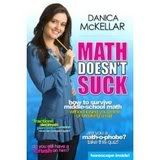
 Many of you may remember Danica McKellar from her role as Winnie Cooper in The Wonder Years in the late 1980s and early 1990s. What you may not know is that, following the television show, McKellar attended UCLA, where she graduated summa cum laude with a major in mathematics (and published proof to boot). Since graduation, McKellar has maintained an interest in math and science education for girls, and has been active in promoting this. She's now also published a book on math education for middle school girls (Math Doesn't Suck: How to Survive Middle-School Math Without Losing Your Mind or Breaking a Nail) that comes out in early August. For those interested, I have a review of the book up here at Aetiology. I also managed to snag an interview with Danica about the book and other topics, including math advocacy for girls that you can check out here.
Slightly off-topic--Danica McKellar: math education advocate
Many of you may remember Danica McKellar from her role as Winnie Cooper in The Wonder Years in the late 1980s and early 1990s. What you may not know is that, following the television show, McKellar attended UCLA, where she graduated summa cum laude with a major in mathematics (and published proof to boot). Since graduation, McKellar has maintained an interest in math and science education for girls, and has been active in promoting this. She's now also published a book on math education for middle school girls (Math Doesn't Suck: How to Survive Middle-School Math Without Losing Your Mind or Breaking a Nail) that comes out in early August. For those interested, I have a review of the book up here at Aetiology. I also managed to snag an interview with Danica about the book and other topics, including math advocacy for girls that you can check out here.
21 Comments
guppy · 25 July 2007
They screamed at poor little Barbie for saying 'Math is hard' and now the antidote is a book that starts with 'Math Doesn't Suck'!?
Anyone remember the episode where Winnie beat Kevin's SAT score by about 300 points which bruised his ego somewhat? Had a crush on her after that.
Henry J · 25 July 2007
I minored in math in college - some areas of it can be right interesting.
Henry
Anonymous · 26 July 2007
It took until the SAT episode before you had a crush on her? Good Lord. I assume you have to be a little older. Those of us who grew up with Winnie were hooked on day 1.
Frank J · 26 July 2007
Ouch, I'm even a bit older than her character. "The Wonder Years" ran from 1988-93, and each season was set exactly 20 years earlier.
Meanwhile, "Laugh-In" ran from 1968-73 and featured a segment with "news" from exactly 20 years later. I remember it well, even laughing at the prediction that then-governor Reagan would be president in the late 80s. What I didn't remember specifically, but recall from a rerun I saw in the '90s, was Dan Rowan's "news of 1989" that the Berlin Wall was torn down.
The Wall did come down in 1989. More irony: Rowan died in 1987.
I like numbers, in case anyone didn't notice.
Frank J · 26 July 2007
The Amazon blurb says "it even includes a Math Horoscope section."
I hope that's not an endorsement of astrology. It's bad enough that Michael Behe wants to expand the definition of science to include it (and ID).
David Heddle · 26 July 2007
Her paper is very cool.
Moses · 26 July 2007
Ah, I was an adult when this show aired. I did enjoy a certain nostalgia of my own middle-school life because of the plot/situation, for a few episodes anyway, but that's about it. And, until this thread, I didn't know it lasted more than one season.
Kudo's to Danica for graduating Summa Cum Laude. Much more impressive than the show.
delphi_ote · 26 July 2007
Just when I thought it was impossible for that woman to be any more awesome...
the pro from dover · 26 July 2007
More celebrity entertainers turned impressive scientists news: Brian May the guitarist-songwriter for Queen has submitted his astrophysics Ph.D thesis 30 years after leaving Imperial College London for fame, money, glory etc. etc. (but mainly for etc. etc.). The title: "radial velocities in the zodiacal dust cloud." I would have thought it would be "nitroglycerine dispersed in wood pulp and calcium carbonate with a light amplification by means of stimulated emission of radiation beam."
Nigel D · 27 July 2007
Thanks, Tara, for bringing this to our attention. I never saw the TV show, but I can imagine her crushworthiness from the pic on the book cover.
BTW, Brits have had a role model in the shape of Carol Vorderman (http://en.wikipedia.org/wiki/Carol_Vorderman) for some years now. Although her degree is in engineering, she is a whiz at mental arithmetic.
Also BTW, I found maths OK at school, but I wish we had been taught a few of the simpler proofs*, because these make the whole thing more interesting. After all, maths is the only field in which something can be absolutely and irrevocably proven as true or false.
* For example, the number of prime numbers is infinite. The proof rests on assuming that there exist a finite number of primes. Multiply all primes together, then add 1. You have a new number that is not divisible by any existing primes and is therefore a new prime. Therefore, the number of primes cannot be finite.
Or the series 1/2 + 1/4 + 1/8 + 1/16 ... results in 1. This can be proven simply by doubling all terms. The series then becomes 1 + 1/2 + 1/4 + 1/8 ... which is the same series +1. The only number that, on doubling, increases its numerical value by exactly 1 is 1.
R.Rodriguez · 27 July 2007
I used to think math was hard. When I went to college I found out not only that I liked it but that I could be good at it. I ended up majoring in Math. It took a one-of-a-kind teacher/professor to show me I could understand it.
Math is not hard - it is taught horribly. Most texts are horrible. I am convinced that like being able to appreciate literature, or foreign languages, or art, music, etc. there is a level of maturity that must be attained before being able to appreeciate mathematics. Unfortunately for most kids by the time they have the maturity to appreciate mathematics, they have learned to hate it or have convinced themselves that they are and cannot possibly be good at it. It's a pity, because a little bit of practice/coaching in math goes a long way.
I have seen first hand how easy it is to discourage kids from Math. I have seen my daughter falling into the trap - but, having been there myself, I've been able to pull her out. Danica should be commended for her efforts.
Christian C. · 27 July 2007
Minor but important correction to #190484. The number you get when you multiply all the primes together and add 1 is not necessarily a new prime number. It's just not divisible by any of the earlier ones. Since every number has a prime decomposition (this is an important fact as well), that number must be divisible by a prime not on the list.
Henry J · 27 July 2007
Axiomatic set theory can be fascinating, but probably too much for early exposure to mathematics. For one thing, the real number system can be derived from the set theory axioms and a few definitions. For another, there's the realization that the axioms themselves are obtained through a trial-and-error process somewhat analogous to that of physical science - at that level mathematics is experimental, although not dependent on physical properties of things the way chemistry, physics, etc., are.
Henry
Coin · 28 July 2007
Math is not hard - it is taught horribly. Most texts are horrible.
I'm beginning to suspect that besides the problem of texts just being generally hard to understand, a big part of the problem with math is that we try to teach it to absolutely everyone the same way. Mathematics is a complicated and multifaceted thing, but we introduce everyone to it on the same path and with the same methods. I think a lot of people are kind of excluded from mathematics just because they couldn't connect with the methods popularly used to teach it, where they could have excelled if the material was simply presented a different way.
Nigel D · 28 July 2007
Science Avenger · 28 July 2007
The problem with math at the junior high and high school level, which is what Danica is writing about in the book, is much more basic than what you guys are talking about. The teachers are almost never math majors, and often don't understand the material very well themselves. My algebra teacher insisted that (2 + B) + 2 was different than 2 + B + 2, and couldn't d word problems at all. Combine that with the emphasis on testing in some states, and math becomes a memory torture test instead of the fascinating area of thought we all appreciate.
André Luis Ferreira da Silva Bacci · 1 August 2007
Nigel D (comments #190855 and #190484)
No.
(2 · 3 · 5 · 7 · 11 · 13) + 1 = 30,031
30031 is not divisible for any prime below 14, but 30,031 = 59 · 509, both primes.
Nigel D · 8 August 2007
Hmmm, André Luis Ferreira da Silva Bacci, that's a good point (and what a name with which to conjure!).
I'm not sure how it applies within the context of the assumption of a finite number of primes. I agree that, if my example used all known primes, your refutation that the new "prime" (call it P+1 where P is the product of all known primes) stands.
However, my method involves all primes being multiplied to form product P. Within this framework, P+1 is prime. Having disproved the assumption (i.e. that there is only a finite number of primes), the door is then opened that P+1 can be decomposed into other primes that were previously unknown.
Maybe it's just a semantic difference. Either way, the starting assumption has been disproved.
In your numeric illustration, you take the set of all primes to contain only six members, yet the prime factors of P+1 are both outside that set. 30,031 is free to be considered prime until it is found to have factors.
Nigel D · 8 August 2007
D'oh!
". . . your refutation that the new "prime" (call it P+1 where P is the product of all known primes) stands."
This makes no sense. I meant that your refutation that the new number (P+1) is prime stands.
Pedro Medeiros · 13 August 2007
Pedro Medeiros · 13 August 2007
"They are outside the set and yet, you claim to use the same method to find a "true prime", while not realising that, giving enough computing power, the very same thing would happen for any arbitrary large (and closed) set of prime numbers (from 2..pn) that you choose. :)"
What I mean exactly, is that there is, at least, one prime number between pn and P+1 (and not that P+1 is never prime). Sorry if that was not clear. :)