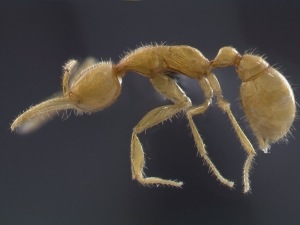
Eureka! Heureka! An Astonishing New Ant!

Posted 22 September 2008 by

by Dr. Alex "Myrmecos" Wild, http://myrmecos.wordpress.com/ This article originally appeared on Myrmecos Blog ---PvM
Martialis heureka Rabeling & Verhaagh 2008 drawing by the inimitable Barrett Klein for PNAS
Most scientific discoveries these days emerge through carefully planned and controlled research programs. Every now and again, though, something unexpected just pops up in a distant tropical jungle. Martialis heureka is a fantastic discovery of that old-fashioned kind. This little ant simply walked up to myrmecologist Christian Rabeling in the Brazilian Amazon. It is not only a new species, but an entirely different sort of ant than anything known before. The remarkable find was announced today in a paper by Rabeling, Manfred Verhaagh (who, a decade ago, collected and subsequently lost the elusive Martialis before he had a chance to properly examine it), and Jeremy Brown in the early edition of PNAS. If the DNA evidence is correct, Martialis is as ancient and as odd as an ant can be and still be called an ant. The lineage emerged right at the dawn of the family and provides a new line of sight back to the elusive ant ancestors. What do we know about Martialis? Not all that much. We have a single insect that was found walking about in the leaf litter, away from its presumed nesting site. The details of its biology must be inferred from the morphology of the preserved specimen and the DNA sequence of a few genes. Until someone locates live colonies, the situation is a bit like having a well-preserved fossil with a smattering of genetic information. We can say that Martialis really is an ant and not just another wayward wingless wasp. The insect bears all the telltale traits marking the ant family: a metapleural gland on the thorax, a constricted waist segment, and an elongate first antennal segment. In Rabeling et al's analysis, DNA sequence from three nuclear genes (18S, 28S, and EF-1alpha) places Martialis outside the rest of the living ants, but only slightly. At left I have drawn up a simplified phylogeny, an amalgamation of Rabeling et al's finding and the landmark 2006 studies of Brady et al and Moreau et al. Martialis is blind and pale, traits normally associated with subterranean species. It was collected in rainforest leaf litter, at dusk, near Manaus, Brazil. The elongate mandibles imply a predatory specialization, although on what we do not know. Rabeling et al suggest "annelids, termites, insect larvae, and other soft-bodied arthropods". The ant has a stinger, as do all the early lineages. The presence of a metaplueral gland---thought to be associated with ant social behavior---indicates that Martialis lives in colonies. Given the antiquity of the lineage, the temptation to view Martialis as an ur-ant of sorts is strong. E.O. Wilson certainly felt that way when interviewed for a recent NYTimes article:
Dr. Wilson...is trying to contain his excitement: the 14,001st ant species has just been discovered in the soils of a Brazilian forest. He steamrolls any incipient skepticism about the ant's uniqueness -- the new species is a living coelacanth of ants, a primitive throwback to the first ant, a wasp that shed its wings and assigned all its descendants to live in earth, not their ancestral air. The new ant is so alien, Dr. Wilson explains, so unlike any known to earthlings, that it will be named as if it came from another planet.
With due respect to Wilson, such a view is a mistake. Martialis has over 120 million years' separation since the ur-ant, plenty of time to develop along its own trajectory. The surviving species is not a throwback but a mix of primitive traits retained from the ancestor and unique traits acquired in the elapsed time. The same is true of most other living ants. Those impossibly long jaws, for example, are not present in any of the other early lineages nor in any of the fossils, almost certainly arising in the intervening millenia as Martialis developed a predatory specialization. And even though both Martialis and the next earliest lineage, the Leptanillines, are blind and pale, such traits evolve so readily among other ant groups (see here, here, and here) it is difficult to infer confidently that the ur-ant was also a yellow eyeless wonder. Rather, Martialis is important because we have a new window backward from which to view the ur-ant. This perspective, when combined with knowledge of the other early lineages (Poneromorphs and Leptanillines), will provide a stronger triangulation on the nature of the first ants. We will be able to infer with greater confidence the sequence of evolutionary events early in ant history. It gives new data where the existing knowledge was fuzzy. As an example, the most troublesome aspect of current ant phylogenies is uncertainty surrounding the very earliest events in ant evolution. The genetic studies of Moreau (2006) and Brady et al (2006) unexpectedly fingered the subterranean Leptanilline ants as sister to all other species. Further exploration by Brady et al (2006) indicated that the Leptanilline arrangement might be an artifact of the data, leaving myrmecologists feeling a bit like we were back where we started. In Rabeling et al's work, Martialis falls in exactly the right place to clear up the confusion: the ancient age of Leptanillines is likely real, not an artifact. And Martialis is older still. Where we go from here will depend on whether someone succeeds in finding living Martialis. The missing link now is not the ant itself but the knowledge about what it does. Alex Wild is a biologist at the University of Illinois, where he studies the evolutionary history of various groups of insects.
Original Paper: Rabeling, C., Brown, J. M., and Verhaagh, M. 2008. Newly discovered sister lineage sheds light on early ant evolution. Proceedings of the National Academy of Sciences. doi: 10.1073/pnas.0806187105. Other sources: Brady SG, Fisher BL, Schultz TR, Ward PS (2006) Evaluating alternative hypotheses for the early evolution and diversification of ants. Proc Natl Acad Sci USA 103:18172-18177.
Moreau CS, Bell CD, Vila R, Archibald SB, Pierce NE (2006) Phylogeny of the ants: Diversification in the age of angiosperms. Science 312:101-104. Specimen images by Rabeling & Verhaagh, used with permission

71 Comments

Wayne Francis · 22 September 2008

They are all still ants....just getting it in before the IDiots...

I love this stuff but I'm cringing on the thought on how this will be warped by creationist minds.

stevaroni · 23 September 2008

They are all still ants.…

Geeze - I'm sure glad that science doesn't have to rely on me for these kind of discoveries. I'd have glanced down, thought "Hey - there's an ant in my house" and stomped variant number 14001 into oblivion. (And don't even ask what would have happened if it was a silverfish)

Cedric Katesby · 23 September 2008

"They are all still ants.…just getting it in before the IDiots…"

Nuts! Beat me to it.
:)

I just console myself with..."Yet more gaps in the Darwinist Religion of the so-called Tree of Life"

Ichthyic · 23 September 2008

Alex-

Is there a good, relatively recent, review paper that addresses what the current thinking is wrt to the evolution of eusocial behavior in ants?

I'm kinda curious where more "solitary" species (like some of the "bulldog" ants) are presumed to fit in at this point.

thanks

D. P. Robin · 23 September 2008

It is nice to know that there is still a place for old-fashioned naturalizing. Just kick around and see what you can find.

iml8 · 23 September 2008

Wayne Francis said: I love this stuff but I'm cringing on the thought on how this will be warped by creationist minds.
Oh dear yes, a new discovery: "EVOLUTION DISPROVED!" It is a little bit fascinating to watch the Wile E. Coyote determination in which any odd new fact is pressed into service in the Darwin-bashing cause. White Rabbit (Greg Goebel) http://www.vectorsite.net/gblog.html

wolfwalker · 23 September 2008

Fascinating stuff. I always get a kick out of "living fossils," or more precisely organisms that preserve primitive body-plans, whether they be ants, lizards, fishes, or trees.

I do want to make sure I understand, though: this gentleman found _one_ example of this ant, and never saw another one? And the one specimen he did get, he lost? Then where did the genetic data come from?

Minor afterthought: I find myself mildly irritated by comparisons of IDers to Wile E Coyote. Poor Wile E always laid his plans as best he could, but was defeated by a Power larger than himself. IDers' problem is not in their stars but in themselves: they insist on trying to change the facts to fit their ideology, and facts are not changeable things.

iml8 · 23 September 2008

wolfwalker said: Poor Wile E always laid his plans as best he could, but was defeated by a Power larger than himself. IDers' problem is not in their stars but in themselves: they insist on trying to change the facts to fit their ideology, and facts are not changeable things.
Yes, the Fates clearly had it in for poor old Wile ... but he also had an odd combination of technical ingenuity and poor judgement. You think I'M going to strap on a pair of Acme Rocket Skates?! And the fact that he kept buying stuff from Acme suggests he really had problems with learning from mistakes. White Rabbit (Greg Goebel) http://www.vectorsite.net/gblog.html

stevaroni · 23 September 2008

Wayne Francis said: I love this stuff but I’m cringing on the thought on how this will be warped by creationist minds.

Simple: There's only one know specimen. Since it has no known species, it has no parents and this is impossible. Until science proves that there are more, we have to assume this ant is the result of special creation. Or maybe it spontaneously mutated from the prevailing ant "kind" into a new creature, proving the veracity of the Noah's Ark story.

Pete · 23 September 2008

I do want to make sure I understand, though: this gentleman found _one_ example of this ant, and never saw another one? And the one specimen he did get, he lost? Then where did the genetic data come from?

If I am reading it correctly, he found a single ant of the same species ten years ago and lost it. He just rediscovered it and still has this one.

Dolly Sheriff · 23 September 2008

...but they are all still ants!

There. feel better now?

Alex · 23 September 2008

Ichthyic:

Unfortunately for studies of incipient sociality, all known ants are truly eusocial, with a few obvious secondary losses among recent parasitic lineages. Even ants heralded for their supposed "primitive" state- such as the bulldog ants- have a division of labor into morphologically differentiated reproductive and non-reproductive castes. So we don't have much grist for a proper study of the transition to sociality.

There are a number of fossil stem-group ants (Armaniidae and Sphecomyrminae) that show signs of some sort of transition. Sphecomyrmines have a metapleural gland, suggesting group living, but their antennae are structured so as to give them some trouble with brood care. There's only so much we can do with fossils, though, as behavior doesn't preserve so well in amber.

It is *possible* that Martialis could be a subsocial species, as so little about it is known, but I'd not bet on it.

There are much better insect groups out there for studies of the evolution of eusociality. The Halictid bees show all sorts of variation in social behavior, from fully solitary to fully eusocial, with some species even having populations of both. Polistine wasps are also a great group showing a range of behavior.

Alex · 23 September 2008

For those interested, the Creationist spin is here.

Julie Stahlhut · 23 September 2008

What an amazing find (and, wow, another new putative ant subfamily!) I always love these kinds of discoveries.

But -- just "walking up to" a myrmecologist? Now we know why it's so rare. :-)

D. P. Robin · 23 September 2008

iml8 said:
wolfwalker said: Poor Wile E always laid his plans as best he could, but was defeated by a Power larger than himself. IDers' problem is not in their stars but in themselves: they insist on trying to change the facts to fit their ideology, and facts are not changeable things.
Yes, the Fates clearly had it in for poor old Wile ... but he also had an odd combination of technical ingenuity and poor judgement. You think I'M going to strap on a pair of Acme Rocket Skates?! And the fact that he kept buying stuff from Acme suggests he really had problems with learning from mistakes. White Rabbit (Greg Goebel) http://www.vectorsite.net/gblog.html
I keep thinking that Acme was owned by the Road Runner! 8^)

Venus Mousetrap · 23 September 2008

stevaroni said:

Wayne Francis said: I love this stuff but I’m cringing on the thought on how this will be warped by creationist minds.

Simple: There's only one know specimen. Since it has no known species, it has no parents and this is impossible. Until science proves that there are more, we have to assume this ant is the result of special creation.
I'm with you on this. The idea that this ant had a parent is a totally unwarranted Darwinian assumption. ID (not creationism) does not take a position on whether the ant was born or not; however, since we know that humans can make things from scratch, the ID inference that the ant was designed is in this case the best explanation.

iml8 · 23 September 2008

Alex said: For those interested, the Creationist spin is here.
Heh! Dramatic radio-announcer voice: "A look inside the paper reveals a few problems with the confident assertions about evolution ... " I can't read this stuff for long. My eyes glaze over. I can bet that we'll be getting an essay from the O'Luskin "ID creationism NOT" crowd that reads pretty much the same, but I don't think anybody would take the bet. White Rabbit (Greg Goebel) http://www.vectorsite.net/gblog.html

iml8 · 23 September 2008

D. P. Robin said: I keep thinking that Acme was owned by the Road Runner! 8^)
I vaguely recall the Acme catapult (not merely incapable of shooting straight but actually capable of smashing poor Wile E. no matter where he was standing or hiding) had, on close inspection, a Roadrunner logo on the label. White Rabbit (Greg Goebel) http://www.vectorsite.net/gblog.html

Ichthyic · 23 September 2008

. Even ants heralded for their supposed "primitive" state- such as the bulldog ants- have a division of labor into morphologically differentiated reproductive and non-reproductive castes. So we don't have much grist for a proper study of the transition to sociality.

I see. For some reason I had thought the bulldog group would be more unique. Thanks for the update.

There are much better insect groups out there for studies of the evolution of eusociality. The Halictid bees show all sorts of variation in social behavior, from fully solitary to fully eusocial, with some species even having populations of both. Polistine wasps are also a great group showing a range of behavior.

There was someone I recall when I was a grad student at Berkeley who had spent much of his time researching the evolution of eusociality in wasps and bees, (it's been quite a while now and I can't recall the name), but I found the issue fascinating.

I had assumed there would be more variability within the ants; why do you suppose this is not the case?

FL · 23 September 2008

Thank you for providing the link Alex. I knew about it already but didn't want to mention it. I sincerely would like to know how evolutionists respond to the following snippet from the link:

They explained that the supposition that ants evolved from wasps relies on ambiguous data subject to alternative hypotheses. One other problem with their suggestion that ants evolved from wasps is that Martialis would make the ant hypogaeic [underground] foraging evolve three times. That’s why they are suggesting the basal ant was already a hypogaeic forager. “The exact nature of the ancestral ant remains uncertain,” though, “given that the propensity for repeated evolution of a hypogaeic lifestyle may be higher than for reevolution of an epigaeic lifestyle.” In short, no clear light seems to have been shed on ant evolution by this discovery.

In short, do y'all agree with these particular assessments in light of the Martialis discovery? Do you disagree? Why? FL

iml8 · 23 September 2008

Where did the cool cladogram of ants come from? (NB that
I don't have subscriptions to science sites like AAAS
science.) I don't know much about the range of adaptations
in ants -- I suppose I'll have to at least skim through
Wilson's work on social insects, though it's like a hundred
times more than I need.

Something tells me that Wilson has been unusually cheery
the last few days. It's always nice to see a person in
love.

White Rabbit (Greg Goebel) http://www.vectorsite.net/gblog.html

Henry J · 23 September 2008

I can’t read this stuff for long. My eyes glaze over.

I got as far as the claim that this critter should be more wasp like since the distant ancestor is presumed to be an early wasp species. Why they didn't think this guy might have been after the acquisition of ant-like traits, I didn't read far enough to learn their reasons for claiming that. Henry

iml8 · 23 September 2008

Henry J said: Why they didn't think this guy might have been after the acquisition of ant-like traits, I didn't read far enough to learn their reasons for claiming that.
My own wearisomeness comes from the fact that, since every time I've tracked down a Darwin-basher claim it's always been a quibble at best and a fraud at worst, all I'm going to accomplish in trying to follow their reasoning is get dragged behind a horse through the cactus. There's only so many times I can hear WOLF! WOLF! before I tune it out. The pity is that if there WERE people out there who actually had a substantial and interesting critique of evo science, they would have a very hard time making it heard through the dull noise. Of course if they had any sense they wouldn't publish it on a creationist website, or for that matter even encourage creationists to discuss it. White Rabbit (Greg Goebel) http://www.vectorsite.net/gblog.html

Eric · 23 September 2008

FL said: In short, do y'all agree with these particular assessments in light of the Martialis discovery? Do you disagree? Why?
With a big sigh of exasperation, is how I respond. ID supposed problem #1: "They explained that the supposition that ants evolved from wasps relies on ambiguous data subject to alternative hypotheses." Sure it does. All data does. So what? Provide us with an alternative instead of just talking about some hypothetical alternative. Then test it. If you find data to support it, biologists will revise their opinion. Until then, wasps are the best candidate. This is a nonproblem. ID supposed problem #2: "One other problem with their suggestion that ants evolved from wasps is that Martialis would make the ant hypogaeic [underground] foraging evolve three times. " There is only one problem here - a problem of reading comprehension on the part of IDers. Wild wrote extensively on this point. I don't see how you could have missed it. But you did, so here you go: Blindingly obvious answer #2a from the original article: "And even though both Martialis and the next earliest lineage, the Leptanillines, are blind and pale, such traits evolve so readily among other ant groups (see here, here, and here) it is difficult to infer confidently that the ur-ant was also a yellow eyeless wonder." Blindingly obvious answer #2b from the original article: "Martialis has over 120 million years’ separation since the ur-ant, plenty of time to develop along its own trajectory. The surviving species is not a throwback but a mix of primitive traits retained from the ancestor and unique traits acquired in the elapsed time." You posed us a question and I answered it. So now I'm going to pose you a question: do you think the ID reviewers missed those two big honking explanations in the middle of the piece out of ignorance, or are they trying to decieve their readers by intentionally ignoring them?

eric · 23 September 2008

I have a Bio 101 question. Dr. Wild implies that the wasp-ant ancestor was a wasp, rather than some critter equally genetically distant from both, and I wanted to know why this is the expectation. Is there some wasp that we know about that hasn't changed for 120 million years?

Stanton · 23 September 2008

eric said: I have a Bio 101 question. Dr. Wild implies that the wasp-ant ancestor was a wasp, rather than some critter equally genetically distant from both, and I wanted to know why this is the expectation. Is there some wasp that we know about that hasn't changed for 120 million years?
Technically speaking, ants and bees are two groups of very distinctive wasps (Order Hymenoptera) in the exact same way iguanas and geckos are two groups of very distinctive lizards. Hence Dr Wild is correct in saying that the immediate ancestor of both modern wasps (i.e., yellowjackets, and mud daubers) and ants was a wasp. Now, if he were speaking about the immediate ancestor of all wasps, including Vespa, sawflies, parasitic wasps, as well as bees and ants, then, no, it was not a wasp, per se.

Alex · 23 September 2008

Eric:

Sorry I didn't clarify this in the post. Ants really *are* wasps. (So are bees, for that matter.) Wasps are an ancient group from which several more specialized lineages- including ants- evolved. This bit isn't really news- ants were always classified within the wasps in the old Linnean system, and recent, more rigorous phylogenetic analyses of both morphological and molecular data confirm that ants are just a specialized form of wasp. So the story of ant evolution is one of acquisition of new ant characters on top of an ancestral wasp state.

iml8:

The "cool cladogram" is from here. I simplified the tree from the original PNAS paper using the freeware program Mesquite, and appended some images from the myrmecos.net ant photo gallery.

Jim Thomerson · 23 September 2008

Aren't there Cretaceous fossil ants,such as Sphecomymodes, which are more intermediate in nature between living ants and other wasps?

Henry J · 23 September 2008

Dr. Wild implies that the wasp-ant ancestor was a wasp, rather than some critter equally genetically distant from both, and I wanted to know why this is the expectation.

Starting at the http://tolweb.org/formicidae page and moving upward using the "containing group" links up to apocrita, it looks like ants are rather deeply embedded inside one branch of the wasp clade. That makes it likely that the ancestor of the apocrita clade had most of the traits prevalent in its descendants, which are mostly wasps. Henry

iml8 · 23 September 2008

Alex said: The "cool cladogram" is from here. I simplified the tree from the original PNAS paper using the freeware program Mesquite, and appended some images from the myrmecos.net ant photo gallery.
It IS cool -- any good sources on the hymenoptera for the nonspecialist online, besides Wikipedia? Dawkins wrote a bit on their "haplodiploid" reproduction ... there's a 1995 NOVA episode on the ants available but only in VHS. White Rabbit (Greg Goebel) http://www.vectorsite.net/gblog.html

eric · 23 September 2008

Alex and Stanton,
Thanks!

eric

Stanton · 23 September 2008

eric said: Alex and Stanton, Thanks! eric
Back in the early 2000's/late 90's, they did a study in California on Argentine ants, in that they did both DNA tests and transplanted workers of one colony into another, and came up with unusual, if not very disturbing results. The transplanted workers were almost always immediately adopted by the different colony, while the test results suggested that all of the Argentine ants from San Francisco to San Diego are all descended from one initial colony, leading the researchers to state that all of the Argentine ants in Central and Southern California are all members of one gigantic super-colony. This does not bode well for California's indigenous ants, nor the animals that feed on them (and can not feed on Argentine ants), such as the Desert and Coast horned lizards.

Ichthyic · 23 September 2008

such as the Desert and Coast horned lizards

awww, damn, I have a long history with those guys:

http://farm1.static.flickr.com/11/12970251_395f49b3b9.jpg

http://farm1.static.flickr.com/10/12886812_187ea3dace.jpg

I would often go to Joshua Tree national park in the early spring to catch them raiding the local red-ant nests.

FL · 23 September 2008

Okay, just quicknotes: (1) Thanks Eric for answering my questions. (2) To answer your question in return, there simply isn't any ignorance, deceit or reading comprehension problems in the creationist article. In fact, the strengh of the creationist article is that it sticks extremely closely to the PNAS/Nature News ant article and quotes them extensively at every turn.

One other problem with their suggestion that ants evolved from wasps is that Martialis would make the ant hypogaeic [underground] foraging evolve three times. That’s why they are suggesting the basal ant was already a hypogaeic forager. “The exact nature of the ancestral ant remains uncertain,” though, “given that the propensity for repeated evolution of a hypogaeic lifestyle may be higher than for reevolution of an epigaeic lifestyle.”

Your two quotes (in response) from Dr. Wild for this "ID supposed problem #2", seem to be suggesting, "Hey, that's no big deal, Martialis is not a throwback nor an ur-ant anyway." That's fine, that may resolve the "ID supposed problem #2" for you, but those two quotes were also NOT a negation nor a refutation of what was actually said in the creationist article. And they certainly do NOT constitute evidence of any ignorance or deceit (nor reading comprehenion problem) within the creationist article, not at all. Here's what I come away with, then. 1) "The exact nature of the ancestral ant remains uncertain," as the ant article puts it. 2) "No clear light seems to have been shed on ant evolution by this discovery", as the creationist article concluded. (You did not respond to this conclusion, btw.) However, it's still an exciting discovery to read about, and I'm happy to see both Dr. Wild's lively and informative account, and also the creationist article as well. 3) This new discovery "jars us out of going with our familiar conceptions" as Harvard curatorial assistant Stefan Cover is quoted. A good start, imo. FL

Wayne Francis · 23 September 2008

Alex said: For those interested, the Creationist spin is here.
Arrg I knew I'd cringe...They just don't understand how science works. Finding something that questions the current theories is good. They on the other hand don't want to question anything. Like my good friend says "I don't want to know anything that will make me question my faith". And they say we are in the dark. *rolls eyes*

Wayne Francis · 23 September 2008

Eric, great question and Alex & Stanton great answers.

Alex · 23 September 2008

FL: Let me spell out my objections to the Creationist take. First. The fine folks over at Creation Safari reveal right off the bat they know nothing about the taxonomy of wasps and ants. They write:
Trouble is, it doesn’t look anything like a wasp, from which ants supposedly evolved
What's the problem? Well, ants are wasps. This taxonomic scheme was recognized long before Darwin, with ants placed as a family within the wasps in the traditional, non-evolutionary Linnean system. Ants have all the trappings of a wasp: the constriction between abdominal segments one and two, the stinger, numerous features of the wings (yes, most ant species are winged in the reproductive caste) and the thorax. Genetically, ants nest within the wasps. Martialis- the new find- really can't not be a wasp. This is a no-brainer to anyone who knows wasps. Consider, for starters, these examples. Second, Creation Safari misses the significance of the phylogenetic analysis and its impact on the stability of the tree. In fact, they get the order of events entirely backward:
"Recent attempts to find a robust phylogeny have now been dealt another challenge with the discovery of M. heureka. Their phylogenetic tree shows it on its own branch, all by itself. Another problem is revealed deep in the paper: 'Second, the basal ant lineages seem to have originated in a relatively short period, potentially making the unambiguous resolution of their relationships quite difficult and sensitive to methodological error.' The only suggestion of light being shed on ant evolution by this discovery is that it turns their attention away from the idea ants evolved from wasps. What they expected, and what they found, were pointing in opposite ways:
This is a dishonest bait-and switch that confuses two different parts of the paper. Creation Safari quotes the background given by Rabeling et al for a problem with the previous phylogeny- uncertainty at the base- and portrays it as if that were the result of the new study. In fact, the result of the new study is the exact opposite. Rabeling et al found that the addition of Martialis to the existing, unstable phylogeny stabilized the relationships to one of the several competing hypotheses. The new ant didn't add a challenge, it resolved an old one. Science advances. Then they quote a different bit of the paper about the problems of having a hypogaeic basal lineage. Here's where a bit of background helps. We've got some simply marvelous transitional fossils leading to ants. Among their other features, they have large eyes, indicating that they forage above ground. Like lots of modern ants and wasps. Now, it so happens that the two living representatives of the earliest divergences from this new ant tree, Martialis and the Leptanillines, are eyeless, below-ground foragers. This poses the problem: did modern ants pass through an eyeless species before radiating into their modern appearance? A simple parsimony explanation would seem to favor it. Or did Martialis and the Leptanillines lose their eyes much more recently? That's the debate, and it is one that will be difficult to resolve. Two other bits of information: One, hypogaeic habits have arisen dozens upon dozens of times elsewhere in the ants. Many genera, for instance, have both eyed and eyeless species. I'd not make much of this as a difficult thing to acquire. Two, there is a Cretaceous fossil called Haidomyrmex, which actually looks a bit like Martialis, but with eyes. Rabeling et al's paper is basically just an announcement of the new ant with a phylogeny. There will be other work to come, papers that include the fossils, papers that look at the rate of eye gain and loss over the phylogeny and make quantitative inferences about the ancestral ants. A major reason why this paper didn't shed much light on ant ancestry is that it didn't attempt to.

Stanton · 23 September 2008

Alex, do you have any information and pictures of Haidomyrex?

Alex · 23 September 2008

Stanton:

The original description is here:

http://antbase.org/ants/publications/8098/8098.pdf

Stanton · 23 September 2008

Thank you very much! I only asked as I'm collecting prehistoric animals to reconstruct and put in a book I'm working on.
Alex said: Stanton: The original description is here: http://antbase.org/ants/publications/8098/8098.pdf

cronk · 23 September 2008

Wayne Francis said: They are all still ants....
Besides, that ant looks glued on.

stevaroni · 24 September 2008

Alex said: The original description is here: http://antbase.org ....

antbase.org!? OK, now I'm convinced that we've reached the point where there is now a web page for every single interest ever invented.

Stanton · 24 September 2008

stevaroni said:

Alex said: The original description is here: http://antbase.org ....

antbase.org!? OK, now I'm convinced that we've reached the point where there is now a web page for every single interest ever invented.
You'd think so, but no. Trust me, I've tried.

iml8 · 24 September 2008

Alex said: FL: Let me spell out my objections to the Creationist take.
Good sir, unfortunately you are not responding to a person who cares. White Rabbit (Greg Goebel) http://www.vectorsite.net/gblog.html

iml8 · 24 September 2008

Alex said: This poses the problem: did modern ants pass through an eyeless species before radiating into their modern appearance? A simple parsimony explanation would seem to favor it. Or did Martialis and the Leptanillines lose their eyes much more recently? That's the debate, and it is one that will be difficult to resolve.
That's very interesting -- forgive my ignorance of the materials, but is there suggestion of the "re-evolution" of eyes, with some species having clearly different eye structures than others? Or that the suggestion is that eyes might have been "regained" by genetic throwbacks -- restoration of broken genes? White Rabbit (Greg Goebel) http://www.vectorsite.net/gblog.html

eric · 24 September 2008

Greg, That's true, but I for one found Alex's last comment a great post script to the article. So thanks again, Alex. Adding my general science two bits, it bears repeating (to FL) that the conclusion "x remains uncertain" is not a black mark against a hypothesis, unless there is another, competing hypothesis to explain x. ID does not explain x (for any x), thus FLs conclusion #1 and all conclusions of parallel structure are worthless.
iml8 said:
Alex said: FL: Let me spell out my objections to the Creationist take.
Good sir, unfortunately you are not responding to a person who cares. White Rabbit (Greg Goebel) http://www.vectorsite.net/gblog.html

iml8 · 24 September 2008

eric said: That's true, but I for one found Alex's last comment a great post script to the article.
I agree, but exactly the same defense could be made without reference to any individuals of the ankle-biter community. It seems a bit awkward to personally address someone who's sitting there with his fingers in his ears. White Rabbit (Greg Goebel) http://www.vectorsite.net/gblog.html

Venus Mousetrap · 24 September 2008

Indeed, very nice post, Alex. I didn't know about the ant-wasp nested relationship, either, and nor it seems did those creationists. It's like finding a new species of bat and saying 'well, bats allegedly evolved from mammals'. I wonder if they'd take a bet on how much DNA an newly-discovered ant would share with a wasp, seeing as they have no reason to predict any similarity?

Frank J · 24 September 2008

IDers’ problem is not in their stars but in themselves: they insist on trying to change the facts to fit their ideology, and facts are not changeable things.

— wolfwalker
The irony is that the ID “theory” can accommodate any set of facts, and IDers occasionally even admit that in so many words. The reason they try to change the facts - by cherry picking, defining terms to suit the argument, quote mining, conflating evolution with abiogenesis, etc. - is to play their games of bait-and-switch. Such the one where ID is, depending on whom they’re trying to fool, either a “scientific” alternative to “Darwinism” or an “alternative worldview” that “accommodates all the results of ‘Darwinism’.”

paul flocken · 24 September 2008

FL said: 3) This new discovery "jars us out of going with our familiar conceptions" as Harvard curatorial assistant Stefan Cover is quoted. A good start, imo. FL
If only the creationists could let the same thing happen to their familiar conceptions. Or would you claim that there aren't any incorrect conceptions in the creationist playbook?

iml8 · 24 September 2008

paul flocken said: Or would you claim that there aren't any incorrect conceptions in the creationist playbook?
I think someone once said about Duane Gish: "Always attack, never defend." This is easy to do when you don't have anything particularly specific to defend. I tend to see the Darwin-bashers as like someone on a pop idol competition show who can't sing a note and in fact doesn't even try, but just sits there to snipe at the other contestants ... and proclaims a win. White Rabbit (Greg Goebel) http://www.vectorsite.net/gblog.html

Wheels · 24 September 2008

What's all this fuss about ants? Everybody knows the Creator is inordinately fond of beetles!

Robin · 24 September 2008

Alex said: FL: Let me spell out my objections to the Creationist take. First. The fine folks over at Creation Safari reveal right off the bat they know nothing about the taxonomy of wasps and ants. They write:
Trouble is, it doesn’t look anything like a wasp, from which ants supposedly evolved
What's the problem? Well, ants are wasps. This taxonomic scheme was recognized long before Darwin, with ants placed as a family within the wasps in the traditional, non-evolutionary Linnean system. Ants have all the trappings of a wasp: the constriction between abdominal segments one and two, the stinger, numerous features of the wings (yes, most ant species are winged in the reproductive caste) and the thorax. Genetically, ants nest within the wasps. Martialis- the new find- really can't not be a wasp. This is a no-brainer to anyone who knows wasps. Consider, for starters, these examples.
Just an aside on this - a friend of mine found a cute, fuzzy, large red 'ant' roaming around on his farm sometime back and picked it up to examine it because he'd never seen anything like it. I told him to put it down and back away. It was a Velvet Ant, otherwise known as a Cow Killer because the sting of this particular wasp can be so painful it is said to have the ability to drop a cow in its tracks. Yikes!! http://lancaster.unl.edu/pest/resources/CowKiller.shtml

eric · 24 September 2008

iml8 said:
paul flocken said: Or would you claim that there aren't any incorrect conceptions in the creationist playbook?
I think someone once said about Duane Gish: "Always attack, never defend."
This just (yet again) highlights the difference between ID and real science. If your goal is to win debates, "Always attack..." is a great strategy. If your goal is to design a new airplane or vaccine, it is a very poor strategy. To make scientific progress you have to be willing to propose, argue, research, and defend models and hypotheses. Apart from any consideration of the design hypothesis per se, smart outsiders can look at ID's choice of strategy and infer from it ID's goal - ideological conversion, not progress.

Paul Burnett · 24 September 2008

Just an aside on this - a friend of mine found a cute, fuzzy, large red 'ant' roaming around on his farm sometime back and picked it up to examine it because he'd never seen anything like it. I told him to put it down and back away. It was a Velvet Ant, otherwise known as a Cow Killer because the sting of this particular wasp can be so painful it is said to have the ability to drop a cow in its tracks. Yikes!!
"Velvet Ants" are wasps - see also http://en.wikipedia.org/wiki/Mutillidae The other thing Velvet Ants were famous for in my childhood farm experience was that if you stomped hard on one on anything but the very hardest soil, they would climb out of their velvet ant-shaped hole in the bottom of your footprint and keep on scurrying along. And several of my young associates could testify to their powerful sting.

iml8 · 24 September 2008

eric said: Apart from any consideration of the design hypothesis per se, smart outsiders can look at ID's choice of strategy and infer from it ID's goal - ideological conversion, not progress.
There's a certain humor to it. The Darwin-bashers like to play the "fairness" angle, but this ends up being like Bugs Bunny playing the referee at the fight: "An' we wanna nice fair fight! No hitting below the belt -- like DIS! [POW!] No poking in the eyes -- like DIS! [JAB!] And no hitting over da head with a brick -- like DIS! [SMASH!] ... " Was it Frank J who was talking about going along with the notion of "teach the controversy" until he found out what the game really was? Life imitates Looney Toons. White Rabbit (Greg Goebel) http://www.vectorsite.net/gblog.html

eric · 24 September 2008

iml8 said: There's a certain humor to it. The Darwin-bashers like to play the "fairness" angle, but this ends up being like Bugs Bunny playing the referee at the fight ...Life imitates Looney Toons.
Personally, Dembski's famous quote always makes me think of Treasure of the Sierra Madre. Scientist (played by Bogart, of course): "If you're scientists, where are your mechanisms?" Dembski: "Mechanisms?!? We ain't got no mechanisms. We don't need no mechanisms. I don't have to show you any stinkin' mechanisms!"

Julie Stahlhut · 24 September 2008

Trouble is, it doesn’t look anything like a wasp, from which ants supposedly evolved...
Even without the caveat that the "eyeball test" can be taxonomically misleading, this is clearly a quote from someone who has never taken a close look at any of the above. Wanna bet that the alleged expert who posted this to Creation "Safari" has never bothered to actually observe live insects?

DavidK · 24 September 2008

The resolution to the issue regarding the origin of this ant is quite clear. Someone left a pile of dirty rags in the corner of the room and this critter was spontaneously generated, thus supporting the creationist/ID viewpoint.

iml8 · 24 September 2008

eric said: Dembski: "Mechanisms?!? We ain't got no mechanisms. We don't need no mechanisms. I don't have to show you any stinkin' mechanisms!"
I've thought exactly the same thing for some time: "Connect de dots? We don't need to connect no steenking dots!" I was also thinking the other day about the fact that Dembski seemed to be operating on a higher plane than the O'Luskins ... but "cleverer" didn't seem to fit the bill. I finally got it: "glib". When confronted with an obstacle, Dembski simply declares it supports his argument and declares a win. He does it instantly and instinctively. White Rabbit (Greg Goebel) http://www.vectorsite.net/gblog.html

Stanton · 24 September 2008

Julie Stahlhut said:
Trouble is, it doesn’t look anything like a wasp, from which ants supposedly evolved...
Even without the caveat that the "eyeball test" can be taxonomically misleading, this is clearly a quote from someone who has never taken a close look at any of the above. Wanna bet that the alleged expert who posted this to Creation "Safari" has never bothered to actually observe live insects?
I'll wager 20 dollars on that.

iml8 · 24 September 2008

Stanton said: I'll wager 20 dollars on that.
I think she was looking for someone to bet AGAINST it. Fat chance. White Rabbit (Greg Goebel) http://www.vectorsite.net/gblog.html

Cedric Katesby · 24 September 2008

That whole bit about the wasp/ant connection and the Velvet Ant info was very interesting.

I had no idea about those things before.

Thanks for digging it up and explaining it so that even a non-scientist lurker like me can understand it.

(Hanging out at the Panda. Gotta love it.)

Henry J · 24 September 2008

It's sort of like ants are to wasps as early amphibians are to fish.

Henry

Stanton · 25 September 2008

Henry J said: It's sort of like ants are to wasps as early amphibians are to fish. Henry
Not exactly: ants are to wasps what mudskippers are to gobies.

Wayne Francis · 25 September 2008

Yea I look at it like ants are to wasps like humans are to chimps. We both have been evolving for a few million years and while the ignorant might call our LCA a chimp it really wasn't.

The LCA of ants and current day wasps might look like a wasp...but then flying Ants look like wasps too.

Ichthyic · 25 September 2008

White Rabbit (Greg Goebel)

ah, your handle triggered a recent news item in my head; hope you aren't fond of the candy with the same name:

http://www.cbc.ca/consumer/story/2008/09/24/whiterabbit.html

iml8 · 25 September 2008

Ichthyic said: Hope you aren't fond of the candy with the same name:
That beats the Chinese toothpaste that used ethylene glycol (antifreeze fluid) as a sweetener. It did a number of people in. White Rabbit (Greg Goebel) http://www.vectorsite.net/gblog.html

Ichthyic · 25 September 2008

Chinese toothpaste that used ethylene glycol (antifreeze fluid) as a sweetener then there were the toys with the lead paint... from last year: http://www.reuters.com/article/worldNews/idUSPEK2206820070710?pageNumber=3&virtualBrandChannel=0
But these were isolated incidents which did not broadly mean Chinese goods and especially its exports were unsafe, insisted Lin Wei, deputy head of the quality inspection bureau's import and export food safety division. "We are confident we can guarantee that Chinese products are of good quality and cheap, yet safe and healthy," he added.
uh huh. I wonder who's head is on the chopping block (literally) for this latest?

pianoguy · 27 September 2008

iml8 said:
wolfwalker said: Poor Wile E always laid his plans as best he could, but was defeated by a Power larger than himself. IDers' problem is not in their stars but in themselves: they insist on trying to change the facts to fit their ideology, and facts are not changeable things.
Yes, the Fates clearly had it in for poor old Wile ... but he also had an odd combination of technical ingenuity and poor judgement. You think I'M going to strap on a pair of Acme Rocket Skates?! And the fact that he kept buying stuff from Acme suggests he really had problems with learning from mistakes. White Rabbit (Greg Goebel) http://www.vectorsite.net/gblog.html
One of the great old Ian Frazier stories, "Coyote vs. Acme."

iml8 · 27 September 2008

pianoguy said: One of the great old Ian Frazier stories, "Coyote vs. Acme."
I've got that in my archives, with the equally witty ACME RESPONDS follow up: "Mr. Coyote's use of ACME Products was clearly outside of the bounds of the proper operation and application for which these products were designed ... " White Rabbit (Greg Goebel) http://www.vectorsite.net/gblog.html