
There's been a lot of blank disbelief on the blogosphere of late, due to the announcement of a conference on Geocentrism (
Galileo was Wrong).
Geocentrism is the belief that Earth is the centre of the Universe and everything revolves around it. You would think that, 400+ years after
Galileo, people would have cottoned on the the idea that the Earth orbits the sun, the sun orbits the galactic centre and the Milky Way galaxy does ... well ...complicated stuff with other galaxies, but basically we worked out long ago that the Earth is not the centre of the solar system, let alone the Universe.
Other people, especially Ethan at
Starts with a Bang and the
Bad Astronomer, have dealt with the technical details (and I have an earlier discussion
here and
here). My goal is to get you, the ordinary person on the Clapham omnibus (or in my case, the Outer Harbour train, where I am writing this), to try and demonstrate the Earth is heliocentric for yourself and to do so with common household materials. After all, science is at heart a practical endeavour, and non-professionals should be able to find the evidence for themselves.
So for this journey into the starry spheres, we will need a pair of binoculars, a camera tripod, some cardboard and alfoil, and lots of gaffer tape. We also have some luck, as the sky is currently cooperating in the Geocentrism debunking stakes.
First we have to ask ourselves, which "geocentric" theory are we disproving. The classic geocentric theory is that of
Ptolemy, in which the planets, Moon and the Sun all orbit the Earth. The most famous variant of this is Tycho Brahe's
helio-geocentric system, where the Sun and Moon orbits the earth and everything else orbits the Sun. There are important differences in the systems which we will explore later.

First off, let's look at the
phases of Venus. For this you will need binoculars and the camera tripod. You will also need a way of attaching the binoculars to the tripod. These days I use a special attachment (but this requires modern binoculars that have a screw thread on the body), but in the past I have used gaffer tape to good effect. Why attach the binoculars to the tripod? Because otherwise there will be too much shaking for you to see the image properly.
The image to the left is the setup I use for observing Sunspots (we come to that later), showing the binoculars gaffer taped to the tripod.
At the moment, Venus is prominent above the western horizon. Point your binocular lash-up at Venus, in my 10x50 binoculars Venus is very small but is a disk which has a distinct "half -Moon" shape. If your binoculars don't have decent anti-glare coatings, you may have to observe in the early twilight in order to see Venus's shape without internal reflections from the binocular lenses getting in the way.
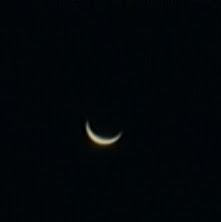
As you watch over the coming weeks, you will see Venus expand in size and become more crescent- shaped.
Sketch the shape so you can follow its progress. This is so fast you should see a visible change in just one week. By mid-October Venus will be a thin crescent almost 2/3rds bigger than when you started observing. By late October Venus has nearly doubled in size and is a thin, glistening wire. Then Venus vanishes into the Suns glare and reappears in the morning. Over the next few months you can watch Venus shrink and become a tiny disk.
And now you have demolished the Ptolemaic geocentric system. Venus does have phases in this system, but quite unlike what you see here (I leave it too the reader to work out what a Ptolemaic systems Venus phases would look like, you can see a model of
Ptolemaic Mercury here, which will give you a good idea). And you have only taken almost 6 months to do it (what, you thought it would be easy). As a reward, here's an
animation of the Phases of Venus.

 Left image Jupiter above the eastern horizon, Right Image, Venus above the western horizon, both at the same time in the evening (around 8pm ish in mid September 2010).
But wait! You say What if it is just an illusion, a trick of the optics? Well, you have a control. Having observed Venus, swing your binocular lash-up to the east, to the brightest object there (and second brightest non-lunar object in the night sky after Venus), Jupiter. Jupiter is a distinct oval in my binoculars, and the four bright
Medicean Stars glitter around it. Over the nights you watch Venus swell and thin, keep an eye on Jupiter as it does...well...nothing.
 Jupiter and three of its moons imaged with a mobile phone.
But Ah! The Medicean Stars, now known as the Galilean Moons, they will shuttle backwards and forwards during the nights as you watch. The realisation that these "stars" were Moons of Jupiter were not a blow to any form of geocentrism
per se, although they were the second of a series of powerful blows against the Aristotelian physics that underpinned Ptolemy's system, which aided its demise. Determining that these specs actually orbited Jupiter, and were not just accidentally there, took a lot of effort.
Try keeping track of these sparks, and without reference to an almanac, try and determine their orbits (heck, try and keep track of which near identical points of light are which). It may take a while, you will need to keep careful sketches, and track the Moons and Jupiter with respect to the stars as Jupiter moves through the heavens, but a) You are sketching Venus anyway and b) it will be well worth it (hey, you proving things for yourself!).
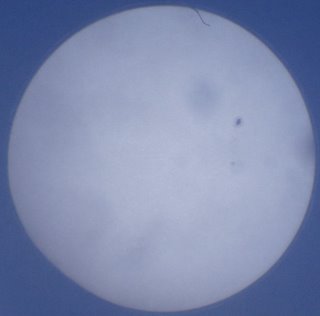
The next bit is more demanding. The Phases of Venus demolished the Ptolemaic Geocentric system, but the Tychonian- Geo-heliocentric system had Venus phases just like a pure heliocentric system (which is not surprising, as Tycho's system is an inverted Copernican system). To eliminate the Tychonian system, we need to observe sunspots.
Luckily the Sun is coming out of its quiet phase, so you will have some to record. For this you will need to set up a
safe binocular projection system (as shown above), where the image of the Sun is projected onto a surface so you can record the Sunspots.
NEVER LOOK DIRECTLY AT THE SUN WITH BINOCULARS AS SEVERE EYE DAMAGE WILL RESULT.
Anyway, while you are recording the Phases of Venus and the orbits of Jupiters' Moons, record the passage of Sunspots over the Suns face, over the 5-6 months you are recording the Sunspots, you will notice the path taken by the sunspots moves up and down. This is due to the Earths orbit not being exactly in the plane of the Suns rotation. In a geocentric system, with the Sun orbiting the earth once a day, this variation would show up on a daily basis, but what you observe can only be seen in a heliocentric system.
So, congratulations, you have just demonstrated that geocentric models don't describe the solar system we see using very simple tools. It took a while, and was hard work, but you have demonstrated it yourself, and all the blovation of geocentricists won't take that away (yes,
Stellar parallax gets all the glory, but annual Sunspot variation was a powerful blow to Tychonian geocentric models). If you want to, you can take this further by making your own
Foucault's Pendulum.
211 Comments
Les Lane · 15 September 2010
I once got into an e-mail argument with a geocentrist. I used Hipparcos measured parallax of nearby stars as evidence against geocentrism. He assured me that Hipparcos data was unreliable because communication channels weren't secure.
Hipparcos
John Farrell · 15 September 2010
Sungenis has been ranting about relativy for years. I would love to put him in a room with some of the DI folks and see how that would go....
Kevin Alexander · 15 September 2010
All this proves nothing. When Galileo invited the church fathers to look through his telescope, they refused, knowing full well that anything seen through an infernal instrument could only be and illusion created by Satan.
The pillars of our faith are much stronger than the flimsy legs of your tripod.
Geez, you scientists, first you kill Tinkerbelle and now this.
Henry J · 15 September 2010
"I don't have to match your pathetic level of detail!!111!!!eleven!!!!"
Karen S. · 15 September 2010
Wheels · 15 September 2010
RIY: Refute It Yourself! I would support this being a semi-regular feature!
TomS · 15 September 2010
First of all, for really eccentric (to put it nicely) ideas, take a look at the Wikipedia article on "Hollow Earth" under the heading "Concave hollow Earths":
"http://en.wikipedia.org/wiki/Hollow_Earth#Concave_hollow_Earths"
The idea being that we, and the whole of the skies above us, are all inside the hollow earth.
Now, I am not a scientist of any kind, but I think that this provides a cautionary tale for those of us who would like to have a handy rebuttal to geocentrism.
What is interesting about this is that one can make a mathematical transformation between the inside of a sphere and the outside of a sphere, so that the two are indistinguishable. There is no way that one can "demonstrate" that we are on the outside of the spherical earth. Even though the idea is crazy - it says that when we go "up", we (and all of our measuring devices) shrink by just the right amount so that we can't tell that it is happening to us.
In a similar way, we can mathematically transform anything that happens in a Galilean universe to something happening in a geocentric universe. The laws of physics and the geometry become horrendously complicated, to be sure, but there is, in principle, no way to "demonstrate" that the earth is moving, given the existence of this transformation.
I don't know whether the geocentrists take this approach. My experience with eccentrics (if not geocentrics) is that they don't have the necessary dedication to consistency to do it. If they trusted rationality, after all, they wouldn't be geocentrists. But the point that I am trying to make is that it isn't all that easy to demonstrate the failings of geocentrism against a persistent supporter.
Some of the geocentrists do make an appeal to the General Theory of Relativity, in which just about any framework, including a framework which rotates and revolves with the earth (that is, moving in Galilean astronomy, but fixed in geocentric astronomy), is physically equivalent to any other such framework. It may be true that there are some unwanted complications in GR for geocentrism, but I suspect that it would take a specialist in GR to understand them. Possibly changes in the rotation of the earth (or, from the geocentric point of view, the rotation of the heavens) due to things that happen on earth (seasonal changes, earthquakes, or even tides) would be problematic for geocentrism (why should something that happens on earth today affect the motion of stars that are lightyears away, immediately?), but I'm not sure that that has been worked out.
Can they just respond with a "you can't explain the changes in the so-called rotation of the earth any better than I can explain the changes to the rotation of the heavens"? (Is there an expert on chronology who can help?)
As I said at the start, I'm not a scientist, so there may be something obvious that I am missing here, and I would be very glad to be corrected.
eric · 15 September 2010
Tom S.,
You may want to visit the Bad Astronomy post on the same subject.* He talks in somewhat more detail about just the subjects you're interested in (mathematical transformation between the two, and use of relativity by geocentrists).
IMO your points bring up a teachable lesson about science: unlike religion, it isn't just about truth. Sometimes science is about useful approximations. If we were to discover tomorrow that the universe was geocentric, we'd still use heliocentric models to launch space probes. Why? Because the heliocentric math is easier. All reference frames may be metaphysically equal, but scientifically some are more useful than others.
*I'm not affiliated with Phil Plait or BA. But I do recommend his book. And I did stay at a holiday inn last night. :)
midwifetoad · 15 September 2010
I think "modern" geocentrists argue that the earth is at the center of the universe rather than at the center of our planetary system.
They seem unmoved by the argument that all points in the universe appear to themselves to be the center.
Mike Elzinga · 15 September 2010
Les Lane · 15 September 2010
For connoisseurs of cranks:
Bio of Robert Sungenis
mrg · 15 September 2010
I suspect that our standard trolls are avoiding this thread. They may be nuts but they're not THAT nuts. We might get a posting from near-blatant jokers like "Higabu".
jaycubed · 15 September 2010
Here's my favorite crank anti-science site:
http://www.fixedearth.com/
-
Here's my favorite crank pseudo-science site:
http://www.holoscience.com/synopsis.php
Rolf Aalberg · 15 September 2010
Ryan · 15 September 2010
Fantastic post. Thanks a lot!
Stan Polanski · 15 September 2010
Rolf Aalberg mentions the apparently paradoxical fact that when we look outward from earth in any direction, we are actually looking inward toward a smaller and smaller universe. All of the sightlines that originate at this time and place - or at any time and place in our universe - converge at the big bang. I first encountered a layman-friendly exposition of this elegant demonstration of the obvious reality of curved four-dimensional spacetime in Robert Osserman's fine little book, Poetry of the Universe. This is a great read for anyone who is, like me, awe-philic and math-phobic.
Olorin · 15 September 2010
So perhaps the position of the Roman Catholic Church on heliocentrism really is the same as for evolution: Allowed, but not encouraged.
FL · 15 September 2010
heddle · 15 September 2010
heddle · 15 September 2010
MememicBottleneck · 15 September 2010
Terenzio the Troll · 15 September 2010
Ian Musgrave · 15 September 2010
Ian Musgrave · 15 September 2010
FL · 15 September 2010
DavidK · 15 September 2010
Philosophically geocentrism makes sense but it's relative to whomever is the speaker. Every religion considers itself infallible and the center of wisdom and truth, physical earth/universe centrism follows spiritual tenets.
Ancient cultures, and modern as well, consider/ed themselves geocentric, e.g., the Chinese, the Greeks, and Egyptians, et. al. The U.S. is the only superpower, we are the center of world power, until the Chinese overtake us of course, when their world view will supplant ours.
FL stated, "Simply put, the Bible does NOT teach geocentrism, and in fact is quite silent about “centrisms” at all."
It is implied if not explicitly stated that the bible is central to the world view, and anything else would imply fallibility, e.g., earth moves, the heavens are not immutable but change/evolve over time.
Sam Harris said in "The End of Faith:"
"Tell a devout Christian his wife is cheating on him or that frozen yogurt can make a man invisible, and he is likely to require as much evidence as anybody else, and to be persuaded only to the extent that you give it. Tell him that the book he keeps by his bed was written by an invisible deity who will punish him with fire for eternity if he fails to accept its every incredible claim, and he seems to require no evidence whatsoever."
Matt Young · 15 September 2010
heddle · 15 September 2010
Mike Elzinga · 15 September 2010
W. H. Heydt · 15 September 2010
heddle · 15 September 2010
Flint · 15 September 2010
OK, I think this is a good reply. We decide which verses to take literally and which to take metaphorically based on our preferred understanding of something. Those we choose to take literally become Absolute Truth. Those who disagree do the schism thing, and form their own sect or denomination. And accordingly, Brahe was an apostate to Heddle's views.
But this begs another question: Why pick the bible to apply this personal and arbitrary set of interpretations to? Wouldn't it seem less obviously wrong if we started with Finnegan's Wake?
John Vanko · 15 September 2010
Matt Young · 15 September 2010
Chris Lawson · 15 September 2010
Jim Thomerson · 15 September 2010
Many years ago, I read an article, maybe in TIME magazine, about a system astronomers had set up to teach kids about astronomy and get them all excited. They were presenting a geocentric model, which I found rather amazing.
heddle · 15 September 2010
Paul Burnett · 15 September 2010
Wayne Francis · 15 September 2010
Heddle, you can convince yourself that anything that is questionable is a metaphor but the fact remains the bible is full of explanations of how the people of the time might explain the world around them.
The fact is most people believed the Earth was the centre of the universe for most of history. That means that if you are correct then the "divinely inspired bible" was misleading in its wording at best.
The fact that you defend any easily refuted statement in the bible with "They didn't really mean it in that way" really speaks volumes about your intellectual honesty.
I respect much of what you say but every time you go down this road I cringe.
Dave Luckett · 15 September 2010
Chris Lawson is saying that "the sun goes down and hastens to the place where he arose" became a figure of speech in English because it's in the Bible. That the Bible actually means it literally, but it became metaphorical and figurative.
Well, he's right to say that the writers of the Old Testament were geocentrists. Everyone was, in 500 BCE. The first known heliocentric model was proposed by Aristarchus of Samos in the third century BCE, but Ptolomaic cosmology was practically universal until the 16th century CE. But if he is suggesting that the writers of the Bible meant that expression severely literally, I think he is contradicted by the words of the passage itself.
heddle is right. This is a figure of speech. The sun doesn't "hasten". That is personification, a metaphorical device. The passage quoted is poetical in form and substance. It is echoed by every person who ever spoke of the sun rising or sinking. I'll guarantee it was common in all languages long before the Bible was written, and if it remains common today it's because it's so ordinary a metaphor as to be unnoticed.
That is, I think the Bible uses it because it was (and remains) the common currency of language, not because the writers wished to inform the reader that the sun orbits the Earth. They were not writing a description of the orbital relationship between the Earth and the sun, they were writing poetry marvelling at the workings of a Universe they ascribed to God.
Torbach · 15 September 2010
center of the universe or not, doesn't the "known universe" issue mean we are at a subjective center?
Keelyn · 15 September 2010
Wayne Francis · 15 September 2010
This isn't just a coordinate choice as Ken G from BAUT often refers to. There are real implications in SR and GR. For example if the Earth was the centre of the universe and everything revolved around it then that would imply that gravity works completely differently then we think it does and it really doesn't have to do with mass as the Earth is CLEARLY not massive enough to cause galaxies billions of light years away to orbit the Earth in the way they do. It is bad enough that there is a rotation curve issue that we have to explain with "dark matter" on a Galactic scale but try to extrapolate that to the universe as a whole is just obscene.
I can accept it as a philosophical sense but if you try to claim that is what these geocentrist are claiming then your intellectual honesty is less then theirs.
If you want to talk about "look back time" then we are not really the centre but the actual edge.
I've actually worked with a man that believed the Earth was the centre of the universe, is flat and everything revolved around it because the bible told him so and rejected satellites, space travel, etc as government hoaxes to fool the masses. This despite the fact that he also flew on a plane with me one time over half way around the world.
These people do exist out there. I have a very good friend that says "I don't want to know anything that makes me question anything the bible says". She takes the bible quiet literal.
The fact is every spot in the universe is a subjective centre so why treat our subjective centre as any more important then any other?
Wayne Francis · 15 September 2010
Dave Luckett · 15 September 2010
Chris Lawson · 15 September 2010
I thought what I meant was clear. Saying that the geocentric verses of the Bible are just "figures of speech" does not take into account the fact that many of these phrases (e.g. "four corners of the earth") are figures of speech today *because* they are in Bible.
Furthermore, since a large number of Biblical verses imply a geocentric cosmos (and none imply anything else), it is rather difficult to argue that the authors of the Bible were anything other than geocentrists and flat-Earthers. I don't see this as an insult, really, given that most people of the time were geocentric flat-Earthers, but it does rather undermine the validity of Biblical literalists.
Dale Husband · 15 September 2010
Dale Husband · 15 September 2010
Stanton · 15 September 2010
Dale Husband · 15 September 2010
Les Lane · 15 September 2010
The most fashionable apologists determine which Bible verses are to be taken literally.
Incidentally geocentrists happily accept scientific opinion on the shape of Earth.
Mike Elzinga · 15 September 2010
Dale Husband · 15 September 2010
Dale Husband · 16 September 2010
Another thing to consider is that Galileo had three children out of wedlock. You have to wonder why the Catholic Church didn't persecute him for that, rather than for this scientific work. I guess doing science was thought more sinful than sexual immorality?
John Harshman · 16 September 2010
E pur si muove.
Ghrom · 16 September 2010
You're wrong.
Here it is said that geocentric system is just as valid:
http://blogs.discovermagazine.com/badastronomy/2010/09/14/geocentrism-seriously
And no wonder - Brahe's system is just an abstractly inverted heliocentric system, so they're fully equal in all observations. So you made a false claim of somehow refuting geocentrism when you've done no such thing.
Ghrom · 16 September 2010
"You say it’s a metaphor, but you insist that other parts of the book are literally true. Please provide an objective means of decide which passages are to be taken literally and which are not. A means that can be applied by anyone…believer or not."
Stop being stupid. One doesn't need to provide a unified general system of distinguishing metaphors to know that this one case is an allowable metaphor, especially as it's not even formally incorrect, since the Sun does literally rise if we take Earth as a frame of reference.
Stanton · 16 September 2010
Dale Husband · 16 September 2010
Ghrom · 16 September 2010
Dale Husband:
"Ghrom, I read that blog entry all the way through. It seems you only read the bits you understood or agreed with. What an idiot."
Hey, asshole, if you cannot grasp relativity (which requires that there be no objectively preferred frame of reference), it's your own mental problem.
"Then by what frame of reference do we affirm the truths of the Genesis creation myths?"
Again, it's your own problem as to how you affirm the truth of your myths. Just don't make silly pronouncements while trying to look like some sort of an enlightened genius while you don't even know the first principles of modern science.
Ghrom · 16 September 2010
Once again, in simple words (for the mentally deficient types, some of which may be around here).
1. Some geocentric models (the ones that are used by modern geocentrists) are observationally indistinguishable from the heliocentric models.
2. This posting tries to disprove all geocentric models with the help of observations.
3. FAIL.
Wayne Francis · 16 September 2010
Daniel J. Andrews · 16 September 2010
Re: metaphor vs literal. When the bible says the "sun stood still", it is rather irrelevant of 21st century people to debate whether that is literal or not. The important point is that the people of the time would have thought it to be an accurate description regardless of whether or not they thought the sun standing still was figurative or literal. To them, the earth stood still, the sun did the moving, and that was the way things were interpreted pretty much until 500 years ago.
If God had inspired the bible, why not have him dictate "so that the sun appeared to stand still"?
Incidentally, there are over 80 verses referring to the earth shall not be moved, the earth stands firm, etc. Dr. Gerald Buow, who is also listed on the geocentric page, has a fascinating site here: nwcreation.net/geocentricity.html
and one of links lists all the verses (read it last year sometime when having a discussion about this very topic).
His definition of geocentricity is the earth is center of the universe, but does move and does orbit the sun, putting him in conflict with some of the speakers of the conference who state the earth is stationary. Now that'd be a debate that would be fun to see.
I note some of his links to his own work no longer exist, but he's also linked to multiple sites including some really extreme geocentric sites--on the other hand he's also linked to talkorigins take on geocentricity too.
heh--see the fixedearth.com site: A stereotypical crackpot site complete with capital letters, different fonts, different highlighting, different coloured lettering and sizes...hmmm, only saw 3 exclamation marks though. Thought there'd be more. :)
--dan
Wayne Francis · 16 September 2010
Ghrom · 16 September 2010
Wayne Francis, who said that I should have an explanation for that? Listen, the Bible is a bunch of fascinating old myths mixed with history. It doesn't mean you have to go all moonbat on select passages.
The Bible does contain purely geocentric verses - the ones that indicate that the Earth does not move at all. It doesn't make "everyday" phrases like "Sun rises" geocentric. Or, rather, they are, but so are we, who are using these very phrases. And we're not wrong either, because we're simply selecting a frame of reference.
Ghrom · 16 September 2010
"If God had inspired the bible, why not have him dictate “so that the sun appeared to stand still”?"
Um, why not otherwise?
"Gerald Buow"
Gerardus Bouw
Michael Roberts · 16 September 2010
Ghrom · 16 September 2010
"This isn’t a frame issue. It isn’t a coordinate issue. Saying everything revolves around the Earth has implications about the Earth’s location and the space time around it."
The problem for you is that everything does revolve around the Earth if you choose your FoR carefully. The question of why anybody would want to do this is a whole other issue. But yes, it is a frame of reference issue. And given the infinity of the Universe, one can also arbitrarily choose the "center", so the location question becomes rather irrelevant.
Anyway, be that as it may, it still is a frame of reference issue in at least in regard to this posting, which achieves much less than it claims.
Wayne Francis · 16 September 2010
Wayne Francis · 16 September 2010
W. H. Heydt · 16 September 2010
Dave Luckett · 16 September 2010
Welcome to the wonderful world of text criticism. Fun for everyone.
eddie · 16 September 2010
Chris Lawson · 16 September 2010
heddle · 16 September 2010
Chris Lawson · 16 September 2010
Heddle --
The problem is that the Bible contains scores of verses that imply geocentrism and Flat Earthism and no verses that imply any other cosmic model. One can certainly overlook a few statements like "the sun rose", just as one can in any modern text, but when the Bible consistently and repeatedly makes reference to geocentrism and a flat earth, even in passages that are not obviously metaphorical, then I think it's fair to say that the authors were geocentric Flat Earthers.
As for the question of whether the Old Testament prophets meant to teach geocentrism as a lesson, well I agree that that's not really important. What is important is that there are people today who teach geocentrism to their kids based on the verses in the Bible. And there are many more who want to teach Biblical creation stories as biological facts based on Biblical inerrancy, but don't want the embarrassment of admitting that the Bible was written by geocentrists. As such, critiques of the Bible's geocentrism are perfectly reasonable even if the prophets weren't trying to write an astronomy text.
Rolf Aalberg · 16 September 2010
Dale Husband · 16 September 2010
Ichthyic · 16 September 2010
Ichthyic · 16 September 2010
Were they inspired to write, as a scientific statement
btw, this is typical weaseling on your part, since of course they could not have written ANYTHING as a scientific statement.
They couldn't have written about spaceships, either.
TomS · 16 September 2010
First of all, of course I don't for a moment think that there is anything to this "concave hollow earth" thing. I choose it as an example of maybe the stupidest idea in cosmology that anybody ever had.
Now, if somebody is a believer of the CHE, do you think that bringing up the physics of gravity is going to make a bit of difference? These are people who think that the whole solar system is small enough to fit inside the sphere of the earth, that people when they go up in airplanes or climb mountains become smaller, and you're going to prove them wrong because of the behavior of gravity inside a shell?
To be more technical about it, make any of your calculations for any of the forces of nature, and then transform the calculations and the laws so that outside is changed into inside, and inside to outside. Gravity, for example, is no longer an inverse-squared force, but something more complicated. Or one may have to introduce new "forces" (think of the Coriolis "force"). I don't even care whether the transformation is continuous or differentiable (the behavior of the point at infinity being swapped with the center of the sphere may be problematic, for example): it will work.
Terenzio the Troll · 16 September 2010
TomS · 16 September 2010
I'm not contending that the coordinate system fixed on the earth is an inertial system. But it very well may be a system which can be treated by the General Theory of Relativity. Or maybe not - I'm not at all adept at GR, and I'm willing to be corrected. Additional forces may be needed - so be it. That is small potatoes compared with Neptune making a daily orbit of the earth at greater than the speed of light (not to mention what the stars must be doing), which the geocentrists obviously don't flinch at. That obviously requires some special force.
It seems to me that the most difficult part of geocentrism is the variation in (what we galileans call) the rotation of the earth. Geocentrists, it seems, must say that the stars change their speed around the earth according to events that happen on earth: earthquakes, tides, seasonal changes. Has a change in the earth's rotation been actually observed and measured as a result of an earthquake or other "local" event?
Paul Burnett · 16 September 2010
Wayne Francis · 16 September 2010
Ian Musgrave · 16 September 2010
Terenzio the Troll · 16 September 2010
Ian Musgrave · 16 September 2010
One problem with relativistic solutions, is there is no privileged reference frame, geocentric is the same as heliocentric, Cytherian centric, Joviancentric 3753 Cruithne-centric, Gliese 581C-centric if you think that's pretty mind boggling, imagine we are all screaming around the sky of HD209458b in a HD209458b-centric system.
(for convenience we will ignore pesky details like Coriolis force, Foucault pendulums, watching exoplanets orbiting their suns and the like)
eric · 16 September 2010
TomS · 16 September 2010
I am not familiar with the geocentrists, what they are really claiming. Just making a guess, I wouldn't be surprised that they are split into many different beliefs, or that they don't go into the details of special and/or general relativity, or that they aren't much concerned with having a coherent position.
So, I suspect, much of our discussion is rather quite irrelevant to geocentrism as it is actually proposed, but is rather against some kind of "ideal" geocentrism that a rational person might try to argue for, and such people don't exist. It can be, in a playful sense, a tool to explore physics and mathematics. I find it interesting what our current knowledge is on the variations in the rotation of the earth, for example.
David Fickett-Wilbar · 16 September 2010
heddle · 16 September 2010
Chris Lawson · 16 September 2010
Ian -- if you want to really make us spin, you can't go past pulsar Ter5ad and its 716 Hz rotation.
But I'm going to take issue with the idea that all FoRs are interchangeable in relativity. Only inertial frames are.
Chris Lawson · 16 September 2010
heddle --
If your point is that the Old Testament was not intended to be a textbook, then you need to be telling that to the literalists out there, not the pro-science community. I don't think anyone here has claimed that the authors of the OT (and some of the NT) were *stupid* for being geocentrists and flat earthers.
Some people today do use Biblical text as a science textbook for their children. And quite a few want to make it a standard textbook. Pointing out the geocentrism in the Bible is a good argument against literalism.
I don't feel any need to dissect errors in the Sumerian cosmos (the universe is enclosed by a tin dome!) while reading Gilgamesh. But then, there aren't many fundamentalist Sumerians around any more.
TomS · 16 September 2010
"Next consider the principle that the collective consensus of the Fathers, when they all accept in the same sense a physical proposition from Scripture, should authenticate it in such a way that it becomes an article of faith to hold it. I should think that this at most ought to apply only to those conclusions in which the Fathers discussed and inspected with great dilligence and debated on both sides of the issue and for which they then all agreed to reject one side and hold the other. However, the earth's motion and sun's rest are not of this sort, given that in those times this opinion was totally forgotten and far from academic dispute and was not examined, let alone followed, by anyone; thus one may believe that the Fathers did not even think of discussing it since the scriptural passages, their own opinion, and popular consensus were all in agreement, and no contradiction by anyone was heard. Therefore, it is not enough to say that all the Fathers accept the earth's rest, etc., and so it is an article of faith to hold it; rather one would have to say that their failure to reflect upon it and discuss it made them leave it stand as the current opinion, but not as something resolved and established. I think that I can say this with very good reason: for either the Fathers reflected upon this conclusion as if it were controversial or they did not; if not, then they could not have decided anything about it, even in their minds, nor should their failure oblige us to accept those principles which they did not, even in intention, impose; whereas if they examined it with care, then they would have condemned it had they judged it to be erroneous; but there is no record of their having done this."
Galileo, Letter to the Grand Duchess Christina
page 108 in:
The Galileo Affair: A Documentary History
ed. and translated by Maurice A. Finocchiaro
U. of California Press, 1989
Web pages at
http://www.fordham.edu/halsall/mod/galileo-tuscany.html
heddle · 16 September 2010
FL · 16 September 2010
Just a small reminder:
Phenomenological language = / = geocentrism
It's also = / = metaphor/parable/allegory
FL
stevaroni · 16 September 2010
DavidK · 16 September 2010
heddle · 16 September 2010
W. H. Heydt · 16 September 2010
Mike Elzinga · 16 September 2010
Simply changing reference frames by shifting one’s position or velocity; or doing some kind of conformal mapping and flipping “zero” with “infinity” (i.e., “turning the world inside out”, so to speak) is not going to do it.
There are fundamental forces involved; gravity being one of the primary ones. And it is not sufficient to simply add “new forces” to explain the effects in the transformed system.
Part of the problem in Galileo’s time was that accelerations were not taken into consideration in changing reference points. Those sorts of things were not considered until Newton. The issues about why things stayed in circular (conical section) orbits could not be adequately addressed in Galileo’s time.
But gravitational potential wells are important in this universe. They have the shape necessary for nucleosynthesis. Things falling into gravitational wells lose total energy, but gain kinetic energy as they probe deeper and deeper into the well. That doesn’t happen for wells arising from forces that go as rn where n is greater than or equal to -1.
So just flipping the universe “inside out” is a bit more complicated than just a geometrical mapping.
Paul Burnett · 16 September 2010
heddle · 16 September 2010
DavidK · 16 September 2010
Let's not lose sight of the root cause of the argument. The discussion regarding geocentrism must take into account the religious strife of the times. When teaching, we used to refer to it as "to save the phenomena," i.e., ancient "revealed" wisdom coupled with inaccurate observations was not to be tampered with (geocentrism) versus heliocentrism. Any number of epicycles could be used to satisfactorily explain planetary motion, but there was no physical basis for them. Copernicus had proposed his heliocentric system (somewhat flawed), but nonetheless staunchly heliocenetric in concept. But this was a time when Protestants and Catholics were struggling for religious supremacy. Luther stated, according to Scripture, that "... Joshua bade the sun and not the earth to stand still." Others quoted the Psalms and Ecclesiastes: "... the earth stands eternally, the sun rises and sets." For Protestants then (and today) strict literal validity of the Bible was the basis of faith, whreas the Catholic Church claimed the right of interpretation, and was later changed to reject Copernicus's concept. Tycho Brahe tried to ease the Copernican system's adoption by modifying it, placing the earth at the center, the moon and sun circling the earth, and the remainder of the planets circling the sun. To make a long story short, what they were trying to do was to explain the non-uniform motions of the planets with epicycles, e.g., connecting circles within circles, to explain this motion. Kepler, with his ellipses, showed how this could be done without the epicycles, Newton refined that view, and Einstein refined it even further. Ironically, the arguments from Biblical inerrancy still garner support, even today.
eddie · 16 September 2010
Mr Heydt, you are confusing the literal with the true.
The bible can be literal about a worldwide flood without there having been such an event. You did not ask for a means of determining truth from falsity but of the literal from the metaphorical.
This latter is a matter of good textual scholarship. The former lies with which ever discipline wishes to have a stake in what is being claimed.
No point was missed, but ironically your words failed to communicate the literal truth you intended.
John Kwok · 16 September 2010
heddle · 16 September 2010
DS · 16 September 2010
harold · 16 September 2010
harold · 16 September 2010
FL -
I have a serious question for you.
If geocentricism is not true, then some parts of the Bible cannot be interpreted literally. That's clear enough.
So, then, exactly which parts of the Bible contradict the theory of evolution - exact passages please - and why should they be interpreted literally?
heddle · 16 September 2010
JASONMITCHELL · 16 September 2010
heddle · 16 September 2010
JASONMITCHELL
You must have me confused with some combination of a Young Earth Creationist (I'm not), an evolution denier (I'm not), or someone who doesn't support solid science teaching (I do--I'm a physicist and a physics professor for crying out loud.)
By the way, the way you attempt to judge, in a scholarly manner, is to recognize the genre of the biblical text--is it written as plain text? Hebrew parallel poetry? apocalyptic? historic? Then you reexamine the translation--is there a tense involved in the Greek that doesn't even exist in English? Are there viable alternative words the translators could have selected or at least considered if they knew what we know now? Is the context always what has been assumed? That's what you attempt--but for the N'th time there is no objective way to judge. Ultimately it is an informed Occam's razor sort of deal.
harold · 16 September 2010
heddle · 16 September 2010
jaycubed · 16 September 2010
Robin · 16 September 2010
heddle · 16 September 2010
DS · 16 September 2010
FL · 16 September 2010
Dale Husband · 16 September 2010
W. H. Heydt · 16 September 2010
Dale Husband · 16 September 2010
FL · 16 September 2010
Dale Husband · 16 September 2010
harold · 16 September 2010
FL · 16 September 2010
heddle · 16 September 2010
FL · 16 September 2010
Dale Husband · 16 September 2010
Rolf Aalberg · 16 September 2010
Myths, and symbolic language - of which we find a lot of in the Bible, must be decoded, interpreted, understood. But in order to do that, we need to know how to identify a myth, we need to learn to appreciate and judge the Bible for what it is. The Christian churches have lost the key.
An eye-opener is required. I believe there is a passage in the NT where Jesus is said to have 'opened the eyes' of his disciples so they could understand the scriptures. Who opened your eyes, FL?
Dale Husband · 16 September 2010
tsig · 16 September 2010
Dale Husband · 16 September 2010
Chris Lawson · 16 September 2010
heddle · 16 September 2010
tsig · 16 September 2010
tsig · 16 September 2010
Bobsie · 16 September 2010
heddle · 16 September 2010
Wolfhound · 16 September 2010
Wasn't there some discussion of relegating FL to the Bathroom Wall? I thought that was an excellent idea.
John Vanko · 16 September 2010
JASONMITCHELL · 16 September 2010
Dale Husband · 16 September 2010
Stanton · 16 September 2010
John Stockwell · 16 September 2010
I am sorry, but the "you can be galileo" discussion will not dissuade the modern geocentricist, because they
are pushing a "modified Tychonic model", wherein the other planets and the celestial sphere orbit the common center of mass of the solar system, and that center of mass orbits the earth.
The Foucault pendulum and stellar abberation observations, as well as observations of Coriolis effects in the Earth's atmosphere further will not phase them, because of a one-liner from a conversation between Mach and Einstein, wherein Einstein asserted that if the universe were orbiting the earth, the intertial effects would be the same as if the earth rotates.
They view any fictitious forces resulting from such a choice of coordinate system to be real forces.
It's all wonderfully ad hoc.
Stanton · 16 September 2010
Wayne Francis · 16 September 2010
Wayne Francis · 16 September 2010
Wayne Francis · 16 September 2010
Wayne Francis · 16 September 2010
Wayne Francis · 16 September 2010
Wayne Francis · 16 September 2010
Wayne Francis · 16 September 2010
jaycubed · 16 September 2010
Wolfhound · 16 September 2010
W. H. Heydt · 16 September 2010
Dale Husband · 16 September 2010
Jimmy · 16 September 2010
I bet FL is really just a scientist who enjoys trolling you guys.
Flint · 16 September 2010
Wayne Francis · 16 September 2010
Henry J · 16 September 2010
FL · 16 September 2010
Dale Husband · 16 September 2010
Mike Elzinga · 17 September 2010
Edward T. Babinski · 17 September 2010
See, "The Cosmology of the Bible," a chapter in the recently published work, The Christian Delusion.
Ian Musgrave · 17 September 2010
Not that I'd want to put the conversation back on topic, but ...
Has anyone actually LOOKED at Venus or Jupiter, or the Sunspots ...
Dale Husband · 17 September 2010
Gingerbaker · 17 September 2010
Wayne Francis · 17 September 2010
D. P. Robin · 17 September 2010
Ichthyic · 17 September 2010
heddley sez:
there is no requirement on me to have an objective rule for determining what should be taken literally.
there is no rule that says anyone needs take you seriously, either.
nobody I've ever seen on any board you post on does.
does that never make you think, at all?
everyone independently concludes that you "you engage in evasion, deception, and equivocation"
it's not just here, it's also on Pharyngula, and everywhere else I've ever seen you post.
Is EVERYONE wrong about you? are you just a poor misunderstood sod? or perhaps, just perhaps, you are in fact communicating equivocally and rather dishonestly.
take a closer look at yourself sometime.
Ian Musgrave · 17 September 2010
TomS · 17 September 2010
hoary puccoon · 17 September 2010
Ian Musgrave · 17 September 2010
Altair IV · 17 September 2010
Eight years ago I was watching a nice sunset. Just before it touched the horizon it entered a band of light clouds, which dimmed it just enough so that I could comfortably look at the disk for a short time. And there, right in the center, was a small black blemish.
On getting home that evening, I checked the solar observation websites and discovered that there was indeed a giant sunspot sitting in the middle of the disk (this one, in fact). So yes it is possible under the right conditions to view sunspots directly.
Ron Okimoto · 17 September 2010
D. P. Robin · 17 September 2010
Wolfhound · 17 September 2010
Stanton · 17 September 2010
Keelyn · 17 September 2010
Ian Musgrave · 17 September 2010
Mike Elzinga · 17 September 2010
Mike Elzinga · 17 September 2010
That was a total solar eclipse BTW.
TomS · 17 September 2010
I think that geocentrism does present an occasion for some interesting thoughts about science. For example, did you know that if we represent the solar system as revolving around the earth once a day, that Neptune, at a distance of about 30 astronomical units, would average slightly above the speed of light?
One simple way of calculating this is if you remember that the sun, at 1AU, is about 8 light-minutes away. That means that 30AU is about 240 light-minutes, and the circumference of a circle of radius 240 light-minutes (the orbital path length for Neptune) is 2pi, more than 6 x 240 = 1440 light-minutes, or one light-day.
Now, recall the old Voyager 2 mission to Neptune? Somehow or other that rocket managed to accelerate in its travel to Neptune to a speed greater than the speed of light!
Yet there's more. We have telemetry data from Voyager 2 which did show (1) the actual distance it was from earth in light-minutes: the signal delay (2) the actual speed it was traveling at, as a fraction of the speed of light: Doppler effect on the signal. Of course, that is radial velocity, not circular (around the earth velocity), but still one wonders how it achieved that superluminal circular velocity, and how it managed the centripetal force from such a rapid rotation.
I know that I am naively accepting the reality of the news about Voyager 2 - I might as well believe that the Apollo astronauts walked on the moon! Yet somehow I find this fascinating. But still it amuses me, and I thought that it might amuse some of you.
AB · 17 September 2010
I may be exposing my incredible stupidity here but isn't the the evident curvature of the Earth the simplest test for determining whether we're living on the inside surface of a hollow sphere versus the outside surface (whether hollow or not)?
Even centuries ago someone could stand on the beach at, say, Ramsgate in Kent, England, stare out to sea and see no other land mass, then scramble up the cliff to the top and do the same thing and see the coastline of France - thereby demonstrating unequivocally the curvature of the Earth's surface.
Even if the hollow Earth was unimaginably large that curvature would not be so readily demonstrable if indeed we were living on the inside surface.
Or am I missing something fundamental here?
Mike Elzinga · 17 September 2010
jaycubed · 17 September 2010
jaycubed · 17 September 2010
Hypatia's Daughter · 17 September 2010
Hypatia's Daughter · 17 September 2010
Ian Musgrave · 17 September 2010
Ian Musgrave · 17 September 2010
heddle · 17 September 2010
jaycubed · 17 September 2010
Dale Husband · 17 September 2010
TomS · 18 September 2010
I am not going to defend this, but this is the excuse given for changing the tense from the past "formed" to the past perfect "had formed":
Biblical Hebrew does not have tenses to the verb like English does. Rather it has "aspects". In this particular case the verb is in the perfect aspect, which means it describes an action as completed. This can be translated into English in various ways, either with the past tense or with the past perfect tense. The NIV translators chose to use the past perfect.
Now, one can argue that the context only makes sense if the animals were formed after it was noticed that Adam was alone, but this is a more nuanced argument. I recall, but unfortunately I didn't save the exact reference, that the famous 20th century commentator Umberto Cassuto in his commentary on Genesis dismissed this "past perfect" interpretation out of hand. (Cassuto is probably the most famous 20th century Hebrew scholar who continued to reject the Documentary Hypothesis, just to give an idea of how "conservative" his stance on the Bible was.)
TomS · 18 September 2010
Dave Luckett · 18 September 2010
harold · 18 September 2010
TomS · 18 September 2010
W. H. Heydt · 18 September 2010
TomS · 18 September 2010
And are the actual corrections in the right direction? I'm thinking that we can see the sun before "geometrical" sunrise because the diffraction of the atmosphere bends light rays "down" around the curvature of the earth, while the correction needed for a concave (or even a flat) earth to appear convex would have to bend light rays "up", woudn't it? I'm thinking that the correction makes the earth appear to be *less convex* because we can see around the curvature somewhat. Or am I mistaken?
jaycubed · 18 September 2010
Mike Elzinga · 18 September 2010
Wade A. Tisthammer · 20 September 2010
It does seem odd that geocentric adherents are still out there, though perhaps not surprising since flat-earthers exist still. Heck, they even have their own website. theflatearthsociety.org
DrStrangepork · 22 September 2010
MrrKAT · 25 September 2010
In special case astronomy amateurs can observe light-delay of variable eclipsing binary stars due to earth rotating around sun.
http://www.student.oulu.fi/~ktikkane/AST/helioc.html
This exludes also Tychonian model out. But only very few amateurs can achieve this level observation.
Carl Hilton Jones · 1 October 2010
The real problem, unfortunately, is that with our current understanding of the universe, one of the things that we know is that the universe has no center. So the real problem is the claim that there is a center at all.
That said, what you are probably demonstrating is that, in some sense, the sun-centered system is closer to a large-scale inertial system than is the earth-centered one.
But all this will be lost on a "geocentrist" because such a person is not actually making claims about the physical world that can be tested in detail. There isn't that much thought involved in their claims.
The simplest, and most accurate answer to the geocentrists is, I think, "there is no center."