Evolution News and Views noticed my
previous post, and wrote
a little reply. Unfortunately for them they completely missed the point, that Dembski claimed "Darwinists" were making stuff up, when there was good theoretical and (indirect) observational evidence to be confident that planets abounded in the galaxy.
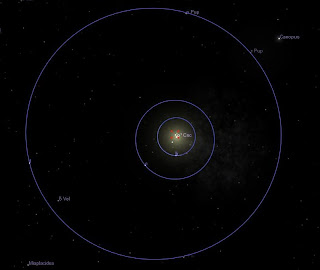 The 55 Cnc system (excluding the outermost planet), 55 Cnc e is marked by the red cross near the sun. The 55 Cne system has features similar to our solar system.
Instead, they chose to focus on whether the planets we have found are habitable, which was beside the point [1].
Guillermo Gonzalez wrote a response for them, which included this:
The typical exoplanetary system is very different from our Solar System. Jovian planets are being discovered in very tight or highly eccentric orbits. Jovian planets in our Solar System are characterized by large nearly circular orbits. Our Solar System looks ever more like the exception, and it is exceptional in ways that are life friendly.
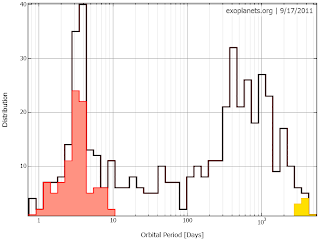 Distribution of orbital periods of the currently discovered exoplanets. The pink bars are "Super Jupiters" and the yellow bars are Jupiter-like planets in Jupiter period orbits.
Well, that's sort of true, but deeply misleading. When we first started looking Super Jupiters were the norm. To explain why, and why this is no longer true, I'm going to digress for a moment to explain the main methods used to find exoplanets. The first is the
radial velocity method. Here the slight wobbles produced in the position of a star by the gravitational tug of an orbiting planet are detected by Doppler shift.
In the
transit method, the slight dimming in the stars light as the planet passes in front of it.
Naturally, the changes are very small, right at the limit of our ability to detect them. This means that bigger planets are easier to find than smaller ones, a big planet tugs more, and can block more light. Planets that are closer to their suns are also easier to find, big close worlds tug more, and can block more light.
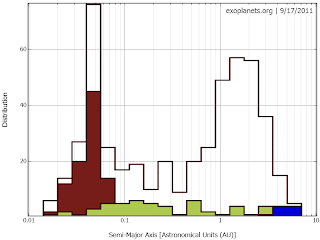 Distribution of exoplanets distance from their suns. Red is "Hot Jupiters", Green is multiplanet systems and blue is Jovian planets at Jovian orbits.
When we first found exoplanets,
back in 1995, they were jaw-dropping
hot super-Jupiters closer to their suns than Mercury and screaming around their suns in a handful of days! This was a big surprise, no one expected
big planets to be that close. There were also lots of
weird orbits (although some of these eccentric orbits turn out to be artifacts of the way multiple stars systems orbits sum up).
Finding solar systems like ours is rather difficult even given the limitations of the telescopes we are using (which will have great difficulty finding Earth sized worlds in the first place). For example, if you were looking at the Sun for Jupiter, you would have to watch for 12 years to detect it, and you would need to wait 24 years to confirm your detection. So it is no wonder that our explanet detections up until now have been dominated by massive planets orbiting closer to their suns then Mercury is to ours.
Now with
Kepler,
HARPS and MOST we are seeing a wider range of solar systems, although still biased away from Earth-like worlds and solar systems like our own you can see from the diagrams above that Super Jupiters no longer predominate, and we have more normal sized planets in more normal sized orbits predominating.
While the typical extasolar system
is different from our own, with more Saturn and Neptune sized worlds (quite a few are closer in, but these are orbiting smaller suns, so their relative positions aren't to far off), the way Dr. Gonzales has written his piece suggests that the typical extrasolar system is hot Jupiters in eccentric orbits. Which they are not.
We are still getting weird ones, like the
planet where it rains pebbles, but even with the gross under-sampling of Earth-like worlds in the current surveys; of the 677 official and 1270 still to be confirmed planets, 54 are in the habitable zone, and 4 are Earth-like (although they are "super -Earths"). When you use these (grossly underestimated) figures to estimate the number of terrestrial worlds in their stars habitable zone (around stable, long lived stars) you get
between 50 million to 50 billion habitable worlds depending on the assumptions you make.
If you take the low end estimate, and factor in habitable exomoons (shades of Avatar), then you get a figure of roughly 100 million habitable environments per galaxy which can now be used to come up with an estimate of habitable worlds in the visible universe. The number works out to 10
18, or
10 million trillion.
I'll let that number sink in a bit. Now, Dr.Gonzales has written that there is a lot of work going on understanding habitable zones, which there is, but he implies that it is all shrinking the habitable zones (which it isn't). As well, some old constraints (like having a large Moon to stabilise a worlds orbit (which turn out to be
relatively common) see to be less constraining than we thought, the
abstracts on habitability from the extreme solar system conference).
Even with very conservative estimates, we still have more than enough worlds in the Habitable zones of stars of our Universe to make Dembski's
original statement false. As well, we have seen how once again the Discovery Institutes members try to distort facts. The DI still fails at exoplanets.
[1] The point in question was whether there was any theory of planetary formation at all which gave confidence that there would be large numbers of planets in the galaxy-universe as opposed to the proportion of planets that were habitable. No astronomer or evolutionary biologist ever suggested that all planet bearing stars had a planet in a habitable zone, but
as far back as 1978 rough estimates of habitable planets came in at the 10 million mark for our galaxy.
(PS, NASA's big announcement was
a planet orbiting a binary star, a bit like Tatooine, if Tatooine was a frigid gas giant. It could have a habitable Moon though.)
(PPS, I'm an amateur astronomer, not a professional, but I have been using the STEREO spacecraft images to hunt for exoplanets. Boy, do I suck at it. Other teams have found an exoplanet using this system though. I'm also a member of the Planet Hunters and search the Kepler data for planetary candidates) The 55 Cnc system (excluding the outermost planet), 55 Cnc e is marked by the red cross near the sun. The 55 Cne system has features similar to our solar system.
Instead, they chose to focus on whether the planets we have found are habitable, which was beside the point [1]. Guillermo Gonzalez wrote a response for them, which included this:
The 55 Cnc system (excluding the outermost planet), 55 Cnc e is marked by the red cross near the sun. The 55 Cne system has features similar to our solar system.
Instead, they chose to focus on whether the planets we have found are habitable, which was beside the point [1]. Guillermo Gonzalez wrote a response for them, which included this:
 Distribution of orbital periods of the currently discovered exoplanets. The pink bars are "Super Jupiters" and the yellow bars are Jupiter-like planets in Jupiter period orbits.
Well, that's sort of true, but deeply misleading. When we first started looking Super Jupiters were the norm. To explain why, and why this is no longer true, I'm going to digress for a moment to explain the main methods used to find exoplanets. The first is the radial velocity method. Here the slight wobbles produced in the position of a star by the gravitational tug of an orbiting planet are detected by Doppler shift.
In the transit method, the slight dimming in the stars light as the planet passes in front of it.
Naturally, the changes are very small, right at the limit of our ability to detect them. This means that bigger planets are easier to find than smaller ones, a big planet tugs more, and can block more light. Planets that are closer to their suns are also easier to find, big close worlds tug more, and can block more light.
Distribution of orbital periods of the currently discovered exoplanets. The pink bars are "Super Jupiters" and the yellow bars are Jupiter-like planets in Jupiter period orbits.
Well, that's sort of true, but deeply misleading. When we first started looking Super Jupiters were the norm. To explain why, and why this is no longer true, I'm going to digress for a moment to explain the main methods used to find exoplanets. The first is the radial velocity method. Here the slight wobbles produced in the position of a star by the gravitational tug of an orbiting planet are detected by Doppler shift.
In the transit method, the slight dimming in the stars light as the planet passes in front of it.
Naturally, the changes are very small, right at the limit of our ability to detect them. This means that bigger planets are easier to find than smaller ones, a big planet tugs more, and can block more light. Planets that are closer to their suns are also easier to find, big close worlds tug more, and can block more light.
 Distribution of exoplanets distance from their suns. Red is "Hot Jupiters", Green is multiplanet systems and blue is Jovian planets at Jovian orbits.
When we first found exoplanets, back in 1995, they were jaw-dropping hot super-Jupiters closer to their suns than Mercury and screaming around their suns in a handful of days! This was a big surprise, no one expected big planets to be that close. There were also lots of weird orbits (although some of these eccentric orbits turn out to be artifacts of the way multiple stars systems orbits sum up).
Finding solar systems like ours is rather difficult even given the limitations of the telescopes we are using (which will have great difficulty finding Earth sized worlds in the first place). For example, if you were looking at the Sun for Jupiter, you would have to watch for 12 years to detect it, and you would need to wait 24 years to confirm your detection. So it is no wonder that our explanet detections up until now have been dominated by massive planets orbiting closer to their suns then Mercury is to ours.
Now with Kepler, HARPS and MOST we are seeing a wider range of solar systems, although still biased away from Earth-like worlds and solar systems like our own you can see from the diagrams above that Super Jupiters no longer predominate, and we have more normal sized planets in more normal sized orbits predominating.
While the typical extasolar system is different from our own, with more Saturn and Neptune sized worlds (quite a few are closer in, but these are orbiting smaller suns, so their relative positions aren't to far off), the way Dr. Gonzales has written his piece suggests that the typical extrasolar system is hot Jupiters in eccentric orbits. Which they are not.
We are still getting weird ones, like the planet where it rains pebbles, but even with the gross under-sampling of Earth-like worlds in the current surveys; of the 677 official and 1270 still to be confirmed planets, 54 are in the habitable zone, and 4 are Earth-like (although they are "super -Earths"). When you use these (grossly underestimated) figures to estimate the number of terrestrial worlds in their stars habitable zone (around stable, long lived stars) you get between 50 million to 50 billion habitable worlds depending on the assumptions you make.
If you take the low end estimate, and factor in habitable exomoons (shades of Avatar), then you get a figure of roughly 100 million habitable environments per galaxy which can now be used to come up with an estimate of habitable worlds in the visible universe. The number works out to 1018, or 10 million trillion.
I'll let that number sink in a bit. Now, Dr.Gonzales has written that there is a lot of work going on understanding habitable zones, which there is, but he implies that it is all shrinking the habitable zones (which it isn't). As well, some old constraints (like having a large Moon to stabilise a worlds orbit (which turn out to be relatively common) see to be less constraining than we thought, the abstracts on habitability from the extreme solar system conference).
Even with very conservative estimates, we still have more than enough worlds in the Habitable zones of stars of our Universe to make Dembski's original statement false. As well, we have seen how once again the Discovery Institutes members try to distort facts. The DI still fails at exoplanets.
[1] The point in question was whether there was any theory of planetary formation at all which gave confidence that there would be large numbers of planets in the galaxy-universe as opposed to the proportion of planets that were habitable. No astronomer or evolutionary biologist ever suggested that all planet bearing stars had a planet in a habitable zone, but as far back as 1978 rough estimates of habitable planets came in at the 10 million mark for our galaxy.
(PS, NASA's big announcement was a planet orbiting a binary star, a bit like Tatooine, if Tatooine was a frigid gas giant. It could have a habitable Moon though.)
(PPS, I'm an amateur astronomer, not a professional, but I have been using the STEREO spacecraft images to hunt for exoplanets. Boy, do I suck at it. Other teams have found an exoplanet using this system though. I'm also a member of the Planet Hunters and search the Kepler data for planetary candidates)
Distribution of exoplanets distance from their suns. Red is "Hot Jupiters", Green is multiplanet systems and blue is Jovian planets at Jovian orbits.
When we first found exoplanets, back in 1995, they were jaw-dropping hot super-Jupiters closer to their suns than Mercury and screaming around their suns in a handful of days! This was a big surprise, no one expected big planets to be that close. There were also lots of weird orbits (although some of these eccentric orbits turn out to be artifacts of the way multiple stars systems orbits sum up).
Finding solar systems like ours is rather difficult even given the limitations of the telescopes we are using (which will have great difficulty finding Earth sized worlds in the first place). For example, if you were looking at the Sun for Jupiter, you would have to watch for 12 years to detect it, and you would need to wait 24 years to confirm your detection. So it is no wonder that our explanet detections up until now have been dominated by massive planets orbiting closer to their suns then Mercury is to ours.
Now with Kepler, HARPS and MOST we are seeing a wider range of solar systems, although still biased away from Earth-like worlds and solar systems like our own you can see from the diagrams above that Super Jupiters no longer predominate, and we have more normal sized planets in more normal sized orbits predominating.
While the typical extasolar system is different from our own, with more Saturn and Neptune sized worlds (quite a few are closer in, but these are orbiting smaller suns, so their relative positions aren't to far off), the way Dr. Gonzales has written his piece suggests that the typical extrasolar system is hot Jupiters in eccentric orbits. Which they are not.
We are still getting weird ones, like the planet where it rains pebbles, but even with the gross under-sampling of Earth-like worlds in the current surveys; of the 677 official and 1270 still to be confirmed planets, 54 are in the habitable zone, and 4 are Earth-like (although they are "super -Earths"). When you use these (grossly underestimated) figures to estimate the number of terrestrial worlds in their stars habitable zone (around stable, long lived stars) you get between 50 million to 50 billion habitable worlds depending on the assumptions you make.
If you take the low end estimate, and factor in habitable exomoons (shades of Avatar), then you get a figure of roughly 100 million habitable environments per galaxy which can now be used to come up with an estimate of habitable worlds in the visible universe. The number works out to 1018, or 10 million trillion.
I'll let that number sink in a bit. Now, Dr.Gonzales has written that there is a lot of work going on understanding habitable zones, which there is, but he implies that it is all shrinking the habitable zones (which it isn't). As well, some old constraints (like having a large Moon to stabilise a worlds orbit (which turn out to be relatively common) see to be less constraining than we thought, the abstracts on habitability from the extreme solar system conference).
Even with very conservative estimates, we still have more than enough worlds in the Habitable zones of stars of our Universe to make Dembski's original statement false. As well, we have seen how once again the Discovery Institutes members try to distort facts. The DI still fails at exoplanets.
[1] The point in question was whether there was any theory of planetary formation at all which gave confidence that there would be large numbers of planets in the galaxy-universe as opposed to the proportion of planets that were habitable. No astronomer or evolutionary biologist ever suggested that all planet bearing stars had a planet in a habitable zone, but as far back as 1978 rough estimates of habitable planets came in at the 10 million mark for our galaxy.
(PS, NASA's big announcement was a planet orbiting a binary star, a bit like Tatooine, if Tatooine was a frigid gas giant. It could have a habitable Moon though.)
(PPS, I'm an amateur astronomer, not a professional, but I have been using the STEREO spacecraft images to hunt for exoplanets. Boy, do I suck at it. Other teams have found an exoplanet using this system though. I'm also a member of the Planet Hunters and search the Kepler data for planetary candidates)
38 Comments
stevaroni · 17 September 2011
Nick Matzke · 17 September 2011
Thanks Ian! I generally follow the exoplanet stuff but clearly I need to add your astroblog to my blogroll...
Also, I never get why IDists are so skeptical of extrasolar life. They say they like the anthropic arguments, i.e. the Universe is designed to support life.* If this argument makes any sense at all, it ought to predict that life is common rather than rare.
(* Actually, these arguments, before the ID movement got hold of them, were about how the Universe was set up just-so so that life could slowly, gradually, naturally evolve. If you're just going to supernaturally create life, there's no real need for a long, slow evolution of the Universe. You might as well just supernaturally create the sun and Earth and ignore the rest of it.)
Mike Elzinga · 17 September 2011
I have a close peripheral interest in this stuff also. One of my former students got her PhD studying with David Charbonneau at the Harvard-Smithsonian Center for Astrophysics. She is now an assistant professor at Cal Tech.
Just to indicate how active this field is, she had 35 publications in this area before she completed her PhD.
Another of my former students studied at Princeton, Cambridge, and got her PhD with Marc Kamionkowski at Cal Tech, and she is now at the Perimeter Institute In Waterloo, Ontario.
As to the thermodynamics of solar system formation; highly elliptical orbits are indicators of young systems, and circular orbits are indicators of older systems. The reason for this is because you can write the equations of motion for an orbiting body in terms of a “centrifugal potential” plus the gravitational potential. This gives a potential energy in the radial direction of the form
(1/2) L2/mr2 - GMm/r
where L is the angular momentum of the orbiting body, and r is the radial distance between the centers of the masses M and m.
This potential has a minimum at a fixed distance between the masses; i.e., for a circular orbit.
So thermodynamically, orbiting bodies are losing energy through collisions with orbiting debris, by friction caused by periodic gravitational tidal distortions that are large for highly elliptical orbits, and by the heat radiated as a result of such collisions and tidal forces.
Thus, another thing that makes younger systems more visible with current technology is that they are radiating lots of energy in the infrared as well as the visible. Objects with lose-in, highly elliptical orbits are radiating far more energy than are farther-out objects that are small and in circular orbits.
Older solar systems are going to be much harder to find and observe because they are already settled in close their lowest energy state.
SensuousCurmudgeon · 17 September 2011
stringfold · 17 September 2011
Frank J · 17 September 2011
Lemme get this straight: The DI's Michael Medved is convinced that Bigfoot is somewhere on our own planet, and we just haven't found him yet (presumably because those "scientists" who try are always "expelled"). And the DI has no problem with that. At least in public.
Just Bob · 17 September 2011
Duhh... of course they have no problem with Bigfoot, and of course he's hard to find. He's a demon, just like the pilots of UFOs!
FL · 17 September 2011
SLC · 17 September 2011
This latest posting by Gonzales in support of Mr. Dumbski is pure unadulterated rubbish. What Prof. Gonzales is basically saying is that we haven't found solar systems so far that resemble our own, therefore it is unlikely that they exist. The fact is that an observer on a planet circling a star 30 light years away would not be able to detect the planetary system of the Sun, or any of the planets therein, using the best equipment that we currently have available. I would be willing to wager that, in a few years when the more sensitive instrumentation is developed, we will detect exo-planetary systems that resemble our own and, in addition, earth-like planets and/or moons in the habitable zones.
The question is not whether there is life elsewhere in the universe. Given that most stars, at least the single ones, have planets orbiting around them, just by the law of large numbers the probability that life exists elsewhere is very close to 100%.
The issue as to whether there is intelligent life elsewhere in the universe is a much tougher question. This issue rests on the question as to whether the evolution of intelligence is inevitable, due to a selection advantage, once the first replicators appear. As I have argued previously on this site, an argument can be made that increases in encephalization factors, which is a necessary condition for intelligence, appears to have a selective advantage. The evidence is that the Cretaceous dinosaurs had larger encephalization factors then did their Jurassic forbears and today's mammals have larger encephalization factors then their forbears of 50 million years ago. I would note, however, that this is a necessary condition and is not necessarily sufficient, based on a sample of 1.
In this regard, there was an interesting debate which took place sometime in the early 1990s between Carl Sagan and Ernst Mayr on the topic of intelligence, with Sagan arguing that intelligent life was widespread in the universe while Mayr arguing that it was rather rare. One can use Google to find links to the debate. As we sit here today, IMHO, the question is open.
harold · 17 September 2011
apokryltaros · 17 September 2011
Mike Elzinga · 17 September 2011
It should be no surprise that FL would lift a partial sentence out of context and miss Nick Matzke’s entire point.
Most of the natural philosophers in the seventeenth century accepted the doctrine of the plurality of worlds. For example John Wilkins, 1614-72 published his Discovery of a New World in the Moone in 1638, and A Discourse concerning a New Planet in 1640.
Wilkins was a Puritan clergyman (Calvinist); and he rejected the practice of interpreting the scriptures literally. He believed that there was a maximum diversity of beings. He wrote:
“There may be other Species of Creatures beside those that are already known in the World. ‘Tis not Improbable that God might create some of all Kinds, that so he might more Completely Glorifie himself in the Works of his Power and Wisdom.”
Fundamentalist demands for literal (theirs) interpretation of their bible flies in the face of much of the history of the Christian religion. Many people in the past have used scripture to justify their speculations about life on other worlds.
Furthermore, FL’s assertion of “no evidence” completely ignores what we already know about matter. Just because he refuses to learn any of it doesn’t cancel out the fact that it all points to the possibility of life existing many places in the universe.
Chris Lawson · 17 September 2011
MichaelJ · 18 September 2011
Rolf · 18 September 2011
Karen S. · 18 September 2011
Just Bob · 18 September 2011
harold · 18 September 2011
harold · 18 September 2011
ksplawn · 18 September 2011
Mike Elzinga · 18 September 2011
Gary_Hurd · 18 September 2011
Thanks for your comment, and for the link to those conference abstracts.
Henry J · 18 September 2011
jps0869 · 18 September 2011
I won't add much to the conversation here other than to say that this comments thread has been an enjoyable primer on exoplanets. Thanks for doing what you do here.
Just Bob · 18 September 2011
Paul Burnett · 18 September 2011
Karen S. · 18 September 2011
apokryltaros · 18 September 2011
Henry J · 18 September 2011
Henry J · 18 September 2011
stevaroni · 19 September 2011
harold · 19 September 2011
harold · 19 September 2011
Torbjörn Larsson, OM · 20 September 2011
The number of habitable planets could be even higher with a factor of two or so, in our galaxy up to ~ 2*1010 perhaps.
It is still abysmal statistics, but by microlensing it has been estimated that for every bound (orbiting) planet there is an unbound that has been ejected. This is supported by modern models of planetary systems, AFAIK. Many of those wanderers would have moons with Europa style gravitationally heated habitable ice covered oceans with lifetimes well enough to establish life.
As for "shrinking the habitable zones", the shrinking is on the concept.
- Solar habitable zones are made problematic by the found dynamics of planetary systems. Planets migrate, they have elliptical orbits that take them in and out of the zone, we are starting to look at atmospheric effects.
The habitable zone concept is a first order tool to estimate statistics of habitables and to focus on habitable targets. That it would be modified with expected (atmospheres) and unexpected (high eccentricities) effects is an expected development.
That it must be replaced by a tool that consider dynamics was not.
- Galactic habitable zones may be fully fragmented by the tentative discovery that terrestrials doesn't follow star metallicity characteristics.
I wrote on this under the earlier post:
"It bears here, as it is a popular idea among those who a priori wants to see us as unique, to note that the galactic habitable zone concept could be blown wide open by a reconciliation between Kepler and Harps data. HARPS finds planets are much more frequent than Kepler, maybe 2-3 times as many. The answer seems to lie in that there are two different types of superEarth populations, hard core terrestrials and fluffy gas planets, and different methods have different bias on those.
And AFAIU these terrestrials doesn’t seem to follow the metallicity trend seen in other planet populations. (They likely form in different ways, and metallicity of the protoplanetary disk could affect these differently.) I wish I had ready references, but these last weeks have been crazy with new observations and hypotheses, and a layman has only so much time…
Terrestrials can potentially be as numerous regardless of the star’s metallicity. If that is so, the idea of a GHZ becomes restricted to preclude regions with too much environmental radiation (perhaps the core regions and some other dynamical areas that comes and goes), I think. The other conditions would be satisfied with the SHZ."
The poster who responded to the earlier post did a terrible job on responding to such specifics, by cutting and pasting unsupported general claims. Gonzales are confusing the concept of habitable zone with habitability of planets, and further habitability with habitation statistics.
As I mentioned in the earlier post, a "habitable zone [is] heuristic in the way [it] take[s] a known working biosphere and extrapolate the necessary conditions in a perturbation analysis, what we can change and still have conditions for life as we know it."
Torbjörn Larsson, OM · 20 September 2011
As for the discussion on planetary habitability, it is really the trend that the new data shows how lenient the conditions can be and what a good case study, what a good representation of a random pick out of the distribution, our own system is.
The foremost find is that all systems are individuals, with large trends in formation and lifetime dynamics which result in scatter. But among those wide parameters our own system places well:
- Our sun has an ordinary star with metallicity that are within the peak of the planetary distribution. (Though as noted, that may not mean anything for number of terrestrials.)
- Our planets have orbits with parameters such as numbers, radius, eccentricities et cetera well within the distributions. It has 8 planets, but the current sample trends of at 6 planets and that with virtual non-detectability of Mars massed, even less Mercury massed planets.
- Our system is only 1 sample, but its pattern of 4 planets up to Earth mass, 2 planets up to Neptune mass, 1 planet up to Saturn mass, and 1 Jupiter mass planet follows exactly the Kepler statistic trend of planet numbers following a 1/r2 trend.
The last correspondence between exoplanet predictions and our own system is very impressive to me!
If we leave habitability to look at possibilities for intelligent life, our planet still doesn't seem unique:
- It is unclear whether a large rotation axis stabilizing moon is harmful or beneficial. However, the fact that three terrestrials and dwarfs seems to have similar impact moons (Earth/Moon system, Mars/Phobos-Deimos-equatorial very elliptical impact scars, Pluto/Charon system) and 2 out of 3 resulted in tight binaries, implies it is a frequent phenomena.
The remaining factor is if we look for technological intelligence, presumably multicellular land life:
- The amount of water on Earth, having enough for plate tectonics but less than full ocean cover or roughly 0.05 % by mass IIRC, seems to be finetuned. However of our own terrestrials 3 of 4 have less water and in models most terrestrials have much more.
It is then the Jupiter-Saturn migration model that leaves us with the amount of water (drier planetoid formation supplemented with watery asteroids). And planetary migration seems to be the norm.
Torbjörn Larsson, OM · 20 September 2011
SLC · 20 September 2011
Science Avenger · 21 September 2011