Snails?
Yes, snails. This research focuses on a specific type of snail called a New Zealand mud snail (Potamopyrgus antipodarum) that lives in freshwater.
The first picture is a close up. We should put it in perspective. These snails are actually very, very small:
The first interesting bit is that New Zealand mud snails are wonderfully invasive. This means that they are very good at invading a new territory (like a pond), reproducing prolifically to reach very high numbers of individuals, often squeezing out other native snails:
The second, and arguably more interesting, bit to know is that there are some New Zealand mud snails who always reproduce sexually (with male snails and female snails getting cosy), and some who always reproduce asexually (a process called "parthenogenesis", which basically means that some females produce clones of themselves). Sexual reproduction results in offspring that are a genetic mix of both parents. This combination increases the variation among individuals (for example, you have some features of your mother, and some features from your father, but are not identical to either). Asexual reproduction results in offspring that are nearly identical to the parent. This would be like if instead of being a mix of your parents you were EXACTLY LIKE YOUR MOM. (Please remind me to tell my husband that it could be sooo much worse. Uh, I mean, I love you mom!)
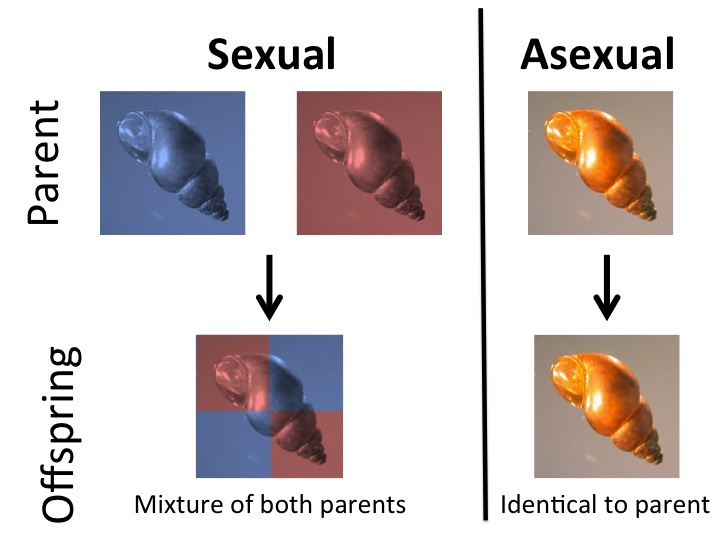 |
| Sexual reproduction results in new combinations Asexual reproduction dosen't fix what isn't broken (or even what is) |
The unique situation with the New Zealand mud snail, with sexual and asexual individuals of the same species, is ideal for investigating how different types of reproduction affect the genome (the set of all a species' DNA), and why, or when, one type might be advantageous over another.
To understand how sexual and asexual reproduction affect the genome, it would be useful to know what the genome looks like. Until recently, however, there were no genome-wide resources for the New Zealand mud snail. Wilton et al., present us with that new resource. They developed reference maps for four mud snail lineages (two sexual, and two asexual). These reference maps are of a subset of the whole genome (called the transcriptome), but contain most of the elements we typically think of as being useful, most notably the coding genes. Now these resources are available for the public to use (and can be accessed here: http://www.biology.uiowa.edu/neiman/transcriptome.php). These resources will greatly assist in studying what the effects of sexual and asexual reproduction are, on a genomic level.
 |
| Sexual reproduction means you won't be "exactly" like your mother. |
Mol Ecol Resour. 2013 Mar;13(2):289-94. doi: 10.1111/1755-0998.12051. Epub 2012 Dec 27.
Characterization of transcriptomes from sexual and asexual lineages of a New Zealand snail(Potamopyrgus antipodarum).
Source
Department of Biology, University of Iowa, Iowa City, IA 52242, USA.
25 Comments
apokryltaros · 25 April 2013
I remember reading about another species of freshwater snail with both sexually and asexually reproducing lineages (may have been the New Zealand mudsnail, but I don't remember exactly), and the author said that the sexually reproducing lineages are better adapted to evolving adaptations against predators and parasites, while the asexually reproducing lineages are better adapted to taking over a new environment.
https://me.yahoo.com/a/JxVN0eQFqtmgoY7wC1cZM44ET_iAanxHQmLgYgX_Zhn8#57cad · 25 April 2013
rightwrong. Nurture, that's the secret to a good near-clone! Glen DavidsonDS · 25 April 2013
There are also populations of Daphnia pulex that have both cyclic parthenogenesis and obligate asexuality. The asexuals are produced by the contagious spread of a dominant meiosis suppressor, so the reproductive system may be more a product of intrinsic genetic constraints than adaptation. This data set might make it possible to identify such a genetic mechanism operating in the snails.
DS · 25 April 2013
Here is a link for the Daphnia genetic study:
http://www.indiana.edu/~lynchlab/PDF/Lynch163.pdf
M. Wilson Sayres · 25 April 2013
You're right, Glen. I am quite similar to her (and I think that's a good thing), but I do have the advantage that I've learned from both her successes and mistakes. I'm also very happy to have the influence of both of my parents.
M. Wilson Sayres · 25 April 2013
DS, thanks for the Daphnia reference. After a cursory read, it seems like the sexual reproduction has resulted in a male-limited chromosome. I don't know is that is the case with the mud snail (or if we just can't identify it yet).
diogeneslamp0 · 25 April 2013
Melissa,
thanks for writing up a description of this (I'm the one who requested it.)
Most of you know this, but for future reference, the "hubbub" she refers to is that Louisiana anti-creationist Zack Kopplin went on Bill Maher's TV show and some anti-science fathead arguing with Zack cited the "snail sex" study as an example of money wasted on science.
Zack's response, "You're not a scientist", was mocked at pro-ID Evolution News and Views. With this info, we can give a more substantive rebuttal to the anti-scientists.
This species appears highly invasive, spread throughout the American West, and I presume is of great economic importance. We'd better know how it reproduces.
DS · 25 April 2013
anothernick · 25 April 2013
matthew.s.ackerman · 25 April 2013
matthew.s.ackerman · 25 April 2013
DS · 25 April 2013
DS · 25 April 2013
matthew.s.ackerman · 25 April 2013
matthew.s.ackerman · 25 April 2013
DS · 25 April 2013
Matthew, if you read the paper I linked to, you will see that meiosis suppressors can convert cyclic parthenogens to obligate parthenogens through males since the suppressor is sex-limited and dominant. There is good evidence that the suppressor arose in glacial refuge in the northeast and is spreading westward. In this sense, asexuality is indeed contagious.
diogeneslamp0 · 25 April 2013
harold · 26 April 2013
matthew.s.ackerman · 26 April 2013
DS · 26 April 2013
Matthew,
We seem to be talking past each other. I am definitely not claiming that asexuality is beneficial, in fact quite the opposite. I am saying that it may spread despite being maladaptive in some circumstances. I do not see how "contagious" implies "beneficial". Lots of diseases are contagious without being in the least beneficial to the host.
As for glacial refugia, the issue is the origin of the meiosis suppressor, not the origin of asexuality. If the proposed hypothesis is not correct, you will have to take it up with Mike Lynch, it's his hypothesis.
matthew.s.ackerman · 26 April 2013
matthew.s.ackerman · 26 April 2013
matthew.s.ackerman · 26 April 2013
DS · 26 April 2013
_Arthur · 27 April 2013
If I remember well, the common dandelion reproduce asexually.
http://en.wikipedia.org/wiki/Dandelion
http://en.wikipedia.org/wiki/Apomixis
Talk about an ill-adapted species !