Coelacanths are unexceptional products of evolution

Posted 20 April 2013 by

The coelacanth genome has been sequenced, which is good news all around…except that I found a few of the comments in the article announcing it disconcerting. They keep calling it a "living fossil" — and you know what I think of that term — and they keep referring to it as evolving slowly

The slowly evolving coelacanth

The morphological resemblance of the modern coelacanth to its fossil ancestors has resulted in it being nicknamed 'the living fossil'. This invites the question of whether the genome of the coelacanth is as slowly evolving as its outward appearance suggests. Earlier work showed that a few gene families, such as Hox and protocadherins, have comparatively slower protein-coding evolution in coelacanth than in other vertebrate lineages.

Honestly, that's just weird. How can you say its outward appearance suggests it is slowly evolving? The two modern species are remnants of a diverse group — it looks different than forms found in the fossil record.

And then for a real WTF? moment, there's this from Nature's News section.

It is impossible to say for sure, but the slow rate of coelacanth evolution could be due to a lack of natural-selection pressure, Lindblad-Toh says. Modern coelacanths, like their ancestors, "live far down in the ocean, where life is pretty stable", she says. "We can hypothesize that there has been very little reason to change." And it is possible that the slow genetic change explains why the fish show such a striking resemblance to their fossilized ancestors.

Snorble-garble-ptang-ptang-CLUNK. Reset. Does not compute. Must recalibrate brain.

None of that makes sense. The modern fish do not show a "striking resemblance" to their fossilize ancestors — they retain skeletal elements that link them to a clade thought to be extinct. This assumption that Actinistian infraclass has been unchanging undermines their conclusions — the modern species are different enough that they've been placed in a unique genus not shared with any fossil form.

Then the argument that they must live in a stable environment with a lack of natural-selection pressure is absurd. Selection is generally a conservative process: removing selection pressures from a population should lead to an increase in the accumulation of variability. Do they mean there has been increased selection in a very narrowly delimited but stable environment?

But even that makes no sense. We should still be seeing the accumulation of neutral alleles. Increased selection is only going to remove variability in functional elements, and most of the genome isn't. I suppose one alternative to explain slow molecular evolution would be extremely high fidelity replication, but even that would require specific selection constraints to evolve.

This article broke my poor brain. I couldn't see how any of this could work — it ignored the fossil evidence and also seemed to be in defiance of evolutionary theory. It left me so confused.

Fortunately, though, the journal BioEssays came to my rescue with an excellent review of this and past efforts to shoehorn coelacanths into the "living fossil" fantasy, and that also explained the molecular data. And it does it plainly and clearly! It's titled, "Why coelacanths are not 'living fossils'", and you can't get much plainer and clearer than that.

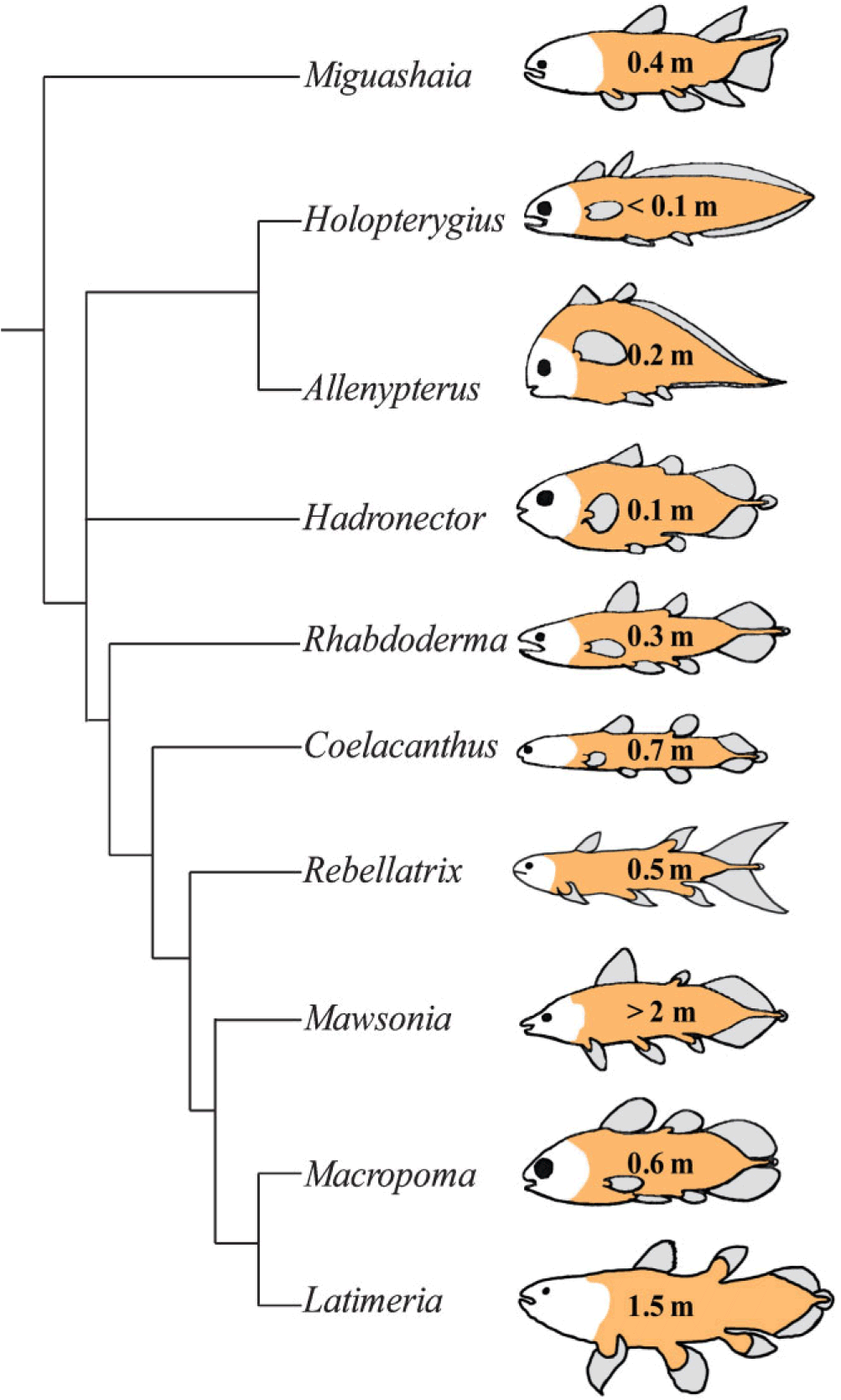
First, let's dismiss that myth of the unchanging Actinistian. Here's a phylogeny of the coelacanth-like fossils and their one surviving species.
coelacanth_fossils
Comparison of extant and selected extinct actinistians, commonly known as coelacanths. A phylogeny of Actinistia; schematic sketches of body outlines and approximate body length (given in metre) illustrate the morphological diversity of extinct coelacanths: some had a short, round body (Hadronector), some had a long, slender body (Rebellatrix), some were eel-like (Holopterygius) whereas others resembled trout (Rhabdoderma), or even piranha (Allenypterus). Note that the body shape of Latimeria chalumnae differs significantly from that of its closest relative, Macropoma lewesiensis.

Love it. I've been looking for a diagram like this for a long time; creationists often trot out this claim that coelacanths haven't changed in hundreds of millions of years, and there you can see — divergence and variation and evolution, for hundreds of millions of years.

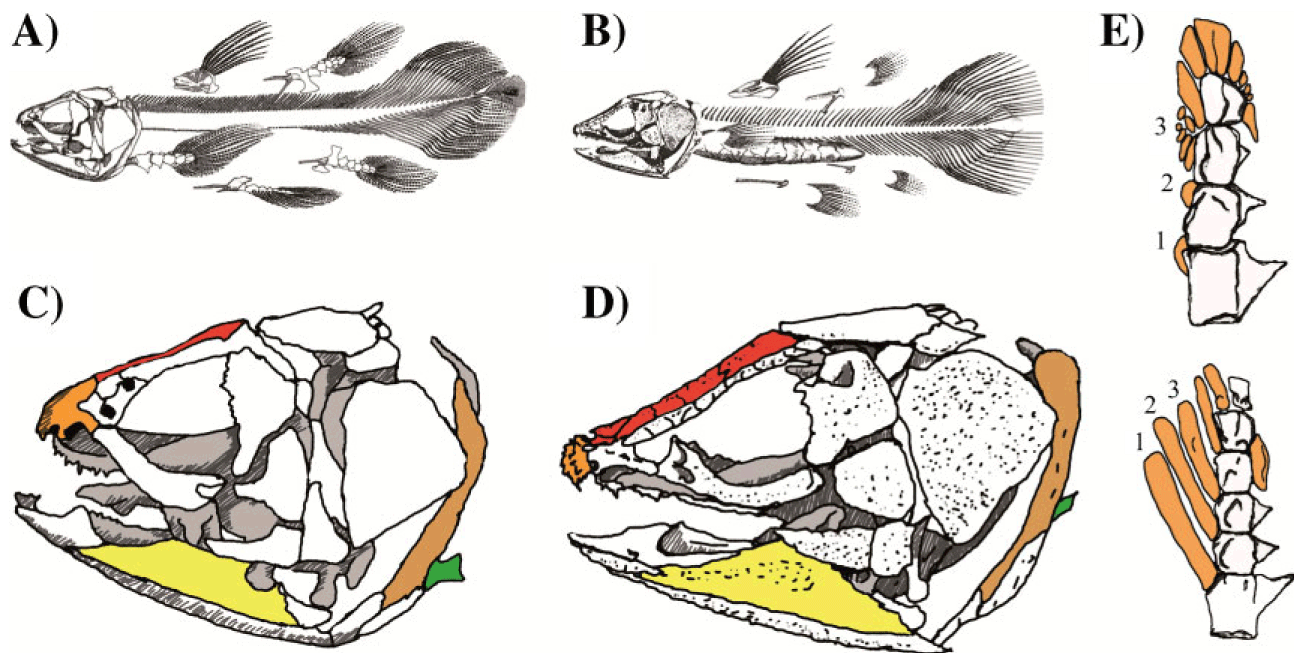
In addition, we can look in more detail at the skull and limbs of these animals. This drawing is comparing modern Latimeria with its closest fossil relative, and even here there are dramatic differences in structure.
actinistian_bones
Comparison of the skeleton of extant and selected extinct coelacanths. A-D: Latimeria and its sister group Macropoma show numerous skeletal differences. A, B: Overall view of the skeletal organisation of the extant coelacanth and of its closest relative. A: Latimeria chalumnae. B: Macropoma lewesiensis. Relative to the body length, in L. chalumnae the vertebrae are smaller, the truncal region of the vertebral column is longer and the post anal region is shorter than in M. lewesiensis. In the latter region, the hemal arches (ventral spines) extend more ventrally in M. lewesiensis than in L. chalumnae. In addition, the swim bladder is ossified in Macropoma but not in Latimeria, and the basal bone of the first dorsal fin is characteristic of each genus. C, D: Comparison of the skulls of L. chalumnae and M. lewesiensis. C: In L. chalumnae, the mouth opens upward, the articular bone (yellow) is long and narrow, the parietonasal shield (red) is short, the premaxillary bone (orange) is devoid of denticle ornamentation, the dorsal part of the cleithum (light brown) is spiny, and the scapulocoracoid (green) is located on the ventral side. D: In contrast, in M. Lewesiensis, the mouth opens forward, the angular bone (yellow) is triangular, the parieto-nasal shield (red) is long, the premaxillary (orange) protrudes and forms a hemispherical snout which is ornamented with prominent denticles, the dorsal part of the cleithrum (light brown) is thick, and the scapulocoracoid, (green) is located more medially. Modified from [3]. E: Pectoral fin skeleton of L. chalumnae (above) and Shoshonia arctopteryx (below). The three first preaxial radials are numbered from proximal to distal. In L. chalumnae the fin appears nearly symmetrical because radial bones (orange) are arranged nearly symmetrically about the fin axis. The proximal preaxial radials 1-2 are extremely short and bear no fin ray, and the preaxial radial 3 is short and fractionated. In contrast, in S. arctopteryx the fin is strongly asymmetrical chiefly because proximal preaxial radials are long and all bear fin rays.

The authors make it clear that this idea of morphological conservation of the Actinistians is simply bogus.

In addition, an examination of the skeleton of the fossil genus Macropoma (approximately 70 Ma), the sister group of Latimeria and the only known fossil actinistian record from the Cretaceous to the present, shows some interesting differences. Not only are the extant coelacanths three times larger than their closest extinct relatives (about one and a half metres vs. half a metre), but there are also numerous structural differences. The swim bladder is ossified in Macropoma but filled with oil in Latimeria, indicating they were probably found in different types of environments. There are also noticeable differences in the vertebral column (the post anal region is shorter and ventral spines extend less ventrally in M. Lewesiensis compared with L. chalumnae), and in the attachment bones of the fins. In addition, Macropoma and Latimeria have distinctly dissimilar skull anatomies, resulting in noticeable differences in head morphology.

Finally, it should not be forgotten that external morphological resemblances can be based on a very different internal anatomical organisation. The most often emphasised resemblance between coelacanths is that they all have four fleshy-lobed-fins. Until recently, the anatomy of the lobed fins of coelacanths was only known in Latimeria, in which the pectoral fin endoskeleton is short and symmetrical. In 2007, Friedman et al. described the endoskeleton of the pectoral fin of Shoshonia arctopteryx, a coelacanth species from the mid Devonian, and therefore contemporary with Miguashaia. They showed that this earliest known coelacanth fin endoskeleton is highly asymmetrical, a characteristic that is probably ancestral since it resembles the condition found in early sarcopterygians such as Eusthenopteron, Rhizodopsis or Gogonasus. This result is additional support, if needed, that extant coelacanths have not remained morphologically static since the Devonian.

Well, so, you may be wondering, what about the molecular/genomic data? Doesn't that clearly show that they've had a reduced substitution rate? No, it turns out that that isn't the case. Some genes seem to be more conserved, but others show an expected amount of variation.

However, a closer look at the data challenges this interpretation [of slow evolution]: depending on the analysed sequence, the coelacanth branch is not systematically shorter than the branches leading to other species. In addition, most phylogenetic analyses - including analysis of Hox sequences - do not support the hypothesis that the Latimeria genome is slow evolving, i.e. they do not place coelacanth sequences on short branches nor do they detect low substitution rates. The clearest example, which involves the largest number of genes, is a phylogeny based study of forty-four nuclear genes that does not show a dramatic decrease, if any, in the rate of molecular evolution in the coelacanth lineage. What we know about the biology of coelacanths does not suggest any obvious reason why the coelacanth genome should be evolving particularly slowly.

So why is this claim persisting in the literature? The authors of the BioEssays article made an interesting, and troubling analysis: it depends on the authors' theoretical priors. They examined 12 relevant papers on coelacanth genes published since 2010, and discovered a correlation: if the paper uncritically assumed the "living fossil" hypothesis (which I've told you is bunk), the results in 4 out of 5 cases concluded that the genome was "slowly evolving"; in 7 out of 7 cases in which the work was critical of the "living fossil" hypothesis or did not even acknowledge it, they found that coelacanth genes were evolving at a perfectly ordinary rate.

Research does not occur in a theoretical vacuum. Still, it's disturbing that somehow authors with an ill-formed hypothetical framework were able to do their research without noting data that contradicted their ideas.

Maybe a start to correcting this particular instance of a problem is to throw out the bad ideas that are leading people astray. The authors strongly urge us to purge this garbage from our thinking.

Latimeria was first labelled as a 'living fossil' because the fossil genera were known before the extant species was discovered, and erroneous biological interpretations have grown and reports still show little morphological and molecular evolution. A closer look at the available molecular and morphological data has allowed us to show that most of the available studies do not show low substitution rates in the Latimeria genome, and furthermore, as pointed out by Forey [3] long before us, the supposed morphological stability of coelacanths from the Devonian until the present is not based on real data. As a consequence, the idea that the coelacanth is a biological 'living fossil' is a long held but false belief which should not bias the interpretation of molecular data in extant Latimeria populations. The same reasoning could be generalised to other extant species (such as hagfish, lamprey, shark, lungfish and tatuara, to cite few examples of vertebrates) that for various reasons are often presented as 'ancient', 'primitive', or 'ancestral' even if a lot of recent data has shown that they have many derived traits [58-64]. We hope that this review will contribute to dispelling the myth of the coelacanth as a 'living fossil' and help biologists keep in mind that actual fossils are dead.

But of course we also shouldn't let that color our data. If analyses showed a significantly reduced substitution rate in the evolution of a species, it ought to get published. If nothing else, it would be an interesting problem for evolutionary theory. Coelacanths, though, don't represent that problem.


Amemiya CT, Alföldi J, Lee AP, Fan S, Philippe H, Maccallum I, Braasch I, Manousaki T, Schneider I, Rohner N, Organ C, Chalopin D, Smith JJ, Robinson M, Dorrington RA, Gerdol M, Aken B, Biscotti MA, Barucca M, Baurain D, Berlin AM, Blatch GL, Buonocore F, Burmester T, Campbell MS, Canapa A, Cannon JP, Christoffels A, De Moro G, Edkins AL, Fan L, Fausto AM, Feiner N, Forconi M, Gamieldien J, Gnerre S, Gnirke A, Goldstone JV, Haerty W, Hahn ME, Hesse U, Hoffmann S, Johnson J, Karchner SI, Kuraku S, Lara M, Levin JZ, Litman GW, Mauceli E, Miyake T, Mueller MG, Nelson DR, Nitsche A, Olmo E, Ota T, Pallavicini A, Panji S, Picone B, Ponting CP, Prohaska SJ, Przybylski D, Saha NR, Ravi V, Ribeiro FJ, Sauka-Spengler T, Scapigliati G, Searle SM, Sharpe T, Simakov O, Stadler PF, Stegeman JJ, Sumiyama K, Tabbaa D, Tafer H, Turner-Maier J, van Heusden P, White S, Williams L, Yandell M, Brinkmann H, Volff JN, Tabin CJ, Shubin N, Schartl M, Jaffe DB, Postlethwait JH, Venkatesh B, Di Palma F, Lander ES, Meyer A, Lindblad-Toh K. (2013) The African coelacanth genome provides insights into tetrapod evolution. Nature 496(7445):311-316.

Casane D, Laurenti P (2013) Why coelacanths are not 'living fossils': A review of molecular and morphological data. Bioessays 35: 332-338.


Larry Moran beat me to it!

103 Comments

DS · 20 April 2013

Thanks PZ.

It is always important to remember that morphological and molecular evolution may be coupled or uncoupled. This is undoubtedly due to the complex relationship between genetics and morphology, given the complexity of developmental pathways.

Does anyone know if the complete genome sequence sheds any more light on the phylogenetic relationships between coelacanths, lungfish and tetrapods? Was this covered in the article? For many years the question proved hard to address. I had the impression that the consensus was that coelacanths are less closely related to tetrapods than lungfish. Does this relationship hold up given the new sequence data?

https://me.yahoo.com/a/JxVN0eQFqtmgoY7wC1cZM44ET_iAanxHQmLgYgX_Zhn8#57cad · 20 April 2013

Well why are there still fossils, if coelecanths evolved from fossilized ancestral forms (or anyway, from relatives of those)?

See, there are always questions for evilutionists.

Glen Davidson

Eric Finn · 20 April 2013

Posts like this one are the reason I keep on lurking at Pandas Thumb.

The issue discussed in this opening post has bothered me. It is indeed true that sometimes (or often) it has been indicated in public that a body shape that remains almost the same indicates either lack of evolution or slow evolution also at genetic level.

On the other hand, I do not remember anyone drawing a conclusion that the genetic makeup of ichthyosaur, dolphin and tuna fish should be highly similar.

According to the answer given here, there is no reason to assume that.
Moreover, even the body shape is not quite as stable as sometimes indicated, at least not in the case of coelacanths.

Just wanted to tell that a layman might possibly have understood something about what you said.

Mike Elzinga · 20 April 2013

I have not been able to find an answer to a question that I have been curious about for quite a few years now.

Have there ever been studies done on the rates of genetic change in creatures that have lived for thousands of years at low temperatures?

The reason I ask this is that there are some fundamental physic/chemistry notions behind the probabilities of mutations. The probability of a “jump” to another state is proportional to exp(-φ/kT), where φ is the height of a potential barrier between different configurations or states of a molecule.

If the general rule for rates of molecular evolution in living organisms is that they are pretty much “temperature independent,” then that would suggest that those barriers are large relative to kT. For example, room temperature kT is on the order of 1/40 of an electron volt.

I would expect that the barriers to molecular changes involved in genetic evolution would be at least 10 to 100 times larger; thus I would not expect any measurable differences in rates of molecular evolution given that the temperatures for life here on earth lie primarily within the range of liquid water.

Down at those geothermal vents, kT is greater because water is superheated under pressure; but one can also imagine that molecular configurations for extremophiles could be “more robust” – i.e., have slightly higher φ’s – also. They also live at considerably higher pressures.

I’m guessing that it is not likely that there will be measurable differences in molecular evolution rates across the entire spectrum of life. There is not much room for φ and T to vary without destroying the organism.

apokryltaros · 20 April 2013

Technically speaking, shouldn't the sentence be
Here's a phylogeny of the coelacanth-like fossils and their one surviving genus.
?

EvoDevo · 20 April 2013

https://me.yahoo.com/a/JxVN0eQFqtmgoY7wC1cZM44ET_iAanxHQmLgYgX_Zhn8#57cad said: Well why are there still fossils, if coelecanths evolved from fossilized ancestral forms (or anyway, from relatives of those)? See, there are always questions for evilutionists. Glen Davidson
Wait until, Byers hears that.

EvoDevo · 20 April 2013

DS said: Thanks PZ. Does anyone know if the complete genome sequence sheds any more light on the phylogenetic relationships between coelacanths, lungfish and tetrapods? Was this covered in the article? For many years the question proved hard to address. I had the impression that the consensus was that coelacanths are less closely related to tetrapods than lungfish. Does this relationship hold up given the new sequence data?
I recall, someone saying that the paper did shed light on the phylogenetic relationship between coelacanths, lungfish, tetrapods. Lungfish are more closely related to tetrapods.

robert van bakel · 20 April 2013

Are there examples of living animals (birds,insects,sharks etc) that DO resemble their respective fossil ancestors extremely closely? So closely in fact that selection seems to have been made redundant by the stability of the environment.
Really, just asking!

Robert Byers · 20 April 2013

Wait a minute. Lets think about this.
If My Myers is saying past and present, very present, scholarship on these things is so poor then creationists are right to lack and teach lack of confidence in anything from evolutionary biology.
Its not just this fish!

If its a Coel and has relatives in fossils said to be so long ago then the differences are so small to in effect say its unchanged.
They even invoked here about size. What does that matter? Irrelevant.

Mr Myers is stressing small differences to press the point this fish type has been evolving with the best of them.
Its very little different from what i read here.
There is indeed no living fossils because this presumes the fossils indicates ancient ages.
Its just a more common type that survived from a greater diversity living a few thousand years ago as the great flood took place.
there are many types of creatures unchanged from fiossil relatives in strata below the k-pg line.

My Myers is right however about modern literature in science fails to do a good job in origin issues.
We know that fossil is still unmorphed.

Scott F · 20 April 2013

robert van bakel said: Are there examples of living animals (birds,insects,sharks etc) that DO resemble their respective fossil ancestors extremely closely? So closely in fact that selection seems to have been made redundant by the stability of the environment. Really, just asking!
I'm no biologist, but IIRC, aren't sharks pretty well adapted to their environment, and also a very old lineage? I realize that there's a wide variety of extant shark species, but aren't the shark fossils pretty closely matched to some of them? I do seem to recall that fossil shark teeth are pretty similar to modern shark teeth.

Scott F · 20 April 2013

Well, Robert, you did get a few things right from the OP:
Robert Byers said: Mr Myers is stressing small differences to press the point this fish type has been evolving with the best of them.
Yes. Now you're getting it. Small differences added up over time equals evolution.
There is indeed no living fossils...
Correct. That is what Professor Myers is saying. You read that part correctly ...
...because this presumes the fossils indicates ancient ages.
and then you went off the rails. Professor Myers did not say that at all.
Wait a minute. Lets think about this.
Yes. Let's. That's what we've been asking you to do for some time, and you can never bother to think outside the bible-shaped box that you have trapped yourself in.

harold · 21 April 2013

Mike Elzinga said: I have not been able to find an answer to a question that I have been curious about for quite a few years now. Have there ever been studies done on the rates of genetic change in creatures that have lived for thousands of years at low temperatures? The reason I ask this is that there are some fundamental physic/chemistry notions behind the probabilities of mutations. The probability of a “jump” to another state is proportional to exp(-φ/kT), where φ is the height of a potential barrier between different configurations or states of a molecule. If the general rule for rates of molecular evolution in living organisms is that they are pretty much “temperature independent,” then that would suggest that those barriers are large relative to kT. For example, room temperature kT is on the order of 1/40 of an electron volt. I would expect that the barriers to molecular changes involved in genetic evolution would be at least 10 to 100 times larger; thus I would not expect any measurable differences in rates of molecular evolution given that the temperatures for life here on earth lie primarily within the range of liquid water. Down at those geothermal vents, kT is greater because water is superheated under pressure; but one can also imagine that molecular configurations for extremophiles could be “more robust” – i.e., have slightly higher φ’s – also. They also live at considerably higher pressures. I’m guessing that it is not likely that there will be measurable differences in molecular evolution rates across the entire spectrum of life. There is not much room for φ and T to vary without destroying the organism.
That's an excellent point and you're almost certainly right. Because of my human-centric education, I've usually studied things that happen at about 37 degrees centigrade. However, most of the biosphere is not homothermic, and much of it lives at substantially lower temperature than that. I don't know off the top of my head, and the detailed kinetics of the chemistry behind common mutations isn't at my fingertips, but your intuition is likely to be correct here. Within the range of temperatures that permit actively reproducing terrestrial life, temperature probably doesn't impact on overall mutation rate in a way that is strongly significant for evolution. Remember that even hot springs bacteria can be killed by raising the temperature a little bit higher, and bacteria effectively stop dividing at temperatures that often exist naturally on some parts of the planet. Actively reproducing life requires a narrow temperature range.

DS · 21 April 2013

Robert Byers said: Wait a minute. Lets think about this. If My Myers is saying past and present, very present, scholarship on these things is so poor then creationists are right to lack and teach lack of confidence in anything from evolutionary biology. Its not just this fish! If its a Coel and has relatives in fossils said to be so long ago then the differences are so small to in effect say its unchanged. They even invoked here about size. What does that matter? Irrelevant. Mr Myers is stressing small differences to press the point this fish type has been evolving with the best of them. Its very little different from what i read here. There is indeed no living fossils because this presumes the fossils indicates ancient ages. Its just a more common type that survived from a greater diversity living a few thousand years ago as the great flood took place. there are many types of creatures unchanged from fiossil relatives in strata below the k-pg line. My Myers is right however about modern literature in science fails to do a good job in origin issues. We know that fossil is still unmorphed.
He did it again. After arguing for months that fossils are "nonbiological" and therefore cannot be used to study the past history of life, Robert once again barfs out some verbal diarrhea claiming that the fossils are evidence for the magic flood! After going on and on about how the different fields of science are separate and paleontology cannot tell us anything about biology, he barfs out this little gem. So I guess you can use fossils to learn about the past history of life after all. And since, by his own logic, fossils that have changed little in millions of years are evidence of little evolution, then I guess all of the fossils that have changed dramatically are really good evidence for evolution. Time to dump the twit to the bathroom wall again. His mindless mumbling verges on the incomprehensible anyway. It is obvious that he literally doesn't think before he posts, but that may just be because he is incapable of rational thought. This is your mind on creationism.

apokryltaros · 21 April 2013

robert van bakel said: Are there examples of living animals (birds,insects,sharks etc) that DO resemble their respective fossil ancestors extremely closely? So closely in fact that selection seems to have been made redundant by the stability of the environment. Really, just asking!
Yes. In these cases, the living organisms would be classified as being in the same genus. Like, fossil species in Cyprinus, Carassius, Canis, Panthera, Helix, Acer, Ginkgo, Celtis, Eucommia, for example. In some cases, researchers determine that a fossil specimen is so similar to the living counterpart, they determine that both belong to the same species.

Mark Sturtevant · 21 April 2013

I have been following the recent spate of postings about the Coelacanth genome. This is the most useful one of 'em all. So I am ready to expunge the idea of 'living fossil' for the coelacanth in my mind. What about horseshoe crabs? Any thoughts?

Dave Luckett · 21 April 2013

There is also the idea that some mutations are caused by radiation - nuclear and ultraviolet. Coelacanths live in deep water, below 100 meters, down to at least 500. There must be less EMR down there to cause mutations.

Or is this pure nonsense?

Marilyn · 21 April 2013

robert van bakel said: Are there examples of living animals (birds,insects,sharks etc) that DO resemble their respective fossil ancestors extremely closely? So closely in fact that selection seems to have been made redundant by the stability of the environment. Really, just asking!
Please also consider the incredible example of the Crinoid http://en.wikipedia.org/wiki/Crinoid I think they are a showstopper if not an evolution stopper the Crinoid looks exactly like it's fossil. The Coelacanths remind me of Darwin's finches either born to be what they are or each adapted to the environment. It seams inhabitants of the Earth were subjected to http://en.wikipedia.org/wiki/Adaptive_radiation This suggests to me that the creatures molicules were perhaps changed due to been trigerd by external influences rather than an independant internal biological prosseses of DNA RNA proceedure.

EvoDevo · 21 April 2013

Marilyn said:
robert van bakel said: Are there examples of living animals (birds,insects,sharks etc) that DO resemble their respective fossil ancestors extremely closely? So closely in fact that selection seems to have been made redundant by the stability of the environment. Really, just asking!
Please also consider the incredible example of the Crinoid http://en.wikipedia.org/wiki/Crinoid I think they are a showstopper if not an evolution stopper the Crinoid looks exactly like it's fossil. The Coelacanths remind me of Darwin's finches either born to be what they are or each adapted to the environment. It seams inhabitants of the Earth were subjected to http://en.wikipedia.org/wiki/Adaptive_radiation This suggests to me that the creatures molicules were perhaps changed due to been trigerd by external influences rather than an independant internal biological prosseses of DNA RNA proceedure.
Are you a crackpot?

Mark Sturtevant · 21 April 2013

Marilyn said:
robert van bakel said: Are there examples of living animals (birds,insects,sharks etc) that DO resemble their respective fossil ancestors extremely closely? So closely in fact that selection seems to have been made redundant by the stability of the environment. Really, just asking!
Please also consider the incredible example of the Crinoid http://en.wikipedia.org/wiki/Crinoid I think they are a showstopper if not an evolution stopper the Crinoid looks exactly like it's fossil. The Coelacanths remind me of Darwin's finches either born to be what they are or each adapted to the environment. It seams inhabitants of the Earth were subjected to http://en.wikipedia.org/wiki/Adaptive_radiation This suggests to me that the creatures molicules were perhaps changed due to been trigerd by external influences rather than an independant internal biological prosseses of DNA RNA proceedure.
I have been wondering if the whole 'living fossil' notion is just an illusion that needs to be abandoned because we would have to refer to thousands of species as living fossils, once we thought of it. Consider the number of bacteria like cyanobacteria and methanogens, and other bacteria that should be referred to as living fossils because they look like, and have metabolisms attributed to fossil bacteria. Then come the various invertebrates -- jellyfish and squid and molluscs and arthropods that have more than a passing resemblance to fossils. Next are the various lizards that look like fossil lizards, fossil turtles that are pretty similar to turtles we see today, and so on. So living fossils are the many lineages that happened to not go extinct AND did not go through an arbitrary amount of divergent evolution. We must be up to our necks in living fossils. OR the whole idea of living fossils is just not useful. I am wondering if we should favor the latter.

harold · 21 April 2013

Marilynn is a transitional form; like other creationists she can never be convinced, but like science supporters, she seems to have some interest in the real world and is not given to unjustified raging. Therefore I will reply to the comment.
Please also consider the incredible example of the Crinoid http://en.wikipedia.org/wiki/Crinoid I think they are a showstopper if not an evolution stopper the Crinoid looks exactly like it’s fossil.
The whole point of this thread is that some (many, actually) basic anatomic plans are conserved for enormous amounts of time. However, this doesn't mean that those lineages didn't and don't evolve. If you want a really obvious example of a long-conserved morphology, go find an ordinary cockroach. The reason Coelacanths are famous is because that particular morphology is common in fossils, but was considered extinct, and then in the sixties someone caught a modern Coelacanth. There are innumerable lineages that are more ancient and more anatomically conservative than Coelacanths.
The Coelacanths remind me of Darwin’s finches either born to be what they are or each adapted to the environment. It seams inhabitants of the Earth were subjected to http://en.wikipedia.org/wiki/Adaptive_radiation
That is basically correct.
This suggests to me that the creatures molicules were perhaps changed due to been trigerd by external influences rather than an independant internal biological prosseses of DNA RNA proceedure.
This is called Lamarckism. It is a perfectly good idea, named after a brilliant man. However, it is one of the many perfectly good ideas brilliant people have had, which turn out in the long run to be wrong. What happens is that each replication of DNA produces offspring DNA that is slightly different from parent DNA. The differences are independent of the "needs" or "wishes" of organisms; they occur at random. "Random" refers to something that humans can measure or deduce the frequency or probability of, but can't predict exactly. If the changes in the DNA (RNA in the case of a some viruses) impact on the phenotype - they usually don't, but if they do - the phenotypic variation may give the individual who carries it some advantage or disadvantage in reproduction - note that this advantage or disadvantage may be so small as to be imperceivable in the short term. Also, an allele may change in frequency due to random chance, because it is linked to another allele that is more strongly selected one way or the other, or because it is recessive. There's plenty more to learn but those are the basics of how it works. Lamarckism isn't religious (or anti-religious), it's a hypothesis of how elvolution might work, but overall, it's not supported. There are lineages in which DNA repair mechanisms can be suppressed in high stress environments (thus leading to a higher net mutation rate); this is called by some "neo-Lamarckism", for better or for worse.

Ray Martinez · 21 April 2013

PZ Myers: "Coelacanths, though, don't represent that problem."
Was Atheist PZ Myers conclusion ever in doubt? Since no God exists Atheists must conclude for evolution; so the answer is no: the conclusion for "evolution-did-it" was never in doubt.

phhht · 21 April 2013

Jeezy C you're stupid, Ray.
Ray Martinez said:
PZ Myers: "Coelacanths, though, don't represent that problem."
Was Atheist PZ Myers conclusion ever in doubt? Since no God exists Atheists must conclude for evolution; so the answer is no: the conclusion for "evolution-did-it" was never in doubt.

DS · 21 April 2013

Ray Martinez said:
PZ Myers: "Coelacanths, though, don't represent that problem."
Was Atheist PZ Myers conclusion ever in doubt? Since no God exists Atheists must conclude for evolution; so the answer is no: the conclusion for "evolution-did-it" was never in doubt.
SInce Ray needs for gods to exist, his conclusion against evolution was never in doubt and never will be regardless of the evidence.

stevaroni · 21 April 2013

Ray Martinez said:
PZ Myers: "Coelacanths, though, don't represent that problem."
Was Atheist PZ Myers conclusion ever in doubt? Since no God exists Atheists must conclude for evolution; so the answer is no: the conclusion for "evolution-did-it" was never in doubt.
The problem, Ray, is that us Evil Atheists(tm), Meyers included, are more than happy to posit scenarios that are a problem for Darwinian evolution. A truly de nevo structure for which there is no antecedent. The infamous rabbit in Precambrian strata. The list goes on and on and we have discussed many, many scenarios here that would go a long way to disproving Darwinian evolution. Darwin himself was troubled by what he thought were fatal flaws in his theory (mostly, that the Earth just wasn't old enough). Organisms living in places like the Great Rift valley, where the environment swings between dense forest and open savannah every 300,000 years feel an enormous amount of selections pressure, and species come and go with regularity. Organisms like the celocanth, cockroach and crionid, organisms that are well suited to their lives in a small environmental niche that's stable in the very long-term just don't face the same amount of selection pressure as creatures in more dynamic niches, and therefore don't change very fast. As Meyers sums up "It's just not a problem". If you feel it is a problem for evolution, why don't you please tell us exactly why.

harold · 21 April 2013

Since no God exists Atheists must conclude for evolution; so the answer is no: the conclusion for “evolution-did-it” was never in doubt.
1) Atheists existed before the theory of evolution. 2) Atheists exist who don't know about, or improperly understand, the theory of evolution. 3) Many religious people accept and understand biological evolution. So why is Ray trying to say that the theory of evolution is about atheism? Remember, people, it's really mainly about society and politics. Science is popular and credible. But science annoys people who make money off things like tobacco or fossil fuels, by raising neutral, objective concerns about the use of those products. Therefore you have to make science shut up, but people like science. But you figure that maybe people like Jesus even better, so you try to tell them that they can't have both science and Jesus. Then, you figure, science will shut up and you won't have to put warning labels on your cigarette packs any more. Also, you can claim that some people are less human than others without some propeller beanie wearing scientist contradicting you with talk about "genetics" (naturally, some people who talk about Jesus are a problem here, too, but it's a lot easier to say "My arbitrary interpretation of the Bible is better than your arbitrary interpretation of the Bible" than to argue with science).

Ray Martinez · 21 April 2013

DS said:
Ray Martinez said:
PZ Myers: "Coelacanths, though, don't represent that problem."
Was Atheist PZ Myers conclusion ever in doubt? Since no God exists Atheists must conclude for evolution; so the answer is no: the conclusion for "evolution-did-it" was never in doubt.
Since Ray needs for gods to exist, his conclusion against evolution was never in doubt and never will be regardless of the evidence.
The response, in essence, simply reverses the point, giving me a taste of my own medicine. Since I am a Christian and Paleyan Creationist my conclusion against evolution is never in doubt. This is completely true. Christians have no choice, neither do Atheists. This is one of only two points I really wish to make. The other point is: When "Christians" accept the Atheist explanation of evidence (evolution) instead of the Biblical explanation, and Paley's explanation, they are without excuse, traitors and buffoons. Again, since the only issue is which assumption or interpretive philosophy best explains the evidence, Theism/Supernaturalism or Atheism/Naturalism-Materialism, the fact that "Christian" Evolutionists side with the latter, and not the former, exposes them, as I observed, to be traitors and buffoons (quote marks justified).

phhht · 21 April 2013

Ray Martinez said: buffoons...
Look in the mirror, Ray.

Ray Martinez · 21 April 2013

stevaroni said:
Ray Martinez said:
PZ Myers: "Coelacanths, though, don't represent that problem."
Was Atheist PZ Myers conclusion ever in doubt? Since no God exists Atheists must conclude for evolution; so the answer is no: the conclusion for "evolution-did-it" was never in doubt.
The problem, Ray, is that us Evil Atheists(tm), Meyers included, are more than happy to posit scenarios that are a problem for Darwinian evolution. A truly de nevo structure for which there is no antecedent. The infamous rabbit in Precambrian strata. The list goes on and on and we have discussed many, many scenarios here that would go a long way to disproving Darwinian evolution. Darwin himself was troubled by what he thought were fatal flaws in his theory (mostly, that the Earth just wasn't old enough). Organisms living in places like the Great Rift valley, where the environment swings between dense forest and open savannah every 300,000 years feel an enormous amount of selections pressure, and species come and go with regularity. Organisms like the celocanth, cockroach and crionid, organisms that are well suited to their lives in a small environmental niche that's stable in the very long-term just don't face the same amount of selection pressure as creatures in more dynamic niches, and therefore don't change very fast. As Meyers sums up "It's just not a problem". If you feel it is a problem for evolution, why don't you please tell us exactly why.
That was the spirit of my point: "It's just not a problem" (Myers) because Atheists, since no God exists, have no choice but to conclude that evolution-did-it. And Evolutionists have made it perfectly clear: problems do not constitute real problems (potential genuine falsification) for a theory held true since circa 1872. Evolution, contrary to what Myers says, is NOT subject to falsification. Once the concept is accepted to explain diversity it is never eligible to be falsified. What is eligible for falsification or modification is how evolution occurs, not if evolution occurs. So if your main or concluding points have not been answered satisfactorily, please let me know.

DS · 21 April 2013

Ray Martinez said:
DS said:
Ray Martinez said:
PZ Myers: "Coelacanths, though, don't represent that problem."
Was Atheist PZ Myers conclusion ever in doubt? Since no God exists Atheists must conclude for evolution; so the answer is no: the conclusion for "evolution-did-it" was never in doubt.
Since Ray needs for gods to exist, his conclusion against evolution was never in doubt and never will be regardless of the evidence.
The response, in essence, simply reverses the point, giving me a taste of my own medicine. Since I am a Christian and Paleyan Creationist my conclusion against evolution is never in doubt. This is completely true. Christians have no choice, neither do Atheists. This is one of only two points I really wish to make. The other point is: When "Christians" accept the Atheist explanation of evidence (evolution) instead of the Biblical explanation, and Paley's explanation, they are without excuse, traitors and buffoons. Again, since the only issue is which assumption or interpretive philosophy best explains the evidence, Theism/Supernaturalism or Atheism/Naturalism-Materialism, the fact that "Christian" Evolutionists side with the latter, and not the former, exposes them, as I observed, to be traitors and buffoons (quote marks justified).
No Ray You are wrong again. Rational people don't decide what to believe based on their preconceptions or prejudices or religious convictions. You are the only one doing that, all the rest is simply projection on your part. One last time for the thinking impaired, the only valid justification for any belief is the evidence. You don't have any Ray and you ignore all of the evidence for evolution. You refuse to even consider it because you are the one who has no choice. Thanks for admitting once again what everyone already knows. You do not honor the evidence, you cannot. Your opinion is completely worthless. I am familiar with the evidence and I have a choice. I choose to honor the evidence no matter the cost. You don't even have the intellectual honesty to look at the evidence. Time to dump the religious fanatic to the bathroom wall and get back to discussing biology.

DS · 21 April 2013

If Ray wants to discuss science he can get to it. IF not he can piss off. No one is interested in his religious delusions.

So mister immutabalist, how do you explain the numerous skeletal differences observed between the fossil and modern coelacanths. Sure don't look immutable to me.

DS · 21 April 2013

Ray Martinez said:
stevaroni said:
Ray Martinez said:
PZ Myers: "Coelacanths, though, don't represent that problem."
Was Atheist PZ Myers conclusion ever in doubt? Since no God exists Atheists must conclude for evolution; so the answer is no: the conclusion for "evolution-did-it" was never in doubt.
The problem, Ray, is that us Evil Atheists(tm), Meyers included, are more than happy to posit scenarios that are a problem for Darwinian evolution. A truly de nevo structure for which there is no antecedent. The infamous rabbit in Precambrian strata. The list goes on and on and we have discussed many, many scenarios here that would go a long way to disproving Darwinian evolution. Darwin himself was troubled by what he thought were fatal flaws in his theory (mostly, that the Earth just wasn't old enough). Organisms living in places like the Great Rift valley, where the environment swings between dense forest and open savannah every 300,000 years feel an enormous amount of selections pressure, and species come and go with regularity. Organisms like the celocanth, cockroach and crionid, organisms that are well suited to their lives in a small environmental niche that's stable in the very long-term just don't face the same amount of selection pressure as creatures in more dynamic niches, and therefore don't change very fast. As Meyers sums up "It's just not a problem". If you feel it is a problem for evolution, why don't you please tell us exactly why.
That was the spirit of my point: "It's just not a problem" (Myers) because Atheists, since no God exists, have no choice but to conclude that evolution-did-it. And Evolutionists have made it perfectly clear: problems do not constitute real problems (potential genuine falsification) for a theory held true since circa 1872. Evolution, contrary to what Myers says, is NOT subject to falsification. Once the concept is accepted to explain diversity it is never eligible to be falsified. What is eligible for falsification or modification is how evolution occurs, not if evolution occurs. So if your main or concluding points have not been answered satisfactorily, please let me know.
And you have made it perfectly clear that for you everything is a problem for evolution. It just ain't true Ray, no matter how much you want it to be.

Mike Elzinga · 21 April 2013

Dave Luckett said: There is also the idea that some mutations are caused by radiation - nuclear and ultraviolet. Coelacanths live in deep water, below 100 meters, down to at least 500. There must be less EMR down there to cause mutations. Or is this pure nonsense?
That’s a good question. There is plenty of background radiation all over the Earth; from incoming cosmic radiation, radioactive decay of various elements throughout the Earth and in the compounds dissolved in sea water, in the deuterium in water, in stuff coming up through thermal vents. There are certainly neutrinos constantly streaming through everything. We now know that the Earth didn’t cool as fast as Lord Kelvin calculated because of huge amounts of radioactivity deep within the Earth. Hits by particles coming from radioactive decays as well as particles, gamma rays, and UV coming in from space certainly do cause an increase in mutation rates. But spontaneous hopping and tunneling of molecular configurations to other configurations and states is also occurring just due to thermal background. Depending on how big exp(-φ/kT) is, fluctuations in φ/kT cause changes because it appears in an exponential. Potential barriers between states can be pulled down due to perturbations of a molecule; and even if the probability is small, over a long enough period of time, some molecule somewhere will change configuration or state.

apokryltaros · 21 April 2013

Marilyn said:
robert van bakel said: Are there examples of living animals (birds,insects,sharks etc) that DO resemble their respective fossil ancestors extremely closely? So closely in fact that selection seems to have been made redundant by the stability of the environment. Really, just asking!
Please also consider the incredible example of the Crinoid http://en.wikipedia.org/wiki/Crinoid I think they are a showstopper if not an evolution stopper the Crinoid looks exactly like it's fossil.
Have you actually considered looking just a little more closely at fossil crinoid diversity, and actually appreciate how goddamned different Paleozoic crinoids are from modern crinoids? Or, are you in some sort of deadly rush to remind us that you are a Moron for Jesus?

KlausH · 21 April 2013

apokryltaros said:
Marilyn said:
robert van bakel said: Are there examples of living animals (birds,insects,sharks etc) that DO resemble their respective fossil ancestors extremely closely? So closely in fact that selection seems to have been made redundant by the stability of the environment. Really, just asking!
Please also consider the incredible example of the Crinoid http://en.wikipedia.org/wiki/Crinoid I think they are a showstopper if not an evolution stopper the Crinoid looks exactly like it's fossil.
Have you actually considered looking just a little more closely at fossil crinoid diversity, and actually appreciate how goddamned different Paleozoic crinoids are from modern crinoids? Or, are you in some sort of deadly rush to remind us that you are a Moron for Jesus?
It seems to me that most fossil crinoids had long stems and were firmly anchored, unlike the legs modern ones have. Most had fairly simple arms, unlike the feathery ones in modern "feather stars".

John Harshman · 21 April 2013

Marilyn said: Please also consider the incredible example of the Crinoid http://en.wikipedia.org/wiki/Crinoid I think they are a showstopper if not an evolution stopper the Crinoid looks exactly like it's fossil
I'm reminded of Harun Yahya's book Atlas of Evolution, in which he attempts to prove that no evolution happens by noting that all fossils are exactly the same as their living relatives. He shows paired photos of fossils and extant species, along with text along the lines of "See? They're exactly the same!" Crinoids are among the most frequent examples. But unfortunately while the fossils he shows are indeed crinoids, the extant species are in every case feather-duster worms. The two do bear some superficial resemblance -- they are after all sessile filter-feeders, but the crinoid is an echinoderm while the worm is an annelid, and it would be hard to some up with two more distant relatives within animals.

Steve P. · 21 April 2013

Why? All niches are filled. There is no selection pressure for organisms to evolve now. You(pl) keep saying evolution is still taking place but where is the selection pressure? There is none. Therefore, there is no macro-evolution taking place, just oscillating allele frequencies.
Stevaroni said As Meyers sums up “It’s just not a problem”. If you feel it is a problem for evolution, why don’t you please tell us exactly why."

apokryltaros · 21 April 2013

KlausH said:
apokryltaros said:
Marilyn said:
robert van bakel said: Are there examples of living animals (birds,insects,sharks etc) that DO resemble their respective fossil ancestors extremely closely? So closely in fact that selection seems to have been made redundant by the stability of the environment. Really, just asking!
Please also consider the incredible example of the Crinoid http://en.wikipedia.org/wiki/Crinoid I think they are a showstopper if not an evolution stopper the Crinoid looks exactly like it's fossil.
Have you actually considered looking just a little more closely at fossil crinoid diversity, and actually appreciate how goddamned different Paleozoic crinoids are from modern crinoids? Or, are you in some sort of deadly rush to remind us that you are a Moron for Jesus?
It seems to me that most fossil crinoids had long stems and were firmly anchored, unlike the legs modern ones have. Most had fairly simple arms, unlike the feathery ones in modern "feather stars".
Actually, many Paleozoic crinoids had extremely complexly branched arms, others had extremely simplified arms, some had their arms arranged to form a cage, some had arms fused into guitar pick-like plates, a few genera even had no arms at all. It's just that I've seen enough of the vast diversity of fossil crinoids to find Marilyn's plea that "crinoids look just like their fossils to stop Evolution" to be so idiotically ignorant so as to be grossly offensive.

DS · 21 April 2013

Steve P. said: Why? All niches are filled. There is no selection pressure for organisms to evolve now. You(pl) keep saying evolution is still taking place but where is the selection pressure? There is none. Therefore, there is no macro-evolution taking place, just oscillating allele frequencies.
Stevaroni said As Meyers sums up “It’s just not a problem”. If you feel it is a problem for evolution, why don’t you please tell us exactly why."
Right Stevie. The environment never changes and there is never any selection. Just keep repeating it over and over until your eyes glaze over.

apokryltaros · 21 April 2013

Did you do any research to demonstrate that this is true, Steve P? Or are you just pulling more inane lies out of your butt, and are now waiting for us to grovel before you, as usual? But, seriously, if your latest inane claim was true, then we would not see new hybrid species, we would not see new species appearing in response to novel environmental changes, we would not see pathogenic microbes developing resistance to new drugs, and we would not be able to produce new breeds and strains of domesticated plants, animals, fungi or bacteria. But what do you care about proving yourself right?
A Moron said: Why? All niches are filled. There is no selection pressure for organisms to evolve now. You(pl) keep saying evolution is still taking place but where is the selection pressure? There is none. Therefore, there is no macro-evolution taking place, just oscillating allele frequencies.
Stevaroni said As Meyers sums up “It’s just not a problem”. If you feel it is a problem for evolution, why don’t you please tell us exactly why."

apokryltaros · 21 April 2013

DS said:
A Moron said: Why? All niches are filled. There is no selection pressure for organisms to evolve now. You(pl) keep saying evolution is still taking place but where is the selection pressure? There is none. Therefore, there is no macro-evolution taking place, just oscillating allele frequencies.
Stevaroni said As Meyers sums up “It’s just not a problem”. If you feel it is a problem for evolution, why don’t you please tell us exactly why."
Right Stevie. The environment never changes and there is never any selection. Just keep repeating it over and over until your eyes glaze over.
Actually, Steve P's problem is that he expects our eyes to glaze over from him repeating that over and over.

stevaroni · 21 April 2013

Steve P. said: Why? All niches are filled. There is no selection pressure for organisms to evolve now. You(pl) keep saying evolution is still taking place but where is the selection pressure? There is none.
No. There is always some kind of drift because there is always mutation. But if you're in an environment where the organism fits its niche well there's little advantage to mutations that take an organism away from the mean which means there' little selection pressure favoring those mutations. Without a change being reinforced, the gene pool drifts back to the mean. Still, there's no population with no long term mutation. As PZ points out, while the modern celocanth survives as the last of the lobe-finned fishes, and that makes it pretty unique, it's still a very different animal from the its fossil fore bearers. Similarly, the extant crinoids and the fossil crinoids are similar, and as a group, distinct enough to lump together, but there's still a lot of variation in the group. Saying they're "the same" animals they once were is like that's like saying all pine trees are "the same". Compared to oaks, well, yes, but within the group there's a wide range.

Just Bob · 21 April 2013

So Steve, that island where you live and work: was it pretty much the same 200 years ago? Same population, same urbanization, same agriculture, same degree of forestation, same type of pressure on the fisheries?

How about 1,000 years ago? 5,000?

Do you seriously think the SAME environmental niches are available today as then? Don't you think that if you looked, you could see new niches open or old ones close; or available niches EVOLVE in their ability to provide resources and protection ...within a very few years or even months in a modern, industrialized, technologically advanced region like Taiwan?

And as niches evolve, guess what their inhabitants have to do.

https://me.yahoo.com/a/JxVN0eQFqtmgoY7wC1cZM44ET_iAanxHQmLgYgX_Zhn8#57cad · 21 April 2013

As PZ points out, while the modern celocanth survives as the last of the lobe-finned fishes, and that makes it pretty unique, it’s still a very different animal from the its fossil fore bearers.
Lungfishes, at least, are also lobe-finned fishes. Coelecanths tend more to be thought of as "living fossils" because they were first known as fossils. Nice to have another clade with the find of coelecanths, since lobe-fins do not have a lot of representatives today. Glen Davidson

stevaroni · 21 April 2013

Lungfishes, at least, are also lobe-finned fishes. Nice to have another clade with the find of coelecanths, since lobe-fins do not have a lot of representatives today.
Doh! And I actually knew not to call them the "last lobe finned fish" because I looked up all kinds of stuff on celocanths when PZ first put up his post. Answering Steve P always makes me stop thinking (just not in the way he wants).

Joe Felsenstein · 21 April 2013

EvoDevo said:
DS said: Thanks PZ. Does anyone know if the complete genome sequence sheds any more light on the phylogenetic relationships between coelacanths, lungfish and tetrapods? Was this covered in the article? For many years the question proved hard to address. I had the impression that the consensus was that coelacanths are less closely related to tetrapods than lungfish. Does this relationship hold up given the new sequence data?
I recall, someone saying that the paper did shed light on the phylogenetic relationship between coelacanths, lungfish, tetrapods. Lungfish are more closely related to tetrapods.
That was already the consensus well before the genome had been sequenced. If you have (say) 100 genes sequenced then you can do a pretty good job of figuring out the phylogeny. It is not true that you can't infer phylogenies until there are complete genomes available.

Rolf · 22 April 2013

I believe the following quote from Ray Martinez several years ago is what he alluded to as an “Eureka moment” of his. He also said he was working hard to finish his ‘paper’ lest he might be scooped. He was very secretive about his Eureka but at last he unveiled it:
Evolution was accepted when Darwin published in 1859. He was the founding architect. The foundation of his explication still stands today. I am after that foundation. Gould 2002 (1000 + pages) was written in defense of that foundation. If that foundation were to fall every thing built on top goes with it.
Darwin (and Wallace) may have been the first to realize how Natural Selection explains biological diversity, but speculation about the origins of species was not new, as known from the writings of Anaximander. (c. 610 BCE–c. 546 BCE) Empedocles (c. 490–430 BCE) Diderot (Oct. 5, 1713 – July 31, 1784) Immanuel Kant (22 April 1724 – 12 Feb. 1804) Charles Lyell (14. nov 1797 - 22. feb 1875) Both Darwin and Carl von Linné were influenced by John Ray, a British taxonomist who introduced the term ‘species’ in 1682. … Charles Darwin, letter to Asa Gray, Sept. 10, 1860:
Embryology is to me by far the strongest single classs of facts in favor of change of forms, and not one, I think, of my reviewers have alluded to this.
There’s been some changes made: Sean B. Carroll in “Endless Forms”, 2005:
The challenge for more than 100 years after Darwin was to explain how embryos – and the adult forms they produce – change. … … Virtually everything I have described in chapters 3-10 has been discovered in the past twenty years. The insights provided by these discoveries have not just filled enormous gaps in our grasp of evolutionary processes, but they have also forced biologists to rethink completely their picture of how forms evolve. …major evolutionary ideas have been expanded, illuminated or reconsidered based on this new body of evidence. (my bold)
Darwin (and Wallace) may have been the first to realize how Natural Selection explains biological diversity, but even if they had not, that obvious concept would soon have surfaced nevertheless. The intervening 150 years of research has not diminished our appreciation of that concept and nothing Ray Martinez may find browsing 19th century writings is of any consequence. If Ray Martinez might be challenged to read at least one science book in his life, “Endless Forms” would be an excellent choice. One doesn’t even have to believe a word of it; it nevertheless just is beautiful.

Bhakti Niskama Shanta · 22 April 2013

Does Current Biology have the Misfortune of Owning an Unreliable Clock?: http://scienceandscientist.org/Darwin/2013/04/20/does-current-biology-have-the-misfortune-of-owning-an-unreliable-clock

TomS · 22 April 2013

harold said: then in the sixties someone caught a modern Coelacanth.
In 1938.

DS · 22 April 2013

Joe Felsenstein said:
EvoDevo said:
DS said: Thanks PZ. Does anyone know if the complete genome sequence sheds any more light on the phylogenetic relationships between coelacanths, lungfish and tetrapods? Was this covered in the article? For many years the question proved hard to address. I had the impression that the consensus was that coelacanths are less closely related to tetrapods than lungfish. Does this relationship hold up given the new sequence data?
I recall, someone saying that the paper did shed light on the phylogenetic relationship between coelacanths, lungfish, tetrapods. Lungfish are more closely related to tetrapods.
That was already the consensus well before the genome had been sequenced. If you have (say) 100 genes sequenced then you can do a pretty good job of figuring out the phylogeny. It is not true that you can't infer phylogenies until there are complete genomes available.
Yes of course. But whole genomes provide a wealth of data that can be used to more reliably infer phylogeny. For example, SINE insertions, chromosomal fusions, synteny and gene rearrangements, selective sweeps, even the possibility of the identification of important developmental genes or changes in cis regulatory elements that have been important for morphological evolution. These characters can be considerably more reliable than sequence data for phylogenetic inference, but if all data sets agree then confidence is considerably increased. I was wondering if the paper stressed phylogenetic issues or if that will be addressed in future publications.

John Harshman · 22 April 2013

stevaroni said: As PZ points out, while the modern celocanth survives as the last of the lobe-finned fishes, and that makes it pretty unique, it's still a very different animal from the its fossil fore bearers.
I will have to put on my cladist hat here and remind you that the most speciose clade of lobefinned fishes (Sarcopterygii) includes frogs, lizards, and PZ Myers.

ogremk5 · 22 April 2013

I just wanted to point out that the paper spends several paragraphs talking about the slow evolution of the ceolacanth. They specifically mention the actual rate.
When these distances to the outgroup of cartilaginous fish were compared, we found that the coelacanth proteins that were tested were significantly more slowly evolving (0.890 substitutions per site) than the lungfish (1.05 substitutions per site), chicken (1.09 substitutions per site) and mammalian (1.21 substitutions per site) orthologues (P < 10−6 in all cases) (Supplementary Data 5). In addition, as can be seen in Fig. 1, the substitution rate in coelacanth is approximately half that in tetrapods since the two lineages diverged. A Tajima’s relative rate test21 confirmed the coelacanth’s significantly slower rate of protein evolution (P < 10−20)
So, it appears that they do evolve more slowly than other species. It doesn't mean that they don't evolve though.

John Harshman · 22 April 2013

ogremk5 said: So, it appears that they do evolve more slowly than other species. It doesn't mean that they don't evolve though.
Maybe. There are certain potential problems with the methods they used. According to the abstract, they took their pairwise genetic distances from tree branches, which would tend to preserve any artifacts of taxon sampling. (Since we detect past changes by observing present states, we see more changes in well sampled groups than in poorly sampled ones, even if there is no real difference in number of changes.)

Henry J · 22 April 2013

Does this mean that their DNA copying mechanism is slightly more accurate than the average for other species? Or do they just reproduce less often than a lot of other species?

Omar · 22 April 2013

Evolution is false because it does not match the fossil record. The fossil record shows species appearing suddenly, it does not show small and minor changes. An example of this is the Cambrian Explosion, which was the fast appearance of most major animal phyla. This was 542 million years ago. Pro evolutionists claim that evolution requires diversity whereas this could not happen with small isolated populations. That's why the morphological resemblance of the modern coelacanth to its fossil ancestors that has resulted in it being nicknamed 'the living fossil' cannot be true.

matthew.s.ackerman · 22 April 2013

Henry J said: Does this mean that their DNA copying mechanism is slightly more accurate than the average for other species? Or do they just reproduce less often than a lot of other species?
Neither. It means that non-synonymous protein changes are fixed at a lower rate than in other species. This could mean that the non-synonymous changes arise at a lower rate (i.e. they have a low mutation rate) but it could also that once a change arises it has a lower probability of being fixed. [mild sarcasm] Since most evolution is just the fixation of mildly deleterious mutations, this would imply that Celocanths have had a large, more stable population than most other modern species. [/mild sarcasm] But I'm still betting on an artefact in the analysis.

Mike Elzinga · 22 April 2013

Omar said: Evolution is false because it does not match the fossil record. The fossil record shows species appearing suddenly, it does not show small and minor changes.
This is a false impression. When looking at the record on a finer scale in geological time, one sees changes leading to new species gradually splitting off as expected.

DS · 22 April 2013

Omar said: Evolution is false because it does not match the fossil record. The fossil record shows species appearing suddenly, it does not show small and minor changes. An example of this is the Cambrian Explosion, which was the fast appearance of most major animal phyla. This was 542 million years ago. Pro evolutionists claim that evolution requires diversity whereas this could not happen with small isolated populations. That's why the morphological resemblance of the modern coelacanth to its fossil ancestors that has resulted in it being nicknamed 'the living fossil' cannot be true.
You seem to be sadly misinformed. Please give you alternative explanation for the changes seen between fossil and modern coelacanths in the figure at the top of this thread. Also, please name the vertebrates that appear in the "cambrian explosion". What is your explanation for the time and order of their appearance? We'll wait.

Ray Martinez · 22 April 2013

DS said: [....] So mister immutabalist [sic], how do you explain the numerous skeletal differences observed between the fossil and modern coelacanths[?] Sure don't look immutable to me.
This comment assumes discovery of skeletal differences among fossil and modern coelacanths to mean evolution has ocurrred (past tense). Assumption is being pass off as evidence supporting cause-and-effect. And I'm not suggesting that our Evolutionist, DS, is doing this on purpose; rather, I'm simply pointing out a major flaw in the way most Evolutionists think. Evolutionists assume discovery of similarity or gradation means evolution has occurred.

phhht · 22 April 2013

Ray, you're dumber than a bag full of broken plates.
Ray Martinez said:
DS said: [....] So mister immutabalist [sic], how do you explain the numerous skeletal differences observed between the fossil and modern coelacanths[?] Sure don't look immutable to me.
This comment assumes discovery of skeletal differences among fossil and modern coelacanths to mean evolution has ocurrred (past tense). Assumption is being pass off as evidence supporting cause-and-effect. And I'm not suggesting that our Evolutionist, DS, is doing this on purpose; rather, I'm simply pointing out a major flaw in the way most Evolutionists think. Evolutionists assume discovery of similarity or gradation means evolution has occurred.

TomS · 22 April 2013

Omar said: The fossil record shows species appearing suddenly, it does not show small and minor changes.
OTOH, Arguments We Don't Use at Answers in Genesis #5 is "No new species have been produced". Many creationists insist that they accept what they call "micro"evolution, evolution within a "created kind" (or "baramin"), something like a taxonomic family (possibly having in mind families like Bovidae, the cattle family, or Felidae, the cat family). So, yes, there really are small and minor changes in evolution, as well as mid-size and big and major changes. Changes within species, changes between species, changes between genera, ...

DS · 22 April 2013

Ray Martinez said:
DS said: [....] So mister immutabalist [sic], how do you explain the numerous skeletal differences observed between the fossil and modern coelacanths[?] Sure don't look immutable to me.
This comment assumes discovery of skeletal differences among fossil and modern coelacanths to mean evolution has ocurrred (past tense). Assumption is being pass off as evidence supporting cause-and-effect. And I'm not suggesting that our Evolutionist, DS, is doing this on purpose; rather, I'm simply pointing out a major flaw in the way most Evolutionists think. Evolutionists assume discovery of similarity or gradation means evolution has occurred.
Bullshit, I am assuming nothing. I simply asked you for your explanation. Your response indicates that you have none, but still feel qualified to denigrate science you clearly don't understand. Noted.

Ray Martinez · 22 April 2013

DS said: So mister immutabalist [sic], how do you explain the numerous skeletal differences observed between the fossil and modern coelacanths[?] Sure don’t look immutable to me.
Ray Martinez said:
DS said: [....] So mister immutabalist [sic], how do you explain the numerous skeletal differences observed between the fossil and modern coelacanths[?] Sure don't look immutable to me.
This comment assumes discovery of skeletal differences among fossil and modern coelacanths to mean evolution has ocurrred (past tense). Assumption is being pass off as evidence supporting cause-and-effect. And I'm not suggesting that our Evolutionist, DS, is doing this on purpose; rather, I'm simply pointing out a major flaw in the way most Evolutionists think. Evolutionists assume discovery of similarity or gradation means evolution has occurred.
[....snip....] I simply asked you for your explanation. Your response indicates that you have none, but still feel qualified to denigrate science you clearly don't understand. Noted.
Based on observation of design and the abrupt appearance of fully formed species in the paleontological crust of the Earth, continuing in a state of changelessness, followed by abrupt disappearance, we explain "each species" to be independent creations (Darwin 1859:6; London: John Murray). Similarity and gradation phenomena indicate the work of one Divine Mastermind (the Genesis Creator).

phhht · 22 April 2013

You're a delusional loony, Ray. You see things that do not exist.
Ray Martinez said: Based on observation of design and the abrupt appearance of fully formed species in the paleontological crust of the Earth, continuing in a state of changelessness, followed by abrupt disappearance, we explain "each species" to be independent creations (Darwin 1859:6; London: John Murray).

Ray Martinez · 22 April 2013

PZ Myers: And then for a real WTF? moment, there's this from Nature's News section.
Nature’s News section: It is impossible to say for sure, but the slow rate of coelacanth evolution could be due to a lack of natural-selection pressure, Lindblad-Toh says. Modern coelacanths, like their ancestors, "live far down in the ocean, where life is pretty stable", she says. "We can hypothesize that there has been very little reason to change." And it is possible that the slow genetic change explains why the fish show such a striking resemblance to their fossilized ancestors.
Snorble-garble-ptang-ptang-CLUNK. Reset. Does not compute. Must recalibrate brain. None of that makes sense. The modern fish do not show a "striking resemblance" to their fossilize ancestors — they retain skeletal elements that link them to a clade thought to be extinct....
Imagine that; Nature's News section doesn't understand coelacanth evolution? One can also traverse over to Larry Moran's blog and see him castigating the published research. http://sandwalk.blogspot.com/2013/04/coelacanths-evolve-more-slowly.html "The coelacanth data make no sense. You should be very skeptical" (Larry Moran). And we know Creationists don't understand evolution either. It appears only Larry Moran, PZ Myers (and a few of his apologists) understand coelacanth evolution, the scientists who published the data do not.

phhht · 22 April 2013

You're really dumb, to boot, Ray.
Ray Martinez said:
PZ Myers: And then for a real WTF? moment, there's this from Nature's News section.
Nature’s News section: It is impossible to say for sure, but the slow rate of coelacanth evolution could be due to a lack of natural-selection pressure, Lindblad-Toh says. Modern coelacanths, like their ancestors, "live far down in the ocean, where life is pretty stable", she says. "We can hypothesize that there has been very little reason to change." And it is possible that the slow genetic change explains why the fish show such a striking resemblance to their fossilized ancestors.
Snorble-garble-ptang-ptang-CLUNK. Reset. Does not compute. Must recalibrate brain. None of that makes sense. The modern fish do not show a "striking resemblance" to their fossilize ancestors — they retain skeletal elements that link them to a clade thought to be extinct....
Imagine that; Nature's News section doesn't understand coelacanth evolution? One can also traverse over to Larry Moran's blog and see him castigating the published research. http://sandwalk.blogspot.com/2013/04/coelacanths-evolve-more-slowly.html "The coelacanth data make no sense. You should be very skeptical" (Larry Moran). And we know Creationists don't understand evolution either. It appears only Larry Moran, PZ Myers (and a few of his apologists) understand coelacanth evolution, the scientists who published the data do not.

PA Poland · 22 April 2013

Ray Martinez said:
DS said: So mister immutabalist [sic], how do you explain the numerous skeletal differences observed between the fossil and modern coelacanths[?] Sure don’t look immutable to me.
Ray Martinez said:
DS said: [....] So mister immutabalist [sic], how do you explain the numerous skeletal differences observed between the fossil and modern coelacanths[?] Sure don't look immutable to me.
This comment assumes discovery of skeletal differences among fossil and modern coelacanths to mean evolution has ocurrred (past tense). Assumption is being pass off as evidence supporting cause-and-effect. And I'm not suggesting that our Evolutionist, DS, is doing this on purpose; rather, I'm simply pointing out a major flaw in the way most Evolutionists think. Evolutionists assume discovery of similarity or gradation means evolution has occurred.
[....snip....] I simply asked you for your explanation. Your response indicates that you have none, but still feel qualified to denigrate science you clearly don't understand. Noted.
Based on observation of design and the abrupt appearance of fully formed species in the paleontological crust of the Earth, continuing in a state of changelessness, followed by abrupt disappearance, we explain "each species" to be independent creations (Darwin 1859:6; London: John Murray).
What you call 'design' can be quite easily produced by known natural mechanisms (ie, evolution). 'Abrupt' appearance only means a population became large enough to leave fossils behind - fossilization is a rare phenomenon, and not all critters that lived will ever become a fossil. 'Sudden/abrupt' on a geological timescale can be tens of thousands of years. What the freck to you mean by 'fully formed species' ?!?! What are you expecting - the front half of a fish with the back half of a reptile (or something even more silly - which COULD exist if life was created by the unknowable whim of an unknowable Magical Sky Pixie). Actual examination of REAL WORLD FOSSILS show life changed quite a bit - but you're too mired in kindergarten level groupings to care about the differences. 'Abrupt disappearance' on a geological time scale can take tens of thousands of years. Observations of REAL WORLD organisms shows that common descent is the most rational and effective explanation than your silly-arsed, magic-based imbecilities (common descent uses known mechanisms, and can be tested and verified, while your silly "My Magical Sky Pixie 'POOFED !!1!!!1!!!!' them into existence when no one was looking !!!" idiocy uses unknowable mechanisms, and cannot be verified. Which is why sane and rational folk don't use it). Do you SERIOUSLY expect people to believe that your MSP saw the mosquitoes in a London subway were good, and so decided to just 'POOF !!1!!!' another needlessly similar species into existence for some unknowable reason ?
Similarity and gradation phenomena indicate the work of one Divine Mastermind (the Genesis Creator).
Only if one is willfully ignorant of real world mechanisms and about two centuries of scientific advancement; sane and rational folk explain all that more simply with evolution.

DS · 22 April 2013

Ray Martinez said:
DS said: So mister immutabalist [sic], how do you explain the numerous skeletal differences observed between the fossil and modern coelacanths[?] Sure don’t look immutable to me.
Ray Martinez said:
DS said: [....] So mister immutabalist [sic], how do you explain the numerous skeletal differences observed between the fossil and modern coelacanths[?] Sure don't look immutable to me.
This comment assumes discovery of skeletal differences among fossil and modern coelacanths to mean evolution has ocurrred (past tense). Assumption is being pass off as evidence supporting cause-and-effect. And I'm not suggesting that our Evolutionist, DS, is doing this on purpose; rather, I'm simply pointing out a major flaw in the way most Evolutionists think. Evolutionists assume discovery of similarity or gradation means evolution has occurred.
[....snip....] I simply asked you for your explanation. Your response indicates that you have none, but still feel qualified to denigrate science you clearly don't understand. Noted.
Based on observation of design and the abrupt appearance of fully formed species in the paleontological crust of the Earth, continuing in a state of changelessness, followed by abrupt disappearance, we explain "each species" to be independent creations (Darwin 1859:6; London: John Murray). Similarity and gradation phenomena indicate the work of one Divine Mastermind (the Genesis Creator).
So that would be a no. You have no explanation whatsoever for the changes that occurred over millions of years, even though you claimed they could not occur. So you just make up fairy tales instead. Got it.

Steve P. · 22 April 2013

DS's purposeful obtuseness is old hat. Oscillating allele frequencies means exactly that organisms change in tandem with the environment. The point being studiously avoided is that there are no new niches to be filled, only niches to be maintained, hence oscillatingallele frequencies. It would take major environmental upheavals that would bring the mass extinction required to trigger a break in the oscillation of allele frequencies. Major morphological changes cannot happen with alleles that are oscillating. There has to be a continuous stream of new alleles. But we don't see that. Therefore, for purely logical reasons, it cannot be assumed that the present mechanism of allele change is the same mechanism for large scale morphological change. This is precisely why Darwinian evolution cannot be used as an explanation for large scale change. Darwinian evolution is only qualified as a maintenance junkie for the simple reason that it doesn't have the opportunity to demonstrate its qualifications to be a building contractor.
DS said:
Steve P. said: Why? All niches are filled. There is no selection pressure for organisms to evolve now. You(pl) keep saying evolution is still taking place but where is the selection pressure? There is none. Therefore, there is no macro-evolution taking place, just oscillating allele frequencies.
Stevaroni said As Meyers sums up “It’s just not a problem”. If you feel it is a problem for evolution, why don’t you please tell us exactly why."
Right Stevie. The environment never changes and there is never any selection. Just keep repeating it over and over until your eyes glaze over.

Steve P. · 22 April 2013

That is a falsehood, Poland. As mentioned to DS, Darwinian evolution has no opportunity to demonstrate its ability to create large scale morphological change in organisms. And for the record, evolution as you promote it, is not any know natural mechanism but a specific mechanism of gradual step-wise change. You are attempting to avoid falsification by covering all the bases. Cecal valves in lizards appearing with lightening speed falsifies Darwinian evolution.
What you call ‘design’ can be quite easily produced by known natural mechanisms (ie, evolution).

Dave Luckett · 22 April 2013

Only that's totally wrong, Steve. It's just non-fact that you're making up and writing down, because you'd like to believe it. But it's simply not true. Environments change, and populations of living things evolve to fit them. Yes, some of that change is cyclic - oscillating, as you put it. But some of it is continuous change in one direction over very long periods of time.

Mountain ranges rise and erode over tens of millions of years. That means, and it must mean, that the climates around them change. Old niches close, new niches open. Organisms migrate, form new populations, and these change the environments and the biosphere in the colonised region, permanently. Continental drift opens new oceans, separating new continents, or closes them, joining lands. What were shallow seas become ocean depths, or low-lying shores. Species adapt by evolutionary change, and that adaptation itself changes the environment, permanently.
Large-scale, long-term change is not an assumption or a conjecture. It is demonstrated fact, and you are simply wrong.

phhht · 22 April 2013

What a greasy-lipped blatherskite you are, SkevieP. "Design" can't be detected, not objectively and empirically. It can't be defined. You can't say how to tell the designed from the non-designed. You can't say how to tell whether a snowflake is designed or not. You can't say how to tell whether the rings of Saturn are designed or not. You can't tell a rock from a pocket watch. You're full of religion-flavored shit, SkevieP.
Steve P. said: That is a falsehood, Poland. As mentioned to DS, Darwinian evolution has no opportunity to demonstrate its ability to create large scale morphological change in organisms. And for the record, evolution as you promote it, is not any know natural mechanism but a specific mechanism of gradual step-wise change. You are attempting to avoid falsification by covering all the bases. Cecal valves in lizards appearing with lightening speed falsifies Darwinian evolution.
What you call ‘design’ can be quite easily produced by known natural mechanisms (ie, evolution).

Rolf · 23 April 2013

Steve P. said: DS's purposeful obtuseness is old hat. Oscillating allele frequencies means exactly that organisms change in tandem with the environment. The point being studiously avoided is that there are no new niches to be filled, only niches to be maintained, hence oscillatingallele frequencies. It would take major environmental upheavals that would bring the mass extinction required to trigger a break in the oscillation of allele frequencies. Major morphological changes cannot happen with alleles that are oscillating. There has to be a continuous stream of new alleles. But we don't see that. Therefore, for purely logical reasons, it cannot be assumed that the present mechanism of allele change is the same mechanism for large scale morphological change. This is precisely why Darwinian evolution cannot be used as an explanation for large scale change. Darwinian evolution is only qualified as a maintenance junkie for the simple reason that it doesn't have the opportunity to demonstrate its qualifications to be a building contractor.
DS said:
Steve P. said: Why? All niches are filled. There is no selection pressure for organisms to evolve now. You(pl) keep saying evolution is still taking place but where is the selection pressure? There is none. Therefore, there is no macro-evolution taking place, just oscillating allele frequencies.
Stevaroni said As Meyers sums up “It’s just not a problem”. If you feel it is a problem for evolution, why don’t you please tell us exactly why."
Right Stevie. The environment never changes and there is never any selection. Just keep repeating it over and over until your eyes glaze over.
StP's problem is that he doesn't want to realize the facts. One of them is that the Earth never has been a harmonious, unchanging happy playground for life. Continental drift, wildly changing climate, all kinds of natural forces requiring life to adapt or perish in all the different locations around the globe. And life itself, forever an arms race. Oscillations? Maybe of finch beaks - because that environment may be fairly constant? Species becoming separated geographically by changes in the path of a river, islands or continents separating, new islands by volcanism, ice ages? Look StP, the planet is always changing, and life with it. And life itself doing it's best to stay alive by adapting as best it can to it's environment. That environment is not only an inert 'habitat', but include all of life's interactions with all other life sharing the same locality. Snake evolution was not about slowly losing your legs, later to grow them back again! Snakes foudn themselves a comfortable niche, without having to spend resources on superfluous appendages. Small cost, great benefit. Now that niche is occupied. Se how easily snakes move around without legs? Being cold-blooded saves a lot of energy, just look at crocodiles. They don't oscillate, they have found a comfortable position. Not to mention bacteria, they will survive forever as long as there are other life forms to provide for them. Your view simply is false, you have a lot to learn yet. For the past 70 years of my life I have tried to learn how to understand the subject, and I am learning something new every day. There is so much more to consider that I believe you aren't even aware of. But it takes an effort: A genuine desire to learn, and application of the best intellect one may muster, to arrive at realization and understanding. That's when the fun begins!

apokryltaros · 23 April 2013

Science-Hating Moron babbled: As mentioned to DS, Darwinian evolution has no opportunity to demonstrate its ability to create large scale morphological change in organisms.
Have you done any research to demonstrate what you say is true, or are you just pulling more lies out of your ass, again?
And for the record, evolution as you promote it, is not any know natural mechanism but a specific mechanism of gradual step-wise change. You are attempting to avoid falsification by covering all the bases. Cecal valves in lizards appearing with lightening speed falsifies Darwinian evolution.
Please to explain the logic of how lizards on a grassy island developing cecal valves and acquiring nematode symbiotes related to indigenous soil nematodes over the course of 40 years since their introduction magically "falsifies Darwinian evolution" and is "lightening fast (sic)" It is extremely hard to find the logic of your anti-science rantings when you have your anti-science blinkers on. That, and, according to Intelligent Design, wouldn't it be more intelligent to magically poof Intelligently Design the lizards to magically transform into scaly goats with the ability to magically make their own cellulase without the aid of cellulase-digesting symbiotes?

apokryltaros · 23 April 2013

Rolf said: StP's problem is that he doesn't want to realize the facts.
Steve P does not want to realize or understand anything because he pretends to have immaculate knowledge. And then he ridicules and mocks us because we will not play along and stroke his bloated ego to reward him for his pretend omniscience.
But it takes an effort: A genuine desire to learn, and application of the best intellect one may muster, to arrive at realization and understanding. That's when the fun begins!
And Steve P already repeatedly demonstrates that the very idea of learning is abhorrent anathema to him. As, after all, Steve P's time is too precious to be wasted on something as useless as learning, especially when he can flaunt his pretend immaculate knowledge.

DS · 23 April 2013

Steve P. said: DS's purposeful obtuseness is old hat. Oscillating allele frequencies means exactly that organisms change in tandem with the environment. The point being studiously avoided is that there are no new niches to be filled, only niches to be maintained, hence oscillatingallele frequencies. It would take major environmental upheavals that would bring the mass extinction required to trigger a break in the oscillation of allele frequencies. Major morphological changes cannot happen with alleles that are oscillating. There has to be a continuous stream of new alleles. But we don't see that. Therefore, for purely logical reasons, it cannot be assumed that the present mechanism of allele change is the same mechanism for large scale morphological change. This is precisely why Darwinian evolution cannot be used as an explanation for large scale change. Darwinian evolution is only qualified as a maintenance junkie for the simple reason that it doesn't have the opportunity to demonstrate its qualifications to be a building contractor.
DS said:
Steve P. said: Why? All niches are filled. There is no selection pressure for organisms to evolve now. You(pl) keep saying evolution is still taking place but where is the selection pressure? There is none. Therefore, there is no macro-evolution taking place, just oscillating allele frequencies.
Stevaroni said As Meyers sums up “It’s just not a problem”. If you feel it is a problem for evolution, why don’t you please tell us exactly why."
Right Stevie. The environment never changes and there is never any selection. Just keep repeating it over and over until your eyes glaze over.
Complete and utter bullshit. This ignores all of history. There have indeed been major upheavals and mass extinctions. New niches are evolving every day. The evidence for macroevolution is overwhelming. Only by ignoring all of this can Stevie maintain his unique brand of insane incredulity. Pity the fool.

DS · 23 April 2013

Steve P. said: That is a falsehood, Poland. As mentioned to DS, Darwinian evolution has no opportunity to demonstrate its ability to create large scale morphological change in organisms. And for the record, evolution as you promote it, is not any know natural mechanism but a specific mechanism of gradual step-wise change. You are attempting to avoid falsification by covering all the bases. Cecal valves in lizards appearing with lightening speed falsifies Darwinian evolution.
What you call ‘design’ can be quite easily produced by known natural mechanisms (ie, evolution).
Bullshit you ignorant twit. Many simple genetic changes can produce large morphological changes and many structures can evolve quickly in response to intense selection pressure. Only by ignoring all of genetics and developmental biology can one make such ludicrous and unsubstantiated claims. Willful ignorance is evidence of nothing.

DS · 23 April 2013

Stevie is once again trying to disrupt a thread with his incessant, mindless babbling. Time for another dump to the bathroom wall.

DS · 23 April 2013

If anyone is interested in lizard cecal valve evolution here is a summary:

http://www.sciencedaily.com/releases/2008/04/080417112433.htm

So large changes were directly observed in natural populations in a short period of time. Stevie concludes that this disproves evolution! What a moron.

DS · 23 April 2013

Here is a scientific reference, complete with phylogenetic analysis:

http://www.ncbi.nlm.nih.gov/pmc/articles/pmc2290806/

DS · 23 April 2013

PZ discusses the topic here:

http://scienceblogs.com/pharyngula/2008/04/23/still-just-a-lizard/

Steve P. · 23 April 2013

Yet it can't be demonstrated. Where is the continuous change? Can the recent (say 100K years) history of an organism be recorded to show this purported continuous change? When asked in the past, the answer is always evolution takes time; millions of years, therefore it is unreasonable to ask for this evidence. Yet, DS attempts to ridicule me for saying that cecal valves, appearing abruptly in response to environmental cues is evidence of the same Darwinian process that take millions of years. Therefore evolution is both extremely slow and extremely fast. If this is the case, then its heads I win, tails you lose; all in favor of Darwin, whom by the way leaned for the extremely slow version. So again, specifically which populations of organisms living today are experiencing continuous change (i.e. breaking out of the oscillating pattern)? My assertion is that there is not one that can be pointed to as undergoing macro evolution for the very simple reason that all niches are filled. You can nitpick about micro niches and what not but it doesn't change the fact. The earth is saturated with biological activity. There is no opportunity for macro change, which wasn't the case millions of years ago. Two different animals. Two different mechanisms.
Dave Luckett said: Only that's totally wrong, Steve. It's just non-fact that you're making up and writing down, because you'd like to believe it. But it's simply not true. Environments change, and populations of living things evolve to fit them. Yes, some of that change is cyclic - oscillating, as you put it. But some of it is continuous change in one direction over very long periods of time. Mountain ranges rise and erode over tens of millions of years. That means, and it must mean, that the climates around them change. Old niches close, new niches open. Organisms migrate, form new populations, and these change the environments and the biosphere in the colonised region, permanently. Continental drift opens new oceans, separating new continents, or closes them, joining lands. What were shallow seas become ocean depths, or low-lying shores. Species adapt by evolutionary change, and that adaptation itself changes the environment, permanently. Large-scale, long-term change is not an assumption or a conjecture. It is demonstrated fact, and you are simply wrong.

Steve P. · 23 April 2013

FYI, missed to proof read the below paragraph. It should read " Yet, DS attempts to ridicule me for saying that cecal valves appearing abruptly falsifies Darwinian evolution because he believes evolution is both slow and fast. If this is the case, then its heads I win tails you lose; all in favor of Darwin, whom by the way leaned for the extremely slow version.
Yet, DS attempts to ridicule me for saying that cecal valves, appearing abruptly in response to environmental cues is evidence of the same Darwinian process that take millions of years. Therefore evolution is both extremely slow and extremely fast. If this is the case, then its heads I win, tails you lose; all in favor of Darwin, whom by the way leaned for the extremely slow version.

PA Poland · 23 April 2013

Steve P. said: That is a falsehood, Poland. As mentioned to DS, Darwinian evolution has no opportunity to demonstrate its ability to create large scale morphological change in organisms.
You 'determined' that HOW, exactly ? Oh, right - you ASSERTED IT ! And since you believe in Magical Sky Pixies, you simply must be right ! Examination of REALITY shows that large scale morphological changes have happened. Examination of REALITY shows that oscillations are relatively unstable in the long term - eventually the least common allele can be lost due to just luck, LEAVING ONE ALLELE BEHIND. Which stops the oscillation. Examination of REALITY shows that even under neutral conditions one allele will eventually fix - takes a long time, but if there are two alleles with equal fitness, eventually there will be only one. Examination of REALITY shows that environments can change. And the greatest selective pressure against an organism is others of its own kind - since they are all competing for the same resources in exactly the same way, any advantage can be useful. Examination of REALITY shows that there are many niches - in a pond, water ten feet down can be a bit different than near the surface (little less light, little less oxygen, different temperature, etc). Even different sides of the same valley can have radically different environs - if a valley runs north to south, one side will be drier than the other. Examination of REALITY shows that a few simple alterations of a few genes can have a significant effect on morphology.
And for the record, evolution as you promote it, is not any know natural mechanism but a specific mechanism of gradual step-wise change. You are attempting to avoid falsification by covering all the bases. Cecal valves in lizards appearing with lightening speed falsifies Darwinian evolution.
And gradual step-wise change is all that is needed to explain the diversity of life OBSERVED in the real world. And there are many mechanisms KNOWN to produce morphological changes of various scales. The fact you are ignorant of them will not make them go away. There are findings that would falsify evolution - you have not presented any of them. 'Lightning speed' ?!?! Seriously ? Forty years is about 40 generations for those lizards, and observations of REALITY show that changes can fix very quickly under some conditions. Selection can work very quickly, changing the make up of a population within a short time (it scales to population size - small populations can change faster than larger ones). Evolution works by modifying what is already present - forming valves doesn't require all that much work. And your 'explanation' for how those lizards developed cecal valves is what again ? Oh, right - 'A MAGICAL SKY PIXIE SOMEHOW DID SOMETHING !! PRAISE IGNORANCE !!!!'

apokryltaros · 23 April 2013

An Idiot whined: Yet it can't be demonstrated. Where is the continuous change? Can the recent (say 100K years) history of an organism be recorded to show this purported continuous change? When asked in the past, the answer is always evolution takes time; millions of years, therefore it is unreasonable to ask for this evidence.
It actually is unreasonable to ask for evidence that you have absolutely no intention of looking at.
Yet, DS attempts to ridicule me for saying that cecal valves, appearing abruptly in response to environmental cues is evidence of the same Darwinian process that take millions of years. Therefore evolution is both extremely slow and extremely fast. If this is the case, then its heads I win, tails you lose; all in favor of Darwin, whom by the way leaned for the extremely slow version.
Did you even bother to click on the links DS provided? No? Did you even bother to parse what we said? No?
So again, specifically which populations of organisms living today are experiencing continuous change (i.e. breaking out of the oscillating pattern)?
All living populations of organisms are experiencing continuous change. That you refuse to believe this does not magically falsify this inconvenient fact.
My assertion is that there is not one that can be pointed to as undergoing macro evolution for the very simple reason that all niches are filled.
What research have you done to demonstrate this? Flaunting your deliberate ignorance does not count.
You can nitpick about micro niches and what not but it doesn't change the fact.
"Micro niches"? So, you're trying to trot out the "Macro/micro Evolution" strain of "moving the goalposts fallacy"?
The earth is saturated with biological activity. There is no opportunity for macro change, which wasn't the case millions of years ago. Two different animals. Two different mechanisms.
So how are the mechanisms of macroevolution and microevolution different? Have you done any research into that that doesn't involve flaunting your deliberate ignorance, or accusing us of malicious stupidity simply because we don't worship you for being deliberately ignorant?

apokryltaros · 23 April 2013

An Idiot whined: Cecal valves in lizards appearing with lightening speed falsifies Darwinian evolution.
Again, you refuse to explain why lizards developing cecal valves over the course of 40 or so years is "lightening speed (sic)" or how it falsifies Darwinian evolution.

Steve P. · 23 April 2013

It certainly disproves Darwin's extremely slow version, which takes millions of years. It is this version you use to decline providing evidence for what Luckett says is the continuous nature of macro evolution. It takes so long that it would be unreasonable to ask for corroborating evidence. Now DS says fast cecal valve emergence is the corroborating evidence for that super slow evolution. Hmm,it would seem to be 'moronic' to assert that super fast lizard changes is the correct evidence to demonstrate super slow evolutionary change. If you want to show super slow evolutionary change, you would have to plot the ancestral changes over the longest period possible and show the steps, even if the change is not from night to day; if you have the history of populations for 5K, 10K, 50K, or 100K years, and can demonstrate several major morphological changes, then you might have something. Cecal valves is not evidence for Darwinian super slow evolutionary change. Rather it is evidence for Shapiro's natural genetic engineering. Different animals.
DS said: If anyone is interested in lizard cecal valve evolution here is a summary: http://www.sciencedaily.com/releases/2008/04/080417112433.htm So large changes were directly observed in natural populations in a short period of time. Stevie concludes that this disproves evolution! What a moron.

apokryltaros · 23 April 2013

Evolution is actually measured in increments of generations, Steve P.

That, and if the lizards' cecal valves magically disprove Darwin's "slow evolution" (sic), then why don't the papers about the lizards mention disproving it?

DS · 23 April 2013

Steve P. said: Yet it can't be demonstrated. Where is the continuous change? Can the recent (say 100K years) history of an organism be recorded to show this purported continuous change? When asked in the past, the answer is always evolution takes time; millions of years, therefore it is unreasonable to ask for this evidence. Yet, DS attempts to ridicule me for saying that cecal valves, appearing abruptly in response to environmental cues is evidence of the same Darwinian process that take millions of years. Therefore evolution is both extremely slow and extremely fast. If this is the case, then its heads I win, tails you lose; all in favor of Darwin, whom by the way leaned for the extremely slow version. So again, specifically which populations of organisms living today are experiencing continuous change (i.e. breaking out of the oscillating pattern)? My assertion is that there is not one that can be pointed to as undergoing macro evolution for the very simple reason that all niches are filled. You can nitpick about micro niches and what not but it doesn't change the fact. The earth is saturated with biological activity. There is no opportunity for macro change, which wasn't the case millions of years ago. Two different animals. Two different mechanisms.
Dave Luckett said: Only that's totally wrong, Steve. It's just non-fact that you're making up and writing down, because you'd like to believe it. But it's simply not true. Environments change, and populations of living things evolve to fit them. Yes, some of that change is cyclic - oscillating, as you put it. But some of it is continuous change in one direction over very long periods of time. Mountain ranges rise and erode over tens of millions of years. That means, and it must mean, that the climates around them change. Old niches close, new niches open. Organisms migrate, form new populations, and these change the environments and the biosphere in the colonised region, permanently. Continental drift opens new oceans, separating new continents, or closes them, joining lands. What were shallow seas become ocean depths, or low-lying shores. Species adapt by evolutionary change, and that adaptation itself changes the environment, permanently. Large-scale, long-term change is not an assumption or a conjecture. It is demonstrated fact, and you are simply wrong.
You got it . Sometimes evolution is fast, sometimes it's slow. Now exactly why do you think this is some kind of argument against evolution? You lose again. This population is experiencing continuous change. Deal with it already. You are the one who is trying to claim that if evolution is slow it doesn't happen and if it is fast it didn't really happen. You are pone claiming that you win either way. Give it up already. You lose agajn.

DS · 23 April 2013

Steve P. said: It certainly disproves Darwin's extremely slow version, which takes millions of years. It is this version you use to decline providing evidence for what Luckett says is the continuous nature of macro evolution. It takes so long that it would be unreasonable to ask for corroborating evidence. Now DS says fast cecal valve emergence is the corroborating evidence for that super slow evolution. Hmm,it would seem to be 'moronic' to assert that super fast lizard changes is the correct evidence to demonstrate super slow evolutionary change. If you want to show super slow evolutionary change, you would have to plot the ancestral changes over the longest period possible and show the steps, even if the change is not from night to day; if you have the history of populations for 5K, 10K, 50K, or 100K years, and can demonstrate several major morphological changes, then you might have something. Cecal valves is not evidence for Darwinian super slow evolutionary change. Rather it is evidence for Shapiro's natural genetic engineering. Different animals.
DS said: If anyone is interested in lizard cecal valve evolution here is a summary: http://www.sciencedaily.com/releases/2008/04/080417112433.htm So large changes were directly observed in natural populations in a short period of time. Stevie concludes that this disproves evolution! What a moron.
Bullshit. How in the world does the fact that evolution can occur quickly in any way shape or form negate the fact that it can also occur slowly? You are grasping at straws in a desperate attempt to avoid the obvious conclusion. Evolution happens. Sometimes it happens quickly, sometimes slowly. Deal with it already.

DS · 23 April 2013

And yet that's exactly what we have in the case of whale evolution, and tetrapod evolution and human evolution and bird evolution and many other lineages as well. You ignorance is evidence of nothing but your ignorance. Deal with it already.

Rolf · 23 April 2013

1. Darwin:
the periods during which species have been undergoing modification, though very long as measured by years, have probably been short in comparison with the periods during which these same species remained without undergoing any change.
2. 19th vs. 21st century. It is not very smart to ignore the fact that some research has been done in the interim.

Jon · 24 April 2013

Wrote this article on ceolocanths and lungfish yesterday:

http://www.policymic.com/articles/37403/this-new-genome-shows-how-all-land-vertebrates-evolved-including-ourselves

DS · 24 April 2013

Jon said: Wrote this article on ceolocanths and lungfish yesterday: http://www.policymic.com/articles/37403/this-new-genome-shows-how-all-land-vertebrates-evolved-including-ourselves
Jon, NIce article, You explained the phylogenetic analysis and its significance very well. I really liked the picture of the lungfish. Also, thanks for the link to the original article, that's something I wish all science reporters would include in summaries of original literature.

DS · 24 April 2013

The original article includes a phylogenetic analysis for 251 genes demonstrating the slow rate of molecular evolution in coelacanths relative to lungfish. It also includes a detailed analysis of hox gene evolution, complete with an analysis of cis regulatory regions and transgenic experiments. Perhaps PZ could start another thread concentrating on these issues.

apokryltaros · 24 April 2013

Rolf said: 1. Darwin:
the periods during which species have been undergoing modification, though very long as measured by years, have probably been short in comparison with the periods during which these same species remained without undergoing any change.
2. 19th vs. 21st century. It is not very smart to ignore the fact that some research has been done in the interim.
Such is the peril of believing in and repeating verbatim the false prophecy that "Darwinism (sic)" will fail any day now for the last 150+ years.

DS · 24 April 2013

Hey Steve, how about this, why don't you look up "punctuated equilibrium" and see what you find? If after that you still think that the fact that evolution can occur slowly or quickly is a problem you can explain why. If after that you still think that this somehow disproves Darwin you can explain why. If you then think that Gould should be venerated as a saint instead of Darwin you can explain why. Until you educate yourself, your ignorant opinions are worthless, as usual.

The last straw has slipped through your fingers and your you are grasping at air.

TomS · 24 April 2013

Wikipedia has an article which discusses this: Italian wall lizard.

scienceavenger · 24 April 2013

SteveP's comments re fast or slow evolution reminds me of AGW deniers who represent the scientific case as "wanting it both ways", thus "warming proves AGW and cooling proves AGW". It's as if there is something inherent in the science-denying mind that demands reality be simple and conducive to one-sentence rules.

Henry J · 24 April 2013

Or like they don't know what "average" means?

apokryltaros · 24 April 2013

Henry J said: Or like they don't know what "average" means?
Nor do they know what "evolution" means, or what "evidence" means.

Karen S. · 28 April 2013

Just noticed today at the American Museum of Natural History that the coelacanth is referred to as a living fossil. They also say that it has changed little. Old habits die hard!

Ray Martinez · 29 April 2013

PA Poland said: [....] And gradual step-wise change is all that is needed to explain the diversity of life OBSERVED in the real world. And there are many mechanisms KNOWN to produce morphological changes of various scales. The fact you are ignorant of them will not make them go away. There are findings that would falsify evolution - you have not presented any of them. 'Lightning speed' ?!?! Seriously ? Forty years is about 40 generations for those lizards, and observations of REALITY show that changes can fix very quickly under some conditions. Selection can work very quickly, changing the make up of a population within a short time (it scales to population size - small populations can change faster than larger ones)....
What would be a rate of mutation that falsifies selection? And how do you explain the decibel ordnance seen in pistol shrimp? Aren't we told that single-step macromutations don't happen?

PA Poland · 29 April 2013

Ray Martinez said:
PA Poland said: [....] And gradual step-wise change is all that is needed to explain the diversity of life OBSERVED in the real world. And there are many mechanisms KNOWN to produce morphological changes of various scales. The fact you are ignorant of them will not make them go away. There are findings that would falsify evolution - you have not presented any of them. 'Lightning speed' ?!?! Seriously ? Forty years is about 40 generations for those lizards, and observations of REALITY show that changes can fix very quickly under some conditions. Selection can work very quickly, changing the make up of a population within a short time (it scales to population size - small populations can change faster than larger ones)....
What would be a rate of mutation that falsifies selection?
Selection works because some variants have an easier time living long enough to reproduce than others; in order to falsify selection, you'd have to show that a mutation that should be lethal is spreading through a population. As to mutational rate, the maximum rate is around 1/L per replication, where L is the number of nucleotides vital for survival; beyond that, you're looking at 'mutational meltdown', where a viable state cannot be maintained. There are a few conditions where the rate can go higher (such as the fitness peak is so wide that just about any sequence would do), but nearly all organisms examined so far have rates well below 'meltdown' levels. The highest rate, IIRC, is for a viroid. This parasitic strand of RNA is 399 bases long, and has an error rate of 1 per 400 nucleotides/replication.
And how do you explain the decibel ordnance seen in pistol shrimp? Aren't we told that single-step macromutations don't happen?
What makes you think that it was a single-step macromutation (other than a pathological need to find somewhere to shoehorn your Magical Sky Pixie into the picture) ? What next - blubbering about how the bombadier beetle couldn't have evolved without blowing itself up, therefore "XTIAN MAGICAL SKY PIXIE DIDIT !!!1!!1!!!" ? All of the pistol shrimp's abilities are explainable as alterations of basic abilities all shrimp have - its decibel ordnance is just due to extremely fast muscle contraction and elastic tissues to store up effort until needed. And your 'explanation' of the pistol shrimp's abilities is what again ? Oh, right : "*** MY *** Magical Sky Pixie willed it thus !!!!!1!!!!!1!!!!1!!!"