This
post has gotten a few questions since yesterday, so I'll take that as a cue to make it my first one here. I'm starting to get a taste for how interactive it is to be a part of PT, so until I make blogging my day job, I will be alternating between new posts and content I wrote before.
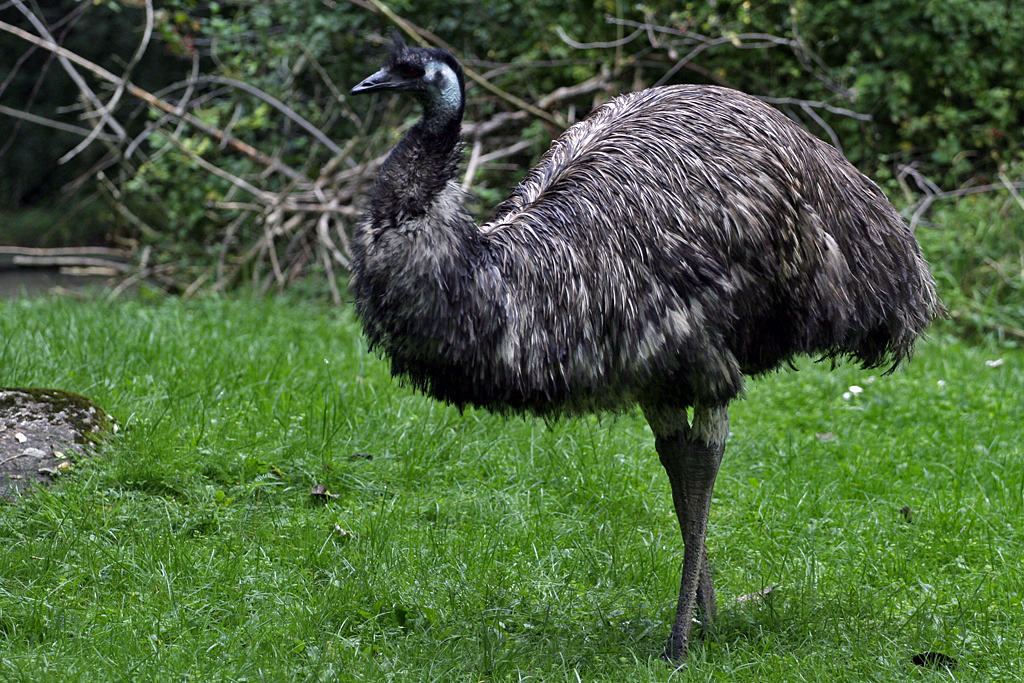
Emu are one of the largest living species of birds:
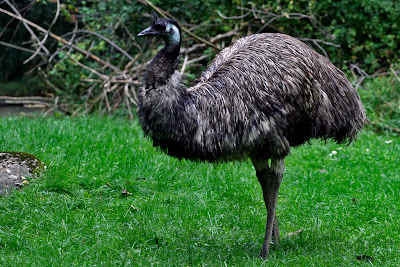 |
| Awesome emu. |
They lay large, blue eggs and have little stripped babies:
 |
| Without arms, emu hug with their minds, or I like to think that they do. |
Like mammals, sex is determined in birds using sex chromosomes, but in birds it is a little different. In mammals (dogs, humans, cows) females have two copies of the same sex chromosome (XX), and males have one X, and one Y, where genes on the Y chromosome turn on the pathways for male features. In birds, it is the males who have two copies of the same sex chromosome (here we call them ZZ), and females who have one Z chromosome and one W chromosome. In birds, male-specific features require expression (product) from two copies of a gene (so males have two Z chromosomes).
 |
| W and Y are usually much smaller than their partners |
What you'll notice in the picture above is that in both mammals and birds one of the sex chromosomes (X or Z) is large, while the other (Y or W) is small. Generally one of the sex chromosomes becomes sex-specific (such as the Y passed down through the male lineage in mammals, or the W passed through the female lineage in birds). As this chromosome becomes sex-specific, it will accumulate genes, and functions, that are beneficial to one sex, and neutral, or even harmful to the other. Usually all chromosome pairs can swap bits of DNA (also called recombination), but to prevent these sex-specific genes from acting in the opposite sex (where they would do harm), the sex chromosomes usually stop swapping DNA. But, these swaps between partners can also serve as a bandage to fix errors that happen (think, having a partner to remove that broccoli you didn't know was lodged in your teeth, but instead of broccoli, it is an error in a gene). A drawback of stopping the swaps is that without a partner to check and make sure everything is working properly, the W and Y chromosomes start accumulating mutations, losing genes, and shrinking.
But, when Vicoso, Kaiser and Bachtrog looked at the emu sex chromosomes, they confirmed something really amazing. Whereas the W in most birds is small and degraded (like the human Y), the W in emu is quite large, nearly the same size as it's partner.
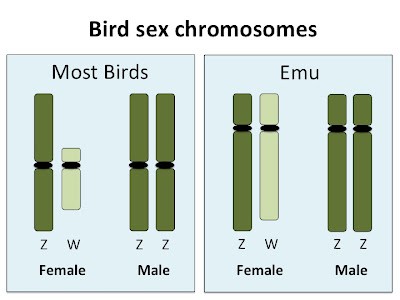 |
| Emu W has nothing to prove to you. |
This is pretty unusual among bird sex chromosomes, and the authors wanted to figure out why. So, they looked at how the genes on the sex chromosomes were working in males and females. Although sometimes we think of genes as being "on" or "off", in reality many genes are "on", but they are doing their jobs (making proteins) with a higher or lower efficiency (think of your heart; if it were ever truly "off" you'd be dead, but there are times when your heart is pumping slowly, and times when it is racing, and it is the level at which your heart is working that is important). So, looking at genes on the emu Z and W, they saw that many of the genes were being used at much higher levels in males than in females. This suggests that there is some mechanism by which genes on the emu sex chromosomes have evolved to favor functions in males over females, which side-steps the usual path of sex chromosome evolution that would lead to a small, degraded W. Well-played, emu, well-played.
 |
| Emu is unimpressed with your degraded W chromosome. |
Department of Integrative Biology, University of California, Berkeley, CA 94720.


21 Comments
balloonguy · 12 April 2013
Informative! Thanks for the post.
Joe Felsenstein · 12 April 2013
In 1977 Gary Thorgaard (working in Stan Gartler's lab in my department) discovered the sex chromosomes of rainbow trout. They had been hard to find because the X and Y were so alike. Gary had to do blind experiments to show that he could reliably tell them apart. That may be a case even more extreme than the emu.
John Harshman · 12 April 2013
All paleognath birds (emus, cassowaries, rheas, ostriches, and tinamous) have homomorphic sex chromosomes, and this has been a puzzle for some time. It's also been known that they are like sex chromosomes in other ways, i.e. that they can be identified as Z and W, that males are heterogametic, and that there are extensive non-recombining regions. So it's nice to have the beginnings of an explanation for the failure of the W to shrink compared to other birds.
Ron Bear · 12 April 2013
I enjoyed your post. I think you did an excellent job of making the material easy for a non-biology major.
Thanks
M. Wilson Sayres · 12 April 2013
Joe, I can imagine. I am fascinated by the diversity among sex chromosome systems, and especially curious about the identification of nascent sex chromosomes. I spoke with a researcher at Pittsburgh who was in the preliminary stages of identify nascent sex chromosomes in a wild strawberry. Super cool!
John, I'm hoping to do many more posts about sex chromosomes, and get into the variation both within and between taxa. Although we don't understand them well, some features of sex chromosome evolution seem to be "universal", until up pop all of these exceptions that make life really interesting.
diogeneslamp0 · 12 April 2013
https://me.yahoo.com/a/JxVN0eQFqtmgoY7wC1cZM44ET_iAanxHQmLgYgX_Zhn8#57cad · 12 April 2013
Consider the alternative explanations.
Like God wanted it that way, and 'stralians are weird.
Glen Davidson
diogeneslamp0 · 12 April 2013
John Harshman · 12 April 2013
Speaking of nascent sex chromosomes, this is one of my favorites:
Ogata, M., H. Ohtani, T. Igarashi, Y. Hasegawa, Y. Ichikawa, and I. Miura. 2003. Change of the heterogametic sex from male to female in the frog. Genetics 164:613-620.
Though I do cringe at "the frog".
M. Wilson Sayres · 12 April 2013
M. Wilson Sayres · 12 April 2013
Dave Wisker · 12 April 2013
I remember reading about sex chromosome systems in some ancient insect lineages where the original "y" chromosome became so degenerated (due to the accumulation of mutations on account of the lack of recombination)that it was lost, and that another chromosome was apparently appropriated for the purpose of sex determination.
diogeneslamp0 · 12 April 2013
Melissa.
I have a suggestion for a post.
Could you discuss the snail sex study that was mocked by Zack Kopplin's opponent on Bill Maher's show?
M. Wilson Sayres · 12 April 2013
Allen Linville · 13 April 2013
I'm a physics teacher who is teaching a general science course. Thanks for the information, this blog makes biology and genetics (almost) as interesting as physics.
diogeneslamp0 · 16 April 2013
How far back does the fossil record of emus go?
apokryltaros · 16 April 2013
diogeneslamp0 · 17 April 2013
apokryltaros · 19 April 2013
diogeneslamp0 · 20 April 2013
No. The point of the article is that the entire Pleistocene can be squeezed into ~2 centuries after Babel, which was ~2250 BC. Mastodons appear 70 years before mammoths. Mammoths appear at the start of the Ice Century, ~2220BC. First human tools and fossils are at Babel time. Humans enter Australia in the middle of the Ice Century. All recorded civilization is post-Ice Age, ~2100 BC. There is no mention of other species. This implies Neanderthals appear post-Babel and are gone within two human generations, but Neanderthals are not mentioned.
Bhakti Niskama Shanta · 22 April 2013
Does Current Biology have the Misfortune of Owning an Unreliable Clock? http://scienceandscientist.org/Darwin/2013/04/20/does-current-biology-have-the-misfortune-of-owning-an-unreliable-clock/