What does microchimerism mean?
Let's start with the biggest part of that word, chimera. In greek mythology, a chimera is a creature made of three different animals (a lion, a snake and a goat). In biology, the word chimera, or chimerism, can be used to refer to the existence of cells from genetically distinct individuals found in one person. So, microchimerism refers to the existence of a small set of cells of one genetic type intermixed with a large set of cells of another genetic type.
Let's think about development for a minute.
My two year old shares about half of her DNA with her father, and about half with me. And, because we have raised her, she's picking up our habits, good and bad. She smiles like her daddy, loves sharing snacks with our dog, and furrows her brow to glare at me when she's upset (exactly like a million pictures of me growing up). I do everything I can to keep her a safe, while still allowing her the freedom to explore her world. It turns out that I've been doing this since she was a tiny, unrecognizable embryo.
Okay, you had a baby, but how did you become a chimera?
When I was pregnant, my body provided nourishment and protection. A portion of that protection came in the form of my immune system providing defense against infections. During pregnancy, some of my immune cells actually passed through the placenta, and became incorporated into my daughter's developing body. This means that although most of the human cells in her body are her own (a unique combination of DNA from her father and from me), incredibly, there are some cells in her body that are actually mine. Even more extraordinary is that this sharing of immune cells is a two-way street. Some of the immune cells from her growing body passed back into mine. A subset of these cells became incorporated into my body, and will continue to replicate, sometimes for decades (Gammill and Nelson have a great review here, if you want to learn more).
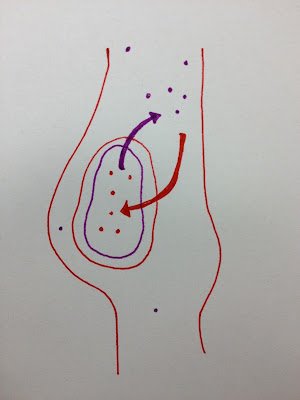 |
| Immune cells cross the plancetal boundary and become incorporated among genetically dissimilar cells where they continue to replicate |
Whoa. So, you are both chimeras?
Yes. In fact, this exchange of cells occurs during all human pregnancies, with both male and female embryos. This means that some women have a small number of cells with male DNA from their sons, and men have some cells with female DNA from their mothers. So, we are all born as chimeras. Scientists are just now starting to understand how this exchange of cells affects our biology. My current interest in this topic is that fetal microchimerism might be responsible for some of the alleviation of symptoms during pregnancy for patients with Rheumatoid Arthritis.
It is also just mind-blowingly awesome.
It amazes me to realize that, right now, some of my daughter's cells are incorporated into my body. There is, literally, a physical part of her with me wherever I go. And, similarly, a few of my cells are incorporated into her. The scientist in me is awestruck. But, as any parent will tell you, it doesn't change how I feel. Regardless of our genetic relationship, I will always be a part of my daughter, and she will be a part of me.
25 Comments
Just Bob · 29 May 2013
Umm, check the spelling in the headline.
Just Bob · 29 May 2013
Also in this sentence: My current interest in this topic is that fetal michrochimerism...
https://me.yahoo.com/a/JxVN0eQFqtmgoY7wC1cZM44ET_iAanxHQmLgYgX_Zhn8#57cad · 29 May 2013
Or as Mom would say, "That's what you get for not calling."
Glen Davidson
M. Wilson Sayres · 29 May 2013
Thank you :) Clearly I need a copy-editor.
fnxtr · 29 May 2013
rossum · 29 May 2013
It the spelling thing UK English (Chimaera) vs US English (Chimera)?
So all males are really transsexuals. Hmmm... I like it.
rossum
Paul Burnett · 29 May 2013
You and your mother similarly share a small percentage / number of cells - right? Does that mean that your daughter shares a vanishingly small percentage / number of cells with her grandmother? How many generations can this sharing span?
Eddie Janssen · 29 May 2013
I was just going to ask the same question!
https://www.google.com/accounts/o8/id?id=AItOawkBWx4uCQ8ZUI2b9C2EMhAArepslRs6TEc · 29 May 2013
@Paul Burnett,
No. You come from a single oocyte from you mother, that was set down quite early in embryo development. This will affect the somatic cells only, not get germline cells (as far as we know, so far).
diogeneslamp0 · 29 May 2013
Henry J · 29 May 2013
So does this mean that if organisms are colonies of cells, that some of those cells are expatriots to their colony?
Ron Okimoto · 30 May 2013
Mark Sturtevant · 30 May 2013
Why do you suppose symptoms of RA decrease (or increase) during pregnancy?
diogeneslamp0 · 30 May 2013
SensuousCurmudgeon · 30 May 2013
harold · 30 May 2013
Just Bob · 30 May 2013
simonheffer1 · 31 May 2013
Does this also mean your next offspring could have cells from your first (and so on)?
diogeneslamp0 · 31 May 2013
M. Wilson Sayres · 31 May 2013
M. Wilson Sayres · 31 May 2013
Mark Sturtevant · 1 June 2013
Marilyn · 2 June 2013
Lots of people mistook my mum for me on the phone and me for mum often asking is that Marilyn or her mum, so could this be an example of the "chimaera" effect. I wonder what determines what part of the body would be affected by chimaera.
harold · 2 June 2013
M. Wilson Sayres · 4 June 2013