Part 2: What it means to be the Most Recent Common Ancestor (MRCA)
On to part 3. Except, what's this? Someone has beat me to it? Gasp!
Okay, go read Dienekes' Anthropology blog post about the two recent Y papers. I agree with all of the critiques and summaries of both the Poznik et al. (2013) and the Francalacci et al. (2013) papers. Perhaps the best part of this summary:
"And, indeed, the fact that the two are of different ages is not particularly troubling or in need of remedy, since for most reasonable models of human origins we do not expect them to be of the same age."But, let's see if I can provide a little more background (you did go read Dienekes' post, right?). Good. But, just in case you didn't, a brief summary of some of the findings of Poznik et al. (2013):
Poznik et al. sequenced a lot of Y chromosomes
Poznik et al sequenced the Y chromosomes of 69 people. Yes, this is more than enough individuals to address this question of the time to the MRCA. Very few lineages, even two can allow us to estimate the time to the most recent common ancestor. Each lineage will contain information (mutations) that have accumulated since they diverged. But, comparing closely related lineages will lead to a lower TMRCA, while comparing very divergent lineages will lead to an older TMRCA. You can learn a lot about the process of how the Y chromosomes diverged by having the intermediate lineages, but they aren't necessary for computing the TMRCA.
In the pictures below, the red dots are observed mutations.
If there aren't very many mutations between two regions, then their TMRCA will not be very long ago:
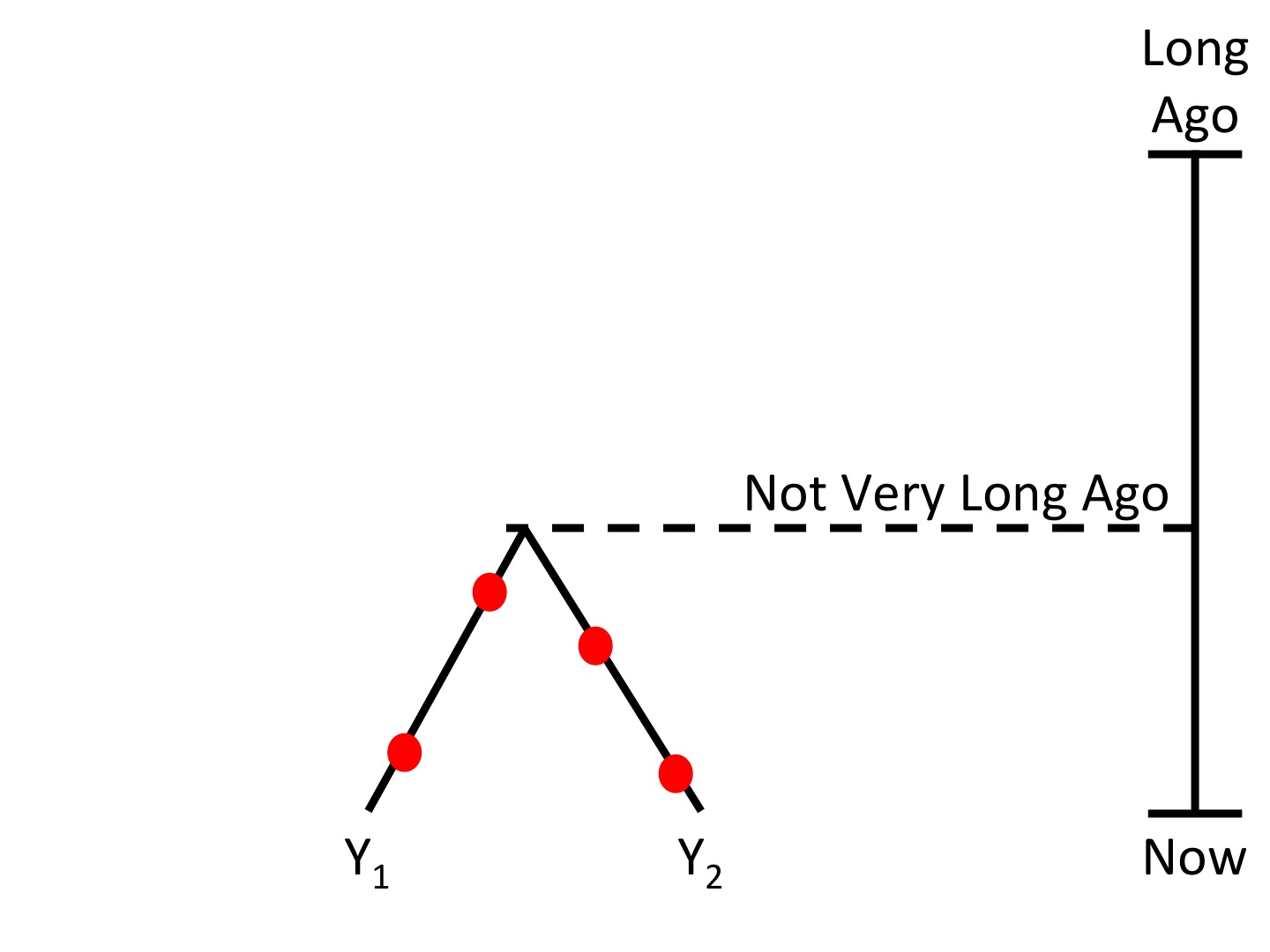 |
| Comparing two closely related lineages gives a younger TMRCA |
If more Y chromosomes are analyzed from very different regions, then more mutations will be observed between any pair of lineages, and the TMRCA will be older.
 |
| The more diverged the lineages, the older the TMRCA |
But, for just estimating the TMRCA, the total number of lineages will have very little (if any) effect on the age estimated, whereas the number of differences observed on the most diverged Y chromosome will be very important.
 |
| For estimating TMRCA, the most diverged lineage (Y5) will have the biggest effect. |
How to estimate the time to the most recent common ancestor (TMRCA)
The time estimated depends very little on the number of lineages (see above). Rather, it is extremeley dependent on:
1) how different the lineages are from one another (how many mutations are observed); and,
2) how quickly those differences are estimate to have accumulated (the rate of mutation).
The Y TMRCA is older than most previous estimates
The time to the most recent common ancestor of the Y chromosome, as computed by Poznik et al. is older than most other estimates. But why?
- The diversity of the Y chromosomes included (the more diverse the Y chromosomes, the older the time to their most recent common ancestor)
- the high sequencing coverage, which means that more mutations can be identified
- The rate of mutation the authors use is 0.82x10⁻⁹ mutations per base pair per year (95% CI: 0.72-0.92x10⁻⁹ mutations per base per year). This mutation rate is lower than estimates from a Y-linked pedigree (1x10⁻⁹ mut/bp/year), and from human-chimpanzee divergence, which lengthens the tree compared to previous estimates. The mutation rate was calibrated assuming that humans reached the Americas ~15,000 years ago. Such an exact timing for the entry of modern humans to the Americas is not yet certain.
The Y TMRCA is not as old as it could be
Mendez et al. (2013) recently described a Y chromosome that is much older (67% w/ 95% CI:35-126%) than all other known Y chromosomes. This Y chromosome has not yet been sequenced to the coverage of the Y chromosomes in the Poznik et al. (2013) paper, and was not included in their analysis. If it were included, all other factors remaining the same, the TMRCA for the Y chromosome would be much older than the TMRCA for the mtDNA in the same paper.
The mtDNA estimate is younger than many other estimates
Although there has been a lot of discussion of the Y chromosome being older than previous estimates, I haven't seen a lot of discussion about the mtDNA, which at 99-148,000 years in this analysis, is estimated a bit younger than previous work (~200,000 years ago). Part of this younger estimate can be contributed to the calibrated mutation rate used. The authors compute a calibrated mtDNA mutation rate of 2.3x10⁻⁸ mutations per base pair per year (95% CI: 2-2.5x10⁻⁸ mut/bp/year), which is higher than some previous estimates (e.g., 1.7x10⁻⁸) - meaning the total tree will be somewhat shorter than previous estimates, all else being equal.
I am excited to see if there exist pockets of mtDNA diversity, such as the highly divergent Y lineage that was recently identified.
So, what is the right mutation rate?
If the mutation rate used across studies varies so much, then it is no surprise that the TMRCA estimates are not consistent across studies. Which one is correct? Well, of course it is_<insert your favorite study>. Okay, so the real answer is that it is not so simple. I know, I know, not the answer you were looking for. It's like when you have a multiple choice question with four answers and you have to choose the one that is most correct. I never did well on those. I'll dodge this bullet by pointing you to a wonderful discussion about human mutation rates by John Hawks.
It is exciting, though, that with the recent ability to isolate and sequence DNA from ancient samples, we should start getting more precise and accurate, estimates of the human mutation rate on the different chromosomes.
One more thing - there is no reason to expect the TMRCA for the Y and mtDNA to be the same.
The process of working backwards to estimate the time to the most recent common ancestor is a paring down of lineages until only one linage remains. This is called coalescent theory. Because they lack recombination, both the Y and the mtDNA represent a single linage, a single coalescent process going back in time. Any number of events could have happened that resulted in a set of mtDNA or Y chromosome lineages being retained longer or shorter than expected. The TMRCA is only the time to the *most* recent common ancestor. There were other ancestors, but we can only identify the most recent. And there are a myriad of reasons why these might not necessarily date to the same time for the Y and mtDNA.
But, why don't we expect the TMRCA to be the same?
To be clear, it is not that we expect them to be different. More that we don't expect them to be the same.
I'm going to make a gross over-simplification (we can do more math in the comments, if you like). But, bear with me. Let's say that you had two dice. If you roll each die once, just once, would you be very surprised if the numbers didn't match up? No, not at all. Likewise, you wouldn't be shocked if, say, each die showed a six. And, if one die showed a two, while the other showed a six, you probably wouldn't call it a discrepancy. Why? Because you only rolled them once.
Similarly (although with a bit more math), when tracing back the Y common ancestor and the mtDNA common ancestor, we should not be surprised if their TMRCAs are different, nor if they overlap.
They represent only one roll of the dice.
-------------------------------------
Science. 2013 Aug 2;341(6145):562-5. doi: 10.1126/science.1237619.
Sequencing Y chromosomes resolves discrepancy in time to common ancestor of males versus females.
Poznik GD, Henn BM, Yee MC, Sliwerska E, Euskirchen GM, Lin AA, Snyder M, Quintana-Murci L, Kidd JM, Underhill PA, Bustamante CD.
18 Comments
DS · 23 August 2013
Another reason why the mitochondrial and Y chromosome dates are not expected to match is the effective population size for each marker. This parameter will affect the time to coalescence. If males leave more offspring per individual on average that females, then the effective population size would be larger and the time to coalescence would probably be greater. And of course the nuclear DNA would have a different effective population size and recombination as well.
Sorry if this was covered previously.
M. Wilson Sayres · 23 August 2013
No, this is a great point! It is one that I am still struggling with in the Poznik et al. paper.
Under neutral (no selection), equilibrium (equal reproductive success) expectations, the Y and mtDNA should both have an effective population size that is one-quarter of the autosomal size. Poznik et al don't analyze the autosomes or X chromosomes, so we don't have a reference, but they do provide estimates that suggest the effective population size of the Y is much smaller (48-33%) than the effective population size of the mtDNA. Intuitively, this should have resulted in estimates of the TMRCA that are much smaller for the Y than for the mtDNA. However, if the Y has pockets of longstanding diversity, as the Mendez paper suggests, and as those highly diverged A Y-haplogroups suggest, then perhaps it is less surprising. Also, as I mentioned, both the Y and mtDNA represent only a single coalescent, so it can happen that different (I guess even wildly different) effective populations sizes can have similar TMRCAs.
Still, it is counterintuitive, to me that the effective population sizes are so different, but the coalescence times so similar.
Steve Schaffner · 23 August 2013
M. Wilson Sayres · 23 August 2013
Thanks for the added clarification, Steve.
John Harshman · 23 August 2013
Am I correct that one of these papers sampled only people from Sardinia while the other sampled overwhelmingly Eurasians? If you're looking for the coalescent of all extant Y chromosomes, shouldn't you be hitting Africa much more than any other area?
Likewise, there seems to be some attempted linkage between the coalescent and the origin of H. sapiens, which makes no sense. Or am I imagining that?
Joe Felsenstein · 23 August 2013
eric · 23 August 2013
Joe Felsenstein · 23 August 2013
Yes, in that case there are more females than males, so the average contribution of males is larger, as I did in fact say.
M. Wilson Sayres · 23 August 2013
DS · 23 August 2013
John Harshman · 23 August 2013
Joe Felsenstein · 23 August 2013
Sorry for being dismissive.
Actually, to quibble with you and with myself, if many males are killed off, that does not change the sex ratio (as we measure that at the end of parental care). But it does increase the variance of offspring number, which in turn reduces the effective population size. Many males have zero offspring, and the rest have more, so the variance is thereby increased.
The net effect is the same but the terminology is different.
M. Wilson Sayres · 23 August 2013
Frank J · 24 August 2013
I'm still saving a "big" question, but in the meantime I have a "little" one that confuses me. Who exactly expects that the age of the last common ancestor via strictly female, and strictly male, lineages must be the same (plus or minus a lifetime)? Committed Biblical literalists will not accept any evidence, and the anti-evolution activists who exploit them will look only for evidence that they can take out of context to further mislead them (anything that's "more recent than previously thought" particularly makes them ecstatic). As far as I can tell, everyone else will react with "sure, that makes sense."
harold · 24 August 2013
As far as I can tell, the primary objective of this work, seeking LCA of genes on the Y chromosome and on mitochondrial genomes is to supplement our understanding of human prehistorical demographics.
It also seems to be designed to give a nod to social genealogy, which traces exact individual ancestry, even though this aspect may actually serve to fuel confusion.
Beyond the fact that there must have been some point at which nothing we would call life existed on earth, and some earliest point at which there was something that any reasonable person would call life on earth, even though we can never know exactly when that was, all tracing of genetic lineages is definition-dependent. In fact, even saying that genes originated with life is definition-dependent.
"Y-chromosome Adam" obviously had a father. He got his Y chromosomes from his father. The ones that went into Adam's particular sperm that fertilized ova must have differed, at least on the loci studied, either due to germline (in Adam) or somatic mutation, in some way, from his father's germline Y-chromosome (I'm using single generation language here to make the point obvious, please bear with me, we all realize that our studies don't have this degree of precision, but this language makes the point more clear). Otherwise, we'd be tracing things back to his father, not to him.
However, the Y chromosome itself has ancestors and so on. There was never a time when the human population of earth was two, nor, likely, when the reproducing human male population was one. If we follow individual polymorphisms they do trace back to founders. The more narrowly we specify the polymorphism we study, the more recent the common ancestry we will discover. If we try to trace back the cytochrome C gene, broadly defined, we'll say that the LCA of all life with cytochrome C was a very ancient unicellular organism. If we take some specific non-coding neutral polymorphism in the gene that occurs in some island population, we might be able to trace it back to a recent historical ancestor with ease.
Elepaio · 30 August 2013
Melissa: related to Y-chromosome Bottleneck Guy, I am having a hard time with this sentence from Neil Shubin's latest (The Universe Within), p 175:
"DNA of Native Americans reveals that they are derived from a single male who likely crossed the Bering Strait when an ice bridge formed during the last ice age."
Why could not Y-cBG for the Amerindians be somewhere further back in the Asian population, perhaps much further back? Is it really likely that Y-cBG himself crossed the Strait, and how could we know this?
Henry J · 30 August 2013
The "Y-cBG" label doesn't stay affixed to the same person indefinitely. If all but one of the Y chromosomes that crossed into the Americas have since ceased to have living descendants, then that one (or possibly one of its descendants) becomes the holder of that title. (That's if I'm properly understanding what "Y-cBG" means. )
(Of course, the holders of other Y chromosomes might still have living descendants in lineages that contain one or more females; so their other chromosomes might still have descendants.)
M. Wilson Sayres · 31 August 2013
Yep, what Henry said.
There was a group of people (the number can be estimated from the amount of autosomal diversity) who entered the Americas.
The one Y (if indeed it is only one Y) that is the common ancestor of all the other Y's was not the only Y chromosome at the time, and the person who housed this Y chromosome also had 22 pairs of autosomes and an X chromosome that mixed with the autosomes and X chromosomes from the other people around at the time.