@realscientists If a tiger shark's eggs hatch inside it and are born live (I saw a pic recently) is it a mammal or a fish? :-)So, I thought I'd go through a few of the common ideas about shared physical features of mammals.
-- Fiona Howie (@MummyFiFi) September 29, 2013
What makes a mammal?
Is it giving live birth? Or having hair/fur? What about feeding their babies milk?
Well, kind of (I'll tell you at the end what really does). First, let's go through these three:
Live birth.
Not all mammals give live birth. Monotreme mammals including the echidna:
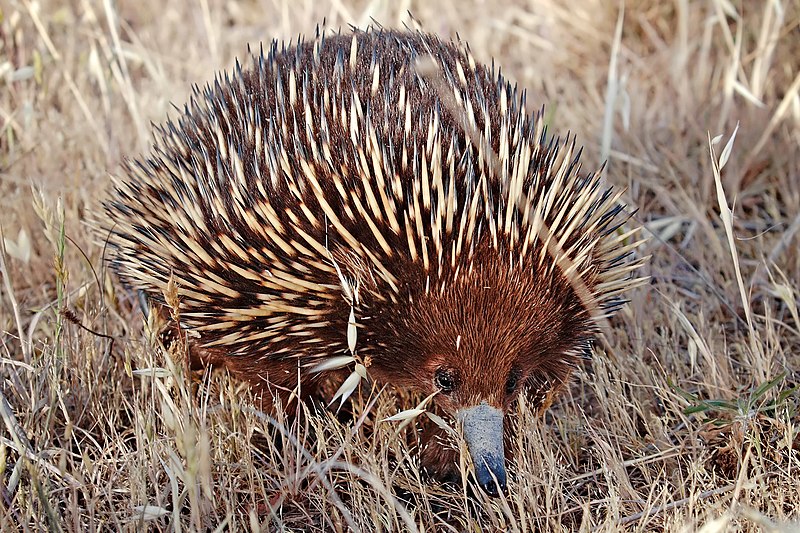 |
| Short-beaked echidna. Photo by Fir0002/Flagstaffotos |
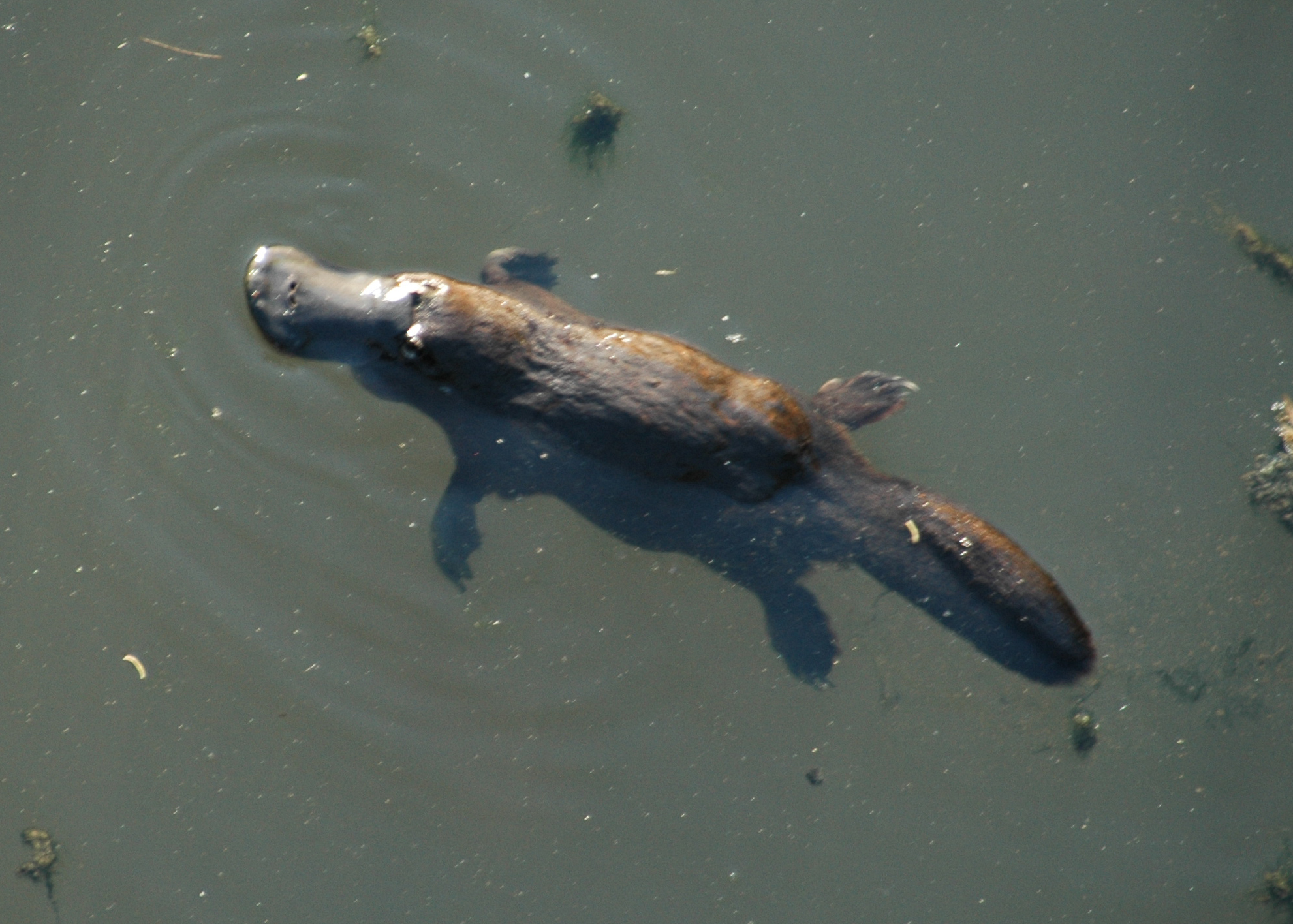 |
| Swiming Platypus. Photo by Peter Scheunis |
don't give birth to live young; They lay eggs.
Okay, so not all mammals give birth to live young.
Hair.
What about having hair/fur. All mammals have hair/fur, right?
Well, I suppose technically baby dolphins have whiskers, but you wouldn't know it from the adults.
 |
| By U.S. Navy photo by Photographer's Mate 1st Class Brien Aho. [Public domain], via Wikimedia Commons |
 |
| By Valerius Tygart (Own work) [CC-BY-SA-3.0 or GFDL] |
 |
| By Ltshears - Trisha M Shears [Public domain], via Wikimedia Commons |
Milk.
Do all mammals feed their babies milk?
 |
| By Trish Steel [CC-BY-SA-2.0], via Wikimedia Commons |
 |
| By User:Ltshears, edited by User:julielangford [Public domain] |
Second, more serious answer - Yes. I don't know of any species of mammal that nourishes their offspring with anything other than milk. To learn more about mammals, lactation, and milk, check out the blog "Mammals Suck (... Milk)" by Dr. Hinde.
 |
| Breastfeeding. By honey-bee [CC-BY-2.0] |
Actually, what makes a mammal is more than just whether they give live birth (because not all do), and have hair, and lactate. And doing each of these things does not necessarily mean the animal should be classified as a mammal. (Note: Although it gives live birth, a tiger shark is not a mammal, it is a shark; sharks are a kind of fish.)
So, what does make a mammal?
Shared evolutionary history
Mammals are a group of species related by their evolutionary history. The picture below is a phylogenetic tree showing the evolutionary relationship between many different species.
All mammals share a common ancestral population.
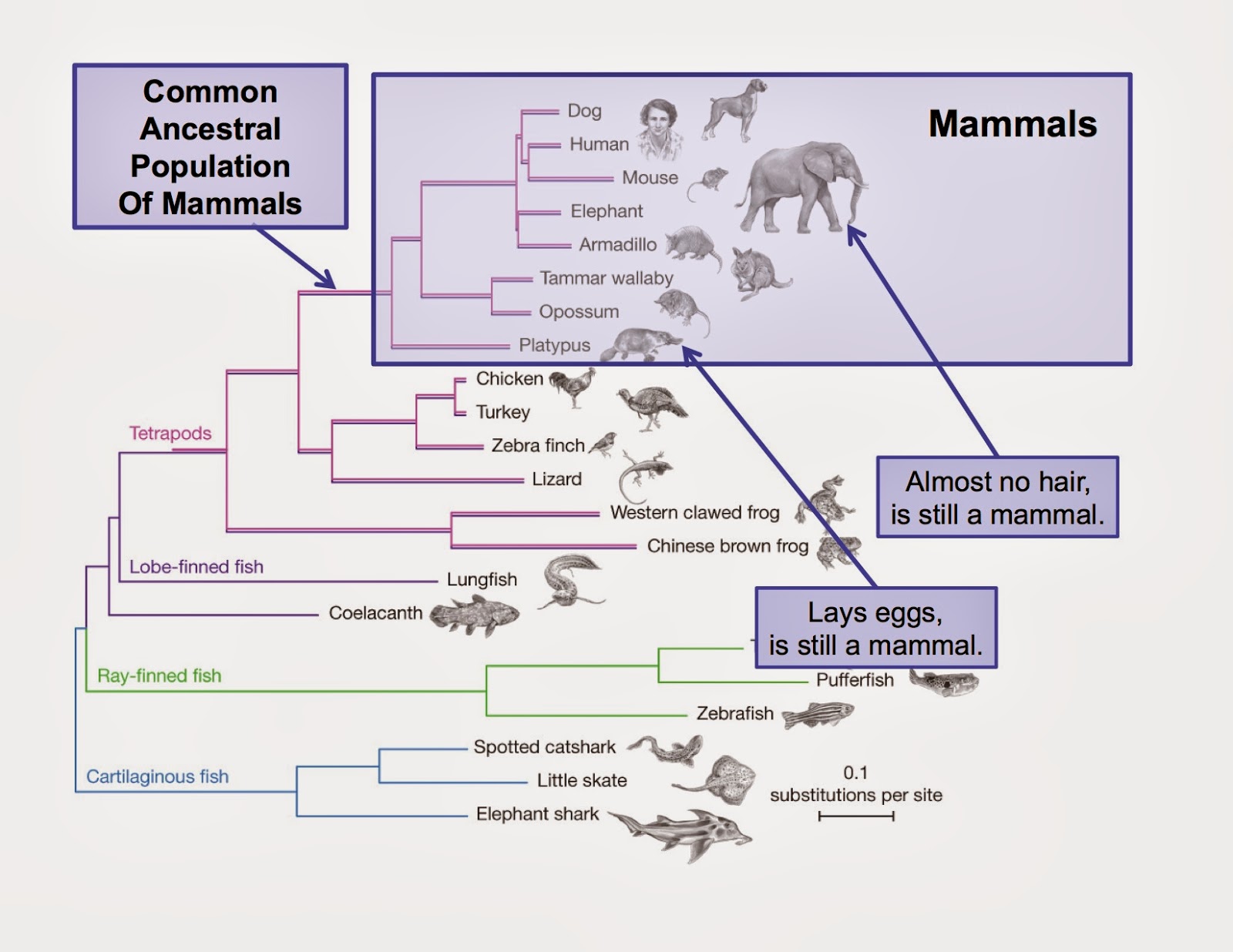 |
| Modified from: CT Amemiya et al. Nature 496, 311-316 (2013) doi:10.1038/nature12027 |
The classification of "Mammals" was made based of shared physical and anatomical characteristics. But, underlying those, is a shared evolutionary history.
We do make sub-divisions within that larger grouping of mammals. For example, the egg-laying mammals, platypus and echidna are called "Proto-theria", while all other mammals are called "Therians". There are many other sub-classifications, but they are all still part of the broader group of mammals.
There are also larger groupings. For example, on the picture above you can see all the species highlighted in pink are called Tetrapods. These are all descended from a common ancestral population of tetrapods that are generally four-limbed vertebrates.
Although their physical characteristics may change, all species that descended from the common ancestral mammal population will all be mammals.
So, how do you tell what a mammal is?
Well, the broad rules of thumbs still apply. If you are a Naturalist, roaming through some uncharted region, and you happen across an animal you've never seen, you can start with some of the general physical characteristics (e.g., is it warm-blooded? does it have fur?). But, now you can also take a look at its DNA as another line of evidence.
You can collect and sequence a sample of DNA from hair, or blood, or a toenail, or even from scat (aka poop), then compare the sequences you find with sequences that are already available to learn more about the creature you sampled. You can build a tree (like the one above) based on the similarity between the sequences. The relationship between the sequences for any one region or gene may not reflect the broader species tree, but it will give you an idea of where your species fits. And, the more DNA sequence you analyze, the better your resolution will be come (although it sometimes happens that biology is just messy).
Mammals
"Mammals" is the term we use to describe the group of species that generally share a defined set of characteristics (warm blooded, lactating, give live birth, have fur/hair), AND share an evolutionarily recent (300ish million years ago) common ancestral population.
59 Comments
DS · 16 October 2013
Which shows that an evolutionary context is necessary for a rational taxonomy. If you don't have that basis, you will have to make many arbitrary decisions and be content with an artificial classification scheme. Just one more reason why evolution is the unifying principle of all modern biology.
M. Wilson Sayres · 16 October 2013
waynerobinson4 · 16 October 2013
It's one of the ways in which Stephen Meyer was (deliberately) confused in 'Darwin's Doubt'. A current phylogenetic group might have a number of common features, but there's no reason why they had to evolve simultaneously. Or that all of the features have to evolve in all members. Or that they have to be subsequently retained.
Meyer claims that arthropods and nematodes can't have a common evolutionary ancestry because a modern arthropod can't evolve into a nematode. Or vice versa. Because the 'body plans' are so radically different.. Ignoring the fact that the body plans in both have developed over hundreds of millions of years. And that the proto-arthropod would have looked almost identical to the proto-nematode.
Andy White · 16 October 2013
In my opinion, all female mammals feed their babies milk and if they didn't do that, why do they cal mammals and why do they have breasts? So they feed their babies with milk.
RodW · 16 October 2013
There are some organisms that have what superficially looks like hair- tarantulas for example.
I believe there is also a species of cockroach where the female feeds the nymphs a whitish high protein fluid produced from glands. I heard about this years ago, but I forgot where. I just remember thinking "roach milk"
Chris Lawson · 16 October 2013
Nick Matzke · 16 October 2013
I love this post and the cheery thread, but it's not what a phylogeneticist would write :-).
Nick Matzke · 16 October 2013
Chris Lawson · 16 October 2013
RodW,
In the original post, Wilson does say that he is not aware of any mammals that don't lactate, but his point is that there are lots of mammals missing one or two of the classic mammalian traits, so it wouldn't necessarily mean that a hypothetical non-lactating animal would *have* to be kicked out of the mammalian clade.
Imagine a descendant of, say, bears that had fur, endothermy, a mammalian neocortex, 3 middle ear bones, and a 4-chambered heart, but whose females had vestigial mammaries that never produced milk.
Chris Lawson · 16 October 2013
Nick,
That's an really interesting point. I guess the DFTD cancer cells can be considered a separate species that reproduces asexually, is an obligate parasite, and has no fur/hair, endothermy, neo-cortex, or middle ear bones. Should we still call it a mammal? I don't know what the best answer should be.
balloonguy · 16 October 2013
I have a few comments. First, thanks for introducing me to pangolins, which I'd never heard of before.
Second, I think you could have made more out of the fact that all female mammals nourish their young with milk. This is the defining characteristic of mammals, and it ties into your main point because it was an evolved trait that every mammal still retains.
Third, in the third to last paragraph you have "it's" when you mean "its". "It's" is a contraction, "its" is the third person neuter singular possessive pronoun.
Robert Byers · 16 October 2013
This comment has been moved to The Bathroom Wall.
apokryltaros · 16 October 2013
This comment has been moved to The Bathroom Wall.
Dave Luckett · 16 October 2013
This comment has been moved to The Bathroom Wall.
apokryltaros · 16 October 2013
DS · 16 October 2013
This comment has been moved to The Bathroom Wall.
Tenncrain · 16 October 2013
Tenncrain · 16 October 2013
This comment has been moved to The Bathroom Wall.
Henry J · 16 October 2013
M. Wilson Sayres · 16 October 2013
M. Wilson Sayres · 16 October 2013
M. Wilson Sayres · 16 October 2013
M. Wilson Sayres · 16 October 2013
M. Wilson Sayres · 16 October 2013
Tom · 17 October 2013
phylogenetically, sharks are much more different from bony fish than an echidna is from you. Bony fish split off from sharks hundreds of millions of years ago.
we really shouldn't be calling sharks fish any more (or calling hagfish "fish" either for that matter), but how does one go about changing such ancient common classification?
Tom · 17 October 2013
This comment has been moved to The Bathroom Wall.
perfusionman · 17 October 2013
Uh, guys, out of all of the sites on the entire internet that I'd expect to know that the defining character of the Class Mammalia is just those three inner ear bones derived from bits of the jaw, it's this one. None of that other stuff (hair, milk, heart shape, etc) fossilizes, making it useless for 99% of all of the mammalian species who have ever lived. We know that Smilodon was a mammal not because today we have furry lions, but because it has that same inner ear structure as all the rest of the clade.
Karen S. · 17 October 2013
balloonguy · 17 October 2013
Andy White · 17 October 2013
RodW · 17 October 2013
M. Wilson Sayres · 17 October 2013
M. Wilson Sayres · 17 October 2013
realgrumpybob · 17 October 2013
balloonguy · 17 October 2013
^secrete, not secret, in my last post
DS · 17 October 2013
John Harshman · 17 October 2013
Nick Matzke · 17 October 2013
The three middle-ear-bones definition isn't perfect either, as there are a variety of early mammal-ish fossils that almost or barely have this character, and it might have evolved independently a few times amongst these closely related almost-mammals. This is why there was a scientific debate, sometimes dug up by creationists, about whether or not "mammals" evolved twice.
And, anyway, picking that character as the dividing line is almost as arbitrary as picking any other. It may or may not correlate with other characters, such as mammary glands and hair, which might have evolved at other times.
This sort of thing is why node-based definitions of taxa are becoming the most popular amongst taxonomists. Nodes define the groups, and characters (as many as possible, in a phylogenetic analysis) are used to diagnose whether or not a species of interest falls into a group of interest.
Melissa wasn't trying to dig into all of this, but for people who want a starter, here's an intro:
http://en.wikipedia.org/wiki/Phylogenetic_nomenclature
Chris Lawson · 17 October 2013
John,
Thanks for clearing that up. From a phylogenetic point of view, it makes sense to classify everything from the root downwards. I had never heard of birds being called theropods, but I'm not in the field. Without meaning to get into all the no doubt innumerable complicated arguments in taxonomy, I imagine this system of classification still has controversies over what to do about endosymbiosis. (I guess this makes humans eukaryotes *and* prokaryotes *and* proteobacteria.)
In the small and recent scale, things seem reasonably easy to work out:
primates > hominoids > hominids > hominines > hominins > humans
On the larger scale I notice most phylogenetic trees for humans on the web only go back as far as eukaryotes, which is I guess where things get hard. Conversely, on the very small recent scale, say the last 5M years, there also seems to be a lot of controversy about where to put various Australopitheci and Homos on the branch.
apokryltaros · 17 October 2013
apokryltaros · 17 October 2013
DS · 17 October 2013
Karen S. · 17 October 2013
DS · 17 October 2013
apokryltaros · 17 October 2013
John Harshman · 17 October 2013
Henry J · 17 October 2013
I suspect that most people use the words "fish", "reptile", etc., to mean something having some set of traits (or some subset of that set), rather than the clade that includes all descendants of the first member species of that group.
Henry
robert van bakel · 18 October 2013
Not sure about the Echidna but I have read (god knows where), that the milk of the Platypus actually oozes through large pores in the skin. This is possibly a modified sweat? Concentrate the screting glands, expand and localise the pores (nipple), hey presto, breast!
Rolf · 18 October 2013
TomS · 18 October 2013
John Harshman · 18 October 2013
eric · 18 October 2013
Just yesterday, Discover magazine came out wih an article on another trait all mammals evidently share. I don't vouch for the research's accuracy, but I will tentatively vouch for its amusement value...
apokryltaros · 18 October 2013
Henry J · 18 October 2013
Karen S. · 18 October 2013
https://me.yahoo.com/a/JxVN0eQFqtmgoY7wC1cZM44ET_iAanxHQmLgYgX_Zhn8#57cad · 19 October 2013
yenicanlitv · 19 October 2013
Thnaks You Very İnteresting
Dave Wisker · 20 October 2013
Another defining characteristic of mammals is a single lower dentary bone. All mammals possess this.
https://me.yahoo.com/a/JxVN0eQFqtmgoY7wC1cZM44ET_iAanxHQmLgYgX_Zhn8#57cad · 20 October 2013
I consider monotremes to be mammalian heretics.
Or evolutionary deviants, having deviated from the proper path lo these many millions of years.*
Same thing, really.
Glen Davidson
*Well, they really are the long-diverged "exceptions" that indicate how taxonomic categories are fairly arbitrary for evolving organisms, apart from extinctions.