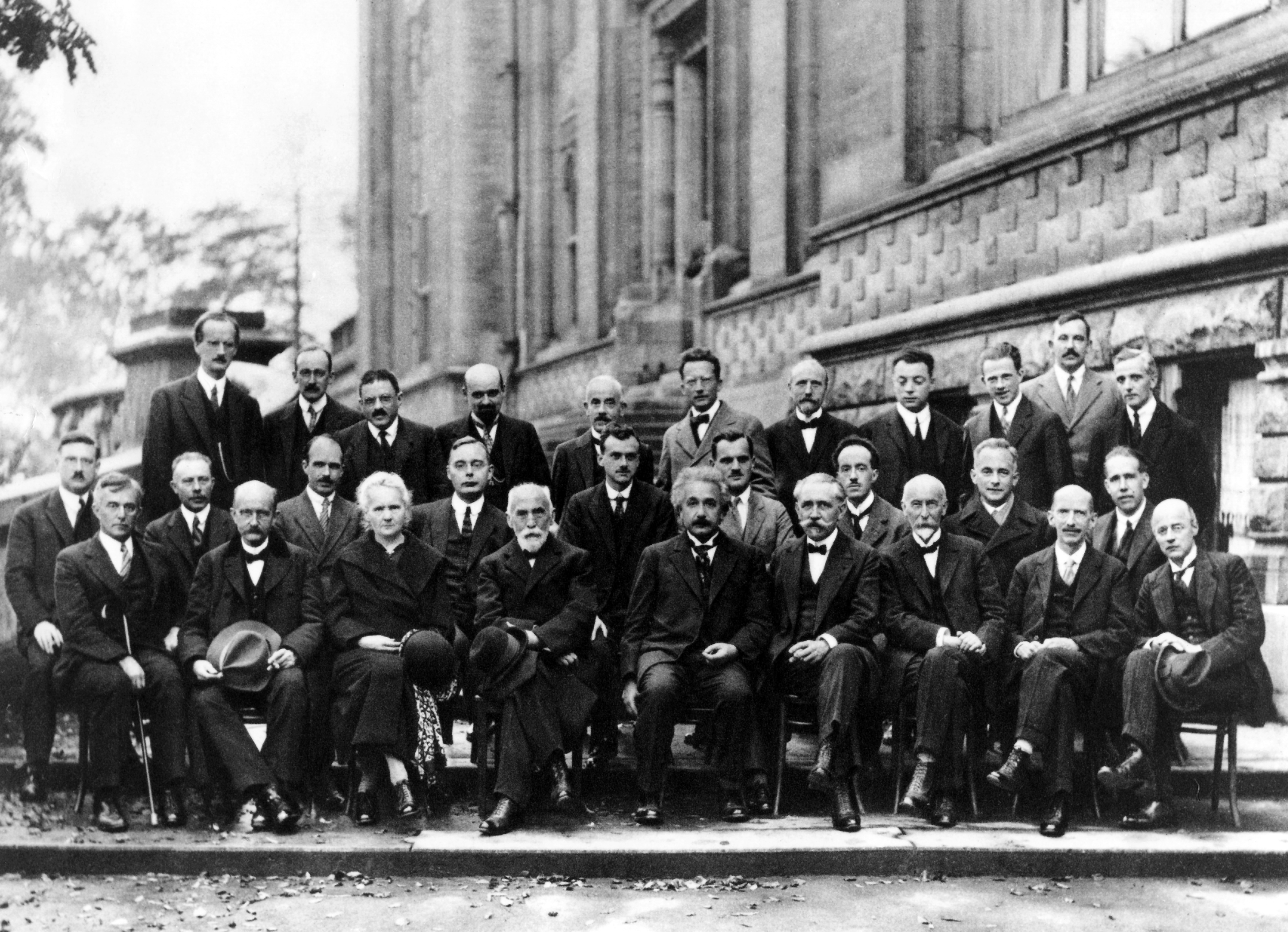
And here is a great quote to sum up the piece:1. There are very few mentors out there encouraging women to go into science. 2. There is still so much unconscious bias within the minds of both males and females towards their female science students. 3. Culturally we start teaching children that scientists look/act a certain way (think TV show The Big Bang Theory).
I agree with a lot of the conclusions brought up by this article. Our society doesn't operate in a way that encourages females to get involved in math or science. I don't know if you've heard of the books by Danica McKellar that try to get girl involved with math. These enrage my stats major roommate; she is appalled that we have to sell math as "quizzes and boy drama" in order to get girls to like math. I have to agree. We don't make math books into sports magazines to get boys to invest in math. My seventh grade science teacher decided that teaching meant writing a transparency of notes that he put up and made us copy down every day. That doesn't get any kid excited. I honestly don't remember a damn thing we were supposed to learn that year (but I can recall 6th and 8th grade science well because my teachers were awesome!). My middle school students had a math teacher for algebra who was kind of mean. He was a good teacher, but his strategy involved teasing them a lot. I know that only some of us were thirteen year old girls once, but there is nothing worse than being picked on and teased when you feel like the biggest pile of awkward in the world (trust me, my lovely male friends, female puberty sucks). I believe (warning, Teacher Brianne is coming out) that the key to getting all students more into math and science is to start encouraging them in their math and science classes from an early age. You need to preform experiments with the kids and you need to give them positive feedback when they're doing well. We need teachers at every level of education that look at the students and think about what that person needs to succeed. For some that is a joking attitude and telling them all the things they need to do better, and for other this is a sympathetic attitude and telling them all the things they did well. I feel fortunate that my math and science teachers were kind and encouraging to me. I wouldn't be at Mines if I had someone constantly reminding me about how much I screwed up. I feel fortunate that although Mines is emotionally challenging a lot of the time, it's not trying to discourage any one gender more than the other. I feel fortunate that I've had bosses in my technical internships that choose me based on my skills, and still respected me as a human being. I don't think every corner of STEM fields is riddled with gender bias/discrimination, but I do know that a lot of those corners need some work.As so many studies have demonstrated, success in math and the hard sciences, far from being a matter of gender, is almost entirely dependent on culture - a culture that teaches girls math isn't cool and no one will date them if they excel in physics; a culture in which professors rarely encourage their female students to continue on for advanced degrees; a culture in which success in graduate school is a matter of isolation, competition and ridiculously long hours in the lab; a culture in which female scientists are hired less frequently than men, earn less money and are allotted fewer resources.
48 Comments
aehchua · 6 October 2013
"a culture in which professors rarely encourage their female students to continue on for advanced degrees"
I discourage ALL my students from getting advanced degrees. I point out that getting an MBA from anyplace other than a top name school is not value for money- this has been empirically demonstrated. I recognize an MBA isn't STEM, but my point is an advanced degree does not necessarily translate into a good career. Get a masters in certain fields and all you are good for is being a lab technician.
I also tell 'em that getting a PhD means knocking yourself out for a number of years (varies by country and discipline) to not get a job when you graduate. Then, when you get a job, you have to win the lottery (publish enough) or you'll be fired in 6 years. I will contend this is true for the majority of PhDs. I do recognize some PhDs go into research labs or the like. For a woman, its worse, because things like getting pregnant can happen. And if you believe in the "your tenure clock will be delayed for one year" thing that some universities have, I have a bridge to sell you.
I guess what I object to in the article you are reporting about is whether women are discouraged by "social pressure" or whether they legitimately assess that going into certain occupations is high risk for low return and rationally steer away from those occupations.
There are useful, money making advanced degrees like a masters in computer science. But not all advanced degrees are worth the money, time, and effort from a financial perspective.
Robert Byers · 6 October 2013
The reason women have not gone into the more intellectual subjects is because of motivation. not because of intellectual failure as many people would quietly suspect from things I've read or heard in my life.
These subjects ask for interest in things either very demanding on personal interest or in a interest in high intellectual things as they are perceived. I don;'t think math is of the same status as 'science " subjects and is case in point of people intersted in a almost useless thing in its higher study. Save a few who get paid to do high math. I bet few high math achievers have dreams of using high math for their job.
I've heard even high physics students never seek or get jobs in these subjects.
Women are simply less motivated then men and its a unnatural recent femenist thing that has tried to create ambition in young women.
The bible says women were to be helpmate wives to their husbands and I see this as almost in their DNA.
The need for more attention in these obscure subjects just reveals this tendency.
Women with ambition all want to be high paid shrinks. One is never wrong and always helping.
Its just part of a spectrum that identity matters in who aims at certain subjects in the worl.
Women no more want to do science then play drums, poker, or football.
Its about motivation profoundly affected by identity.
I bet most women in these subjects come from identites and families in these subjects.
By the way . Why be opposed to male prominence or dominance??
Who's counting and deciding what is the right answer??
Why the thumbs down to boys? Why are people looking at identity and not the person/soul?
If its fair and square why not even nurture the boys more?
I don't think women ever will equal men in subjects demanding lots of energy demanding motivation.
I wish well for girls in anything but only from agreement to live with each other equally.
In reality women should support their husbands ambitions and destiny and not their own unless both could be done at the same time.
anyways creationist welcome and have excellent creationist women.
By the way Darwin insisted women were biologically intellectually inferior to men.
He was wrong and would be surprised at womens contributions in modern science but evolutionists should point out Darwin was wrong.
If they think he was of coarse.
Mike Elzinga · 6 October 2013
I am one of the geezers who have lived through many of the changes that have brought more women into what have been traditionally male-dominated areas of work. I can recite some pretty horrific comments and that revealed some rather nasty attitudes that males had toward women in engineering, physics, and the various technical fields.
I have seen these things directly in academia, industry, and in the military. Given the barriers that have already been broken down, and seeing so many successful women now making up at least half of many of the formerly male-dominated professions, I would suggest that women have made remarkable progress. They are good students – better organized than males in high school – and they are better collaborators in areas that require multidisciplinary efforts. The female undergraduate and graduate students I mentored in industry were excellent.
Engineering has come around much faster; contrary to what I would have thought, from my experiences with engineers’ attitudes way back then, that it was the most hostile and least likely to admit women.
Unfortunately two of the areas I am very familiar with - physics and submarines - are still pretty much male-dominated. Although women now are crew members and captains of may surface vessels in the Navy, the first women officers are just now qualifying on submarines. Enlisted women will eventually be allowed, but this requires not only redesign of submarine facilities and berthing areas, it requires enormous changes in male attitudes.
The resistance to women on submarines is a little more understandable; although male submariner attitudes, especially among the old guys, are not.
Physics is a bit more puzzling.
I had the enormous good fortune to have had a dream job fall in my lap very late in my career. I was about to retire but had an opportunity to teach in a very selective program (ethnic and gender blind selection) at a math/science center for bright high school students. I did that for ten years and had a ball.
Some of my best students were the young women; and those are now PhDs at places like Cal Tech, the Perimeter Institute, and a number of other prestigious research facilities. They all had physics based degrees. These include a cosmologist; a planetary physicist studying extra solar planets, a biophysicist, and a Mars probe explorer. There was no question about their determination to go into physics at that early age. In fact, the father of one of the young women forbid her to go into physics and said she must enroll in engineering instead; which she did. But when she got to the university, she promptly switched into physics and was one of their top undergraduates. She went on for her PhD work in biophysics at Stanford.
However, of all the students at that math/science center that went into the sciences or engineering –male and female alike – most went into biology related fields such as medicine or biomedicine. The next larger group went into engineering. Physics and chemistry brought up the rear.
I have some insight as to why; and this came primarily from the female students. They, as a group, seemed to be savvier about where the interesting research and jobs were. They also already had more experience with biology because they started with biology earlier. All students were given access to outside mentors for research; and there were far more medical doctors as well as a pharmaceutical company that were willing to take on young students for research opportunities and mentorship.
We routinely placed a number of students each year with local physicists and engineers at a nearby university or with a number of local engineering corporations, including a major company that makes medical equipment; and that worked out well. Many students were able to become coauthors of research papers as a result; some having several publications before they graduated.
Overall, I suspect that the female students were already more aware of where the interesting developments in research were going to be taking place; and most saw that happening in the biology related areas. Physics often looks like too much of a long shot these days compared to other areas of science. The perception is that there are more opportunities for collaboration in other areas of science if one really wants to do science.
When students think of engineering, they don’t usually think of physics being just as good or better if they want to be able to adapt to rapidly changing technology and be able to cross disciplinary lines.
P.S.: Byers is a complete wacko. He knows nothing, as usual.
Rolf · 7 October 2013
Women have so much going for them. In short: They are superior to men.
I believe the reason has much to do with evolution: the female gender is crucial not only for propagation but also for the survival of the species. Wasn't that the reason Elaine Morgan called her first book "The Descent of Woman"?
The sexes are different but on many counts the women come out on top. Man's contribution to a certain degree may make life a little easier but it seems women are quite capable on their own as well.
It is a pity so much of the world still view women mostly as breeders, housekeepers and a sex toy.
Mustafa · 7 October 2013
Josephine Cochran in America :)
https://me.yahoo.com/a/9XtYyqwHus51kUMH7Mwuv6A3ZS5X#5360b · 7 October 2013
Can we call them women in science instead of girls?
RWard · 7 October 2013
My perception (sans any real data) is that things have changed dramatically since I was in graduate school in the late 70s & early 80s. There were very few women in the biology program & many of those finished with a MS. Today the small program I teach in has above 50% female grad students.
[quote]a culture in which female scientists are hired less frequently than men, earn less money and are allotted fewer resources.[/quote]
Are there data to support these conclusions. Is a statistically significant smaller percentage of new Ph.D. women hired than new Ph.D. men? Does a beginning female Ph.D. earn less than a beginning male Ph.D. in comparable positions? Once hired, are women scientists allotted fewer resources?
Maybe. But I'd like to see the data.
RWard · 7 October 2013
My perception (sans any real data) is that things have changed dramatically since I was in graduate school in the late 70s & early 80s. There were very few women in the biology program & many of those finished with a MS. Today the small program I teach in has above 50% female grad students.
[quote]a culture in which female scientists are hired less frequently than men, earn less money and are allotted fewer resources.[/quote]
Are there data to support these conclusions. Is a statistically significant smaller percentage of new Ph.D. women hired than new Ph.D. men? Does a beginning female Ph.D. earn less than a beginning male Ph.D. in comparable positions? Once hired, are women scientists allotted fewer resources?
Maybe. But I'd like to see the data.
RWard · 7 October 2013
Sorry for the double post!
Paul Burnett · 7 October 2013
In the photo, is that Einstein in the middle of the front row?
Kevin B · 7 October 2013
https://me.yahoo.com/a/GOgxpCAhjJnoBehuZ63UmH6rOnVYu87.#ee43d · 7 October 2013
Yes
http://facpub.stjohns.edu/~testaa/solvay.html
Bobsie · 7 October 2013
Is that Madam Curie to Einsteins right?
Matt Young · 7 October 2013
Thanks to everyone for not responding to the Byers troll. I may be getting soft in the head, but I will let him have his 1 nonsensical comment. This time.
Carl Drews · 7 October 2013
My research lab held a talk on this topic on 2010. The title was "Gender Roles in Science and Math; Balancing Work and Personal Life". Unfortunately, I did not record the name of the speaker, but I did take notes. A couple of points jumped out at me:
1. Gender bias is present in women and men. That's clear from the data. We cannot blame the gender difference on chauvinist men alone.
2. The STEM pipeline leaks. And it leaks faster for women than for men. As many girls as boys enter the STEM career track in middle school. Years and schools go by. By the PhD level, more women have left the track for various reasons.
If anyone can verify these points or provide citations, please comment.
About those submarines: Most science meetings and talks I attend here seem to have about as many women as men in attendance. Our Human Resources department keeps track of those numbers closely. But about 5 years ago I attended a conference in Los Angeles that was about the military applications of geosciences. There were a lot of defense contractors. It was a different world! The conference room had about 95 men and 5 women. Very strange.
Matt Young · 7 October 2013
I did not want to preface Ms. Fagan's article with this thought, but I am frankly more concerned with the pay gap between men and women, and between fields that are seen as men's fields and women's fields. I frankly do not care as much whether women go into physics as whether women who enter teaching or social work are paid as much as engineers or electricians with similar educations and experience.
Matt Young · 7 October 2013
Mike Elzinga · 7 October 2013
On September 16, 2013, I listened to NPR’s “Fresh Air with Terry Gross” in which Terry interviewed Barnard President, Debora L. Spar about her book “Wonder Women.” Spar has some insights as to why women may have been expecting too much of themselves to want a career as well as a family.
One of the interesting facets of Spar’s career is that she always had some backup in the way of parents to help take care of children.
I don’t know how prevalent this issue is.
bigdakine · 7 October 2013
Chris Lawson · 7 October 2013
Matt Young:
You should care that there are so few women going into STEM careers. While I'm not disputing your point that pay grades ought to be a lot fairer than they are now*, the fact remains that there is no good reason why there should be more men than women going into STEM. And if there is no good reason for something that is demonstrably occurring, then there must be bad reasons behind it.
*(Are the awful pay and conditions for STEM post-docs any worse than being a social worker or a teacher? I doubt it.)
Matt Young · 7 October 2013
harold · 7 October 2013
aehchua · 7 October 2013
I'm not bitter. I survived the process and have a steady academic job. I also am not a woman. But sadly, many (if not most) of my colleagues (including women) did not. I know many brilliant, but bitter people who were denied tenure. Why would a smart person want to bang their head against a wall for 4-6 years (getting a PhD), then get insulted for another 6 years (getting rejection letters), before being fired (denied tenure). It just boggles the mind what life we put junior academics through. In some universities, I swear the administrators use the HR revolving door as a fan, cause there are so many junior academics going in and out.
We've got this ridiculous pipeline where we recruit slaves (PhD students), use them (training them at the same time), and then send 'em to the unemployment line or into careers they could have gotten without starving for so long.
https://www.google.com/accounts/o8/id?id=AItOawn03G9TYHrs7Al9lZ7B0FnSbzI5vP9KHPE · 7 October 2013
I find this negativity about graduate school in STEM fields very frustrating! Some people (male and female) truly like science! We should be encouraged to continue studying and working in science!
Yes, we need practical advice about how to get where we'd like to be. Yes, it's important to discuss employment probabilities. Yes, it's important to encourage students to find ways to go to graduate school without taking out student loans. Yes, it's important to encourage people to get potentially paying skills and certifications, including teacher certification. Do all that but also encourage interested students to pursue science!
I say this as a woman who decided in second grade that I would be a biologist and now, over five decades later, works as a professional biologist. Working toward my graduate degrees in minimally practical fields was very worthwhile to me as a person. And I'm now a partner in a tiny consulting firm that gets paid to do projects that I find fascinating (as well as relative boring projects -- no job is perfect). True, I'm badly paid for a person with 14 years of post-high-school education, but I'm paid enough to survive and even pay for health insurance, and I do work I love. That is worth a lot! Surely, others will get the opportunity to do that too.
Mike Elzinga · 8 October 2013
Paul Burnett · 8 October 2013
Bobsie asked "Is that Madam Curie to Einsteins right?"
Yes, it is. Go to the Wikipedia "Solvay Conference" article - Planck, Bohr, Heisenberg, Pauli are there, along with other luminaries.
daoudmbo · 8 October 2013
eric · 8 October 2013
Duncan Buell · 8 October 2013
When one is talking about careers in science, one must be careful to have the facts at hand. Although we are overproducing graduates when matched against the job market in virtually every sub-area of STEM (taken as computer/information science; life and physical science; engineering and engr. tech; mathematics), we are underproducing in computer science by almost a factor of three.
And we have very low rates of women and minority participation in computing; we are in essence short by a factor of three in graduates but drawing nearly all our graduates from only 30% of the total population. I think we can all recognize the mathematical problem here.
And the pay is very, very good. Why aren't more women going into computing? I don't know. One reason, I think, is the undue assumption that computing is not science but rather has some resemblance to engineering. Since the numbers of women in engineering are lower than in science (even outside the life sciences), one might surmise there was a connection in the perception of computing.
There are lots of jobs in STEM. It's just that three out of five are in computing, and yet that doesn't seem to be appreciated.
Mike Elzinga · 8 October 2013
There is another factor - beginning in the 1990s after the Berlin Wall came down - that contributed to the downturn in hiring of US graduates. The US government, in order to prevent former Soviet scientists from heading off to other countries with their knowledge of nuclear physics and other fields related to military defense, started clearing the way for these scientists to be hired immediately in the US.
There was such a large influx of well-qualified Soviet scientists at the time that they flooded the market for physicists, as well as other scientists, in the US for quite a few years after the fall of the Soviet Union.
The effect on the job market lead to a lot of US PhD theoretical physicists heading off to Wall Street and pulling down six figure starting salaries right out of graduate school. I knew a couple of such PhDs who told me that they had earned back their entire first year’s salary for the financial companies they worked for in the first three months of their employment.
Given the effect of some of the “mathematical tricks” with derivatives and other predictive models physicists generated, we got a lot of hubris in the financial markets that resulted in the meltdown in 2008. Maybe these guys (it was guys) should have been kept in physics research instead.
Chris Lawson · 9 October 2013
harold · 9 October 2013
harold · 9 October 2013
Matt Young · 9 October 2013
First, I think we should float as many plausible arguments as possible and then evaluate them. Second, I did not mean to single out the "soft" sciences vs. the "hard" sciences but rather to distinguish between professions that work with people vs. professions that work with things (yes, yes, oversimplification, but you get my point). Next, past discrimination against other groups does not necessarily undermine the argument that women (or young girls) do not in general prefer different subjects than men (or young boys); women are more different from men than Irish from earlier American immigrants. (Even A.S. Neill of the Summerhill School ultimately had to admit that girls in general chose different toys from boys.) Finally, I have noted that women are indeed discriminated against, but I am more concerned with pay discrimination; I do not care what field a woman chooses, as long as she is paid fairly.
TomS · 9 October 2013
The world needs talented people. The number of talented people should not be halved by invidious discrimination. Each of us is harmed by that, in addition to the harm done to the people who are not encouraged to develop their talent.
eric · 9 October 2013
harold · 9 October 2013
Duncan Buell · 9 October 2013
On the other hand, I can remember being advised (by someone who will remain nameless) to hunt for ex-Soviet scientists instead of paying for local graduate students on the basis that the foreign scientists coming in on H1-B visas would be more than willing to work for very low wages that no American would accept. There may well have been some significant salaries, but there was also the strong incentive to defraud the visa system.
Duncan Buell · 9 October 2013
I have to disagree with harold. The students I teach do not go out into worlds that ask for narrow niche skills. They go out into a world that is desperate for talent, asks for niche skills, and settles for well-educated computer scientists who can rapidly retrain. Me? I have taught first semester computer science in seven different programming languages, and expect to be learning a new one before I retire.
One of the issues that has not been dealt with properly in computer science is the gap between the entry level jobs that stay entry level and the higher level jobs that lead to career advancement. In a world desperate for talent, the number of jobs at the low end sometimes dominates the statistics of what employers are looking for. If looking to satisfy this quarter's requirements, then specific skills are needed. If looking to groom management for 5 to 10 years out, then a solid education is needed and the employers absolutely know this.
MememicBottleneck · 11 October 2013
Carl Drews · 11 October 2013
harold · 13 October 2013
MarckusB · 13 October 2013
harold · 14 October 2013
Tom · 14 October 2013
Tom · 14 October 2013
Tom · 14 October 2013
bfagan · 24 October 2013
I just would like to start out by saying that it was really fascinating to see where this conversation went based on what I wrote for a class blog, so thank you.
I would like to bring the conversation back to the original topic; why are there so few females in STEM? There were some comments made about the biological differences between men and women. We can try to find the biology link all we want, but it comes down to psychology so much more than it ever comes down to biology. We are culturing our children to believe that women are good at some things and men are good at others. It’s a cultural problem.
We teach our children from the time that they are born about what gender they should be. We gender our children to think that “boys can’t cry” and girls must be nurturing. Boys are raised to be independent and assertive while girls are raised to be communal and passive. Science and math are taught to our elementary and middle school children as independent activities where the students must be somewhat assertive about their education. We’re teaching science and math to the people that think “like boys.” It’s taught to the children who like to learn and work more independently and who are more proactive with their learning. And we’re gendering our girls unintentionally to not be such independent thinkers and learners. The problem is that we’re teaching math and science to one type of thinker. Girls are getting bored with math and science as children because it’s not a community activity at all. This is a real shame because out in universities and industry, science and engineering is work done in conjunction with a lot of different people. There is collaboration, questioning, and teamwork abundant later in the career work, but absent from the early education.
I’ve been at Colorado School of Mines for almost three and a half years. I’ve seen the types of thinkers attracted to the school because so many of them are stand-alone thinkers, self-assertive in their educations, and competitive. The diversity of thinkers overall at the school is extremely low. I consider myself different because I think very globally about the work I want to do as a future chemical engineer. I don’t want to engineer something without collaboration and input from people, and I certainly don’t want to only interact with one kind of thinker.
The problem is the way we’re teaching our children math and science and how that one type of teaching lines up extremely closely with the cultured male persona we have also created. We have to change the way we teach it in order to get more girls involved. It’s not that girls are biologically less adept at math or science, it’s that culturally we’re telling them that they will fail, we teach contrary to the way they were hardwired to think/learn, and we write off the problem as “biology” rather than warped culture. I am a woman. I think in relation to others. I care about people’s feelings. I think engineering is fascinating and amazing. I know that the whole point of engineers is to make life for our society better.
So why do we discourage the thinkers who think communally when they can make those connections to people that are needed to complete an engineering design?