 |
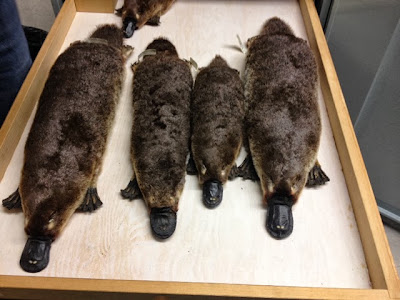
| Platypuses at Berkeley's Museum of Vertebrate Zoology |
The platypus is currently tied for my favorite mammal (along with hedgehogs and manatees). Platypuses have a lot of unique characteristics, but one of the features I find most fascinating is their sex chromosomes. Before a post about their chromosomes, there's a few things we need to clear up.
1. The platypus is not a "cross" between a duck and a beaver.
Because of its unique features, there is a lot of confusion about the platypus. The platypus is not some strange hybrid. A duck and a beaver cannot produce an offspring together. The population of platypuses evolved, like all other living organisms.
Upon closer inspection, looking at the picture above, the platypus bill looks very little like a duck bill at all. The platypus bill is wide and flat, and appears to be more leathery than the hard duck bill.
 |
| By DickDaniels (http://carolinabirds.org/) (Own work) via Wikimedia Commons |
 |
| The beaver has a large, flat, hairless tail. By Steve, Washington, DC via Wikimedia Commons |
2. The platypus is not the ancestor of modern mammals, it is a modern mammal.
Although it lays eggs, and doesn't have breasts or nipples, the platypus is still classified as a mammal. Platypuses are part of the group of egg-laying mammals called "monotremes." These are not "proto-mammals." Nor are they "primitive". Monotreme mammals have been evolving for the same amount of time as all other mammals. As humans we share a common ancestor with platypuses, approximately 220 million years ago. That doesn't mean that it isn't useful to understand more about the platypus, but interpretations should be careful not to assume the platypus has maintained the ancestral state of all mammalian traits.
3. The platypus is not the only egg-laying mammal.
In addition to the platypus, there is another group of monotreme mammals that lay eggs: Echidnas. Echidnas and platypuses diverged from one another about 64 million years ago. While they share some characteristics that are unique to monotreme mammals (relative to other mammals), such as egg-laying and oozing milk out of mammary pores instead of having nipples, the two groups of species have accumulated many differences. Perhaps one of the most notable is that there are at least four species of echidna, and only one species of platypus.
Other cool echidna features include their body covering which includes a mixture of course hair and dense, pointy, spines.
 |
| Echidnas at Berkeley's Museum of Vertebrate Zoology |
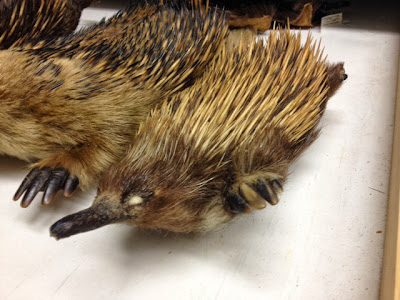 |
| Check out those nails. |
4. Platypuses are about the size of a house cat
I don't know why, but when I was growing up, I always imagined that platypuses would be fairly large critters - not unlike a recently discovered branch in the platypus tree that went extinct 5-15 million years ago. Turns out, modern platypuses are actually about the size of a house cat. You can see the pictures below with my hand next to them.
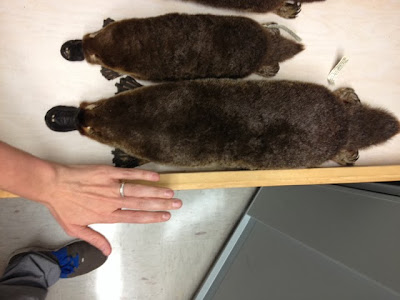 |
| Not so giant platypus. |
70 Comments
DS · 15 November 2013
Well unless you can show me a cross between a duck and a beaver, then evolution can't be true. What's that? Oh, I meant a cross between a duck and a crocodile. Yea, that's it, that's what I meant. What's that? Oh, ... never mind.
eric · 15 November 2013
Another nifty factoid: the males are venomous, a trait which is also fairly rare in mammals.
Charley Horse · 15 November 2013
For a laugh...https://i.chzbgr.com/maxW500/5978955264/h86E19339/
Charley Horse · 15 November 2013
I get a 404..Not Found for this: If you want to see a live platypus (which I really, Really, REALLY do!!), check out this video of some people hand feeding a platypus.
Glenn · 15 November 2013
@Charley Horse: try http://www.youtube.com/embed/a6QHzIJO5a8
M. Wilson Sayres · 15 November 2013
Thanks for the comment - I fixed it. Originally, I had tried to embed the video, but that didn't work. When I made it into a link, I forgot to take the embedding code out.
https://me.yahoo.com/a/JxVN0eQFqtmgoY7wC1cZM44ET_iAanxHQmLgYgX_Zhn8#57cad · 15 November 2013
Henry J · 15 November 2013
John Harshman · 15 November 2013
You couldn't at least produce a duck whose distribution overlaps the platypus? Or the beaver, for that matter? Give hybridization a chance. Maybe an otter would be a better choice than beaver.
Paul Burnett · 15 November 2013
Are the Platypuses pictured at Berkeley’s Museum of Vertebrate Zoology dead or alive?
DS · 15 November 2013
M. Wilson Sayres · 15 November 2013
patrick.j.may · 15 November 2013
But, what do they taste like?
stevaroni · 15 November 2013
MJHowe · 15 November 2013
M. Wilson Sayres · 15 November 2013
This thread proves that there needs to be a way to up-rate (and probably down-rate) comments on PT.
Henry J · 15 November 2013
apokryltaros · 15 November 2013
Dave Luckett · 16 November 2013
Behold the duck-billed platypus/That's native to Australia!/As mammals go, not quite like us/But certainly no failure.
Not primitive, not left behind/Adaptions? Yes, they've gottem/That bill is brilliantly designed/For feeling on the bottom.
Designed? Well, clearly, that's not right./I meant "evolved", no, really./And "bottom of a stream at night."/Not lewdly touchy-feely.
But that's our language. It's a tool/that tends to the assumption/that "common sense" will always rule,/and all you need is gumption./Nor has equivoque occurred,/ for every single separate word/Has just one meaning. (That's absurd.)
Robert Byers · 16 November 2013
To this YEC creationist the platypus is case in point of wrong, too quick off the hip for the old ones, classification systems.
Its only unique is presumptions that like traited creatures are from like origins or just should be lunped together.
Laying eggs is no big deal in the animal kingdom. Its not a defining trait of heritage.
The platypus is just some kind of otter with adaptions for a niche it migrated too back in the day.
I understand the "beak" is sensitive for finding food and thats all it is. So the creature is always in the water and couldn't watch its kids like other creatures etc.
Like marsupials its just minor differences from relatives that lived elsewhere on the planet but now extinct.
Indeed evolutionists used to say it was between reptiles and mammals and so primitive. Its not primitive whatsoever.
Egg layers is just in a spectrume of a rathyer common plan of reproduction.
Some snakes lay eggs and some birth without them. Its no big deal.
The platypus, I think, is not a strange aberration but a revelation of the true equation that classification systems based on like traits is purely speculative.
As the bible says there is just kinds. no mammals or reptiles or dinosaurs.
Dave Luckett · 16 November 2013
And speaking of absurd...
Jared Miller · 16 November 2013
I can't help but thinking Byers is a spoof. His "mistakes" seem artificial and contrived, don't you think?
MJHowe · 16 November 2013
Not to mention platitudes... So the platypus is just 'some kind of otter' wearing a bush hat hung with corks tied to pieces of string - works for me.
Karen S. · 16 November 2013
Scott F · 16 November 2013
Surprisingly, Byers is making more sense here than usual, if only unintentionally. The comment about "kinds" is silly (the notion suffers far worse problems than "species"), but it is certainly true that there are a spectrum of features in the animal kingdom, which often blurs the dividing lines between species. Looked at historically, species do run together. But what Byers is describing is a definition of Evolution, not a problem for it. In contrast, his observation of a spectrum of features completely contradicts his conclusion of distinct "kinds". Were the notion of "kinds" true, one would expect to see clear dividing lines, distinct clusters of features, rather than spectra.
https://me.yahoo.com/a/JxVN0eQFqtmgoY7wC1cZM44ET_iAanxHQmLgYgX_Zhn8#57cad · 16 November 2013
Just Bob · 16 November 2013
Mark Sturtevant · 16 November 2013
There are platypus jokes.
A platypus walks into a bar and tells the bartender,"Got any shrimp?" The bartender says ,"No, now go away!." The platypus walks in to the bar again and says, "Got any shrimp?" The bartender says,"No and if you ask me that one more time I'll staple your webbed feet into the floor!" The platypus walks into the bar again and says,"Do you have any staples?" And the bartender says,"No." Then the platypus says,"Got any shrimp?"
Lodos Emre · 16 November 2013
istanbul escort ve escort istanbul olarak teşekkür ederiz
ksplawn · 16 November 2013
stevaroni · 16 November 2013
Just Bob · 16 November 2013
phhht · 16 November 2013
Henry J · 16 November 2013
ksplawn · 16 November 2013
robert van bakel · 17 November 2013
My brother and his family live near Bundaberg near Brisbane, Oz. He had a bone dry creek running through his property. The property is largely sand, rock and eucalyptus. He bulldozed bolders across the creek one very dry season hoping to create a large pond next time it rained.In 2007 it rained and he got his pond, it's still there and seems almost permanent, even though he has had no appreciable rain for almost three years. With the water came a pair of platypuses (platypi?) which he has named and watches on many calm evenings; Bert and Bertha, heh! Don't know where they came from. He (and I) just considers himself lucky: He also has a couple of crocs, possibly three:)He has no idea how they got there also, as the nearest major water is about 15 km from his property.
Robert Byers you are foolish and offensive, but your worst failing is that ultimate crime against humanity, willfull ignorance.
Dave Luckett · 17 November 2013
"Near Brisbane" here needs to be understood in the Australian context. Bundaberg is about 230 miles north of Brisbane.
Dave Luckett · 17 November 2013
Oh, and that's fairly typical of the Australian and Queensland climate. "Droughts and flooding rain" is the norm. As one of our more inspired clerics once remarked, "Don't pray for rain - dam it."
robert van bakel · 17 November 2013
Quite right Dave. Once upon a short visit to his farm he took me, 'down the road' for a beer. 120km later we arrived at his 'local'.
prongs · 17 November 2013
Some distant cousins emigrated to Australia. They found a nice flat, dry spot to build a house and start a farm, I guess. It didn't rain very much so I don't know why they chose that spot to farm. After a few years they got the rain of a century. Water up to the rooftop, which is where they baked in the sun and almost starved until the water finally receded after a number of days. No one had ever seen anything like it in the Old Country.
Just Bob · 17 November 2013
prongs · 17 November 2013
Panspermia · 17 November 2013
Hey guys, love this site, have you read this over at Nat Geo about the giant platypus..
http://news.nationalgeographic.com/news/2013/11/131104-giant-platypus-evolution-science-animals-paleontology/?utm_source=NatGeocom&utm_medium=Email&utm_content=inside_20131114&utm_campaign=Content
Robert Byers · 17 November 2013
stevaroni · 17 November 2013
Robert Byers · 18 November 2013
Robert Byers · 18 November 2013
ksplawn · 18 November 2013
Marsupials DON'T look exactly like placentals. I've already pointed you at anatomical features which are unique to marsupials that go beyond their reproductive system. No placental mammals have those traits.
Why can't we then classify living marsupials separately from the living placentals?
DS · 18 November 2013
So. according to Booby, all real biologists is wrongly like. He is no way going to be believing what them says cause they do not to studying biology. He is just to be placing hands over ears and screaming it aint so at the tops of his lungfuls. No traits is to be considered as to relations. It not to be mattering weather all nested hierarchy is convincing. Rapid and sudden evolution can only to be occur when he be saying, like after falling and what not. Its just a line of reasoning and not biology. There is no groups, just baramin like to be surely. And no, i am never to be learning anything from you of coarse. My minds is made up on the internets and i am not imagining biological like change so i am a odd man out. Yet was in fact change of a more accurate equation not being a revelation.
And now back to our regularly scheduled platypus.
Karen S. · 18 November 2013
gnome de net · 18 November 2013
I can has cheezburger?
M. Wilson Sayres · 18 November 2013
https://me.yahoo.com/a/JxVN0eQFqtmgoY7wC1cZM44ET_iAanxHQmLgYgX_Zhn8#57cad · 18 November 2013
It's really more correct to classify platypuses with "really cool animals."
Glen Davidson
ksplawn · 18 November 2013
Technical correctness is the best kind of correctness, of course, but that's a bit higher than the division I'm thinking of (eutherian vs. metatherian, where metatherian represents marsupials and their closest extinct relatives). Byers doesn't buy into any division between different "mammals" at all, despite the other anatomical features that distinguish eu/meta/prototherians from each other.
corbsj · 18 November 2013
To throw in another cool platypus feature they also have a 6th sense electroperception!
A platypus will keep its eyes firmly closed under water. It uses its bill to help scan and dig up the mud and is quite sensitive to touch. However it also highly sensitive to small electric fields. The ability is similar to sharks but evolved completely separately of course.
http://monash.edu/news/releases/show/2
So the platypus is a mammal that has a bill, fur, lays eggs, has venom and radar...
Robert Byers · 18 November 2013
This comment has been moved to The Bathroom Wall.
Robert Byers · 18 November 2013
This comment has been moved to The Bathroom Wall.
Robert Byers · 18 November 2013
This comment has been moved to The Bathroom Wall.
DS · 18 November 2013
This comment has been moved to The Bathroom Wall.
ksplawn · 18 November 2013
This comment has been moved to The Bathroom Wall.
PA Poland · 18 November 2013
corbsj · 18 November 2013
DS · 18 November 2013
Bobbity boobity bobbidty boop.
Scott F · 18 November 2013
John Harshman · 19 November 2013
The metatherian placenta is different in structure from the eutherian placenta. The former involves the chorion only, while the latter involves both the chorion and the allantois.
Robert Byers · 19 November 2013
Sorry folks but no more discussions. WHY??????? It was interesting, on thread, and part of the whole purpose behind the forum. Oh well at least a little conversation on interesting matters in biology.
I know how that Freshwater guy feels !! Except telling the family about the loss of income!
DS · 19 November 2013
Bobby,
Your particular brand of "discussion" is only allowed on the bathroom wall. Go there if you dare. I am sure that you will get all of the "discussion" you can handle. This thread is for grown ups.
ksplawn · 19 November 2013
Just go discuss the matters at the Bathroom Wall you big doof.
Christine Janis · 20 November 2013
Peter Naus · 26 November 2013
I was lucky enough to swim with one platypus (Numi) at Healesville Sanctuary a few weeks ago.
It turns out that they're more inquisitive than a kitten, quicker than a sneeze, and love having their artmpits (legpits?) scratched! And they're more endearing than a baby Black Rhino.
And astonishingly friendly, once they've figured out what you're up to. (At least, in a 50,000 gallon tank, anyway.)
Best 35 minutes of my insignificant life.