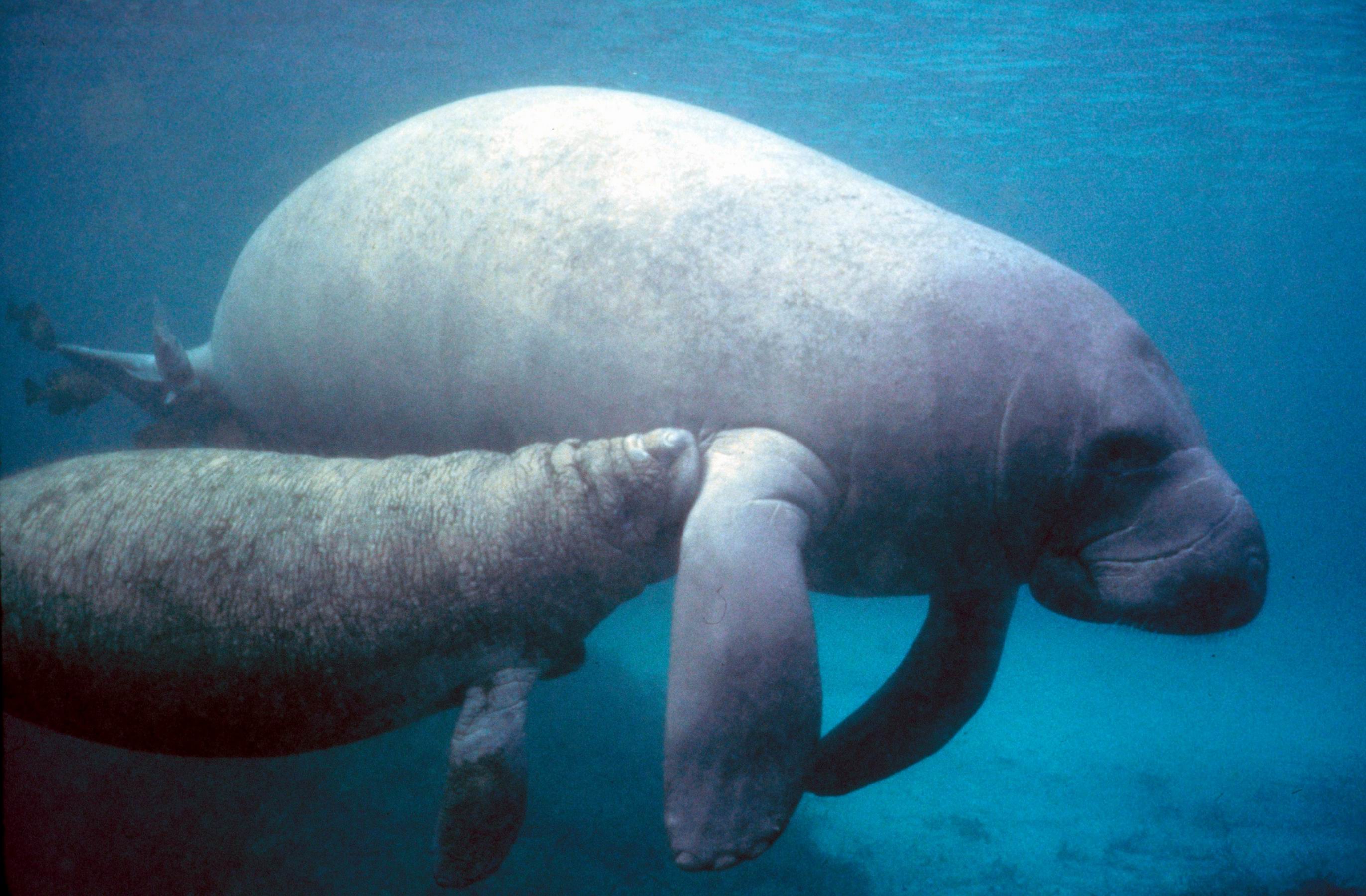
 |
| By Gaylen Rathburn, via Wikimedia Commons |
Well, first off, I've always been fascinated with manatees: they are so defenseless, and yet grow so large that they are rarely predated on. They are, however, especially susceptible to human-made water vessels. I am excited for their genome because I've always loved them. But, they are also pretty evolutionarily awesome.
1. Manatees are more closely related to elephants than they are to dolphins or whales.
The manatee and the bottlenosed dolphin are approximately 100 million years diverged from each other. The manatee is classified under the Afrotheria, which also includes elephants, hyraxes, and aardvarks, while the dolphin is classified as Laurasiatheria, which also includes the red panda, hippos, horses, rhinoceros, and bears. You can click on the links above for more detailed lists of the species included in each group.
Although about 100 million years separate manatees from dolphins, the manatee and elephant are only separated by about 61 million years. Unlike dolphins, but like elephants, manatees have toenails:
 |
| By Fritz Geller-Grimm, via Wikimedia Commons |
2. Manatees convergently (independently) evolved the ability to live under water
Unlike other mammals that live primarily in the water (whales and dolphins), the manatee (and dugong) does not breath air through a blowhole on top of its head. Instead, manatees breath through their nostrils. How cool is that?
.jpg) |
| By Rusty Clark from Merrit Island FL via Wikimedia Commons |
Manatees also convergently lost most of their hair (although this isn't unique to water-dwelling mammals as many terrestrial mammals lost most of their hair too, including pigs, naked mole rats, and humans). I wonder whether similar genes are involved (disrupted?) to result in the loss of hair across these mammals?
3. Manatees have a much lower metabolic rate than expected for their body mass.
Manatees are fairly sedentary, and have a low metabolic rate (0.36 times the predicted rate for placental mammals). Dolphins have a much higher metabolic rate, but a similar expected lifespan as manatees (approximately 50-60 years, to my understanding). So, it will be fascinating to investigate how genomes differ between fspecies with similar generation times, but very different metabolic rates.
37 Comments
https://me.yahoo.com/a/JxVN0eQFqtmgoY7wC1cZM44ET_iAanxHQmLgYgX_Zhn8#57cad · 3 December 2013
And why do they look like that? Do they really think other manatees look hot?
Glen Davidson
M. Wilson Sayres · 3 December 2013
If we could only peer into a manatee's mind...
pngarrison · 3 December 2013
There was a recent paper on genes involved in hair loss in cetaceans.
Characterization of hairless (Hr) and FGF5 genes provides insights into the molecular basis of hair loss in cetaceans
http://www.ncbi.nlm.nih.gov/pmc/articles/PMC3608953/
Karen S. · 3 December 2013
Toenails! I never knew that.
DS · 3 December 2013
Thanks for the reference pngarrison.
It will be interesting to compare genomes in order to elucidate the mechanisms whereby different mammalian lineages have independently returned to the aquatic lifestyle. Just another example of evo devo and comparative genomics in action.
Paul Burnett · 3 December 2013
My wife was in the water with some manatees in Florida years sgo. Imagine a garden slug the size of a refrigerator...and about as lively.
M. Wilson Sayres · 3 December 2013
M. Wilson Sayres · 3 December 2013
Carl Drews · 3 December 2013
TomS · 3 December 2013
You guys are all assuming that manatees have DNA that can be sequenced. On the Theory of Intelligent Design, it is just as likely that manatees were intelligently designed with RNA genes, or with something not based on the usual four (or five) bases, so there might be problems sequencing. What's the probability that manatees were intelligently designed to be like the rest of life?
M. Wilson Sayres · 3 December 2013
fnxtr · 3 December 2013
Human hairlessness has been attributed to neoteny (we're flat-faced, too, like baby chimps); in pigs and rats it looks more like physical environment adaptation, so yeah, it'll be interesting to see if similar genes are involved.
Robert Byers · 3 December 2013
Manatees , to this YEC, are indeed adapted land creatures that took to the seas after the flood.
Their original kind is unknown . The idea of biological relationship to elephants is entirely based on minor like traits in morphology or genetics equally based on extrapolation of present like genes.
The interesting point brought up is about convergent evolution. Indeed evolutionists must invoke this to explain why manatees have traits that unrelated creatures have. In fact its unlikely by any reasoning.
Rather they have them from triggers in the body that give like traits. Just like people have like colour though from separate environmental causes.
The idea of lucky mutations coming along to create very like flippers and tail as elsewhere in creatures is just asking too much.
Dave Luckett · 3 December 2013
Byers, just out of idle curiosity, for I know that in the unlikely event of any answer at all, it will be neither cogent nor coherent, but:
How is it possible to believe that manatees "are indeed adapted land creatures" and that "the idea of lucky mutations...is just asking too much", both at the same time?
DS · 3 December 2013
becuz it is much thusly and not top be considered. especialy i further in the far of theg of coarse. Clear to elsewheres pairwise being?
(Sorry, I used one capital appropriately).
jjm · 3 December 2013
diogeneslamp0 · 4 December 2013
The most important reason for sequencing the manatee genome is to compare it to the elephant genome, when that is sequenced.
It would be thrilling to see how the ERVs align. More death to creationism.
Robert Byers · 4 December 2013
Tenncrain · 4 December 2013
Dave Luckett · 4 December 2013
Sigh. Cogency and coherence. Prediction confirmed.
I think this word-salad means that Byers rejects the ideas of natural selection and of deep time, but paradoxically, not evolution itself. Not that what he uses for thought is actually coherent.
He thinks that evolution happens, but it's more like what happens when humans breed animals, except God does the selecting. He also thinks it happens quickly - far more quickly, taking far fewer generations, than evolutionary theory predicts, and so takes thousands, not millions or tens of millions of years.
The first part of this - divine selection - is pure omphalos. It looks like the environment is selecting, but it's really God, because, well, it is. Because I say so, and you can't prove it isn't.
The second part is simply contrary to demonstrable fact. Mutation rates are measurable, have been measured in many species, and are known and knowable. The dateable fossil record confirms them, as a cross-check. The Byers idea that a land-dwelling mammal could evolve into a manatee in the course of a few thousand years is simply ridiculous.
DS · 4 December 2013
yEs lucky mutations is to much to be believing inwardswise. insteadly the intelligencia of man atees is no doubted to be responding to every aquatic protuberances. yEt there is other mechanisms of which i am not to be saying becuz explaining peoples explains allmostly in the majority of instantaneousness. likewise for man atees
https://me.yahoo.com/a/JxVN0eQFqtmgoY7wC1cZM44ET_iAanxHQmLgYgX_Zhn8#57cad · 4 December 2013
Scott F · 4 December 2013
Robert Byers · 5 December 2013
DS · 5 December 2013
No evidence of nature exists to say otherwise? Really? Really? And exactly how would you know this sir?
phhht · 5 December 2013
Henry J · 5 December 2013
TomS · 6 December 2013
Carl Drews · 6 December 2013
TomS · 6 December 2013
Henry J · 6 December 2013
Also does "after its kind" mean all descendants indefinitely, or just the next generation? As I understand it, a change of species in one (or a few) generations is very rare (hybridization or polyploidy (how do you spell that?) might cause it.
M. Wilson Sayres · 6 December 2013
Robert Byers · 7 December 2013
Dave Luckett · 7 December 2013
Uh-huh. Flood legends from people who experienced catastrophic local flooding is evidence of a world-wide flood. Absence of flood legends from people who didn't is also evidence for a world-wide flood.
This'll end up on the BW, and very right, too.
Scott F · 7 December 2013
Robert, my dear poor deluded boy. You have once again missed the point. *IF* the story of Noah's flood were true, then there would be no Middle Kingdom of Egypt, the written history of Egypt would not exist, and we would see unmistakeable evidence of the Great Pyramids having been under water.
1. But the Middle Kingdom of Egypt *did* exist. The Middle Kingdom consisted of several hundred thousand people. In order for there to be hundreds of thousands of people (in Egypt alone) just 200 years after the Flood, then every single female descendant of Noah's family must have given birth to 3 live children every year for 20 years of her life, for over two hundred years. And that only counts the population of Egypt, not to mention the rest of Mesopotamia, or China. Not only did Noah's children live for hundreds of years, they also bred like rabbits.
2. The fact that the written history doesn't mention a global flood doesn't mean that the flood was "forgotten". The fact is that we have an *unbroken* physical written history spanning the centuries around 2400 BC. It doesn't matter what words they wrote. Most of the written "history" we have is of the little things of life: how much grain was received on this date; what king died; what king was born; what battles were fought, and who won; how many cows were sold; how much olive oil was transported. Very little of that talks about water or floods. But here's the point. *IF* the Flood story were true, then there would be no people left alive to write these things down!!. The fact that there were people, alive, writing things down during the year of the flood, and after the year of the flood, is by itself physical proof that those living people existed. They were not under water, and they were not dead.
3. The Pyramids of Giza were built before 2400 BC. There is no physical evidence that the Great Pyramids were ever under water.
DS · 7 December 2013
Well what did you expect? This from the same mind that told you that preventing creationism from being taught in public schools was censorship but that it wasn't censorship if enough people voted to have evolution banned from public schools! Now an entire civilization that not only survived a "world-wide" flood, in fact never even noticed a "world-wide" flood, is evidence that there was a "world-wide" flood! Literally unbelievable. If Robert had two neurons to rub together you would swear he was a POE. As it is, not so much.
phhht · 7 December 2013