Happy Jason Lisle Day!

Posted 12 September 2014 by

Note: This is a guest-post by DiogenesLamp. He has cross-posted it at WordPress and Blogger versions of his blog. I have BLEEPed a few things as PT is supposed to be in part an educational resource. -- Nick Matzke Happy Jason Lisle Day! Today is the second anniversary of the day when Jason Lisle, director of what passes for research at ICR (Institute for Creation Research), promised he would explain why his alleged solution to the creationist "Starlight Problem" wasn't really demolished by the math of Einstein's General Relativity-- in spite of much proof to the contrary that had been shoved right in his face. Lisle had whipped up a convoluted, technical explanation for why Young Earth creationists [YECs] are right about the universe being created only 6,000 years ago, even though we can see galaxies that are millions of light years away, and their starlight must have been traveling towards us for much longer than 6,000 years. Subsequently critics confronted Lisle with a handful of different mathematical and observational arguments that refuted his alleged solution to the Starlight Problem, which he calls "ASC" [Anisotropic Synchrony Convention]-- one point being that his ASC would in fact require a gravitational field that ought to be observable, but isn't observed. In his only response, two years ago today, Lisle promised to explain why we're all stupid and maths are all wrong and his BLEEPy model actually rules.
Lisle: I've seen this criticism [observable gravity field] but I haven't responded yet. It is very easy to refute. I plan on doing a series on this blog on the topic of ASC, in which I will refute this and other criticisms made by those who have not studied the topic. [Jason Lisle, comment September 11, 2012 at 6:18 pm]
Uh huh. Sure you will Jason. Two years later, we're still waiting. His comment has no content beyond the usual creationist combination of genetic fallacy plus ad hominem attack: ignore the math because it was "made by those who have not studied the topic"-- as if Lisle's toy model is so friggin' hard! (For other entertaining examples of creationists who respond to the demolition of their faked evidence and/or terrible math with the very mature, "Wah, it don't count because you're all ignorant of my genius, ignorant ignorant!!", without ever actually employing their superior intellects to show what's wrong with the maths, you can peruse IDer William Dembski's ad hominem "refutation" of Felsenstein and Shallit's demolitions of his pseudomath, and creationist Jeffrey Tomkins' infantile mental meltdown presented by him as a "refutation" of AceofSpades' exposure of Tompkins' incompetent huge overestimate of the genetic difference between humans and chimps.)

So on Sept. 11 of this year and every year, let's celebrate not just the genius of Dr. Jason Lisle of the ICR, but the genius of all the YECs over the years who've said they could explain how starlight can get here from galaxies millions of light years away in a mere 6,000 years-- all of whom subsequently crashed and burned, including Lisle, as we'll see below.

In this blog post, I'll review the math that shows why Lisle's model is dead, dead, dead, and why his cosmogony is absurd on several levels, because contradicts Lisle's assumptions. But first, for your entertainment, let's review some previous, disastrous, failed attempts by YECs to "solve" the starlight problem.

Background: Previous YEC Attempts to Solve the Starlight Problem

The "Starlight Problem" has vexed Young Earth creationists for as long as there have been Young Earth creationists. Simply put, the universe cannot be 6,000 years old if we can see galaxies millions of light years away, and if light travels at the speed of 186,000 miles per second-- not unless God is tricking us with phony light shows in the sky. Here are four dead proposals.

1. "Omphalos", aka "Appearance of Age": the Deceiver-God is tricking us with phony light shows in the sky that didn't really come from stars. You might think that this argument is an evolutionist spoof of a creationist argument, but in fact it was promoted for decades by none other the most famous creationist in American history, Henry Morris, the "Godfather" of modern YEC, author of the influential The Genesis Flood (1961), and founder of the ICR where Jason Lisle now works. Morris never backed down over several decades but aggressively defended the idea of deceptive light shows in the sky, along with his ICR lieutenant and "star debater", Duane Gish. These light shows must be extremely complex and highly contrived by Deceiver-God, due to the complexity of many observed astronomical events and structures. For example, from time to time a supernova comes into the news, and astronomers can detect both photons and neutrinos from the exploding star, and in years afterward they observed the expansion of the gas and dust clouds thrown off in a shell around it, e.g SN 1987A that exploded in 1987. All fake, all an illusion, according to the ICR when Morris and Gish were alive-- fake photons, fake neutrinos, fake dust, fake clouds... if the object is more than 6,000 light years away. If it's closer than that, it might be real. Some large astronomical structures are light-years across and in principle could cross the 6,000 light-year boundary, a topic the YECs discreetly avoid discussing, but in principle structures like large nebula could be half real and half make-believe, like Fox News.

Henry Morris used Deceiver-God to explain away both the starlight problem and also radiometric dating: In The Genesis Flood Morris said God just created rocks with a high ratio of daughter isotopes to parent isotopes, making them appear old by radiometric dating, because the Bible says "a thousand years is as a day to the Lord." Morris never explained why God made deeper rocks appear older than rocks near the surface, or why volcanic intrusions appear younger than the strata they intrude into. In a debate against Ken Miller in 1981, Morris defended his "fake photons" argument for starlight but in a comical/pitiful performance, he seems embarrassed by it. In the Q and A session afterward, an audience member asks him, "[C]ould we not equally accept that the universe was created a millisecond ago with prepackaged memories of your two-and-a-half-hour debate implanted in our minds?" [a philosophy called Last Thursdayism]. Morris' 1981 answer is still amazing.
[Henry Morris]: ...obviously when you suggest the creator could create things with the appearance of built-in memories... yes, in principle of course as the creator he could do that, and if there is a creator then you can't say 'No.' ...But when we suggest that there is creation, then the only way to say that there is no possibility of creation with an appearance of maturity, or completeness or appearance of age, or whatever, is to say that creation is impossible. And that's to say that there is no creator, which is tantamount to atheism. [Henry Morris vs. Ken Miller debate, 1981]
So you have to like Morris' Deceiver-God and his fake photons, fake supernovae, fake nebulae, fake light shows in the sky, fake geological evidence etc., or else you're an atheist. This is the classical defense of Omphalos, still used by Jason Lisle today: flip the burden of proof onto the other guy by demanding, "Where is your evidence that my all-powerful God can't trick me?"

2. The Speed of Light is Slowing Down. This terrible idea was the go-to answer in the 1970's and 1980's.  Do I have to say that the method to "prove" this was a hoax, and that energy is converted into mass by the equation E = mc^2, so when creationists say that the speed of light c could have been, say, a hundred million times (10^8) faster in the past, that means that the energy released by nuclear fusion in stars would have been ten quadrillion times (10^16) greater back in the old days and the universe would blow up? Likewise all the radioactive uranium, thorium and radium in the whole Earth would release ten quadrillion times more heat, and in your own body the fraction of your potassium that is radioactive would friggin' kill you.

This dumb idea of light "tiring out" from its long journey was concocted by Norman and Setterfield about 1969 and the method behind it was thoroughly debunked by the time of the 1982 book Scientists Confront Creationism. Norman and Setterfield took a historical value of the speed of light and a then-current measurement, then they drew a curve through the the highest end of the error bar of the first, to the the lowest end of the error bar of the second, and surprise!! The curve goes down over time!! And of course they used an exponential curve, so if you go back in time a few centuries, the speed of light would be vastly, exponentially larger than now. Also, al stars would explode, the Earth would vaporize and your own potassium would kill you.

This dumb idea was pushed by Flood fossil fraudster "Dr." Carl Baugh (fake Ph.D.) and by "Dr." Kent Hovind (fake Ph.D.), aka Federal Prisoner #06452-017. Naturally, Ken Ham, Andrew Snelling and Carl Wieland, in a precursor to Answers in Genesis ministry, pushed the idea in the 1990 edition of The Answers Book (pages 189-192).

3. Stars are Not Big and Very Far Away, They're Small and Close Up. Again, this is a real creationist argument, not a parody of creationism.
[Carl Baugh]: One of the concepts of evolutionary consideration is that some of the stars appear to be much closer. The formula which calculates these distances is by no means proven. But even if God wanted them to be sixteen billion light years away, that's no problem for an omnipotent... God. ["Dr." Carl E. Baugh (fake Ph.D.), 'Panorama of Creation', (1992), p.11-13, 16, cited here]
Ooh, the jury is still out!! The stars might be fifty feet away and just very tiny, who knows, scientists can't prove a damn thing!

Henry Morris again, embarrassed to have to invoke this argument, but invoking it anyway, because what the hell?
[Henry Morris]: ... we can't even be sure that these stars are billions of light years away. There're very sophisticated esoteric sort of assumptions involved in calculating the distances. [Henry Morris vs. Ken Miller debate, 1981]  
Ooh, them scientists are doin' long division and my head hurts! So esoteric! No, scientists do have sophisticated methods to estimate the distances to stars, and the laws of physics don't permit the stars to be shiny nails pounded in the dome of heaven like the Bible says. Here creationist Danny Faulkner summarizes and disputes other creationists who claim stars are small and close up.

4. Space could be Riemannian, then light from the most distant galaxies could get to us in 15 years! BullBLEEP, and the people who say it don' t even know what Riemannian means.  They just want to use jargon. It means that space is curved in an invisible dimension, but negatively curved, like a saddle. Well, that would have observable effects, and they're not seen. So this is a toy model of a hypothetical universe but we know from observation it's not true of our universe.

5. Earth is at the Center of the Universe and We're at the Bottom of a Gravity Well. This idea was concocted by Russell Humphreys and recently popular for a few years, then it crashed and burned due to its basic mathematical blunders. Humphreys denied the Copernican principle-- that the universe looks about the same no matter where you are-- and says that all the galaxies form a big sphere with the edge far away, and Earth at its center.  Anyway, Humphreys proposed that we're at the center of a spherical universe so that Earth would be at the bottom of a big gravity well, and in General Relativity, time runs slower at the bottom of a gravity well. So 6,000 years can pass on Earth while billions of years pass out in the Universe, get it? No, it sucks on many levels.

To start with, when light falls into a gravity well, it slows down, so the wavelengths get shorter; it's shifted to the blue end of the spectrum. That's the reason why the signals from GPS satellites have to be tuned to a slightly higher frequency than the receivers on Earth are tuned to-- time runs slower in Earth's gravity well, so the radiation is blue-shifted as it falls into Earth's gravity. Thus if Earth were in a huge gravity well, the light from distant galaxies would be blue-shifted, but it's actually red-shifted.

Also, there's no solution for intermediate distance objects-- what about nearby stars or planets in the solar system? They should be slowed down about as much as Earth, but instead they look very old: Mars and Jupiter's moons have tons of craters, and among the asteroids there is considerable evidences of long-term processes: from the Kirkwood gaps in asteroid orbital periods, from the tumbling rate of larger vs. smaller asteroids, and from running the orbits of asteroid families backward in time until they coalesce on the partent body from which they were broken off, etc. we know the asteroid families are tens of millions of years old. Likewise, there's no smooth way to say Earth is young, asteroids are a tiny tiny bit older, Pluto slightly older, etc. It's dead.

This idea is often conflated with long-debunked claims that galaxies are found in concentric shells with gaps between them, like a set of Russian nesting dolls with Earth at the center. The alleged evidence for the shell game is a bit of pseudoscience called "quantized red shift" meaning that red shifts from distant galaxies supposedly come in fixed intervals, therefore galaxies distance must come in shells with gaps between them (they don't, and they're not). The problem here is hypothesis fishing: if you analyze a bunch of galactic distances and test them for, say, a thousand different periodicities, the odds are that at least one periodicity will pass a statistical test at a level of 1 in a thousand, even if the data you analyze is random.  Or if you test them for, say, a million different periodicities, at least one periodicity will pass a statistical test at a level of 1 in a million, even for randomized data.
Hypothesis fishing is a classic blunder and you have to reject it by doing the Bonferroni correction and trying to reproduce the exact same method on a totally independent data set.

Anyway, if it weren't for the popularity of GPS technology, we'd still have to deal with Humphreys' BLEEP, but now even most creationists sweep it under the rug. Except that according to the recent Texas newspaper article on ICR, the long-debunked "shells of galaxies" crap is still one of ICR's big current lines of research.

Now we'll finally get to Jason Lisle's idea, complicated yes, but smart, no.
Jason Lisle's Solution: Anisotropic Synchrony Convention (ASC)

Lisle's solution is cobbled together from three different ideas, which we should not get mixed up together.

1. The Anisotropic Synchrony Convention. Here Lisle simply defines all events happening in the universe, no matter what the distance, as being simultaneous with what's happening now on Earth. Simultaneity of any two events depends on the observer's position, so I say events A and B are simultaneous, but if you're in a different location, you say A happened before B (unless you are sitting on my lap.) Thus, God could create the whole universe simultaneously relative to Earth (see Point 3 below), and light from distant objects would instantaneously arrive at Earth no matter the distance -- but note that all creation events would not besimultaneous relative to observers  not on Earth. Believe it or not, there is no way to falsify this because it's just a convention, so it can't be rejected on observational grounds. The problem is not terrible, but Lisle then combines it with the next two ideas, which are disastrous.

2. A variable speed of light that depends on the position of the observer, and the position and direction of travel of the photon, via the angle θ made between the eye-line from the observer to the photon and the photon's direction of travel. For all observers in the universe, not just those on Earth, photons come straight at them at infinite speed. Photons moving perpendicular to our line of sight move at the conventional c. If a photon is approaching you at a glancing angle, it decelerates precipitously, then at closest approach to you it moves at speed c, and continues to slow down after it passes you, as it recedes away finally approaching one-half the speed of light (c/2). If you jump to the left, the velocity of every photon in the universe changes. If you send a light beam to bounce off a mirror on Alpha Centauri, 4.5 light years away, in Einstein's convention it would take 4.5 years on each leg of the trip, 9 years total. But in Lisle's convention, it will take 9 years to get there and zero time to bounce back. From the point of view of the guy on Alpha Centauri, your light beam came to him instantly, and then took 9 years to bounce back to you.

This idea of Lisle's is disastrous as it would induce an observable gravity field in General Relativity (GR) and also mucks up two physical constants known from electromagnetic theory, the permeability and permittivity of free space, which must then become position-and-angle dependent instead of being constants. The variable, position-dependent speed of light (2) is a separate idea added onto the Synchrony Convention (1) above, though Lisle conflates 1 and 2, and incorrectly calls the combination a mere "coordinate transformation." Falsely calling them both a mere "coordinate transformation" was at the point of Lisle's promised refutation when two years ago he wrote "It is very easy to refute", then never delivered. He can't deliver, because (2) is not a coordinate transformation, because it sets the velocities of photons to be dependent on their position and on their direction of travel.  Lisle never writes down his alleged coordinate transformation as a matrix (which should be easy if he were telling the truth) nor differentiates the matrix as is necessary.

3. Lastly Lisle hypothesizes a Cosmogony in which God creates the universe in concentric shells, outward from the edge of the universe and coming in towards the place where Earth will finally be, with a black sphere of "uncreated" nothingness in the center that slowly contracts as God creates stars and galaxies one thin shell at a time at the inner edge of the sphere. The creation "wave" converges on the place where the Earth will be at a speed of 1/2 the speed of light (not the speed of light as some have thought, and as Lisle himself incorrectly wrote in an early paper.) The intermediate steps of creation involve one-quarter stars, half-galaxies, half-black holes, three-quarter relativistic jets, etc. etc., and all kinds of huge complex structures that are millions of miles or hundreds of thousands of light years across, that God sloooowly constructs slice by slice: imagine a 3-D printer constructing a living human baby slice by slice, while it cries, thinks, and poops, but somehow doesn't die even when it has half-arteries and half-veins, half-loops of an intestine going in and out, half-brain etc. Same idea here, but with half-stars and half-galaxies instead of a half-baby. Lisle hypothesizes this cosmogony because if ASC is assumed then all creations by shells would then be simultaneous relative to an observer on Earth, if any existed (Day 4 of Creation Week, no humans existed to watch it); though the creation process would  be highly non-simultaneous, relative to the planets and stars getting created, and in fact it would all take ~80 billion years (relative to a distant non-Earth observer) before God got around to making Earth, because the observable univserse is ~40 billion light-years across and creation shells would converge at half the speed of light.

It is not sufficient to call this cosmogony absurd or counter-intuitive. It is wrong because it is non-falsifiable; because the scientific method requires a theory to be simpler than the observations it explains, but here Lisle's "God made colliding galaxies etc. to trick us" hypothesis is always more complex than all observations; and because, significantly, it contradicts its own assumptions. YECs say that in principle, there can never be "Appearance of Age" (there is Apperance of Absence of Age) and their hypothesis is "Appearance of Maturity", but "Maturity" has no definition except in terms of "function". But this cosmogony has God slowly creating countless half-finished non-functional entities that he must intervene to prop up supernaturally when they're half-finished or quarter-finished. A baby, as it is being printed by a 3-D printer, cannot be alive or functional when its half-finished and its half-loops of intestines and blood would squirt out, it can't be "functional" without supernatural intervention. Likewise Lisle's cosmogony, to create well-balanced stars and galaxies and black holes, which all have complex internal structures and internal balance of gravitational pressure and photon pressure, would require God to supernaturally create far more fake photons and fake neutrinos and fake phonons and fake convection currents etc., all with the appearance of being from events that never happened-- far more fake photons and phony light-shows than Henry Morris ever conceived of.

More on Strange Conventions of Simultaneity.

Let's return to 1. While this convention is counter-intuitive, this idea is not disastrous and does not by itself entail testable predictions that might falsify it. All of us has have heard that Einstein's Special Relativity begins with the assumption that the speed of light is the same for all observers in the universe, so that if an airplane shoots out a light beam, the light beam still travels at only the speed of light c and not c plus the speed of the airplane. This assumption is experimentally justified by the Michelson-Morley experiment, which proved that light beams going along the direction of the Earth's movement as it revolves around the sun, have the same travel time as light beams going perpendicular to the Earth's movement.

However, Lisle and other creationists correctly and cleverly point out that the Michelson-Morley experiment only measures the total travel time for a light beam making a round trip, and there's no experimental way to measure the speed of light going one way without some kind of round trip arrangement. What if (let's say) the speed of light went faster when going north and slower when going south, or vice versa, and the round trip looked like c when averaged out? Or if light went instantaneously going north and travelled at c/2 when going south, which averages out to c?

In fact, there's no rule against that, not by itself. Einstein's convention was that the speed of light goes at c in all directions, which is simpler and makes the math easier, but it can't be proven per se. You are permitted certain other conventions, e.g. if you just have all north-going photons go faster and all south-going photons go slower in a fashion that does not depend on the position of the photon. Where Lisle screwed the pooch was by making light speed depend on the position of the photon, which turns out to not be allowed, and is not a coordinate transformation as he claims.

For the permitted synchrony conventions, we must consider some bizarre (but not forbidden) consequences for the idea of simultaneity. The pre-Einstein idea of simultaneity was that it's the same for all observers, so if events E1 and E2 are simultaneous for Bob, then E1 and E2 are also simultaneous for Julie, no matter where she is or if she's moving relative to Bob.

But with Einstein's convention, event E1 could happen before E2 for Harry, if Harry is moving relative to Bob. What matters for Einstein is direction of motion, not position. With Lisle's convention, it's position that matters, not motion: so E1 could happen before E2 for Harry, if Harry is in a different place that Bob.

Here's the classic Einstein "train" argument: Bob is standing on an embankment as a train is passing; at the moment that the center of the train passes Bob, two lightning bolts strike, E1 at the front and E2 at the back of the train. Bob says, "Both light signals come towards me at the same speed c and traveled the same distance, so I subtract the same amount off the times when I saw each flash, and conclude E1 and E2 were simultaneous." But Harry is riding the train in its center; he travels towards the photons from E1 and away from the photons from E2, so he intercepts the E1 photons before those from E2. Like Bob, Harry starts off saying, "Both light signals come towards me at the same speed c and traveled the same distance, so I subtract the same amount off both times", but because Harry saw E1's photons first, after subtraction he concludes E1 happened before E2. This is bizarre, but it's basic Special Relativity.

In Lisle's convention, what affects simultaneity is not velocity but position. All the "shells of creation" as God creates the universe are created simultaneously relative to some one point on Earth (Eden?), but not simultaneously relative to any observers not on Earth. This means that all observers outside Earth believe their planets were created long, long before Earth; and for millions of years, as they look in the direction where Earth will be, they see only a sphere of black nothingness because, relative to them, God hasn't created Earth yet. Indeed, for stars sufficiently far away but visible now in our telescopes, we still do not exist relative to them, and we can see them but they can't see us, because God has not created the Earth yet, Adam has not eaten an apple yet, and you don't exist.

This produces strange hypothetical effects. [I owe this 'mirror' argument to Tim Reeves of Quantum Nonlinearity.] Now suppose Lillith blinks into existence at the center of the Andromeda Galaxy at the moment it is created (hint: not the same time Earth is created) and Lillith immediately picks up a mirror. Back on Earth, at the moment Eve is created, she thinks the universe is all created simultaneously and assumes light from Andromeda comes to her instantaneously too, so Eve immediately sees brand new, young Lillith, way off in Andromeda, 2.5 million light years away, picking up her mirror. Now suppose Eve sends light towards Lillith; Eve thinks her light beam recedes from her at speed c/2 and thus thinks it will take 5 million years to get to Andromeda.

When Eve is 5 million years old, her light finally reaches Lillith, while Eve sees Lillith as also 5 million years old at that instant; for Eve has been watching Lillith age the whole time, and for the whole 5 million years, Lillith's mirror has been black reflecting nothingness because the Earth didn't exist yet for her. Finally Eve's light bounces off Lillith's mirror and zips back to Eve at a speed Eve thinks is instantaneous by Lisle's convention. So when Eve is really 5 million years old, she will finally see her reflection, far away, and will see herself young and newly created as reflected in a mirror held by 5-million-year-old Lillith.

What does Lillith see? At the moment she was created, she looked around and saw half of the Andromeda galaxy created (the side away from Earth), but the other half (in the direction where Earth will someday be) just black emptiness. Needless to say, the galaxy will not be "mature" or "functional" as creationists claim, because half a galaxy cannot be stable or functional; it will look like a multi-armed spiral chopped in half, with spiral arms all sliced up into disconnected half arc-circles or quarter-circles, etc. which are rotating all the time, but the rotation of disconnected half-arcs without gravitational balance will tear it to bits. Worse, at its center will be half a giant black hole, and no one knows what half a black hole would look like. If M31 had relativist jets squirting out of the galactic center (M31 doesn't, but some do), the jets could be split down the middle like Robin Hood's arrow, or part of a jet could be coming out of the black sphere of still uncreated space, phony particles contrived to look like the result of phony events that never happened: a vast, slow trick of the Deceiver-God. Then God will finish creating Andromeda slowly, relative to itself-- slice by slice, at half the speed of light, so the second half of the galaxy (radius= 50,000 ly) will take God 100,000 years to finish, relative to Lillith; or no time relative to Eve.

Lillith at her creation picks up a mirror, but sees no light from Earth at all-- just blackness in that direction-- and waits until she is five million years old. When she finally gets light from Earth, that planet and Eve look young and newly created; but Lillith (like all observers, under Lisle's convention) believes that photons approach her instantaneously, therefore Lillith subtracts zero flight time for photons coming from Earth.

Conclusion: Lillith concludes that Andromeda was created 5 million years before Earth, and that she is 5 million years older than Eve. Eve by contrast concludes that Andromeda was created (about) the same time as Earth, and that she and Lillith are the same age.

Also we see here why the shells of creation must be created at c/2 and not c: Lillith waits 5 million years before the empty black sphere in the direction of Earth get filled up with matter, but Andromeda is 2.5 million light years from where Earth will be; therefore Lisle's cosmogony creates shells of matter at speed c/2, so all large-scale structures will be completely unstable, not mature and not functional, unless God supernaturally tricks us, filling up all stars and galaxies with fake photons and fake neutrinos and fake convection currents etc. that look like the after-effects of real processes, except the events never happened. The fake light show is not creation of "maturity", so Lisle's cosmogony contradicts his claim that his all-powerful god is limited by "appearance of maturity."

In an earlier paper, Lisle, writing as Robert Newton (wow, humble), says creation will converge on Earth at lightspeed.
[Lisle]: So, we present the following picture of Creation as described in Genesis, but converted from observed time to calculated time... this creation process moves inward; space is created nearer to Earth... About 4.3 years before Earth is created, 'the beginning' occurs for the space near Alpha Centauri [which is 4.3 light years away]. ...Finally the Earth is created. [Lisle's early paper, writing as Robert Newton.]

Apparently wrong; it should be 8.6 years before Earth is created. Probably Lisle caught this error later.

Lisle's Variable Speed of Light Creates a Gravity Field in General Relativity and is Not A Coordinate Change!

We move on to where Lisle really screwed the pooch, with his variable speed of light.
[Lisle]: The act of choosing a synchrony convention is synonymous with defining the one-way speed of light. If we select Einstein synchronization, then we have declared that the speed of light is the same in all directions. If we select ASC, then we have declared that light is essentially infinitely fast when moving directly toward the observer, and ½c when moving directly away. Under ASC, the speed of light as a function of direction relative to the observer (θ) is given by c(θ) = c/(1-cos(θ)), where θ = 0 indicates the direction directly toward the observer. [Anisotropic Synchrony Convention: A Solution to the Distant Starlight Problem. Jason Lisle. September 22, 2010. Answers Research Journal 3 (2010): 191-207. Emphasis added.]
First, it is not true that "The act of choosing a synchrony convention is synonymous with defining the one-way speed of light." This might be true for some synchrony conventions where the speed of light does not depend on position. But Lisle's variable speed of light, c(θ) = c/(1-cos(θ)), depends on θ, and θ depends the position {x1,y1,z1} of the observer and on the position {x2,y2,z2} and direction {v_x,v_y,v_z} of the photon.  

θ is the angle between your line of sight to the photon and its direction of travel: θ = 0 if it's coming at you, so c(θ) is infinite, θ = 90 degrees if perpendicular to your line of sight, so c(θ) = c, and θ = 180 degrees if receding from you, so c(θ) = c/2. If you jump to the left, the speed of every photon in the universe changes. This is not a mere synchrony convention nor is it a mere transformation of coordinates, as we'll prove below.

Valid synchrony conventions might be expressed as one or more permitted coordinate transformations, which could be written as 4x4 matrices (3 space dimensions plus time dimension). For example, you could say that all photons going north travel instantaneously and all going south travel at c/2; that is not dependent on photon position. But Lisle's c(θ) = c/(1-cos(θ)) rule is not uniquely fixed by his synchrony convention-- he does not derive c(θ) = c/(1-cos(θ)) from his convention, he merely shows that it is consistent with his convention, but "consistent with" is not a derivation or proof of uniqueness. He calls it a "transformation of coordinates" but never writes it down as a 4x4 matrix (Einstein does, that's called the Minkowski transformation) and Lisle never differentiates it.

Now Lisle was confronted with this fact by Timothy Reeves to who I am indebted for this argument.


Because it depends on positions of the observer and of the photon, it induces a gravitational field and curvature of space time. I will explain this three ways: A. intuitively, B. by proving that Lisle's rule can't be written as a mere "coordinate transformation", and C. from General Relativity and Jian Qi Shen's scientific paper on synchrony conventions and the Riemannian operator in GR.

Method A. The easiest way to see the problem is to note that in General Relativity, a speed of light that varies with position and a gravity field are the same thing. In Lisle's rule, if a photon comes at you, just missing you and glancing off, it's decelerating all the time-- that's a gravity field. This is not the case (for example) if we picked a synchrony convention where all photons going north travel instantaneously and all going south travel at c/2. Then lightspeed doesn't varies with direction but not with position, so no gravity field.

There, that wasn't so bad.

Method B. Just a Coordinate Change? At his blog, Lisle's only response to Reeves' critique was to claim that his ASC is just a mere "coordinate change." Because he says this over and over, I have to prove that his rule c(θ) = c/(1-cos(θ)) cannot ever be just a coordinate change. This should not be painful even for those who hate linear algebra.

First, a real coordinate transformation could be written as a 4x4 matrix. Lisle never does this. We want to show how velocities of photons transform in Lisle's case, but for comparison we'll first show how velocities add (for different observers) in Einstein's conventions; that's easier.

Consider an Einsteinian, special relativity transformation between two observers, Unprimed Guy and Primed Guy, one of whom is moving at velocity u relative to the other. In all of this I will consistently multiply all time coordinates t, t' and so on by the speed of light c, to give ct, ct', cdt, cdt', etc. units of meters; and I will always define v's and u's as distance /(time x c), so that all u's and v's have no units. That just makes the equations easier.

To make it even easier, I'll mostly use one space dimension x and time dimension ct. The first observer will see an event at coordinates {ct, x} while the second person "Primed Guy", traveling at speed "beta" with respect to Unprimed Guy, will see the same event at coordinates {ct', x'}. ("beta" is a unitless velocity, that is, it's the normal velocity u divided by c, = u/c.) The matrix is then 2x2.

We want to ask things such as: if a particle moves with velocity v with respect to Unprimed Guy, what is its velocity v' with respect to Primed Guy? For example, if an airplane shoots out a light beam, and it goes at lightspeed relative to the pilot, will it go faster than the speed of light relative to a ground observer?

So first we build a 2x2 matrix. The Minkowski transformation gives us the matrix:

ct' = Gamma* [ ct - beta * x]

x' = Gamma* [- beta * ct  +  x]

Gamma == sqrt( 1 - beta*beta). If we write vectors in the form {ct, x}, then Primed Guys' coordinates can be computed from Unprimed Guy's by the usual multiplication of a matrix times a vector:

{ct', x'} = M* {ct, x}

where M is a 2x2 matrix. That means that M's elements M00, M01 etc. are defined by

ct' =  M00* ct + M01* x

x'   = M10 *ct  +  M11* x

Of course subscript 0 is for time and 1 is for x.  The elements are easily seen from the above to be:

M00 = Gamma                M01 = - Gamma*beta
M10 = - Gamma*beta     M11 = Gamma

These matrix elements depend on velocity beta but not on positions {ct', x'} nor {ct, x}. As we shall see, Lisle's convention can't be written like this, because his M00, M01 etc. must depend on coordinates {ct, x} etc., which is his fatal problem.

We want to show how velocities add under Einstein conventions because that's easier. So since velocities take the form v = dx/dt, or actually I will divide by c and write

v == dx/c dt

we have to differentiate dx/dt but don't kill yourself over it. From the matrix transformation above:

cdt' = M00 * cdt + M01* dx

dx'    = M10 * cdt + M11* dx

Dividing numerator and denominator by cdt to get:

v' == dx'/cdt'  = [M10 * cdt + M11* dx] / [M00 * cdt + M01* dx]
    =  [M10 + M11* dx/cdt] / [M00  + M01* dx/cdt]

    =  [M10 + M11* v] / [M00  + M01* v]

Where I plugged in v == dx/c dt. Now we have our answer, because the matrix elements M00, M01 etc. were given above and we just stick them in:

v' = dx'/cdt'  = = [v - beta] / [1 - beta*v]

There, that wasn't so bad was it! You derived the relativistic equation for "adding" velocities. OK, now can we do this with Lisle's rules? No.

We want a guess a matrix like M00, M01 etc. that transforms from a photon's coordinates in Einstein's convention to one in Lisles' convention. What would matrix M look like? Lisle never tells us M, but we can guess some stuff about M from what he requires for photon velocities.

Consider a photon coming straight at you along the x-axis. Just like before, no change:

ct' = M00* ct + M01* x

x' = M10 * ct  +  M11* x

The only difference is that Einstein tells us M00, M01 etc. but Jason Lisle doesn't. He makes us guess at M00, M01 by dropping hints about photon velocities. So we have to relate the photon velocity in Lisle's convention, v', to the photon velocity in Einstein's convention, v. With the same trick of differentiating and rearragning we get the same equation:

v' = [M10 + M11* v] / [M00  + M01* v]

Same as before, except now we don't know what M00, M01 etc. are

Now you can see what's very wrong with this. Consider a photon coming straight at you along the x-axis.  But problem, what happens when the approaching photon zips past you? In Einstein's convention, v does not change; in Lisle's convention, v' is supposed to instantly decelerate to 1/2 (that's c/2 divided by c). The right half of the equation above does not change as the photon passes you; the left half of the equation changes infinitely. This cannot happen unless the matrix elements M00, M01 etc. depend on coordinates of observer and of photon, so that they "know" when to slow down-- but if M00, M01 etc. depend on coordinates of observer and of photon, that is no longer a mere "coordinate transformation" as Lisle claims, but instead a non-linear transformation of space-time. And a a non-linear transformation of space-time means space-time is curved. That means gravity.

Above I considered the simple case of one space coordinate and time. What if we do three space coordinates and time? Relax, I'm not going to repeat the whole thing. I'll just skip to the end.

Consider a photon coming at you at an arbitrary angle and glancing off. But I have to define the velocity of the photon as a vector with three space components along three axes, plus time, that is, {ct, v_x, v_y, v_z} for Einstein's photon velocity and {ct', v_x', v_y', v_z'} for Lisle's photon velocity. The rule for four coordinates is pretty obvious so I'll skip the blah blah blah and jump to it:

v_x' = [M10 + M11* v_x + M12* v_y + M12* v_z]/[M00 + M01* v_x + M02* v_y + M02* v_z]

There are similar equations for v_y' and v_z' which I'll skip. The speed of the photon is then

v' = sqrt( v_x'^2 + v_y'^2 + v_z'^2)

Problem: according to Lisle, the whole time the photon approaches it's decelerating. That means, again, the left-hand side of the equation changes with position, but the right hand side cannot. Not unless M00, M01 etc. depend on coordinates {x, y, z} -- but that would falsify Lisle's claim that he's only doing a coordinate transformation.

C. Jian Qi Shen's Paper on Synchrony Conventions and the Riemannian.

For a more professional take,  Timothy Reeves cited a physics paper by Jian Qi Shen [PDF] on the subject of synchrony conventions in General Relativity. He emphasizes that some syncrhony conventions are kosher, but if you don't follow the rules they produce a gravity field. Shen considers g, the spacetime metric tensor, which is used to measure distance between two points in a curved space time; the value of g tells you whether or not space is curved, and therefore whether or not a gravity field exists (more technical description below.)

Shen writes g in terms of a parameter X which in turn depends on in what way the speed of light is anisotropic-- how c varies in all directions. A "kosher" synchrony convention would be something like: all photons going north move at infinite speed; all photons going south move at c/2. In these case X would depend on direction of travel, but not depend on coordinates x, y, z, so then the g takes on a value for flat space-time, no gravity.


Shen concludes:
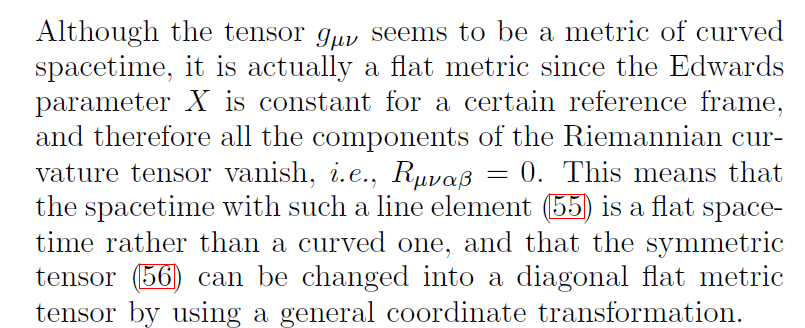

To be more technical, what tells you if space-time is curved is the Riemannian curvature tensor [R] that is derived from g which depends on X.

But in Lisle's convention,  X would depend on (1-cos(θ)) which in turn depends on coordinates {x,y,z} of the photon and of the observer. Thus metric tensor g depends on coordinates via X, and the Riemannian curvature tensor does not vanish, so space-time is curved, therefore Lisle's convention makes a gravity field, but this is not observed.

Compare this to what Lisle wrote:

The anisotropic synchrony convention is just that: a convention. It is not a scientific model; it does not make testable predictions. It is a convention of measurement and cannot be falsified any more than the metric system can be falsified. [Jason Lisle, 2010]
It makes testable predictions, it can be falsified, it was falsified.

Problems with Permittivity and Permeability of Free Space

Lisle has more problems with two physical constants that are important in electromagnetic theory, the permeability of free space μ0 and the permittivity of free space, ε0. These two constants are involved in electronics, setting the strength of electrostatic attraction and the relationship between current and and magnetic field. They are together intimately connected to the speed of light c, so Lisle mucking with the speed of light will mess with them too. In ordinary units c is determined by the identity  

c^2 = 1/ μ0ε0.

Since Lisle makes c depend on θ which varies with the position of the photon, μ0 and ε0 must depend on position as well. For this point I am indebted to a comment by Gabriel Hanna, who writes:
Nowhere does Lisle address this point, and I can't believe he is ignorant of it. When you do experiments with magnets and capacitors, you always get the same value for the speed of light even though you have no idea what direction that light might be moving in... If you forget that light is an electromagnetic wave, then you can accept Lisle's analysis.

…Einstein assumed the Maxwell equations were true. Lisle just abolishes them without mentioning that he did so. Every engineer and scientist has seen the derivation of the invariant speed of light from the Maxwell equations. [Gabriel Hanna comment]
Hanna emailed Jason Lisle and like so many, got no substantive response:

He [Lisle] says that e0 and m0 are tensors, different in every direction, and doesn't say anything about how many experiments must now come out totally wrong. He also says that ASC is a convention and can't be experimentally distinguished from Einstein's. He also repeats that the speed of light can only be measured by a round trip, and that Einstein said that he was merely assuming light to be anisotropic, when Einstein explicitly said in 1916 that no experiment has demonstrated anisotropy of light. [Gabriel Hanna comment]

A Final Comment on the Deceiver-God and His Creation With "Appearance of Maturity"

Because Lisle is today's most aggressive pusher of  "Appearance of Age" argument, I'm going to discuss its paradoxes in more detail. The term "Omphalos" means "belly button" and is used to describe generic creationist arguments in which God deceptively makes the universe look different then it actually is, typically by creating the appearance of an ancient history that never really happened. The term was coined by Phillip Henry Gosse in his 1857 creationist book. Much like creationists after him, he argued by analogy: God had to create Adam with a belly button "omphalos" even though Adam had never been connected to an umbilical cord, because the function of the human body requires a belly button; and likewise, the function of the planet Earth requires fake fossils in the ground that look just like dead animals even though they never really lived.

Gosse's "fake fossils" idea was received very negatively by all sides, and today all big-money creationists would deny that they employ it; but in fact, all YECs, especially Jason Lisle, still invoke Omphalos for countless things-- for certain fossils, for starlight, or radiometric dating, or tree rings in ancient trees-- they just grew sneakier about it, choosing their Omphalos targets by carefully assessing what their target audience would consider absurd and what they could get away with.

All big-money creationists today would deny that they believe dinosaur fossils are fake-- but in fact, they only really assert the reality of fossils of complex animals and plants from the post-Cambrian era (e.g. dinosaurs). Many older or non-dinosaur fossils can still be tricks, for example, fossil stromatolites (multi-layered bacterial mats) and Grypania (multicellular algae) if they are pre-Cambrian are dismissed as not organic but made in some vague way, while post-Cambrian stromatolites that look just the same are indisputably organic. YECs treat dinosaurs and pre-Cambrian fossils differently because 1. Kids love dinosaurs but don't know about stromatolites or Grypania, and YECs know what their audience knows, and 2. YECs say that Noah's Flood started in the geological column at about the time of the Cambrian explosion, that is, with the first trilobite fossils. (By contrast the Ultra-Orthodox rabbi Menachem Schneerson did in fact teach his fanatical followers that dinosaur fossils are fakes planted by the devil; and some Jews in Israel demanded that dinosaur cartoons be taken off of kid's milk cartons because dinosaurs never existed.) Furthermore, there are huge numbers of pre-Cambrian marks from long, long before the dinosaur era like sedimentary strata, raindrop impressions, water ripples, dessication cracks, granite intrusions, etc. that look like records of past events, but which YECs like Robert Gentry say were created directly by God during Creation Week to look just like events that never happened.

Tree rings in very ancient trees, like the bristlecone pines are up to 4,900 years old which makes the oldest 600 years older than Noah's Flood. Tree rings don't just look old, they record history, for example forest fires, droughts, climatic cycles, etc. and they agree with each other and with known cyclic variations in solar output. Observe how Frank Lorey, writing for Jason Lisle's current employer, the ICR, bats away tree rings with a bit of Deceiver-God.

[Frank Lorey of ICR]: Also, creation had to involve some superficial appearance of earth history. Trees were likely created with tree-rings already in place. Rocks would likely have yielded old dates by the faulty radio-isotope methods in use today. Even man and animals did not appear as infants. This is known as the "Appearance of Age Theory." [Frank Lorey, M.A. 1994. Tree Rings and Biblical Chronology. Acts & Facts (ICR). 23: (6)]

Note that Morris and his ICR colleagues all used to call it "Appearance of Age theory", but later YECs later decided we must never call it that, we must only call it "Appearance of Maturity" since changing the name of a problem solves the problem. You see, the term "Appearance of Age" that they made up was a dirty trick played on them by evil evolutionists! And evolutionists even brainwashed Henry Morris, I guess, since he called it "Appaerance of Age" in The Genesis Flood.

Now they tell us, see, everything in the Garden of Eden was perfect, so any "Appearance of Age" can't be real but is just a trick played on them by evolutionist brainwashing; and they've been tricked because Adam ate an apple in the Garden and "Fell" and that makes our reason and our senses unreliable, as creationism itself amply proves. Now YECs insist that appearance of Age cannot ever be objectively real, but Appearance of Youth is objectively real. Here's Ken Ham of Answers in Genesis on fake tree rings.
[Ken Ham]: [on Creation Week] The various original plants, including trees, would have mature fruit... Perhaps trees even had tree rings, as a regular part of the tree's structure. Adam and Eve and the animals were created mature and fully functional so they could reproduce. But none of these things were 'old' or 'looked old.' [Ken Ham. Mature for Her 'Age'. AIG. August 25, 2008.]
Never looked old? His wife must love him. Again, everyone has to call it "Appearance of Maturity" now, with maturity defined in terms of "function"... but "function" undefined. This vagueness can be exploited to falsely claim observations as "predictions" of the creationist model, a business that Jason Lisle, Ph.D. has built his career on.

Lisle never claimed that dinosaur fossils are fake, and rejected Morris' hypothesis that God created phony photons, neutrinos etc. en route from distant stars, so you might think Lisle rejects Omphalos. But you'd be wrong-- he's a presuppositionalist who defends "Appearance of Age" (don't call it "Appearance of Age!") more aggressively than any other YEC today. He just applies it to a huge number of other things besides Henry Morris' fake supernovae, or Gosse's fake dino fossils. Lisle's "ASC" solution to the Starlight Problem requires a different kind of fake photons created directly by God, on a far larger scale than Morris ever imagined, but Lisle's fake photons have to be way out in space and not necessarily the ones we see.

Here's an example of how devoted to Omphalos Lisle is: at a creationist meeting, Chris Sharp asked Lisle to explain Kirkwood Gaps. What are those? Well, if you plot the time periods that it takes all asteroids to make one revolution around the sun, you get a big scatter plot of diverse time periods, but certain periods are conspicuously absent-- those which are related to the period of Jupiter by a ratio of small integers. This can be easily explained by simple physics: over millions of years, Jupiter would approach those asteroids over and over, until its giant gravity field knocked them out of that orbit, clearing out the Kirkwood Gap. Simple-- if the solar system is more than a few millions of years old. But Lisle, put on the spot, yanks Deceiver-God out of his ass:
[Christopher Sharp writes]: ...I asked [Lisle] about... the Kirkwood gaps in the asteroid belt, showing irrefutably that the Solar System is much more than 6000 years old... I pointed out to him that after a few hundred thousand or million years of simulated time on a computer, asteroids in certain orbits are ejected, which confirms the Kirkwood gaps, to which he replied that God created the Solar System to appear that way. [Christopher Sharp on Lisle's visit to Tucson]
Lisle especially demands that we must always call it "appearance of maturity" because if you call it a different name, that makes it plausible. He insists that "Appearance of Age" can't be objectively real but claims "Apperance of Youth" all through the universe is objectively real, because the absence of age is real, but its presence cannot be.

They define "maturity", if at all, in terms of "function"... but "function" is undefined. This becomes a big problem later when you ask what's the "function" of colliding galaxies, or a supernova, or its expanding nebula; and if you can't define "function", how can you define "mature"?

Creationists of course invoke an infinite number of teleological arguments: if the moon reflects light, its purpose is to reflect light; if glaciers melt in the spring, their purpose is to melt in the spring-- these are real creationist arguments, not parodies. So how do you define "maturity" or "function" of a supernova? Is its function to blow up?

Well, what Lisle does is, first he asks what real scientists have observed, and then he computes what scientific facts he can lie to his church audience about (some of Lisle's favorite "ha ha sucker" lies: scientists never observed stars or solar systems forming! Spiral galaxies can't last more than a few million years, because they'll unwind!), and he takes the sum of those two sets and tells his church audience that those are the "predictions" of the creationist model. Fraudictions, more like it.

All YECs including Lisle also deny that their god is a deceiver, feigning to be angry about it, on the grounds that God said one thing in the Bible and contradicted himself in the rocks and bones and stars, but he told the truth in the Bible, and contradiction is not deception. Of course, in the Bible God makes no mention of minutely arranging the ratios of daughter and parent isotopes in rocks, so that the more deeply buried rocks look much older than the surface rocks, or making fake stromatolites, or arranging asteroids into the Kirkwood Gaps. So he never really told us what he did or how he did it, or when or how we will some more Appearance of A-- excuse me, Maturity.

Conclusion: Lisle's Magical Cosmogony Fails

I raise all these issues of how you define "maturity" and "function" because Lisle's cosmogony, in which God slooowly creates the universe in concentric shells, contradicts all their jive about how God is required to create a "mature" universe, how their all-powerful God is unable to create a non-mature universe, like "mature" relativistic jets that are a hundred thousand light years long and would take at least a hundred thousand years to form, or the "mature" after-effects of galaxies colliding, or star clusters that penetrate our galaxy and in their "mature" form are torn up to shreds like shredded cotton run over sand paper.

In Lisle's cosmogony, God creates quarter-stars, then half-start, then three quarter stars, etc. and he does so slowly. The intermediate stages are not mature and not functional. Some stars are 100 times bigger than our sun, and at speed c/2 it would take God a long time to finish one. A star is a complicated machine, and it depends on balance. In Lisle's cosmology, when God has a star one-third finished, either the thing is not stable, not mature and not functional, and it will collapse or explode; or else God is supernaturally creating vast numbers of fake photons, fake phonons, fake convection currents etc. that appear to come from events that never happened: more Omphalos. The photons normally start from nuclear fusion in the core and take a very long time to work their way to the surface. The photon pressure pushing "up" is required to balance the gravitational weight pulling down, or else the whole shebang is unstable, and will either collapse or explode. But when God has a star is one-quarter finished, he would need to create fake photons that appear to come from the core of the star (which doesn't exist yet) produced by nuclear reactions (that never happened) in order to balance the whole thing.

Stars have complex internal structures, including convection currents far larger than many Earths that swirl around the interior, spherical harmonic vibrations jiggling the surface like a snare drum, solar flares and vast magnetically-guided storms that burst from the surface. All of these are part of their function and thus, "maturity." When God has a star one-quarter finished, they either collapse, or else God  supernaturally creates huge numbers of fake phonons, magnetic fields etc. from events that never happened.

Similar arguments apply for even bigger structures: colliding galaxies, relativistic jets a hundred thousand light years long, vast nebulae, star birthing regions, elephant trunks, the Great Cosmic Bubble in the Magellanic Cloud, and on and on. All these structures would take Lisle's God a long time to slowly build, slice by slice, and the intermediate stages would not be mature and not functional, thus contradicting creationist blather about "Appearance of Maturity".

Reading Jason Lisle's blog, it's clear he wants his acolytes to know as little as possible about large-scale cosmic structure: he wants church audiences to think there basically is no large-scale structure in space-- like stars are just, you know randomly distributed or something! He knows the structure of the universe plus YEC requires an Omphalos Deceiver-God creating phony photons and phony particles in relativistic jets like records of make-believe histories that never happened.

180 Comments

TomS · 12 September 2014

I wonder about any argument which seems to save the Bible from saying something false (for example, that the Earth is fixed and not moving) by pointing out that there is a relativity to the statement (that there is no way to tell the difference between the motion of the Earth and the motion of everything else). This seems to "save" the Bible from saying something false by have it saying something meaningless.

That is to say, saying something meaningless about the natural world. Rather than expressing a poetic (or spiritual) truth in terms which have a poetic meaning. ("Tells us how to go Heaven, rather than how the heavens go.")

At the very best, it is saying something which could not be understood by its audience, not only beyond comprehension in the Ancient Near East, but also for some 3000 years (from its composition by Moses about 1500 BC or so, up to the beginnings of modern science in AD 1500 - or the General Theory of Relativity in AD 1900 or so). And about something which, as so many tell us, is important to the Christian faith.

Mike Elzinga · 12 September 2014

Nick's post illustrates one of the objectives of ID/creationists - especially YECs like Lisle - try to achieve; namely to up the ante by forcing "technical" discussions onto higher and higher levels of science and mathematics and onto their own territory of misconceptions and misrepresentations

To the rubes of the ID/creationist community this makes their "PhD" heroes appear to be taking down simultaneously all the best and brightest of science community (e.g., superhero Lisle defeating multiple demons all at once).

We had some discussion of this subject on the "Ohio: Here we go again" thread.

Everything Matt has mentioned about relativity can be found in undergraduate physics textbooks; the concepts, the history, and the mathematics. It is not hard to find where Lisle screws up; and as all ID/creationists do, they bollix up at the most basic levels. It is not really necessary to follow them into their labyrinths of misconceptions and misrepresentations about "advanced" physics, chemistry, geology, or biology.

As I mentioned on that previous thread, there are immediate consequences to messing around with the kinematics of relativity; and these show up in the dynamics of relativity. Broken symmetries produce observable effects in the universe. This is a pretty deep and fundamental idea in physics.

Lisle's attempt to make light travel at infinite speed toward everything and everyone and at c/2 away from everything and everyone is bizarre in the extreme. Even more bizarre is his ad hoc injection of the speed of light being c/(1 - cos(theta)), where theta is the angle relative to the radial line extending out from the receiving point in space.

Think about that for a moment; every receiving point in space?

Just what the hell does that mean for any extended object? What does it mean for a plate of glass for which one wants to know the index of refraction? What does it mean for a prism? What does it mean inside a transparent material? What does it mean for a cloud of, say, hydrogen absorbing and emitting photons? What does it mean for the Rydberg constant or the fine structure constant?

What does c even mean in mc2? How does Lisle explain the Ultimate Speed experiment shown to all undergraduates in physics? What does it mean for the Doppler Effect, the Lorentz transformations, or any other effect involving v/c?

You don't have to jump into General Relativity or any graduate level physics to begin seeing all sorts of problems with Lisle's scheme; you can see the problems already with high school level physics.

And that, I would claim, is an important lesson to take away from Lisle's sleight-of-hand attempts to appear to be a genius. Look first at the high school level and undergraduate levels of science that ID/creationists are mucking around with.

You can almost always make them look silly just by demonstrating that they don't even get the basics right. You don't need to follow their siren calls to drag you into debates about "advanced" science. You can make them look stupid right where high school and undergraduate students can see the problems.

It also helps to remember that these ID/creationists know they are directing their arguments at children and trying to screw up their attitudes toward learning. Just look at Ken Ham's AiG website.

tedhohio · 12 September 2014

So on the Creationist Calendar we have a Jason Lisle Day and a Paul Nelson Day. Do we also have a William Dembski day for releasing the explanation of his Design Inference Filter?

TomS · 12 September 2014

Mike Elzinga said: Nick's post illustrates one of the objectives of ID/creationists - especially YECs like Lisle - try to achieve; namely to up the ante by forcing "technical" discussions onto higher and higher levels of science and mathematics and onto their own territory of misconceptions and misrepresentations To the rubes of the ID/creationist community this makes their "PhD" heroes appear to be taking down simultaneously all the best and brightest of science community (e.g., superhero Lisle defeating multiple demons all at once). ... Lisle's attempt to make light travel at infinite speed toward everything and everyone and at c/2 away from everything and everyone is bizarre in the extreme. Even more bizarre is his ad hoc injection of the speed of light being c/(1 - cos(theta)), where theta is the angle relative to the radial line extending out from the receiving point in space.
I fully agree with Mike. Just take a look at that last sentence, and think of all of those people out there who are glad that they will never have to set foot in an algebra class again. Can't we just say to them: Yes, it isn't that you don't understand math. This is nonsense.

Doc Bill · 12 September 2014

tedhohio said: So on the Creationist Calendar we have a Jason Lisle Day and a Paul Nelson Day. Do we also have a William Dembski day for releasing the explanation of his Design Inference Filter?
Dembski has his "Bottle of Single Malt" challenge that might have passed the 8-year mark. So long I don't remember exactly.

SLC · 12 September 2014

It seems to me that the most preposterous thing about Lisle's conjecture is the following. Consider a photon approaching you. According to him, it has infinite speed. However, as soon as it passes you, it suddenly has a speed of c/2, an instantaneous infinite transition. Among other things, this would appear to provide a preferred direction in space which violates rotation invariance and hence conservation of angular momentum.

diogeneslamp0 · 12 September 2014

SLC said: It seems to me that the most preposterous thing about Lisle's conjecture is the following. Consider a photon approaching you. According to him, it has infinite speed. However, as soon as it passes you, it suddenly has a speed of c/2, an instantaneous infinite transition. Among other things, this would appear to provide a preferred direction in space which violates rotation invariance and hence conservation of angular momentum.
Not exactly, because that would be true for all photons, no matter which direction they approach you from.

diogeneslamp0 · 12 September 2014

Mike Elzinga said: Nick's post illustrates one of the objectives of ID/creationists - especially YECs like Lisle - try to achieve; namely to up the ante by forcing "technical" discussions onto higher and higher levels of science and mathematics and onto their own territory of misconceptions and misrepresentations... Everything Matt has mentioned about relativity can be found in undergraduate physics textbooks; the concepts, the history, and the mathematics.
Uh, I take the blame for this post.

Mike Elzinga · 12 September 2014

diogeneslamp0 said:
Mike Elzinga said: Nick's post illustrates one of the objectives of ID/creationists - especially YECs like Lisle - try to achieve; namely to up the ante by forcing "technical" discussions onto higher and higher levels of science and mathematics and onto their own territory of misconceptions and misrepresentations... Everything Matt has mentioned about relativity can be found in undergraduate physics textbooks; the concepts, the history, and the mathematics.
Uh, I take the blame for this post.
Doh! My bad! Sorry about the misattribution, diogenes.

diogeneslamp0 · 12 September 2014

Mike Elzinga said: Everything Matt has mentioned about relativity can be found in undergraduate physics textbooks; the concepts, the history, and the mathematics.
Well, No. Most undergraduate physics majors don't learn General Relativity. Special Relativity, yes.
You don't have to jump into General Relativity or any graduate level physics to begin seeing all sorts of problems with Lisle's scheme; you can see the problems already with high school level physics.
Well, no, I needed General Relativity, not just special. It's one to thing to "see problems" with a claim; it's another thing to prove it CANNOT be true.
It is not hard to find where Lisle screws up; and as all ID/creationists do, they bollix up at the most basic levels.
This is true of many creationist arguments, but not Lisle's. It was hard to figure out where he screwed up. He bollixed it at an advanced level.
It is not really necessary to follow them into their labyrinths of misconceptions and misrepresentations about "advanced" physics, chemistry, geology, or biology.
I disagree. What you say is often true. But in a few cases, you do have to follow them into the labyrinth. Again, it's one thing to "see problems"; it's another thing to prove their claim CANNOT be true.
It also helps to remember that these ID/creationists know they are directing their arguments at children and trying to screw up their attitudes toward learning. Just look at Ken Ham's AiG website.
This is true of most, but not all creationist arguments, not Lisle and not Russell Humphreys.

ksplawn · 12 September 2014

How does the gravity well thing work without turning us into a fine atomic paste?

diogeneslamp0 · 12 September 2014

tedhohio said: So on the Creationist Calendar we have a Jason Lisle Day and a Paul Nelson Day. Do we also have a William Dembski day for releasing the explanation of his Design Inference Filter?
No, if we want a Dembski Day, there are numerous cases where Dembski made specific predictions that were falsified. For example, in 2006 he said in this newspaper article that evolutionary theory was "disintegrating very quickly" and he tells the reporter it will be dead in 10 years, that's 2016. The article is titled, hilariously, "Evolutionary theory on last legs, says seminary teacher." However, I think this is a good candidate for Dembski Day.
William Dembski wrote in 2004: In the next five years [by 2009, FIVE YEARS AGO!!], molecular Darwinism -- the idea that Darwinian processes can produce complex molecular structures at the subcellular level -- will be dead. When that happens, evolutionary biology will experience a crisis of confidence because evolutionary biology hinges on the evolution of the right molecules. I therefore foresee a Taliban-style collapse of Darwinism in the next ten years [by 2014, this year]. Intelligent design will of course profit greatly from this. For ID to win the day, however, will require talented new researchers able to move this research program forward, showing how intelligent design provides better insights into biological systems than the dying Darwinian paradigm. [William Dembski, cited in "The Measure of Design: A conversation about the past, present & future of Darwinism and Design," Touchstone Magazine, July/August 2004, 17(6), pp. 60-65.]
That's a great one. Dembski had pioneered the comparison of scientists to the Taliban two years before, in 2002, when he issued his single-malt challenge. There he also says that evolution will suffer a Taliban-style collapse. But he doesn't give a specific date for when that will happen. This edition of Touchstone had no specific date, just July/August 2004. So the start of that range would be July 1 which could be Dembski Day.
William Dembski wrote in 2002: Comment: They are herewith throwing down the gauntlet. I'll wager a bottle of single-malt scotch, should it ever go to trial whether ID may legitimately be taught in public school science curricula, that ID will pass all constitutional hurdles. To see why, check out the fine Utah Law Review article by David DeWolf et al. at http://www.arn.org/docs/dewolf/utah.pdf. [Paraphrasing Eugenie Scott and Glenn Branch]: In other words, if you don't want to face social and legal intimidation from the ACLU, NCSE, and other groups and individuals in that small ten percent of the population that are hostile to ID (Gallup poll after Gallup poll confirms that about 90 percent of the U.S. population are behind some form of intelligent design), stay clear of intelligent design. All it will take is a few school boards and individuals to stand up against this pressure, and in short order we'll see a Taliban-style collapse of the Darwinian stranglehold over public education. [Darwin's Predictable Defenders. By William A. Dembski, IDEA. July 2, 2002]
If we pick that then July 2 would be Dembski Day. I vote for July 1. That would work for both quotes, because it's one day before his July 2 quote above. We could call July 1 "Last Day for Darwin" since it's the last day we're allowed to do research on evolution. Instead of celebrating it (as we do with Paul Nelson Day and Jason Lisle Day), we could make July 1 an international day of mourning, when scientists and pro-science people around the world gnash their teeth and rend their clothes as it is our day to do real research in biology. We could make effigies of Darwin and hold a symbolic funeral for him, and throw roses on his coffin.

Mike Elzinga · 12 September 2014

diogeneslamp0 said: I disagree. What you say is often true. But in a few cases, you do have to follow them into the labyrinth. Again, it's one thing to "see problems"; it's another thing to prove their claim CANNOT be true.
It also helps to remember that these ID/creationists know they are directing their arguments at children and trying to screw up their attitudes toward learning. Just look at Ken Ham's AiG website.
This is true of most, but not all creationist arguments, not Lisle and not Russell Humphreys.
I suspect that you may giving ID/creationists far more deference and credit than they deserve. I have lots of physics textbooks, undergraduate and graduate, in my personal library (I taught physics at the college/university level and also to bright high school students at a math/science center); and the basic ideas behind general relativity - particularly Einstein's Equivalence Principle - are introduced quite early in many of them. You can't get through an undergraduate major without encountering relativity. This is true even in the Advanced Placement Physics courses taught in many high schools these days. AP courses in high school are aiming to include a good introduction to the basic concepts in modern science; even if those introductions are sometimes qualitative. Science students in high school take AP Calculus these days; even as freshmen in the kinds of program I taught in for ten years. I read Lisle's "paper" when he first put it up on the internet and I instantly spotted the fundamental issues with it that even high school students can understand. The most obvious questions it raises are about the index of refraction and the Doppler Effect. And it doesn't take long to see the implications for electromagnetic phenomena that high school students are exposed to. A little more thought takes us into mc2 and what that implies. High school physics students already know about this stuff. The Ultimate Speed experiment is a classic old film from MIT still shown to beginning students, even in high school. Lisle claims to have an undergraduate major in physics - summa cum laude no less - from Ohio Wesleyan University (I have a brother-in-law who taught there). Why should Lisle not know about any of this? I have been watching these characters ever since the 1970s, and one of the most obvious and repeated characteristics about their "scientific" arguments is that they are outrageously stupid at even the most basic level. There is a reason for that; they were originally meant to pique scientists into debating them on public stages. That was how they tried to get free rides on the backs of scientists and gain "credibility" as "participating members of the scientific community" when in fact they remain very much on the outside. Novices and camp followers who get sucked into this ID/creationist crap are their other targets. Anything that gets a "serious" discussion going on ID/creationist misconceptions and misrepresentations gets them the publicity they want. It is far better to point out the stupidity of their arguments at the levels at which high school students can understand them. It is not necessary - and never has been during the 50 years I have been watching them - to get dragged into their "advanced" science ploys. It is also better pedagogically to avoid getting sucked into these "advanced" arguments and, instead, test one's own understanding of the basics. The misconceptions and misrepresentations by ID/creationists have been part of the flood of memes in our society that contributes to the misconceptions high school students and undergraduates bring with them into the science classrooms. Take a cue from the comedians by revealing and laughing at the fundamental stupidity of ID/creationist arguments rather than taking them seriously.

Joe Felsenstein · 12 September 2014

Mike Elzinga said: ... Take a cue from the comedians by revealing and laughing at the fundamental stupidity of ID/creationist arguments rather than taking them seriously.
One of the strangest recent developments is that creationists (and I mean people who really believe there were large numbers of de novo creation events, and many of whom believe the earth is young) are starting to cry foul when they are called "creationists". See, it's this unfair slander being directed against them. It is apparently necessary for them to do this, as the word has acquired a negative connotation with many people. I'd have thought they should be proud to label themselves creationists, but instead they whine about the unfairness of the label.

Reynold Hall · 12 September 2014

Oh man, I remember him. I and some other people got into a long series of arguments with Lisle over on his blog.

We argued about everything from physics/astronomy, logic, and morality. That last was the most horrifying:
http://www.jasonlisle.com/2012/11/09/deep-time-the-god-of-our-age/comment-page-2/#comment-7376

Lisle says, quoting me at first:
"Remember Joseph saying that it would be immoral to NOT kill a baby if god commanded it?"

[Dr. Lisle: Joseph is right. What God commands is necessarily right. Any other definition of morality is ultimately arbitrary and therefore logically unjustified.]

Details and a bunch of screenshots here, if anyone is interested, though it's about 37 pages long:
http://www.wearesmrt.com/bb/viewtopic.php?p=114746#p114746

Reynold Hall · 12 September 2014

I could have really used this page back during those arguments, I believe.

Mike Clinch · 12 September 2014

I've always had a sneaking admiration for the original "Omphalos Creationism" proponents. After all, at the time it was proposed, Darwin had not yet published, and the idea of an old Earth was fairly new.

The Omphalos Creationism adherents wanted to believe that a benevolent God placed Adam and Eve in a mature forest, with fruit trees old enough to produce fruit (and presumably with annual growth rings in the branches, in case Adam wanted to roast that apple, and with a geomorphically mature landscape with eroded mountains, hills, integrated river systems and sand on the beaches of the ocean. Even the bellybuttons that gave rise to the name "Omphalos" seemed reasonable, so that Adam and Eve didn't appear too different to their kids, or in Medieval paintings.

It was a logical response to the scientific needs of the modern (i. e. scientific, historical) world view to the problems of how a newly-created couple of perfect humans could live in a world just created. Reasonable, given the time that it was proposed, and absolutely wrong, as we know that the world WASN'T created 6,000 years ago, and that the theory led itself to be caricatured by "last Thursdayism". It was a reasonable solution to the creationism of over 150 years ago, but it doesn't work today, since we know better - the world is actually 4.5 billio years old, life has evolved by Darwinian processes working on our DNA, the evidence of an ancient Earth is true, and there's no need to believe the Earth was created last Thursday.

Lisle and his cohorts are just barking up the wrong tree to still keep arguing this unnecessary, illogical world view. At least the modern YECers are rejecting Omphalos Creation, and claiming that Adam and Eve DIDN't have bellybuttons. They are consistent, even though they are still dead wrong.

TomS · 12 September 2014

IMHO the Achilles Heel of Creationism is the Omphalos Hypothesis. Well, I don't want to get into a Monty Python skit, but there are also Age of Starlight, There is No Alternative, and a couple of others.

But my favorite is the Omphalos Hypothesis because it was long ago recognized as a necessity for a sudden appearance of a world basically like today's world. Because it has its simple slogan, "Which Comes First, the Chicken or the Egg?" Because it doesn't require any deep science to understand. And, let it be admitted, because it really rankles. (I have a certain amount of respect for creationists who bite the bullet on this one. And geocentrists. I understand that the Rabbi Schneerson accepted both.)

Seriously, I see no way to avoid it, if one does not accept gradual change, or eternity or cyclical time.

There are some ways to mitigate its intimations of divine deception - that it was logically necessary for the world to appear with the appearance of age ("logic" being the only acceptable limit on omnipotence), and that God, realizing that the world would have the appearance of age, wrote the Bible to set the record straight.

But, for some reason, that excuse has not acquired much traction among the creationists. (A rare instance of lack of nerve to accept whatever it takes.)

Mike Elzinga · 12 September 2014

Joe Felsenstein said: One of the strangest recent developments is that creationists (and I mean people who really believe there were large numbers of de novo creation events, and many of whom believe the earth is young) are starting to cry foul when they are called "creationists". See, it's this unfair slander being directed against them. It is apparently necessary for them to do this, as the word has acquired a negative connotation with many people. I'd have thought they should be proud to label themselves creationists, but instead they whine about the unfairness of the label.
A lot of them also take offense at the label "ID/creationist" as well; even though it is a well-documented historical linkage in their socio/political shenanigans to get around the law and the courts. They also don't recognize that the fundamental misconceptions and misrepresentations started by Henry Morris, et. al. followed them right into ID. In addition, their followers aren't so careful in hiding their sectarian identities when they write letters to their local newspaper editors and sneak bills into legislation. I can understand that misconceptions can linger for a while after one completes one's formal education. These things get ironed out through interactions with peers, by having to present concepts to students, and by having to think through the details of one's research programs. However, the persistent misconceptions and misrepresentations by the ID/creationists must find their roots in the ID/creationist subculture. Lisle's thinking processes are a mess; and they prompt one to wonder how he got through his formal education. The analogy that comes to mind is that of getting an enema one hundred yards from the john; a continuous process of loading up, running and dumping, and retaining nothing at the end of it all.

harold · 12 September 2014

Joe Felsenstein said:
Mike Elzinga said: ... Take a cue from the comedians by revealing and laughing at the fundamental stupidity of ID/creationist arguments rather than taking them seriously.
One of the strangest recent developments is that creationists (and I mean people who really believe there were large numbers of de novo creation events, and many of whom believe the earth is young) are starting to cry foul when they are called "creationists". See, it's this unfair slander being directed against them. It is apparently necessary for them to do this, as the word has acquired a negative connotation with many people. I'd have thought they should be proud to label themselves creationists, but instead they whine about the unfairness of the label.
This is fascinating because they themselves made up the term "creationist".

harold · 12 September 2014

Mike Elzinga said:
Joe Felsenstein said: One of the strangest recent developments is that creationists (and I mean people who really believe there were large numbers of de novo creation events, and many of whom believe the earth is young) are starting to cry foul when they are called "creationists". See, it's this unfair slander being directed against them. It is apparently necessary for them to do this, as the word has acquired a negative connotation with many people. I'd have thought they should be proud to label themselves creationists, but instead they whine about the unfairness of the label.
A lot of them also take offense at the label "ID/creationist" as well; even though it is a well-documented historical linkage in their socio/political shenanigans to get around the law and the courts. They also don't recognize that the fundamental misconceptions and misrepresentations started by Henry Morris, et. al. followed them right into ID. In addition, their followers aren't so careful in hiding their sectarian identities when they write letters to their local newspaper editors and sneak bills into legislation. I can understand that misconceptions can linger for a while after one completes one's formal education. These things get ironed out through interactions with peers, by having to present concepts to students, and by having to think through the details of one's research programs. However, the persistent misconceptions and misrepresentations by the ID/creationists must find their roots in the ID/creationist subculture. Lisle's thinking processes are a mess; and they prompt one to wonder how he got through his formal education. The analogy that comes to mind is that of getting an enema one hundred yards from the john; a continuous process of loading up, running and dumping, and retaining nothing at the end of it all.
Lisle has the unfortunate characteristic of being smart enough to fool himself. He thinks he's the cleverest boy on Earth and everyone else is a dummy. In the sense of cognitive muscle, rather than insight, equation solving and word game playing, he is indeed within the top 5% of the population, probably well within. He's able to convince himself that everyone who disagrees with him "must be wrong". It's unlikely that this will change.

Mike Elzinga · 12 September 2014

harold said: Lisle has the unfortunate characteristic of being smart enough to fool himself. He thinks he's the cleverest boy on Earth and everyone else is a dummy. In the sense of cognitive muscle, rather than insight, equation solving and word game playing, he is indeed within the top 5% of the population, probably well within. He's able to convince himself that everyone who disagrees with him "must be wrong". It's unlikely that this will change.
A lot of conspiracy theorists can do the same kinds of mental gymnastics in order to retain their theories. I'm not sure if that puts them near the top in mental abilities. There are many examples of people who have better-than-average abilities at various kinds of socially respectable skills and knowledge, but who also have some serious problems with mental illness. The economist and Nobel laureate, John Nash, comes to mind because of the book and subsequent movie about him. Physicist and Nobel laureate, Brian Josephson appears to have become a bit loopy in the areas of parapsychology. We don't disparage them so much as we feel sorry for them. In the case of ID/creationists, I suspect it is their subculture that demands a peculiar form of schizophrenia that can result in bizarre thinking that borders on, if not plunges directly into, mental illness. Fear of hell seems to play a major role in the YEC subculture; causing them to inject themselves uninvited into the lives and learning paths of other people's kids. Add to that mix an ego that yearns to be a "supreme leader"/rock star, along with a following that questions nothing you say, then, I suspect, you can get someone who can become quite self-delusional.

Doc Bill · 12 September 2014

Lisle had the opportunity, training and education to be a normal person, but he chose to be a dick. I don't think he should be given any slack for that decision that was his own to make. As Dawkins observed of creationists he's "a disgrace to the human species."

No, I have no respect for any creationist.

Joe Felsenstein · 12 September 2014

Doc Bill said: Lisle had the opportunity, training and education to be a normal person, but he chose to be a dick. I don't think he should be given any slack for that decision that was his own to make. As Dawkins observed of creationists he's "a disgrace to the human species." No, I have no respect for any creationist.
Here we go again. I have objected to this before. In terms of holding YEC views, 25% of the U.S. population are creationists, so more if you include OEC creationists. And you have no respect for any of them? I hate to tell you, but some of that 25-45% are quite wonderful people, though not because they are creationists. In fact 25-45% of the people in the country who are wonderful people are in those groups. And let's not say "well we meant creationist debaters". Creationists and ID advocates long ago perfected picking up statements like this and telling their audience "look, these people have contempt for you and think you're idiots". A little qualification of statements would really help here.

TomS · 12 September 2014

Joe Felsenstein said:
Doc Bill said: Lisle had the opportunity, training and education to be a normal person, but he chose to be a dick. I don't think he should be given any slack for that decision that was his own to make. As Dawkins observed of creationists he's "a disgrace to the human species." No, I have no respect for any creationist.
Here we go again. I have objected to this before. In terms of holding YEC views, 25% of the U.S. population are creationists, so more if you include OEC creationists. And you have no respect for any of them? I hate to tell you, but some of that 25-45% are quite wonderful people, though not because they are creationists. In fact 25-45% of the people in the country who are wonderful people are in those groups. And let's not say "well we meant creationist debaters". Creationists and ID advocates long ago perfected picking up statements like this and telling their audience "look, these people have contempt for you and think you're idiots". A little qualification of statements would really help here.
Did Dawkins really say that? If so, did he apologize for it?

Reynold Hall · 12 September 2014

Mike Elzinga said:
harold said: Lisle has the unfortunate characteristic of being smart enough to fool himself. He thinks he's the cleverest boy on Earth and everyone else is a dummy. In the sense of cognitive muscle, rather than insight, equation solving and word game playing, he is indeed within the top 5% of the population, probably well within. He's able to convince himself that everyone who disagrees with him "must be wrong". It's unlikely that this will change.
In the case of ID/creationists, I suspect it is their subculture that demands a peculiar form of schizophrenia that can result in bizarre thinking that borders on, if not plunges directly into, mental illness. Fear of hell seems to play a major role in the YEC subculture; causing them to inject themselves uninvited into the lives and learning paths of other people's kids. Add to that mix an ego that yearns to be a "supreme leader"/rock star, along with a following that questions nothing you say, then, I suspect, you can get someone who can become quite self-delusional.
For more examples of how that man thinks: http://fstdt.com/Search.aspx?Fundie=jason+lisle

stevaroni · 12 September 2014

SLC said: Consider a photon approaching you. According to him, it has infinite speed. However, as soon as it passes you, it suddenly has a speed of c/2, an instantaneous infinite transition.
Maybe pairs of photons have arranged to trade energy as they sail past you in opposite directions. Tricky little bastards.

Robert Byers · 13 September 2014

God can do anything. it would be that way. I have no interest in cosmology but there is no evidence that the light has been traveling this long but only a result that is now observed by the present "primate" ideas of how starlight moves.
whose says and who knows if there isn't more to be learned about such things?
Must the lesson of einstein correcting Newton always be invoked to prove things ain't settled.

Zetopan · 13 September 2014

Harold said: "[some] are starting to cry foul when they are called “creationists”."

And as bizarre as it sounds, some of them actually "believe" that they are not creationists. I recently saw where a woman became incensed when she was called a creationist and she blurted out "I am NOT a creationist, I AM a Jehovah's Witness". Critical reasoning is apparently an exceptionally alien concept to such people.

Zetopan · 13 September 2014

Byers bleats: "God can do anything."

"Supernatural explanation (i.e. "magical explanation") is an oxymoron. Rational people can recognize that "to explain" means to render unknowns in terms of knowns. "Magical explanations" get this totally backwards by trying the explain knowns in terms of unknowns.
By happenstance, a very recent scientific paper has been published showing that universal constants like the strength of electromagnetism (and hence the speed of light in a vacuum) have not changed in at least the last 10 billion years. So much for Lisle and his ultra-credulous acolytes.
http://phys.org/news/2014-09-eyes-sky-track-laws-nature.html

TomS · 13 September 2014

Zetopan said: Byers bleats: "God can do anything." "Supernatural explanation (i.e. "magical explanation") is an oxymoron. Rational people can recognize that "to explain" means to render unknowns in terms of knowns. "Magical explanations" get this totally backwards by trying the explain knowns in terms of unknowns. By happenstance, a very recent scientific paper has been published showing that universal constants like the strength of electromagnetism (and hence the speed of light in a vacuum) have not changed in at least the last 10 billion years. So much for Lisle and his ultra-credulous acolytes. http://phys.org/news/2014-09-eyes-sky-track-laws-nature.html
Or, another way of looking at explanations is that they distinguish between one possible result and another. This means that we have an idea that the agent is more compatible with some things than others. This means that there are some limitations on the agent. Because God is apt to do anything, then - even if it is true that God did it, that does not explain why this (rather than that). "Why is the sky blue?" "Because God did it" is not an explanation because it works just as well with the sky being a bronze and cerise paisley. God is capable of doing that, just as easy. Or, to take a somewhat different approach to this: "Why does the Mona Lisa have a smile?" "Because Leonardo da Pisa was the painter" is not responsive to the question. It is not an attempt at an explanation. It is true, but he could have painted her frowning, or with a blank look, or winking, or surprised, or sleepy, ... "Why do humans have a complex eye typical of a vertebrate?' Your answer should tell us why the eye is not more like the eye of an octopus, a fly, or a potato. Or no eye at all. God is capable of giving sight in any way at all.

Sylvilagus · 13 September 2014

TomS said:
Zetopan said: Byers bleats: "God can do anything." "Supernatural explanation (i.e. "magical explanation") is an oxymoron. Rational people can recognize that "to explain" means to render unknowns in terms of knowns. "Magical explanations" get this totally backwards by trying the explain knowns in terms of unknowns. By happenstance, a very recent scientific paper has been published showing that universal constants like the strength of electromagnetism (and hence the speed of light in a vacuum) have not changed in at least the last 10 billion years. So much for Lisle and his ultra-credulous acolytes. http://phys.org/news/2014-09-eyes-sky-track-laws-nature.html
Or, another way of looking at explanations is that they distinguish between one possible result and another. This means that we have an idea that the agent is more compatible with some things than others. This means that there are some limitations on the agent. Because God is apt to do anything, then - even if it is true that God did it, that does not explain why this (rather than that). "Why is the sky blue?" "Because God did it" is not an explanation because it works just as well with the sky being a bronze and cerise paisley. God is capable of doing that, just as easy. Or, to take a somewhat different approach to this: "Why does the Mona Lisa have a smile?" "Because Leonardo da Pisa was the painter" is not responsive to the question. It is not an attempt at an explanation. It is true, but he could have painted her frowning, or with a blank look, or winking, or surprised, or sleepy, ... "Why do humans have a complex eye typical of a vertebrate?' Your answer should tell us why the eye is not more like the eye of an octopus, a fly, or a potato. Or no eye at all. God is capable of giving sight in any way at all.
This post lays out a complex idea very clearly. Thanks. I'll be using this.

harold · 13 September 2014

This is true of many creationist arguments, but not Lisle’s. It was hard to figure out where he screwed up. He bollixed it at an advanced level.
and
Everything Matt has mentioned about relativity can be found in undergraduate physics textbooks; the concepts, the history, and the mathematics. It is not hard to find where Lisle screws up; and as all ID/creationists do, they bollix up at the most basic levels.
I'm fairly sure you both mean "bollocks" when you say "bollix". http://en.wikipedia.org/wiki/Bollocks I'll split the difference, Lisle makes basic errors about physics but is good enough at disguising them, that they are easily detectable only by those with fluent knowledge of physics at their fingertips.
Reynold Hall said:
Mike Elzinga said:
harold said: Lisle has the unfortunate characteristic of being smart enough to fool himself. He thinks he's the cleverest boy on Earth and everyone else is a dummy. In the sense of cognitive muscle, rather than insight, equation solving and word game playing, he is indeed within the top 5% of the population, probably well within. He's able to convince himself that everyone who disagrees with him "must be wrong". It's unlikely that this will change.
In the case of ID/creationists, I suspect it is their subculture that demands a peculiar form of schizophrenia that can result in bizarre thinking that borders on, if not plunges directly into, mental illness. Fear of hell seems to play a major role in the YEC subculture; causing them to inject themselves uninvited into the lives and learning paths of other people's kids. Add to that mix an ego that yearns to be a "supreme leader"/rock star, along with a following that questions nothing you say, then, I suspect, you can get someone who can become quite self-delusional.
For more examples of how that man thinks: http://fstdt.com/Search.aspx?Fundie=jason+lisle
A lot of undefined terms, and circular/non sequitur reasoning, obsessively repeated.

ksplawn · 13 September 2014

I'm still wondering how Earth is supposed be at the bottom of a gravity well significant enough to dilate time so severely that a 6,000 year old World looks embedded in a 14+ billion year old Universe, or whatever, and yet we're not being crushed into a thin smear by the force of that gravity.
Robert Byers said: God can do anything. it would be that way. I have no interest in cosmology but there is no evidence that the light has been traveling this long but only a result that is now observed by the present "primate" ideas of how starlight moves.
Byers displays a classic lack of comprehension about how science works. Those same "primate" ideas that determined, very consistently, how starlight moves also enable GPS to work. If we were wrong about starlight, we would be wrong about GPS and it wouldn't function. The same "primate" type of thinking has also led to the elimination of smallpox, the quantum effects that allow microchips to work, and the electro-magnetic field theory that powers the computer Byers bangs away at to post his nonsense. Byers is totally and completely immersed in the stunning success of that "primate" thinking he rejects as somehow inadequate to describe light, despite that same description of light making his modern life possible. This is why you can't pick and choose when it comes to the scientific method. If Byers wants to reject something as firmly established and demonstrated as relativity, he has no reason to accept the workings of anything else around him either. But we don't see him raising a stink about those other things. Much to our dismay, he continues to exploit the fruits of "primate" thinking in order to bleat at us over the Internet (a network infrastructure built on naturalistic engineering accomplishments the likes of which no application of religious belief has ever matched).
Must the lesson of einstein correcting Newton always be invoked to prove things ain't settled.
Speaking of Relativity:
I RECEIVED a letter the other day. It was handwritten in crabbed penmanship so that it was very difficult to read. Nevertheless, I tried to make it out just in case it might prove to be important. In the first sentence, the writer told me he was majoring in English literature, but felt he needed to teach me science. (I sighed a bit, for I knew very few English Lit majors who are equipped to teach me science, but I am very aware of the vast state of my ignorance and I am prepared to learn as much as I can from anyone, so I read on.) It seemed that in one of my innumerable essays, I had expressed a certain gladness at living in a century in which we finally got the basis of the universe straight. I didn't go into detail in the matter, but what I meant was that we now know the basic rules governing the universe, together with the gravitational interrelationships of its gross components, as shown in the theory of relativity worked out between 1905 and 1916. We also know the basic rules governing the subatomic particles and their interrelationships, since these are very neatly described by the quantum theory worked out between 1900 and 1930. What's more, we have found that the galaxies and clusters of galaxies are the basic units of the physical universe, as discovered between 1920 and 1930. These are all twentieth-century discoveries, you see. The young specialist in English Lit, having quoted me, went on to lecture me severely on the fact that in every century people have thought they understood the universe at last, and in every century they were proved to be wrong. It follows that the one thing we can say about our modern "knowledge" is that it is wrong. The young man then quoted with approval what Socrates had said on learning that the Delphic oracle had proclaimed him the wisest man in Greece. "If I am the wisest man," said Socrates, "it is because I alone know that I know nothing." the implication was that I was very foolish because I was under the impression I knew a great deal. My answer to him was, "John, when people thought the earth was flat, they were wrong. When people thought the earth was spherical, they were wrong. But if you think that thinking the earth is spherical is just as wrong as thinking the earth is flat, then your view is wronger than both of them put together."

Frank J · 13 September 2014

Happy Jason Lisle Day! Today is the second anniversary of the day when Jason Lisle, director of what passes for research at ICR (Institute for Creation Research), promised he would explain why his alleged solution to the creationist “Starlight Problem”...

— DiogenesLamp
You "Darwinists" need to be patient. 10 years ago Paul Nelson promised us his "theory" of "ontogenetic depth" "any day now." In 2007 Ray Martinez said that his paper demolishing "Darwinism" would be out by the end of the year.

Doc Bill · 13 September 2014

Joe Felsenstein said:
Doc Bill said: Lisle had the opportunity, training and education to be a normal person, but he chose to be a dick. I don't think he should be given any slack for that decision that was his own to make. As Dawkins observed of creationists he's "a disgrace to the human species." No, I have no respect for any creationist.
Here we go again. I have objected to this before. In terms of holding YEC views, 25% of the U.S. population are creationists, so more if you include OEC creationists. And you have no respect for any of them? I hate to tell you, but some of that 25-45% are quite wonderful people, though not because they are creationists. In fact 25-45% of the people in the country who are wonderful people are in those groups. And let's not say "well we meant creationist debaters". Creationists and ID advocates long ago perfected picking up statements like this and telling their audience "look, these people have contempt for you and think you're idiots". A little qualification of statements would really help here.
You're right, Joe, I'm a horrible person. I should be more discriminating in my discrimination, more forgiving of the less fortunate. Perhaps I could start my making amends with one of our favorite chew toys, Casey Luskin. My, oh, my how I've lumped on the little Attack Gerbil (see, there I go again!) all these years. First, he's just doing his job. He works hard, the Tooters appreciate him and I'm sure he's fun to have around the office. Second, he obviously supports his family, attends church regularly, volunteers at a food pantry (so we're told), votes, pays taxes and he's probably a prudent driver - Toyota Camry, I wager. Third, Casey is passionate about education and wrote a science book for children. He has a doting mother who gave her son a 5-star review on Amazon. He obviously has friends and relatives who welcome him at Thanksgiving and Christmas. Clearly, by any measure, I have been totally unfair in my characterization of Mr. Luskin who is obviously a wonderful person in the 25 - 45% group. Only a mean-spirited curmudgeon would label Mr. Luskin a "disgrace to the human species." Thanks, Joe, I'm a better person now.

https://me.yahoo.com/a/JxVN0eQFqtmgoY7wC1cZM44ET_iAanxHQmLgYgX_Zhn8#57cad · 13 September 2014

Casey's so cute on his little wheel, too.

Glen Davidson

Henry J · 13 September 2014

I’m still wondering how Earth is supposed be at the bottom of a gravity well significant enough to dilate time so severely that a 6,000 year old World looks embedded in a 14+ billion year old Universe, or whatever, and yet we’re not being crushed into a thin smear by the force of that gravity.

Maybe we're in the middle of the sphere that's producing that gravity, instead of on its surface?

Mike Elzinga · 13 September 2014

harold said: I'm fairly sure you both mean "bollocks" when you say "bollix". http://en.wikipedia.org/wiki/Bollocks I'll split the difference, Lisle makes basic errors about physics but is good enough at disguising them, that they are easily detectable only by those with fluent knowledge of physics at their fingertips.
See bollix and "bollixed up" in Merriam Webster's dictionary. As to Lisle's - or any other ID/creationist's - ability to disguise their errors, misconceptions, and misrepresentations; yes, they can fool anyone who is unfamiliar with the material, no matter which area of science. Their misconceptions and misrepresentations are, to put it mildly, quite sleazy. They are capitalizing on the rather poor state of science education in this country; so it is partly the fault of our society that devalues education and turns public education into a political football that also demonizes teachers. That is why it is important for teachers to be trained to spot this kind of ID/creationist crap. All the sciences have professional organizations devoted to teaching; and science and math teachers should be encouraged to belong to these organizations. Also, most of the scientific professional organizations have forums and divisions devoted to interfacing with educational outreach and teaching; and professional researchers should be encouraged to join these forums and divisions and become familiar with the pedagogical issues in science. We would be remiss if we didn't mention the National Center for Science Education, which has been a remarkably effective clearing house for all the socio/political activities of the ID/creationists over the years. Every educator should be totally familiar with what NCSE has to offer. Perhaps we should also put in a plug for Panda's Thumb.

Scott F · 13 September 2014

Zetopan said: Byers bleats: "God can do anything." "Supernatural explanation (i.e. "magical explanation") is an oxymoron. Rational people can recognize that "to explain" means to render unknowns in terms of knowns. "Magical explanations" get this totally backwards by trying the explain knowns in terms of unknowns.
Oh, I very much like that. I don't think I've heard it stated it so concisely.

Mike Elzinga · 13 September 2014

Henry J said:

I’m still wondering how Earth is supposed be at the bottom of a gravity well significant enough to dilate time so severely that a 6,000 year old World looks embedded in a 14+ billion year old Universe, or whatever, and yet we’re not being crushed into a thin smear by the force of that gravity.

Maybe we're in the middle of the sphere that's producing that gravity, instead of on its surface?
A quite remarkable fact about being inside a spherical shell is that there is no net gravitational force acting on anything inside. Pick any arbitrary point inside a spherical shell and draw two straight, non-parallel lines through that point. Extend the lines so that they intersect the spherical shell on either side of the point inside. The gravitational force decreases as 1/r2, but the mass subtended within the angles between those two lines increases with r2 from the point. The two effects exactly cancel each other. Therefore, the masses within those angles on either side of the point exert equal and opposite forces on the point. Now consider the masses subtended by the other opposite angles between those two lines. They also exert equal and opposite forces on the point. This would be true no matter which pair of lines one draws through the point. Therefore there is no net force on any point within the spherical shell.

Matt Young · 13 September 2014

“Because Leonardo da Pisa was the painter” ...

Leonardo da Pisa, I just learned, was Fibonacci. Leonardo da Vinci was the painter.

Joe Felsenstein · 13 September 2014

Doc Bill said: You're right, Joe, I'm a horrible person. I should be more discriminating in my discrimination, more forgiving of the less fortunate. Perhaps I could start my making amends with one of our favorite chew toys, Casey Luskin. ...
You are not a horrible person, but you do overgeneralize. Such as when you imply that I called you a horrible person. Or when you took my complaint as a demand that you show great respect for Casey Luskin. I certainly would not carry things that far.

Scott F · 13 September 2014

Mike Elzinga said:
Henry J said:

I’m still wondering how Earth is supposed be at the bottom of a gravity well significant enough to dilate time so severely that a 6,000 year old World looks embedded in a 14+ billion year old Universe, or whatever, and yet we’re not being crushed into a thin smear by the force of that gravity.

Maybe we're in the middle of the sphere that's producing that gravity, instead of on its surface?
A quite remarkable fact about being inside a spherical shell is that there is no net gravitational force acting on anything inside. Pick any arbitrary point inside a spherical shell and draw two straight, non-parallel lines through that point. Extend the lines so that they intersect the spherical shell on either side of the point inside. The gravitational force decreases as 1/r2, but the mass subtended within the angles between those two lines increases with r2 from the point. The two effects exactly cancel each other. Therefore, the masses within those angles on either side of the point exert equal and opposite forces on the point. Now consider the masses subtended by the other opposite angles between those two lines. They also exert equal and opposite forces on the point. This would be true no matter which pair of lines one draws through the point. Therefore there is no net force on any point within the spherical shell.
That works fine for a "shell". If you're inside a sphere of mass, there's a different problem. True, you have only the mass "below" you creating effective gravity (the concentric "spheres" above you canceling out), but you still have the mass "above" you with all the pressure it is applying. You might weigh less the closer to the center you go, but you're still going to get crushed. Unless I'm mistaken, and there is in fact (for example) no net force at all at the center of the solid sphere. But that would seem to contradict the conditions inside a star, or black hole. I recall reading a SF story (perhaps by Larry Niven, if memory serves??) positing a race sufficiently advanced that they were able to move a sufficient number of stars into a volume of space sufficiently small that, outside the ball of stars it appeared to be a massive black hole, but inside it was perfectly habitable.

Scott F · 13 September 2014

Zetopan said: Harold said: "[some] are starting to cry foul when they are called “creationists”." And as bizarre as it sounds, some of them actually "believe" that they are not creationists. I recently saw where a woman became incensed when she was called a creationist and she blurted out "I am NOT a creationist, I AM a Jehovah's Witness". Critical reasoning is apparently an exceptionally alien concept to such people.
These are probably the same groups of people that "believe" that lowering taxes will create jobs and reduce the deficit at the same time. It's that level of mathematical ability that you're dealing with.

Mike Elzinga · 13 September 2014

Scott F said: That works fine for a "shell". If you're inside a sphere of mass, there's a different problem. True, you have only the mass "below" you creating effective gravity (the concentric "spheres" above you canceling out), but you still have the mass "above" you with all the pressure it is applying. You might weigh less the closer to the center you go, but you're still going to get crushed. Unless I'm mistaken, and there is in fact (for example) no net force at all at the center of the solid sphere. But that would seem to contradict the conditions inside a star, or black hole. I recall reading a SF story (perhaps by Larry Niven, if memory serves??) positing a race sufficiently advanced that they were able to move a sufficient number of stars into a volume of space sufficiently small that, outside the ball of stars it appeared to be a massive black hole, but inside it was perfectly habitable.
Inside a solid sphere (assuming you are in a narrow tunnel passing along the diameter of the sphere), you have only the mass contained within the radius between you and the center of the sphere. That mass increases as the cube of the distance from the center but the gravitational force decreases as the square of the distance from the center. The net effect is a force that increases linearly with distance from the center of the sphere; and that is a Hooke's law type force. An object dropped down a shaft along the diameter of the sphere executes Simple Harmonic Motion with the same period that an orbiting satellite would have in a circular orbit just above the surface of the sphere. These are examples of some of the "cute little exercises" one can use to develop deeper insights into other similar physical situations. Obviously none of this would work if there were no tunnel; your elements would be crushed into some exotic form of crystalline structure inside something like the Earth. Inside a black hole you would be totally "spaghettified" by tidal forces.

Mike Elzinga · 13 September 2014

Mike Elzinga said: Inside a solid sphere (assuming you are in a narrow tunnel passing along the diameter of the sphere), you have only the mass contained within the radius between you and the center of the sphere.
By the way, it doesn't have to be a tunnel along the diameter; it can be any straight tunnel between any two points on the surface of the sphere. A subway train dropped into such a tunnel would take the same amount of time going between any two points on the surface of the spheres.

Kevin B · 13 September 2014

diogeneslamp0 said:
tedhohio said: So on the Creationist Calendar we have a Jason Lisle Day and a Paul Nelson Day. Do we also have a William Dembski day for releasing the explanation of his Design Inference Filter?
No, if we want a Dembski Day, there are numerous cases where Dembski made specific predictions that were falsified. For example, in 2006 he said in this newspaper article that evolutionary theory was "disintegrating very quickly" and he tells the reporter it will be dead in 10 years, that's 2016. The article is titled, hilariously, "Evolutionary theory on last legs, says seminary teacher." However, I think this is a good candidate for Dembski Day.
William Dembski wrote in 2004: In the next five years [by 2009, FIVE YEARS AGO!!], molecular Darwinism -- the idea that Darwinian processes can produce complex molecular structures at the subcellular level -- will be dead. When that happens, evolutionary biology will experience a crisis of confidence because evolutionary biology hinges on the evolution of the right molecules. I therefore foresee a Taliban-style collapse of Darwinism in the next ten years [by 2014, this year]. Intelligent design will of course profit greatly from this. For ID to win the day, however, will require talented new researchers able to move this research program forward, showing how intelligent design provides better insights into biological systems than the dying Darwinian paradigm. [William Dembski, cited in "The Measure of Design: A conversation about the past, present & future of Darwinism and Design," Touchstone Magazine, July/August 2004, 17(6), pp. 60-65.]
That's a great one. Dembski had pioneered the comparison of scientists to the Taliban two years before, in 2002, when he issued his single-malt challenge. There he also says that evolution will suffer a Taliban-style collapse. But he doesn't give a specific date for when that will happen. This edition of Touchstone had no specific date, just July/August 2004. So the start of that range would be July 1 which could be Dembski Day.
William Dembski wrote in 2002: Comment: They are herewith throwing down the gauntlet. I'll wager a bottle of single-malt scotch, should it ever go to trial whether ID may legitimately be taught in public school science curricula, that ID will pass all constitutional hurdles. To see why, check out the fine Utah Law Review article by David DeWolf et al. at http://www.arn.org/docs/dewolf/utah.pdf. [Paraphrasing Eugenie Scott and Glenn Branch]: In other words, if you don't want to face social and legal intimidation from the ACLU, NCSE, and other groups and individuals in that small ten percent of the population that are hostile to ID (Gallup poll after Gallup poll confirms that about 90 percent of the U.S. population are behind some form of intelligent design), stay clear of intelligent design. All it will take is a few school boards and individuals to stand up against this pressure, and in short order we'll see a Taliban-style collapse of the Darwinian stranglehold over public education. [Darwin's Predictable Defenders. By William A. Dembski, IDEA. July 2, 2002]
If we pick that then July 2 would be Dembski Day. I vote for July 1. That would work for both quotes, because it's one day before his July 2 quote above. We could call July 1 "Last Day for Darwin" since it's the last day we're allowed to do research on evolution. Instead of celebrating it (as we do with Paul Nelson Day and Jason Lisle Day), we could make July 1 an international day of mourning, when scientists and pro-science people around the world gnash their teeth and rend their clothes as it is our day to do real research in biology. We could make effigies of Darwin and hold a symbolic funeral for him, and throw roses on his coffin.
Could we have June 15th as well? There was a was a small military fracas on this date in 1815.

diogeneslamp0 · 13 September 2014

If you mean Waterloo, it was June 18.

diogeneslamp0 · 13 September 2014

All this talk about gravity raises the point in Lisle's model, for most of the universe, we don't exist yet. Because of relativity of simultaneity as explained in the article. So for most galaxies at this moment, when they look Earthward they see a black sphere of nothingness in that direction and we don't exist for them. They see themselves within a hollow sphere of mass with an outer edge and an inner edge, so they will feel a gravity force pulling them in. How big?

The Universe was created 6,000 years ago and God creates inward at half the speed of light in Lisle's model. We on Earth see all points in the universe as they are right now, so all galaxies are 6,000 years old. Therefore for all points in the universe right "now" with "now" defined by Earth frame, when they look Earthward they see 3,000 light years of mass and then the edge of the black sphere of nothingness. Since galaxies are ~100,000 light years across, an observer in the center would see 53,000 ly of stars and then a black wall. Virtually all points in the universe now see their galaxies as incomplete. Is that "mature creation", Jason?

They will not feel a gravity field from the shells "above" them, that is toward the edge of the universe. But they will "now" feel gravity from the 3,000 light years of created stars in the Earthward direction, before you hit the black sphere of nothing.

Mike, care to calculate the strength of that force?

Kevin B · 13 September 2014

diogeneslamp0 said: If you mean Waterloo, it was June 18.
That was leakage from the year.....

Frank J · 13 September 2014

Matt Young said:

“Because Leonardo da Pisa was the painter” ...

Leonardo da Pisa, I just learned, was Fibonacci. Leonardo da Vinci was the painter.
And Leonardo DiCaprio is king of the world. ;-)

Henry J · 13 September 2014

They will not feel a gravity field from the shells “above” them, that is toward the edge of the universe. But they will “now” feel gravity from the 3,000 light years of created stars in the Earthward direction, before you hit the black sphere of nothing.

Maybe there were gas clouds, or dark matter, or something, of about the right amount of gravitational mass? Then that gets replaced by something "designed"? (Although if it's "designed", why does this planet have only a few hundred million more years of habitability (or less if one lives in the tropics)? It ought to be eternal! Or something. ) Henry

Scott F · 13 September 2014

Okay. I'm confused. This subject came up on another thread here, and I didn't follow it completely. I can follow the coordinate transformation stuff from diogenes (thank you!), and recognize the lack of same in Lisle’s model. The problem I have is with the photon going toward all points at an infinite speed, and away from all points at c/2. Actually, several problems.

First (and I think someone touched on this) is the actual speed of the light coming toward you. If the speed is "infinite", then practically speaking the light takes zero time to get from point A to B. Effectively, the light simply arrives at your eyeball the instant it leaves the "source". There is no "time" in which the light can actually traverse the intervening space. It cannot "approach" you in any meaningful sense of the word, because "approach" implies a velocity, which implies a distance divided by time. But in this case, the "time" is (effectively, or approaches) zero.

This seems to lead to some serious problems. First is the observed Doppler shift. There shouldn't be any, if the light has infinite speed. Or rather, the Doppler shift certainly wouldn't be the one that we actually see, would it? Second would be the problem with the absorption lines in stellar spectra. If the light arrived at your eyeball instantaneously, it could not possibly have passed through the intervening interstellar dust. With an infinite speed, and hence a traversal time of zero, there would simply be no time in which the light could have interacted with the intervening medium. It doesn't even have to be stellar light. Any absorption spectroscopy would fail for the same reason. Wouldn't it? Otherwise, the implication would be that the light arriving at you eyeball in fact interacted with all of the intermediate media at the same instant. That is, it must have arrived at your eyeball simultaneously with arriving at the intervening galaxy millions of light years away. With an infinite speed, the photon has to have been at every point between the source and your eyeball at the same instant, making the photon infinitely long.

The second problem I have is watching the light (in principle) approach and leave my friend. I'm at point "A", my friend is a short distance away at point "B". If I could (in principle) "see" light "approaching him perpendicular to my line of sight from "A" to "B", wouldn't I "see" the light "approach" him (say from my right) at "infinite" velocity and the "leave" him (to my left) at c/2? Would I in fact "see" a change in the velocity of the light? If not, lets start shortening the distance between "A" and "B". At what distance "AB" does the "perpendicular" light start changing velocity? Is it an asymptotic or instantaneous transition as Length(AB) approaches zero?

The third problem is, with light "approaching" every point in space at an infinite speed, and leaving every point in space at c/2, how the heck does the light "know" whether it is coming or going? Isn't any photon simultaneously leaving one point and approaching another? And we're not talking here about "simultaneous" meaning "at the same time". It's a physical quality, or (perhaps in quantum terms) a superposition??? The light must be traveling both infinitely fast and at c/2, depending on who is looking at the photon, and probably traveling at all possible speeds in-between at the same time.

I realize that trying to understand quantum phenomena in typical physical terms is always problematic. But even Schrodinger's Cat makes some kind of sense. I mean, I get the notion that a Q-Bit contains all possible states until you "look" at it, at which time the wave function collapses to a single "real" value. But to have a photon that can have all possible velocities at the same time, and (essentially) be in all possible points of space along a line until you know whether you sent the light or received it? This doesn't seem to reach even that level of comprehension.

Of course, this would most likely make the Improbability Drive a "real" thing. You can be at your destination simultaneously with leaving your starting point, with no intervening time or space.

prongs · 13 September 2014

Mike Elzinga said: You can almost always make them look silly just by demonstrating that they don't even get the basics right. You don't need to follow their siren calls to drag you into debates about "advanced" science. You can make them look stupid right where high school and undergraduate students can see the problems.
Lisle reminds me of the Emperor With No Clothes. He drapes himself in his Anisotropic Synchrony Convention as though it were some beautiful new discovery in physics, but anyone with more than a high school understanding of physics can very soon see that Lisle HAS NO CLOTHES! Still, he continues to prance around in his fashionable duds of his own making, pretending that he is right up there on the stage, the fashion runway, on par with the great minds of modern physics. He is pathetic, sad, and laughable. But the sheep keep sending money.

Mike Elzinga · 13 September 2014

diogeneslamp0 said: Mike, care to calculate the strength of that force?
What speed of light should observers use in their "observing" no matter where they are? The point I keep making is that, in Lisle's scheme, light travels at infinite speed toward every point and at c/2 away from every point. He further muddies up the assertion by another assertion - pulled out of nowhere - that c(theta) = 1/(1 - cos(theta)), where theta is the angle between the photon's velocity vector and a line between the point in question and the photon. According to what "observer" does this hold? Do gravitational effects travel according to Lisle's scheme? Which speed of light should an observer looking Earthward from the shell of newly created stars use; infinite or c/2? After all, it travels from the stars to the Earth at infinite speed. Or is it c/2 away from the stars? But doesn't the observer receive light from Earth at infinite speed? But doesn't light leave Earth at c/2? To make matters worse, in order for an observer of any type - sentient or simply a photonic system of some sort - to detect light, photons have to interact with the atoms making up the "observer". The response to light depends on the Rydberg constant, which has c in its denominator. Is the Rydberg constant zero for approaching light and double its value for light emitted by an atom? Do atoms in Lisle's scheme have emission and absorption spectra; and are they in the same spectral locations? When an atom is placed in an excited state, it "detects" a photon. It passes this information to other atoms by emitting the energy to other atoms to which the detecting atom is coupled by chemical bonds. What is the Rydberg constant - which can be written in terms of the fine structure constant also containing c - in this case? How can any kind of detection - and, hence, any kinds of "observation" take place? Now add these considerations to the process of light crossing a boundary between two different materials, or between a vacuum and a condensed matter system such as glass. In normal physics, you can derive Snell's Law from minimizing the time it takes for light to go from Point A in one material, across a boundary and on to Point B in another material. Which speed of light do you use for light when light is entering glass from a vacuum and leaving glass back into a vacuum? If entering from a vacuum, the path of least time, no matter which angle to the interface it approaches, is for the refracted ray to travel normal to the interface upon entering the glass. But now, at what angle to the normal to the interface does the light leave upon crossing the boundary back into the vacuum? Is this the same for all wavelengths of light? Do telescopes work? The notion of the least time of travel becomes meaningless the moment you place any form of matter into Lisle's scheme in order to detect light, refract light, and bind atoms to other atoms in order to make any kind of condensed matter system that can be used for capturing photons and doing measurements. How does the Doppler shift work for light coming at you? In normal physics, the Doppler shift multiples the frequency by (1 + v/c)1/2/(1 - v/c)1/2. This raises two issues: (1)What are the frequency and wavelength of a wave traveling at infinite speed? Frequency multiplied by wavelength gives the speed, which in normal physics is c. How do you apportion wavelength and frequency for infinity or for c/2? (2)What does c being infinite imply for the Doppler shift? How can you possibly use speed, wavelength, and frequency in making a calculation of the Doppler shift? Does the light actually carry any indication of frequency and Doppler shift? This is just the tip of the monstrous mess Lisle's scheme causes. You can't calculate anything because you don't know what anything in his scheme means. What does an "observer" SEE? When it comes to doing experiments in "Lisleworld", nothing works because all matter is schizophrenic about the speed of light. How can there be a universe filled with condensed matter out of which to make experimental equipment and sentient observers who do experiments if c is both infinite and c/2? What are they "seeing;" REALLY? This gets to the heart of ID/creationism's sterility; NOTHING WORKS, and ID/creationists can't even make experiments work in the real world.

Doc Bill · 13 September 2014

prongs said:
Mike Elzinga said: You can almost always make them look silly just by demonstrating that they don't even get the basics right. You don't need to follow their siren calls to drag you into debates about "advanced" science. You can make them look stupid right where high school and undergraduate students can see the problems.
Lisle reminds me of the Emperor With No Clothes. He drapes himself in his Anisotropic Synchrony Convention as though it were some beautiful new discovery in physics, but anyone with more than a high school understanding of physics can very soon see that Lisle HAS NO CLOTHES! Still, he continues to prance around in his fashionable duds of his own making, pretending that he is right up there on the stage, the fashion runway, on par with the great minds of modern physics. He is pathetic, sad, and laughable. But the sheep keep sending money.
The sheep keep sending the money and it's small potatoes, very small potatoes. Check out Joel Osteen of gospel of wealth fame. His church got robbed a few weeks back and thieves got away with $600,000 in cash from a single Sunday service. Process that for a moment. That's not including credit card, monthly or annual donations. That's cash. One week. It's an average of about $30 per attendee. Gospel of wealth. God is happy if you are wealthy and the way to get wealthy is to give part of your paycheck to Joel Osteen and his family so they can continue to live in their $20 million mansion and live a first class life. Sorta makes me feel sorry for old Hambo and Luskin who barely make ends meet spreading their lies. Must be sad for them to be such pikers.

Mike Elzinga · 13 September 2014

prongs said: Lisle reminds me of the Emperor With No Clothes. He drapes himself in his Anisotropic Synchrony Convention as though it were some beautiful new discovery in physics, but anyone with more than a high school understanding of physics can very soon see that Lisle HAS NO CLOTHES! Still, he continues to prance around in his fashionable duds of his own making, pretending that he is right up there on the stage, the fashion runway, on par with the great minds of modern physics. He is pathetic, sad, and laughable. But the sheep keep sending money.
Lisle's "paper" is nothing but pure sectarian apologetics. He gussied up to make it look like he understands and is doing relativity; but he is doing nothing of the sort. As far as the "science" is concerned, the "paper" is pure puffery. Granville Sewell is trying to pull off the same stunt with entropy and the second law of thermodynamics. As in Lisle's case, Sewell is proving nothing; he has no clue what entropy and the second law are all about. David L. Abel of "Spontaneous Molecular Chaos" fame has his own fake foundation out of his own house that he references as support for his "research papers" that he also writes out of his own house. And so it goes with every other ID/creationist "Newton" and "Einstein" and unsung hero of the "sciences" that will sweep away evolution and modern science with their vastly superior insights. It is pretty obvious why these characters don't submit their "research" to journals like Physical Review Letters. The thought never crosses their minds. But this is all in the same tradition of Henry Morris and Duane Gish. Every time those two characters got caught in their fakery, they just doubled down and babbled some more; pretending to be arguing science and confounding their "enemies" in front of their adoring audiences. That whole scene has become excruciatingly predictable and boring. They have the protection of the US Constitution; but they have never learned how to keep their hands off other people's kids. On the other hand, Doc Bill is right; this is small potatoes compared to those faith healers and televangelists who bilk poor people out of millions routinely. And they too are protected by the US Constitution. Fundamentalism protected by law can be a pretty lucrative business. P.T. Barnum had nothing compared to these guys. On the bright side, I suppose, it's good to have it out there in the open so that those who are alert can see what happens to others who never check anything out.

tedhohio · 13 September 2014

If we pick that then July 2 would be Dembski Day. I vote for July 1. That would work for both quotes, because it's one day before his July 2 quote above. We could call July 1 "Last Day for Darwin" since it's the last day we're allowed to do research on evolution. Instead of celebrating it (as we do with Paul Nelson Day and Jason Lisle Day), we could make July 1 an international day of mourning, when scientists and pro-science people around the world gnash their teeth and rend their clothes as it is our day to do real research in biology. We could make effigies of Darwin and hold a symbolic funeral for him, and throw roses on his coffin.
I would vote for it . . . do you think Dembski would even get it?

TomS · 13 September 2014

There has been announced the plotting of the Laniakea Supercluster of galaxies which contains our Local Cluster of galaxies as a small part. You can read about it Wikipedia, and Wikipedia has links to a couple of videos. Take a look. It also includes a plot over time. Now imagine, if you can, the same thing as imagined as happening over a time scale of YECs. Yes, I know that this not a proof of anything. But it sure gives graphic illustration of the immensity of space and time that the YECs are trying to fit into a six-day creation. All of that was created in what - the lights in the firmament on day four? Yes, I know that it is a computer-generated video on the "assumption" of "naturalistic/evolutionist" science. But let's see what a YEC can do with the same data.

And remember that our galaxy is one dot. And that the Laniakea Supercluster is a fraction of the universe.

Rolf · 14 September 2014

Scott F said: Okay. I'm confused. This subject came up on another thread here, and I didn't follow it completely. I can follow the coordinate transformation stuff from diogenes (thank you!), and recognize the lack of same in Lisle’s model. The problem I have is with the photon going toward all points at an infinite speed, and away from all points at c/2. Actually, several problems. ... Of course, this would most likely make the Improbability Drive a "real" thing. You can be at your destination simultaneously with leaving your starting point, with no intervening time or space.
Without understanding much - if anything about all that, I already determined that infinite speed of light would be impossible in any universe. Wouldn't tham make relativity go down the drain? Every spot in the universe would be set at the same time - time would in fact cease being a parameter of anything. And so on. So I just dismiss the idea as insane. We are still living in a four dimensional space-time continuum as far as I am concerned. GPS is a great tool and we are able to communicate with our space probes. We take the world we have and try to make the best of it as best we can. I don't see the Disco Tute, AiG CMI, YEC or general science deniers having anything of value to offer. All they have is their pessimistic view and distrust of mankind, that unless it is under threat from a supernatural force to behave according to certain arbitrary rules something bad is going to happen. What I see is that bad happening every day with very similar people doing it. I'll lay my money on science anytime. It may not be right all the time about everything but it is our only way of sorting out the problems and as far as I can tell, it also is the only way we can identify what scientific problems we may have - and work towards a solution. Scientific progress and development probably was delayed for centuries (the dark ages) for religious-cultural reasons. They are still at it.

TomS · 14 September 2014

Would your (legitimate) problems with the infinite speed of light (in one direction) be addressed by making it a very large speed? I assume that the factor of 1/(1-cos(theta)} was an arbitrary choice, and could be replaced by 1/(a+1-cos(theta)), witha small positive number, with as much theoretical justification, and still being compatible with less than 10,000 years.

harold · 14 September 2014

Doc Bill said:
prongs said:
Mike Elzinga said: You can almost always make them look silly just by demonstrating that they don't even get the basics right. You don't need to follow their siren calls to drag you into debates about "advanced" science. You can make them look stupid right where high school and undergraduate students can see the problems.
Lisle reminds me of the Emperor With No Clothes. He drapes himself in his Anisotropic Synchrony Convention as though it were some beautiful new discovery in physics, but anyone with more than a high school understanding of physics can very soon see that Lisle HAS NO CLOTHES! Still, he continues to prance around in his fashionable duds of his own making, pretending that he is right up there on the stage, the fashion runway, on par with the great minds of modern physics. He is pathetic, sad, and laughable. But the sheep keep sending money.
The sheep keep sending the money and it's small potatoes, very small potatoes. Check out Joel Osteen of gospel of wealth fame. His church got robbed a few weeks back and thieves got away with $600,000 in cash from a single Sunday service. Process that for a moment. That's not including credit card, monthly or annual donations. That's cash. One week. It's an average of about $30 per attendee. Gospel of wealth. God is happy if you are wealthy and the way to get wealthy is to give part of your paycheck to Joel Osteen and his family so they can continue to live in their $20 million mansion and live a first class life. Sorta makes me feel sorry for old Hambo and Luskin who barely make ends meet spreading their lies. Must be sad for them to be such pikers.
That's one way of looking at it, but I take a more sobering view. People like Casey Luskin and Jason Lisle make an excellent living for just occasionally peddling anti-science ravings. And they don't have to work hard, either. What has Lisle done lately? He doesn't have to do experiments or theoretical physics. He doesn't have to apply for grants. He doesn't have to teach courses. He probably doesn't even have administrative duties. All he had to do was get a PhD, write some crap once that he can now repeat and claim has not be refuted for the rest of his life, and he's set. Joel Osteen makes even more. No shit. Joel Osteen is smooth, charismatic, and does, as he himself puts it, focus on the positive (except when he's attacking equal rights for gay people, of course, but the guy does have to make a living). Joel Osteen also, unlike Lisle Luskin, etc, hustles hard for his money. Joel Osteen is the kind of guy who'd be rich as a popular generic charismatic preacher, health guru, sentimental "family style" comedian, or some such thing, in any time or place. By no means am I defending what I perceive as the incredibly tragic waste of people giving money to Joel Osteen. And I'm interested to know how much the average church attendee gives, and how often they attend. But guys like Lisle, Luskin, and a substantial number of DI fellows put the "welfare" in "wingnut welfare". (No offense to those who legitimately receive social program benefits, which I strongly support, intended here, by the way.) A regular person with a PhD in physics is off to years of hard work at low pay as a post-doc or assistant professor, or off to some industry that may pay more but will demand plenty for it. All Lisle had to do was declare himself a creationist, and now he has what amounts to a sinecure.

Frank J · 14 September 2014

By no means am I defending what I perceive as the incredibly tragic waste of people giving money to Joel Osteen.

— harold
(again, writing to readers in general) "Tragic" is also an excellent word to describe how anti-evolution activists reinforce the misconceptions of committed evolution-deniers (whether YEC, OEC, Geocentrist, etc.), even when little of no money changes hands. But there too there's almost nothing we can do about it. It's as hard as getting someone who has been chain-smoking for decades to quit. But doesn't that make the obsession with fundamentalists at best a colossal waste of time? Committed Biblical literalists are going to believe what feels good no matter what evidence they're shown, and anti-evolution activists are going to tell them what they want to hear. If that's all there were to it, we might as well pack up and go home. But it's not. Even though the activists are mostly fundamentalists (Jews like Medved, Stein and Klinghoffer as well as the usual Christian suspects), and all radical paranoid authoritarians, at least half of the audience they keep fooled does not fit that stereotype. At least 1/3 are Democrats, and many are not even religious. They tend to say things like "I hear the jury's still out about evolution," or "what's the harm, let them believe." People in that huge demographic can and do change their minds when patiently shown how they have been misled. It's only rare because we mostly ignore them or pretend they don't exist.

harold · 14 September 2014

Frank J said:

By no means am I defending what I perceive as the incredibly tragic waste of people giving money to Joel Osteen.

— harold
(again, writing to readers in general) "Tragic" is also an excellent word to describe how anti-evolution activists reinforce the misconceptions of committed evolution-deniers (whether YEC, OEC, Geocentrist, etc.), even when little of no money changes hands. But there too there's almost nothing we can do about it. It's as hard as getting someone who has been chain-smoking for decades to quit. But doesn't that make the obsession with fundamentalists at best a colossal waste of time? Committed Biblical literalists are going to believe what feels good no matter what evidence they're shown, and anti-evolution activists are going to tell them what they want to hear. If that's all there were to it, we might as well pack up and go home. But it's not. Even though the activists are mostly fundamentalists (Jews like Medved, Stein and Klinghoffer as well as the usual Christian suspects), and all radical paranoid authoritarians, at least half of the audience they keep fooled does not fit that stereotype. At least 1/3 are Democrats, and many are not even religious. They tend to say things like "I hear the jury's still out about evolution," or "what's the harm, let them believe." People in that huge demographic can and do change their minds when patiently shown how they have been misled. It's only rare because we mostly ignore them or pretend they don't exist.
To clarify something - I am not obsessed with YEC fundamentalists. It is perfectly legal to be a YEC fundamentalist. If they would simply do so and respect my rights, I would have no problem with them. What I am concerned about, not obsessed with, are the following - 1) Violation of my rights by using tax dollars to teach sectarian dogma in public schools. 2) Use of science denial and pseudo-science when setting public policy. 3) Reduction of funding for research by those who are opposed to science. 4) Any other political or public policy decision which violates my rights, or wastes my tax dollars and harms my society. For example use of tax dollars to subsidize the "Ark Park". As you can see, these are all political/legal issues. And that makes perfect sense. Because it is another person's right to be a foolish science denier if they wish to. It is when they seek to harm me that I react to them. What I wish to emphasize here, over and over again, is that the harm-doing political science deniers are, at this point in US history, essentially 100% percent associated with the right wing of American politics. That's just the way it is. It's a statistical certainty that some people at least passively deny or misunderstand science in their personal lives, yet don't vote for creationism in public schools. Those people aren't hurting me and their private lives aren't my business. If some people choose the wrong answer on a poll but then vote Democratic, I wish they'd learn the right answer, but they aren't voting for creationism in schools, so I don't have a big problem with them. The vast majority, in fact effectively all, anti-evolution bills, are always introduced by right wing Republicans, for example, whether at the local school board level or at the highest level of political representation. The dissent in Edwards was written by Scalia, the current leader of the right wing coalition in SCOTUS. If communists were violating my rights I'd object to that, too, but in this case, on this issue, it's right wing authoritarians who are doing so. It was the Kansas School Board in 1999 that got me interested in this issue. I have been aware of Jack Chick tracts since my childhood. The people who handed out Jack Chick tracts were not, at that time, violating anyone's rights, so I didn't give a damn. I still don't. It's a free country. The Kansas School Board voted to harm science education in the interest of favoring one particular religious sect over everyone else. I give a damn about that. (I should note that not only is it also everyone's right to educate the public about sound science, I applaud those who do so.) Now, when I point out that ID panders to YEC, I am referring to the way that the political movement maintains, not logical coherence, of course, but ideological cohesion. I am never saying that Dembski "is" a sincere anything, I am never saying that Behe "believes" any particular thing. How could I possibly know? I am saying that when they speak I recognize the language, sometimes coded, that is used to pander to and motivate all members of the coalition. One feature of the way they do this is that they always "respect" the most extreme fundamentalism. It is similar to the way they treat racism and sexism. They don't always use the most extreme language but they always produce code to make it clear that those who would support the most extreme language are "respected" by their right wing authoritarian ideological coalition. But this web site was founded because of the illegal ID/creationist threat to taxpayer funded public education. I am telling you, people may get certain loaded polling questions wrong, but when people traffic in known creationist slogans and distortions that are associated with legal/political efforts to teach sectarian science denial in public schools, they are usually signaling their commitment to that political ideology. Even Robert Byers is doing so. You can believe me or not. I am telling you that there is a difference between belonging to a traditional fundamentalist denomination and getting a poll question about evolution wrong, versus hanging around on the internet, or anywhere else, repeating slogans and distortions that come from known politically active right wing ID/creationist organizations. AIG is openly political; they don't focus as much on public schools, but they manipulate the government of Kentucky for unfair tax benefits. The stated goals of the DI, when they were revealed, were seen to be 100% social and political - religious, yes, but focused on legal and political efforts to enforce a privileged position for sects that deny evolution. There is not a word about bringing sinners to Jesus or finding spiritual peace in the Wedge Document, it is 100% about social and political domination of US society. That is the stuff I object to. And the DI and AIG are on the same side. That is why the DI will almost never make strong statements that would truly antagonize AIG. They always leave the door open for showing "respect" to the AIG position.

Frank J · 14 September 2014

To clarify something - I am not obsessed with YEC fundamentalists.

— harold
That's why I qualified both comments (one apparently didn't make it) by saying that I'm writing to the readers, not to you specifically. Whether one painstakingly reads 100s of articles criticizing creationism/ID, or just samples a few at random, invariably most of the talk is about God, religion, fundamentalism, etc. It's certainly necessary to mention them of course, but too often the discussion gets stuck there. As you know, creationism is pseudoscience and as I like to say, ID is the "central" pseudoscience, which accommodates everything from a flat earth to acai berries curing cancer.

Frank J · 14 September 2014

What I wish to emphasize here, over and over again, is that the harm-doing political science deniers are, at this point in US history, essentially 100% percent associated with the right wing of American politics. That’s just the way it is.

— harold
Right, but note the intense irony. Here's the "right wing" - or more correctly the radical authoritarian subset of it - demanding the same taxpayer-funded handouts that they whine about for "liberals." Demanding that Johnny get credit for wrong answers on the test because "its only fair." Whining about "liberals" teaching "revisionist history" while demanding that students learn, or at least infer via prior misconceptions, "revisionist prehistory."

stevaroni · 14 September 2014

Mike Elzinga said: The response to light depends on the Rydberg constant, which has c in its denominator. Is the Rydberg constant zero for approaching light and double its value for light emitted by an atom? Do atoms in Lisle's scheme have emission and absorption spectra; and are they in the same spectral locations?
Here's another weird thought. I work with light emitting diodes all the time. For the laymen out there, the way a diode works is that it's a bit of semiconductor crystal with two joined regions of different, intrinsic, embedded charge. Think of electrons flowing past the junction as marbles rolling over a small step. Electricity can flow "downhill" through the junction in one direction, but can't climb "uphill" in the other direction. Marbles rolling over a step loose a discrete amount of energy in the fall, and we can specify it at say, 4 "marble-inches". Likewise electrons flowing through a p-n junction loose a discrete amount of energy as they "fall". In a green LED the "step size" is about 2.1 volts, and an electron flowing through this device will shed 2.1 volts of potential in one discrete go. One electron "falling" 2.1 volts liberates 2.1 electron-volts of energy, which is conveniently just the perfect amount of energy to be create a green photon, and that's where the light comes from. The important point here is that a green LED, while not a perfectly coherent source, can still only make photons in a tight range of energies, centered right around 2.1eV. They won't be red (1.7eV), they won't be blue (2.5eV). But in "Lisle space" things get weird. If I'm looking at a green LED, then light moving toward me has higher speed so it launches with higher energy, or maybe it's red-shifted downward into the infrared so as a less-energetic photon moving at higher speed it's overall energy is the same. Or is it the other way round? Am I supposed to see* a blue shift? After all, the source can only launch photons of discrete energy. Assume there's a mirror on the other side of the LED so I can see both the device and its reflection. The colors look the same to me, but this cannot be. Those photons that launched away from me launched with half the speed but the same energy. Are they consequently upshifted to blue? Does the mirror then downshift the photons to bounce them back to me? Does it manipulate the photons energy level? Where does the excess energy come from or go? And what will an observer on the other side of the LED looking at through a hole in the mirror see? If he sees the photons as infinity-speed green how can the mirror bounce it back to me while downshifting/upshifting/cross-shifting it to another speed/energy level/spectra and still allow me to see it green? If I keep the input current constant, shouldn't I be able to measure a difference in light intensity as I add observers, since I now have to launch faster, ergo more energetic, photons in more directions using the same amount of input energy? What if my "observers" are a shell of narrow-band photodiodes completely surrounding the LED? Shouldn't I see the LED go dark as it struggles to keep up? Oddly, I actually can see how this works to some extent in a "conventional" relativistic frame warp where, say in one direction light moves twice as fast as the orthogonal direction, but all dimensions are shrunk to compensate, but it requires a relatively "smooth", or at least monotonic, "warp" to space-time. What I totally fail to see is how it can work in a framework where every single observer is a walking singularity of space-time that infinitely warps his own little reference well. Especially when "observer" can mean an commercial rooftop the size of a football field covered with photovoltaic solar cells. * I use the word "see" but I can just as easily receive the photons via a semiconductor device that performs the inverse function of an LED, only accepting photons in a narrow range of energies, so it's not just my subjective opinion here.

stevaroni · 14 September 2014

stevaroni said: Especially when "observer" can mean an commercial rooftop the size of a football field covered with photovoltaic solar cells.
Actually, it's worse than that. Since chlorophyll works best in a preferentially narrow band of wavelengths, so say, Siberia or the Amazon rainforest could work as very large scale wavelength detectors. If a large group of people - i.e. observers - go to the Amazon and all look in one direction for a few weeks, then sunlight traveling in the opposite c/2 direction should redshift/blueshift/justshift to a degree that it has a detectable effect on plant growth.

Frank J · 14 September 2014

More on irony and the left-right issue:

Judge Jones was not at all fooled by DI's games, and even saw fit to address the "replacement scam" (the one that never mentions ID or creationism) that the DI preferred. The DI wasn't happy about defending clowns that were not only promoting ID directly, but had previously advocated Biblical creationism (and tried to lie about that to boot). But since they were on the same radical anti-science side they had to grin and bear it (or weasel out as some of them did). Meanwhile, the conservative-but-not-authoritarian, and Christian-but-not-fundamentalist judge ruled solidly and forcefully against them. But he had the luxury of hearing their entire spiel (and the rebuttals of course), not just the sound bites that trickle down to the point that almost every American past 8th grade has heard at least one.

But compare a nonscientist-on-the-street, one that is even less conservative and/or religious than Judge Jones. They're likely to hear only the catchy but misleading sound bites that the DI wants them to hear. If they hear any rebuttals, chances are it will be unnecessary whining about "lying for Jesus" and nothing like the 50+ volumes of technical literature that Behe pretended didn't exist. Net effect is that most of them would side with the DI, and by extension, the Biblicals, if only for misguided "fairness" reasons. And many of them might also come away with: "Gee, evolution is not as slam dunk as I thought it was."

Mike Elzinga · 14 September 2014

stevaroni said: Oddly, I actually can see how this works to some extent in a "conventional" relativistic frame warp where, say in one direction light moves twice as fast as the orthogonal direction, but all dimensions are shrunk to compensate, but it requires a relatively "smooth", or at least monotonic, "warp" to space-time. What I totally fail to see is how it can work in a framework where every single observer is a walking singularity of space-time that infinitely warps his own little reference well. Especially when "observer" can mean an commercial rooftop the size of a football field covered with photovoltaic solar cells. * I use the word "see" but I can just as easily receive the photons via a semiconductor device that performs the inverse function of an LED, only accepting photons in a narrow range of energies, so it's not just my subjective opinion here.
There is a very well-known phenomenon known a "beaming" for relativistic, charged particles emitting radiation in a cyclotron. As the particle approaches relativistic speeds, its synchrotron radiation is increasingly "thrown forward" into a beam instead of being radiated equally in all directions. This is easily explained with special relativity. This phenomenon is quite useful in directing the radiation at experimental targets set up around the periphery of the cyclotron. And no particle with mass outruns c (not c/2 and not infinity) even though we can measure times-of-flight to very high precision. The speed c is the limiting speed of massive particles in any reference frame. You cannot design and build particle accelerators that will work at relativistic energies without the quantitative knowledge of special relativity. Even a 1 MeV electron is already relativistic; and 1 MeV is child's play these days. And, contrary to Lisle's assertions, the one-way speed of light is measured all the time in literally hundreds of ways that Lisle can't even imagine. My former, bright high school students did lab experiments with tabletop optical setups that measured the one-way speed of light. Time-of-flight measurements with photons are done routinely with off-the-shelf equipment these days. Even if Lisle were told of these experimental procedures and routine measurements, he would then have to come up with an ad hoc explanation for each of them that would keep his "theory" and retain his "interpretation" of a book written by Bronze Age people and subsequently edited and recompiled through hundreds of years of bloody, sectarian political processes. The resulting mess would be nothing more than a set of mutually contradictory explanations for each and every experiment and measurement. Of course, that is not what Lisle is all about. If he can get a debate with a real, working scientist, he wins with his followers and keeps his job as sectarian apologist. If he is ignored and/or laughed at, he gets sympathy from his followers by reinforcing their belief that scientists and the secular world are out to get them. Lisle has a pretty cushy job for no work and all babble; and he doesn't have to lift a finger to do any kind of experiment. The most he appears to do is "interpret" data collected by others who use experimental apparatus designed and built by others according to the laws of physics he himself rejects. And he doesn't seem to care about how that looks.

Scott F · 14 September 2014

harold said: What I wish to emphasize here, over and over again, is that the harm-doing political science deniers are, at this point in US history, essentially 100% percent associated with the right wing of American politics. That's just the way it is. It's a statistical certainty that some people at least passively deny or misunderstand science in their personal lives, yet don't vote for creationism in public schools. Those people aren't hurting me and their private lives aren't my business. If some people choose the wrong answer on a poll but then vote Democratic, I wish they'd learn the right answer, but they aren't voting for creationism in schools, so I don't have a big problem with them. The vast majority, in fact effectively all, anti-evolution bills, are always introduced by right wing Republicans, for example, whether at the local school board level or at the highest level of political representation. The dissent in Edwards was written by Scalia, the current leader of the right wing coalition in SCOTUS.
While I generally agree with your sentiments, I wouldn't be too hasty in painting with too broad of a brush. For example, there are plenty of people on the "left" in American politics that deny some categories of science, sometimes to society's detriment. Homeopathics, while not actively hostile to my interests, waste resources on charlatans that could otherwise go to actual cures or at least treatments for disease. Vaccination deniers and truthers are actively hostile to the well being of society as a whole. In general, I associate both of those groups with the "left" on the political scale. While the growing majority on the "right" do appear to be science deniers (in fact, "reality" deniers), there are not insignificant numbers on the "left" as well. They just have their own particular focus. In fact, my understanding is that the absolute numbers of science/reality deniers on the "right" isn't actually growing, it's just that the relative percentage of them in right-wing politics is growing, as those of us who don't deny reality continue to flee the Republican party. Because the percentage of crazies in the Party is growing, the politicians that they elect have been steadily moving to the right into certifiable crazy-land.

prongs · 14 September 2014

Mike Elzinga said:
prongs said: Lisle reminds me of the Emperor With No Clothes. He drapes himself in his Anisotropic Synchrony Convention as though it were some beautiful new discovery in physics, but anyone with more than a high school understanding of physics can very soon see that Lisle HAS NO CLOTHES! Still, he continues to prance around in his fashionable duds of his own making, pretending that he is right up there on the stage, the fashion runway, on par with the great minds of modern physics. He is pathetic, sad, and laughable. But the sheep keep sending money.
Lisle's "paper" is nothing but pure sectarian apologetics. He gussied up to make it look like he understands and is doing relativity; but he is doing nothing of the sort. As far as the "science" is concerned, the "paper" is pure puffery. Granville Sewell is trying to pull off the same stunt with entropy and the second law of thermodynamics. As in Lisle's case, Sewell is proving nothing; he has no clue what entropy and the second law are all about. David L. Abel of "Spontaneous Molecular Chaos" fame has his own fake foundation out of his own house that he references as support for his "research papers" that he also writes out of his own house. And so it goes with every other ID/creationist "Newton" and "Einstein" and unsung hero of the "sciences" that will sweep away evolution and modern science with their vastly superior insights. It is pretty obvious why these characters don't submit their "research" to journals like Physical Review Letters. The thought never crosses their minds. But this is all in the same tradition of Henry Morris and Duane Gish. Every time those two characters got caught in their fakery, they just doubled down and babbled some more; pretending to be arguing science and confounding their "enemies" in front of their adoring audiences. That whole scene has become excruciatingly predictable and boring. They have the protection of the US Constitution; but they have never learned how to keep their hands off other people's kids. On the other hand, Doc Bill is right; this is small potatoes compared to those faith healers and televangelists who bilk poor people out of millions routinely. And they too are protected by the US Constitution. Fundamentalism protected by law can be a pretty lucrative business. P.T. Barnum had nothing compared to these guys. On the bright side, I suppose, it's good to have it out there in the open so that those who are alert can see what happens to others who never check anything out.
Another embarrassing "genius" is Schlafly of Conservapedia. Schlafly's "debate" about the exponent of r in Newtonian gravitational attraction (differing slightly from exactly 2) is another instance of "I'm so smart, see what I've proposed?" Yet he isn't smart enough to see the error in his pet hobby horse. So he keeps riding it, for all it's worth. Pathetic. Sad. Laughable. It's the price of Democracy.

Scott F · 14 September 2014

stevaroni said: [ emphasis added in underlined-bold ]
Mike Elzinga said: The response to light depends on the Rydberg constant, which has c in its denominator. Is the Rydberg constant zero for approaching light and double its value for light emitted by an atom? Do atoms in Lisle's scheme have emission and absorption spectra; and are they in the same spectral locations?
Here's another weird thought. I work with light emitting diodes all the time. For the laymen out there, the way a diode works is that it's a bit of semiconductor crystal with two joined regions of different, intrinsic, embedded charge. Think of electrons flowing past the junction as marbles rolling over a small step. Electricity can flow "downhill" through the junction in one direction, but can't climb "uphill" in the other direction. Marbles rolling over a step loose a discrete amount of energy in the fall, and we can specify it at say, 4 "marble-inches". Likewise electrons flowing through a p-n junction loose a discrete amount of energy as they "fall". In a green LED the "step size" is about 2.1 volts, and an electron flowing through this device will shed 2.1 volts of potential in one discrete go. One electron "falling" 2.1 volts liberates 2.1 electron-volts of energy, which is conveniently just the perfect amount of energy to be create a green photon, and that's where the light comes from. The important point here is that a green LED, while not a perfectly coherent source, can still only make photons in a tight range of energies, centered right around 2.1eV. They won't be red (1.7eV), they won't be blue (2.5eV). But in "Lisle space" things get weird. If I'm looking at a green LED, then light moving toward me has higher speed so it launches with higher energy, or maybe it's red-shifted downward into the infrared so as a less-energetic photon moving at higher speed it's overall energy is the same. Or is it the other way round? Am I supposed to see* a blue shift? After all, the source can only launch photons of discrete energy. Assume there's a mirror on the other side of the LED so I can see both the device and its reflection. The colors look the same to me, but this cannot be. Those photons that launched away from me launched with half the speed but the same energy. Are they consequently upshifted to blue? Does the mirror then downshift the photons to bounce them back to me? Does it manipulate the photons energy level? Where does the excess energy come from or go? And what will an observer on the other side of the LED looking at through a hole in the mirror see? If he sees the photons as infinity-speed green how can the mirror bounce it back to me while downshifting/upshifting/cross-shifting it to another speed/energy level/spectra and still allow me to see it green? If I keep the input current constant, shouldn't I be able to measure a difference in light intensity as I add observers, since I now have to launch faster, ergo more energetic, photons in more directions using the same amount of input energy? What if my "observers" are a shell of narrow-band photodiodes completely surrounding the LED? Shouldn't I see the LED go dark as it struggles to keep up? Oddly, I actually can see how this works to some extent in a "conventional" relativistic frame warp where, say in one direction light moves twice as fast as the orthogonal direction, but all dimensions are shrunk to compensate, but it requires a relatively "smooth", or at least monotonic, "warp" to space-time. What I totally fail to see is how it can work in a framework where every single observer is a walking singularity of space-time that infinitely warps his own little reference well. Especially when "observer" can mean an commercial rooftop the size of a football field covered with photovoltaic solar cells. * I use the word "see" but I can just as easily receive the photons via a semiconductor device that performs the inverse function of an LED, only accepting photons in a narrow range of energies, so it's not just my subjective opinion here.
Ouch! That seems to be a rather staggering problem. But I think it's worse that you describe. As I understand the description of the problem, the light in one direction isn't traveling at twice the speed as in the other direction. It's "actual" Lisle-World-speed is infinite in one direction. In the real world, light would cover a round-trip distance "2D" at speed "c" in both directions for a total time of "2D/c". But as I understand it, in Lisle-World, the light traverses a round-trip distance "2D" in two steps. It covers half the distance (or "D") at a velocity of "c/2" (inbound or outbound doesn't matter). This would take a time of "2D/c". Therefore, in order to achieve an apparent time of "2D/c" for the full round trip, the second half of the trip must take zero time, and hence must occur at an infinite velocity. What is the electron-volt energy (or frequency or wavelength) of a photon with a velocity of infinity? And how does your mirror interact with this infinite-speed photon in order to reflect it?

Mike Elzinga · 14 September 2014

prongs said: Another embarrassing "genius" is Schlafly of Conservapedia. Schlafly's "debate" about the exponent of r in Newtonian gravitational attraction (differing slightly from exactly 2) is another instance of "I'm so smart, see what I've proposed?" Yet he isn't smart enough to see the error in his pet hobby horse. So he keeps riding it, for all it's worth. Pathetic. Sad. Laughable. It's the price of Democracy.
The inverse square law of gravity has definitely been investigated in physics going back quite a ways in history. And there are good reasons to test it, The precession of the perihelion of Mercury was not explained by the inverse square law and it took General Relativity to explain it. Type in "tests of the gravitational inverse square law" into your browser and find examples of various research efforts by a number of research groups. For example, the University of Washington has a group that has been working on this issue for decades. There are lots of reasons to suspect deviations at both small distances and at large distances. Deviations may indicate the presence of other effects (e.g., quadrupole moments of a gravitating body or quantum effects at small distances). These tests are also related to the experimental determination of whether or not inertial mass is the same as gravitational mass. See, for example, the various versions of the Eotvos Experiment (pronounced somewhat like "Ut vush"). There is also a very extensive discussion of all this in Chapter 1 of Gravitation and Spacetime by Ohanian and Ruffini.

Scott F · 14 September 2014

A question just occurred to me, related to all this, though probably OT. You describe the emission of a photon from an electron changing energy states in an LED (or vice versa in a detector).

Does the transfer of energy from the electron to the photon, the "creation" of the photon, take any measurable time? Perhaps in a quantized reality, this might not be a meaningful question, or might not have a meaningful answer.

Put another way, does the transition of the electron from one energy state to another take any measurable time, and is there any measurable time between that change of state and the appearance of the photon?

The opposite direction might be easier. Is there any measurable time between the arrival (and apparent distraction) of a photon of the correct energy, and the change in energy state of the electron? I can imagine that in a quantized system, the transfer might be instantaneous (no measurable time), or the energy state of the electron might oscillate for a period of time as the probability wave of the photon arrives and is "absorbed" by the probability wave of the electron (that might depend on the "width" of an election and the "length" of a photon, or there might be some observable delay between the arrival of the photon and the change in state of the electron.

Conversely, the question might be meaningless, because the "measure" of the change in energy state of the electron might, in fact, the observation of the photon. The transition, and the means of "measuring" the transition are the same phenomenon.

This is sort of related, because if the speed of light is infinite in Lisle-World (at least in one direction), that might become a problem if the creation of the photon takes more than zero time.

Mike Elzinga · 14 September 2014

Scott F said: A question just occurred to me, related to all this, though probably OT. You describe the emission of a photon from an electron changing energy states in an LED (or vice versa in a detector). Does the transfer of energy from the electron to the photon, the "creation" of the photon, take any measurable time? Perhaps in a quantized reality, this might not be a meaningful question, or might not have a meaningful answer.
It's a subtle question because it is mixed up with the metastability of an energy state. Energy states can persist for a while and decay according to an exponentially decaying time scale. The actual transition to a lower state, i.e. when and how long it takes, is a bit more subtle and has an "interesting" history. It is likely not zero. One way to look at it is from the perspective the Heisenberg Uncertainty Principle. In the case of energy uncertainty and time uncertainty, it is (delta energy) x (delta time) proportional to Planck's constant. Transitions between two very narrow energy states would take more time; but if the two energy levels are smeared out - say, because of thermal motions - the transition times would be shorter. No energy level has zero width. Ultrafast laser spectroscopy studies the dynamics of molecular reactions and energy transitions and gives some indication of the issues involved.

Doc Bill · 14 September 2014

I'm with Harold and, in fact, we co-founded the Darwinian Pressure Group, Delta Pi Gamma, back in the day when Ohio was in the news. They never got their Delta Pi Gamma Athletic Stadium, Nail Care and Tire Emporium after we cut off funding.

However, that said, the Tooters in particular and creationists in general are not accountable to anyone for what they do. In my career I had to be right very much most of the time. If I was wrong about a decision or project I got dinged for it. Delayed promotion or reduced merit pay. I had to perform to progress. Not so creationists. Luskin, Behe, Meyer, Wells and the entire circus can be proven wrong on every aspect of their career and they just move on. Sure, old Behe might have suffered some merit raises because he's a doofus, but he's cruising along to retirement. Same with the rest of them, Lisle included. As was pointed out earlier, he doesn't have to do squat for the rest of his life to keep drawing a salary.

The question I ask is who can live like that? Certainly not me! I can only imagine that in some Bizzarro world they are rewarded for their prevarication and somehow sleep well at night. Very strange.

harold · 15 September 2014

Scott F -
For example, there are plenty of people on the “left” in American politics that deny some categories of science, sometimes to society’s detriment. Homeopathics, while not actively hostile to my interests, waste resources on charlatans that could otherwise go to actual cures or at least treatments for disease. Vaccination deniers and truthers are actively hostile to the well being of society as a whole. In general, I associate both of those groups with the “left” on the political scale.
I'm surprised to see the usually adept and perceptive Scott F offer this. We all have our moments of lapse, I guess. Since I am already aware of the high intelligence and insight usually exhibited by Scott, I'm going to give this the strong critique it richly deserves, not mincing words. I think he's mature enough to benefit from that. I've enjoyed numerous insightful comments by Scott F, but this one missed the mark. We've been through this false equivalence crap a thousand times here. 1) If these movements were associated with "the left", in the name of all that's holy, it's obvious that neither of these is strongly associated with constant and organized attempts to violate rights. There would be no equivalence. 2) They aren't associated with "the left". http://mikethemadbiologist.com/2013/01/03/anti-vaccination-has-a-slight-rightwing-lean/ http://www.motherjones.com/environment/2014/09/left-science-gmo-vaccines 'In general, I associate both of those groups with the “left” on the political scale.' That's because you didn't challenge your own biased presuppositions with a ten second Google search. 3) If I were painting with too broad of a brush, I'd have to be either overstating the number of Republicans who support anti-evolution legislation - something I did not do - or I'd have to be overstating the percentage of anti-evolution policies that emanate from Repbublicans - also something I did not do. A "liberals are just as bad" lowest common denominator argument, even if it were factually accurate, simply doesn't logically support a "broad brush accusation". I don't like either of the two major parties much, nor, although I more support their political ideas, do I necessarily like all or most American self-identified "progressives" as a group, in the social sense. But this is a blog about ID/creationist efforts to deny evolution in public schools and do similar things. It's mainly a blog about Freshwater, AIG, the DI, Jason Lisle, and similar persons and organizations. Those people and organizations, the subject of this blog, are pandered to, supported by, and in some cases elected members of exactly one of the major political parties, and that party is the current Republican, Republican, Republican, Republican, Republican party. And to deny this obvious fact, or to offer factually false and logically irrelevant "they do it too" arguments, is to deny easily verified reality, and borders on being similar to creationism in this regard. I don't give a damn if you hate the Democrats and worship the Republicans. That's your business. But the Republicans are the party that supports anti-evolution policy, and that's a fact, and an easily checked one.

Frank J · 15 September 2014

For example, there are plenty of people on the “left” in American politics that deny some categories of science, sometimes to society’s detriment. Homeopathics, while not actively hostile to my interests, waste resources on charlatans that could otherwise go to actual cures or at least treatments for disease. Vaccination deniers and truthers are actively hostile to the well being of society as a whole. In general, I associate both of those groups with the “left” on the political scale.

— Scott F
And don't forget that at least 1/3 on the "left" also deny evolution, and probably many more who don't still fall for the "fair to teach both sides" scam. Plus more still who accept evolution (or the false caricature that they think is evolution) for all the wrong reasons. They are just a sound bite away from defecting to the dark side. It's the anti-evolution activists who are almost 100% from an extreme subset of self-described "conservatives" better descibed as "authoritarian." A few years ago I did a quick survey of NCSE's list of politicians who introduced anti-evolution legislation, and ~20% were Democrats. I think that % is declining, but unfortunately not because Democratic politicians are becoming friendlier toward science, but only because they don't need to, and that doing so might cost them votes. Most politicans are not full-fledged activists, but most are probably more clued-in than their average constituent.

Frank J · 15 September 2014

1) If these movements were associated with “the left”,

— harold
In defense of Scott, he is clearly referring to the rank-and-file, not activists. There is no "Acai Berry Institute" that's a far-left equivalent of the Discovery Institue. Not that I'm aware of at least.

Dave Lovell · 15 September 2014

Mike Elzinga said: A quite remarkable fact about being inside a spherical shell is that there is no net gravitational force acting on anything inside. Pick any arbitrary point inside a spherical shell and draw two straight, non-parallel lines through that point. Extend the lines so that they intersect the spherical shell on either side of the point inside. Therefore, the masses within those angles on either side of the point exert equal and opposite forces on the point. Therefore there is no net force on any point within the spherical shell.
Not disagreeing with your conclusion, but my geometry teacher would probably have pointed out that his pencil had zero thickness and subtended no mass, and that drawing another pair of parallel lines in a slightly rotated plane would introduce another "r" into the equations?

Frank J · 15 September 2014

@Harold & Scott:

I hope you both also agree that plenty of the rank-and-file on the far right also embrace pseudosciences other than creationism/ID. I personally know a few who never met a pseudoscience that they didn't like. And I think that trend is growing. For example, Steve Deace is a radio talk show host who is so radically "so con" that he makes Medved look downright libertarian. Many of the commercials on his show are for "all natural" "alternative" cures.

Once one denies the scientific method iteself, one is free to deny any substantiated claims, and/or believe any alternative that has been debunked. Once one subscribes, innocently (e.g. Morton's Demon) or deliberately, to the practice of cherry-picking "evidences," defining words to suit the argument, etc., a whole new seductive world awaits.

Dave Lovell · 15 September 2014

Scott F said: Unless I'm mistaken, and there is in fact (for example) no net force at all at the center of the solid sphere. But that would seem to contradict the conditions inside a star, or black hole.
Aplogies if this has alredy been addressed, but I haven't caught up with the end of the thread yet. There is indeed no net force at the centre of a hollow sphere. A spherical object in the hollow centre of the sphere feels no net gravity even if the hole is only a tiny bit bigger than the object. This works as long as the material of which the spherical shell is made holds together. Once this fails mechanically anything at the centre will be crushed by the weight of the material above it in all directions. So no gravity, but huge pressure.

Dave Lovell · 15 September 2014

diogeneslamp0 said: All this talk about gravity raises the point in Lisle's model, for most of the universe, we don't exist yet. Because of relativity of simultaneity as explained in the article. So for most galaxies at this moment, when they look Earthward they see a black sphere of nothingness in that direction and we don't exist for them. They see themselves within a hollow sphere of mass with an outer edge and an inner edge, so they will feel a gravity force pulling them in. How big? The Universe was created 6,000 years ago and God creates inward at half the speed of light in Lisle's model. We on Earth see all points in the universe as they are right now, so all galaxies are 6,000 years old. Therefore for all points in the universe right "now" with "now" defined by Earth frame, when they look Earthward they see 3,000 light years of mass and then the edge of the black sphere of nothingness. Since galaxies are ~100,000 light years across, an observer in the center would see 53,000 ly of stars and then a black wall. Virtually all points in the universe now see their galaxies as incomplete. Is that "mature creation", Jason? They will not feel a gravity field from the shells "above" them, that is toward the edge of the universe. But they will "now" feel gravity from the 3,000 light years of created stars in the Earthward direction, before you hit the black sphere of nothing. Mike, care to calculate the strength of that force?
I did make a tongue-in-cheek post on Jason's blog after David M posted the link on the "Ohio: Here we go again" thread and did think about posting again when he responded. However, I struggled because any example I could think of that begins with "What would an Observer 6000 light years away see looking at Earth" could be counted with an assertion that God created no such Observer, and by the time we can send one there to investigate all would appear well.

eric · 15 September 2014

stevaroni said: But in "Lisle space" things get weird. If I'm looking at a green LED, then light moving toward me has higher speed so it launches with higher energy, or maybe it's red-shifted downward into the infrared so as a less-energetic photon moving at higher speed it's overall energy is the same. Or is it the other way round? Am I supposed to see* a blue shift? After all, the source can only launch photons of discrete energy.
From the previous thread's discussion, I believe that the 'Lisle answer' is that you use our standard c to calculate the energy-frequency relationship, even though the photon is not traveling at c. Under the Lisle model, its actual velocity is not connected to its energy or frequency, and c becomes merely an empirically derived constant. But I am glad Diogeneslamp wrote this post, because I agree, what Lisle has done here is more than just a convention choice: it's a change in physics, with all that that entails.

harold · 15 September 2014

Frank J said: @Harold & Scott: I hope you both also agree that plenty of the rank-and-file on the far right also embrace pseudosciences other than creationism/ID. I personally know a few who never met a pseudoscience that they didn't like. And I think that trend is growing. For example, Steve Deace is a radio talk show host who is so radically "so con" that he makes Medved look downright libertarian. Many of the commercials on his show are for "all natural" "alternative" cures. Once one denies the scientific method iteself, one is free to deny any substantiated claims, and/or believe any alternative that has been debunked. Once one subscribes, innocently (e.g. Morton's Demon) or deliberately, to the practice of cherry-picking "evidences," defining words to suit the argument, etc., a whole new seductive world awaits.
I most certainly do Frank. That vast majority of people adhere to many beliefs that are actually unexamined cultural biases, wishful thinking, superstition, and so on. No doubt including me. Plenty of "liberals" believe in ghosts, UFO conspiracies, health quackery, and so on. But so do plenty of "conservatives". If we were concerned with some contest of who personally, passively accepts the most unexamined crap, I'd guess that the average "liberal" accepts a bit less, but that the score would be disgracefully high on both counts. And there would be plenty of overlap. There are obviously liberals who accept, on a largely harmless personal level that does not impact me, many silly things, and there are obviously outlier conservatives who accept less such than those liberals (although I would argue that support of the current Republican ideology increasingly requires a fair level of reality denial). But the idea that conservatives, people who support Michelle Bachmann for example, are, as a group, more immune to magical thinking and BS, would be insane. One problem, I think, is the pre-Great Depression stereotype of Republicans, which still persists. Before Lyndon Johnson, who whatever his personal and foreign policy flaws facilitated incredible beneficial progress domestically, the Democrats were a dichotomous party. In the south, hyper-conservative segregationists were Democrats, and were willing to tolerate, although not like, things like the New Deal, in the context of mainly denying the benefits to black people, in order to defeat their most hated enemies. In the rest of the country the Democrats were mainly the party of white blue collar workers, a major consistency in the days of the industrial economy. Neither side of the dichotomy was entirely averse to racism. Although Republicans lost a lot of their traditional following due to their response to the Depression, still, they were seen to some degree, up until the civil rights movement and its aftermath, as a Northern and Western party of sensible people like small farmers, small business owners, white collar workers, and so on. If any stereotype of a "rock-ribbed Republican" who is characteristically sensible and skeptical was ever justified, which I question, it is far less justified today. Today's end stage authoritarian ideology of reality denial, get rich quick fantasies, and suicidal hyper-militarism can no longer be stereotyped as policies that a wise old Vermont farmer would approve of after cautious consideration (much as unwise, and/or subsidy-wealthy, old farmers may vote for it). But as I said, my interest is not in a some pointless contest of wrangling over which segment of the population holds the most irrational beliefs. My interest here is in preventing anti-evolution activists from violating my rights and harming my society.

harold · 15 September 2014

Once one denies the scientific method iteself, one is free to deny any substantiated claims, and/or believe any alternative that has been debunked. Once one subscribes, innocently (e.g. Morton’s Demon) or deliberately, to the practice of cherry-picking “evidences,” defining words to suit the argument, etc., a whole new seductive world awaits.
Minds, whether great or not, think alike here. I was going to say the same thing. Reality denial is like tooth decay or metastasis. Once a certain threshold is reached, it proceeds in manner that is almost impossible to stop until those who embraced it are destroyed. To take an example from Monty Python, who ridicule this tendency in several famous sketches, once the Black Knight denies that one of his arms is cut off, why should he stop there? A reality denial ideology still functions to support the perceived interests of its adherents, but increasingly, wishful thinking and resentful lashing out are mistaken for support of pragmatic interests.

TomS · 15 September 2014

harold said: pre-Great Depression stereotype
Should that be "pre-Great Society stereotype"?

Mike Elzinga · 15 September 2014

eric said: From the previous thread's discussion, I believe that the 'Lisle answer' is that you use our standard c to calculate the energy-frequency relationship, even though the photon is not traveling at c. Under the Lisle model, its actual velocity is not connected to its energy or frequency, and c becomes merely an empirically derived constant.
I haven't followed any of Lisle's responses to any questions put to him about his "theory," but I suspect you are correct. Such a response would be a convenient brush-off that requires no thinking about the fact that the one-way speed of light gets measured routinely in hundreds of labs and technological devices every day. And the timing is done on a single clock at rest in the lab frame. I don't get the impression from what I have seen of Lisle's thinking that he would be able to imagine how any of these measurements are done; and he would have to twist himself into a pretzel coming up with ad hoc "refutations" of such measurements in order to preserve his "theory." The fundamental fact about ID/creationists remains; they don't do experiments. Instead, they hijack the papers and data from the work of others and then mangle it before their unquestioning audiences. That has been an ongoing routine at all the major ID/creationist sites for many years. With them it is always sectarian socio/political tactics; not science. They don't give a damn about the science and there is no point in debating them.

Mike Elzinga · 15 September 2014

Dave Lovell said:
Mike Elzinga said: A quite remarkable fact about being inside a spherical shell is that there is no net gravitational force acting on anything inside. Pick any arbitrary point inside a spherical shell and draw two straight, non-parallel lines through that point. Extend the lines so that they intersect the spherical shell on either side of the point inside. Therefore, the masses within those angles on either side of the point exert equal and opposite forces on the point. Therefore there is no net force on any point within the spherical shell.
Not disagreeing with your conclusion, but my geometry teacher would probably have pointed out that his pencil had zero thickness and subtended no mass, and that drawing another pair of parallel lines in a slightly rotated plane would introduce another "r" into the equations?
Perhaps such a "syndrome" afflicts Granville Sewell who "refutes" physics with third semester calculus.

Rolf · 15 September 2014

TomS said: Would your (legitimate) problems with the infinite speed of light (in one direction) be addressed by making it a very large speed? I assume that the factor of 1/(1-cos(theta)} was an arbitrary choice, and could be replaced by 1/(a+1-cos(theta)), witha small positive number, with as much theoretical justification, and still being compatible with less than 10,000 years.
I dunno, afaik 'our' speed of light is an absolute limit and we'd certainly see a very different universe of a quite different age? I wonder about size, age, black holes - would not a radically different speed have an impact on so many things? Not that it would be unthinkable but I wonder if there might be a finite range of speeds within which a universe could be anything like our universe? Is there a particular reason why the speed of light is of the vslue it is, or could it just as well have been different yet with very little impact on other parameters? Guess I am out of bounds in a discussion like that.

TomS · 15 September 2014

Rolf said:
TomS said: Would your (legitimate) problems with the infinite speed of light (in one direction) be addressed by making it a very large speed? I assume that the factor of 1/(1-cos(theta)} was an arbitrary choice, and could be replaced by 1/(a+1-cos(theta)), witha small positive number, with as much theoretical justification, and still being compatible with less than 10,000 years.
I dunno, afaik 'our' speed of light is an absolute limit and we'd certainly see a very different universe of a quite different age? I wonder about size, age, black holes - would not a radically different speed have an impact on so many things? Not that it would be unthinkable but I wonder if there might be a finite range of speeds within which a universe could be anything like our universe? Is there a particular reason why the speed of light is of the vslue it is, or could it just as well have been different yet with very little impact on other parameters? Guess I am out of bounds in a discussion like that.
My approach is that sometimes silly questions make one think. Not that there is any chance of this particular YEC apology could cause a revolution in science. Just restricting oneself to General Relativity, one has to fill in more details, rather than just changing one thing without recognizing its repercussions; but before one can claim that it makes a less-than-million-year-old life on Earth, let's see how it works out - what about ancient astronomical observations, what about ice core data, what about DNA studies, what about fossils, what about population of the Earth, what about archeology, ... (Just think of Copernicus, he didn't just say, "The Earth goes around the Sun - now prove me wrong!" He realized his obligation to work out the details of Sun-centered motions of the planets.) But one can take, for example, what if Star Wars were taken seriously in its science? (Not that I am comparing Creationism with something as comprehensible as Star Wars.) Or, to go back to an earlier era, how many angels can dance on the head of a pin?

Mike Elzinga · 15 September 2014

TomS said: (Not that I am comparing Creationism with something as comprehensible as Star Wars.)
Heh! Just look how Lisle's scheme would screw up light sabers. ;-)

callahanpb · 15 September 2014

TomS said: My approach is that sometimes silly questions make one think.
True, but creationists mostly provide silly answers followed by strenuous insistence on their non-silliness. The motive is not to exercise the mind with thought experiments, but to bludgeon the mind with the requirement that the initial preconception is true regardless of the implausible path taken to get to it.

TomS · 15 September 2014

callahanpb said:
TomS said: My approach is that sometimes silly questions make one think.
True, but creationists mostly provide silly answers followed by strenuous insistence on their non-silliness. The motive is not to exercise the mind with thought experiments, but to bludgeon the mind with the requirement that the initial preconception is true regardless of the implausible path taken to get to it.
Oh, I agree. What I was thinking of was something like the menagerie on Noah's Ark. How many taxonomic families of tetrapods are there, what is the average size, and so on? That is a serious question, not particularly deep to be sure, and we know whatever the answer is, the creationists will come up with an ad hoc solution. But it can be fun. Think of a simple demonstration of the orbital motion of the Earth. (Daily rotation presents an easier question.) It was in that spirit that I wondered whether one can come up with an ad hoc solution to the problems raised by the infinite speed of light, by making it just only very, very fast (millions of time faster).

Henry J · 15 September 2014

Mike Elzinga said:
TomS said: (Not that I am comparing Creationism with something as comprehensible as Star Wars.)
Heh! Just look how Lisle's scheme would screw up light sabers. ;-)
The farce would be with him?

Mike Elzinga · 15 September 2014

Henry J said:
Mike Elzinga said:
TomS said: (Not that I am comparing Creationism with something as comprehensible as Star Wars.)
Heh! Just look how Lisle's scheme would screw up light sabers. ;-)
The farce would be with him?
Ah; y'ave a strong Irish brogue y'do.

Scott F · 15 September 2014

Mike Elzinga said:
eric said: From the previous thread's discussion, I believe that the 'Lisle answer' is that you use our standard c to calculate the energy-frequency relationship, even though the photon is not traveling at c. Under the Lisle model, its actual velocity is not connected to its energy or frequency, and c becomes merely an empirically derived constant.
I haven't followed any of Lisle's responses to any questions put to him about his "theory," but I suspect you are correct. Such a response would be a convenient brush-off that requires no thinking about the fact that the one-way speed of light gets measured routinely in hundreds of labs and technological devices every day. And the timing is done on a single clock at rest in the lab frame. I don't get the impression from what I have seen of Lisle's thinking that he would be able to imagine how any of these measurements are done; and he would have to twist himself into a pretzel coming up with ad hoc "refutations" of such measurements in order to preserve his "theory." The fundamental fact about ID/creationists remains; they don't do experiments. Instead, they hijack the papers and data from the work of others and then mangle it before their unquestioning audiences. That has been an ongoing routine at all the major ID/creationist sites for many years. With them it is always sectarian socio/political tactics; not science. They don't give a damn about the science and there is no point in debating them.
Diogenes touched on GPS in the OP about having to correct for the frequency shift in the Earth's gravity well. But there would be an even more fundamental problem with GPS in Lisle-World. GPS works by measuring the difference in arrival times of signals from different spacecraft, giving a distance to each satellite. If all light (including radio ways) travel to the receiver at infinite velocity (or even at varying velocity depending upon direction), then there would be no way to determine how far away any of the GPS satellites are, and GPS triangulation simply wouldn't work.

Scott F · 15 September 2014

harold said: Scott F -
For example, there are plenty of people on the “left” in American politics that deny some categories of science, sometimes to society’s detriment. Homeopathics, while not actively hostile to my interests, waste resources on charlatans that could otherwise go to actual cures or at least treatments for disease. Vaccination deniers and truthers are actively hostile to the well being of society as a whole. In general, I associate both of those groups with the “left” on the political scale.
I'm surprised to see the usually adept and perceptive Scott F offer this. We all have our moments of lapse, I guess. Since I am already aware of the high intelligence and insight usually exhibited by Scott, I'm going to give this the strong critique it richly deserves, not mincing words. I think he's mature enough to benefit from that. I've enjoyed numerous insightful comments by Scott F, but this one missed the mark. We've been through this false equivalence crap a thousand times here.
Hi harold. My goodness, you make me blush. I'm barely able to follow much of this stuff, let alone being adept or perceptive. But I'm glad you think so. I think you may have been reading too much into what I was saying. I was not trying to claim any "false equivalence crap". Far from it. Were that what I was saying, it certainly would be crap. As I said, I mostly agree with you. The only thing I was objecting to was the use of "100% this" or "100% that". If we're going to ding creationists on imprecise qualifications, I think it behooves us to avoid hyperbole. Call it 98% or 99% of the crazies are on the "right", or whatever you feel comfortable with. Other than that minor qualification, I don't disagree with what you were saying. I find the notion of an "Acai Berry Institute" quite amusing. :-) On the one hand, PETA (as one example) is far from "amusing", and I would not consider PETA to be "right wing". That said, certainly the vast majority of the crazy-world science-denying political activism and (more importantly) money are certainly on the "crazy right".

Mike Elzinga · 16 September 2014

Scott F said: Diogenes touched on GPS in the OP about having to correct for the frequency shift in the Earth's gravity well. But there would be an even more fundamental problem with GPS in Lisle-World. GPS works by measuring the difference in arrival times of signals from different spacecraft, giving a distance to each satellite. If all light (including radio ways) travel to the receiver at infinite velocity (or even at varying velocity depending upon direction), then there would be no way to determine how far away any of the GPS satellites are, and GPS triangulation simply wouldn't work.
We already mentioned the Pound-Rebka experiment on another thread. X-ray diffraction is a routine part of studying the structure of materials. You can get x-rays from a number of sources; including cyclotron facilities designed for the study of the structure of matter. X-ray diffraction experiments wouldn't work in Lisle's scheme. There are experiments that measure the speed of light being emitted in the forward direction from highly relativistic particles; and it is still c. Delaying signals, whether by coaxial cables, varying optical path lengths by various means, Mach-Zehnder interferometers, and the numerous optical metrology techniques are all part of everyday technology and techniques used in the lab. There are literally dozens of ways to do time-of-flight measurements for photons; and these are all taking place on a moving, rotating Earth. There are dozens of experiments that race particles against photons, and other probing techniques that carefully slew the time a probing light pulse occurs after an earlier pulse that was used to "hammer" a molecular system to put it in an excited state. I have done many experiments using many of these techniques myself; and many of them are routine techniques that even high school physics students can do. With all the technology and experimental techniques that are well-known in engineering and research, it is quite stunning that Lisle never considered any of this when concocting his "theory." On the other hand, this may also tell us what he thinks he can get past his target audience.

Rolf · 16 September 2014

Tom S, Indeed. The problems with YEC are so huge that it must take a tremenduous effort an a strong dedication to reject and deny all the evidence against it. And pecuniary interests should not be overlooked; they are among the strongest incentives facing the brittle human soul.

Not only is lots of the evidence by itself very clear and easily interpreted, but the correlation with entirely different kinds of evidence from all over and under the Earth as well as on the firmament makes a mountain of evidence dwarfing the Himalayas. But see, Robert Byers or Kurt Wise, still happily whistling the YEC anthem.

TomS · 16 September 2014

Mike Elzinga said: With all the technology and experimental techniques that are well-known in engineering and research, it is quite stunning that Lisle never considered any of this when concocting his "theory." On the other hand, this may also tell us what he thinks he can get past his target audience.
It it isn't just that he can say that maybe, somehow, starlight can reach the Earth from distant events at speeds larger than c, with a gross effect of affecting chronology by as much by a factor of millions; but so undetectable as not to affect any experimental test by as much as a few percent.

harold · 16 September 2014

Scott F said:
harold said: Scott F -
For example, there are plenty of people on the “left” in American politics that deny some categories of science, sometimes to society’s detriment. Homeopathics, while not actively hostile to my interests, waste resources on charlatans that could otherwise go to actual cures or at least treatments for disease. Vaccination deniers and truthers are actively hostile to the well being of society as a whole. In general, I associate both of those groups with the “left” on the political scale.
I'm surprised to see the usually adept and perceptive Scott F offer this. We all have our moments of lapse, I guess. Since I am already aware of the high intelligence and insight usually exhibited by Scott, I'm going to give this the strong critique it richly deserves, not mincing words. I think he's mature enough to benefit from that. I've enjoyed numerous insightful comments by Scott F, but this one missed the mark. We've been through this false equivalence crap a thousand times here.
Hi harold. My goodness, you make me blush. I'm barely able to follow much of this stuff, let alone being adept or perceptive. But I'm glad you think so. I think you may have been reading too much into what I was saying. I was not trying to claim any "false equivalence crap". Far from it. Were that what I was saying, it certainly would be crap. As I said, I mostly agree with you. The only thing I was objecting to was the use of "100% this" or "100% that". If we're going to ding creationists on imprecise qualifications, I think it behooves us to avoid hyperbole. Call it 98% or 99% of the crazies are on the "right", or whatever you feel comfortable with. Other than that minor qualification, I don't disagree with what you were saying. I find the notion of an "Acai Berry Institute" quite amusing. :-) On the one hand, PETA (as one example) is far from "amusing", and I would not consider PETA to be "right wing". That said, certainly the vast majority of the crazy-world science-denying political activism and (more importantly) money are certainly on the "crazy right".
Agreed. Except one thing. I was right when I said 100%. Because I said it in a very specific way. I said essentially 100% of current anti-evolution policy comes from Republicans. That's basically true. PETA isn't right or left wing. They probably don't attract many conservatives, but they are a one issue group, and I'm willing to bet that there is some right wing and even fundamentalist membership. They certainly aren't pandered to by the Democrats, or even the Green Party. I knew a PETA member once who was not at all progressive in attitudes toward human beings. Whether actively a voting right winger I don't know. They certainly attract some misanthropic individuals. Also, they are associated with some science denial - they falsely claim, sometimes, that cell culture can perfectly substitute for animal models. But they don't deny major scientific theories. So, and I absolutely understand that you didn't intend any equivalence, there is none. Acai berries are a weight loss supplement. The product is taken by people of all political persuasions.

Scott F · 16 September 2014

harold said: PETA isn't right or left wing. They probably don't attract many conservatives, but they are a one issue group, and I'm willing to bet that there is some right wing and even fundamentalist membership. They certainly aren't pandered to by the Democrats, or even the Green Party.
I think that may the key right there. Regardless of what percentage of the "masses" on the left or right may hold "odd" or "science denying" views, in general those in leadership positions on the "left" (political, cultural, religious) appear to view such folk on their side of the aisle with some embarrassment. In contrast, those in leadership positions on the "right" do seem to pander to the most extreme elements on their side of the aisle.

Rolf · 17 September 2014

TomS said:
Mike Elzinga said: With all the technology and experimental techniques that are well-known in engineering and research, it is quite stunning that Lisle never considered any of this when concocting his "theory." On the other hand, this may also tell us what he thinks he can get past his target audience.
It it isn't just that he can say that maybe, somehow, starlight can reach the Earth from distant events at speeds larger than c, with a gross effect of affecting chronology by as much by a factor of millions; but so undetectable as not to affect any experimental test by as much as a few percent.
Undetectable? We'd soo enough detect any aberration like that. The speed of light is not just about how fast starlight travels through the universe. The speed of light is a property shared by all electromagnetic radiation. I think even a slight deviation would have a huge effect on global telecommunacations. A speed change of that magnitude would cause a change in wavelength making all or most of our wireless communication systems inoperable. Wouldn't among many other things, Yagi antennas become useless?

TomS · 17 September 2014

Rolf said:
TomS said:
Mike Elzinga said: With all the technology and experimental techniques that are well-known in engineering and research, it is quite stunning that Lisle never considered any of this when concocting his "theory." On the other hand, this may also tell us what he thinks he can get past his target audience.
It it isn't just that he can say that maybe, somehow, starlight can reach the Earth from distant events at speeds larger than c, with a gross effect of affecting chronology by as much by a factor of millions; but so undetectable as not to affect any experimental test by as much as a few percent.
Undetectable? We'd soo enough detect any aberration like that. The speed of light is not just about how fast starlight travels through the universe. The speed of light is a property shared by all electromagnetic radiation. I think even a slight deviation would have a huge effect on global telecommunacations. A speed change of that magnitude would cause a change in wavelength making all or most of our wireless communication systems inoperable. Wouldn't among many other things, Yagi antennas become useless?
AIUI, he presents an ad hoc equation for the way that light could possibly behave. The one consequence of this that he considers is that light could get to Earth in less than 6000 years from objects which are billions of light-years distant. He doesn't, as far as I know, tell us how this effect would make the Universe otherwise look like it is about a million times older than it "really" is. As far as he is concerned, this one way that makes the Universe look old is accounted for, and his work is done. He doesn't consider all of the other consequences of this major change to physics, from E=mc2 to gravity fields. He doesn't even tell us how this change is coordinated with things like ice cores and stellar "evolution" to make the same false impression of an old Universe. He hopes that his change is undetectable by any experimental method, but has such far-flung implications on radioactive decay rates and the fossil record.

Kevin B · 17 September 2014

Scott F said: Diogenes touched on GPS in the OP about having to correct for the frequency shift in the Earth's gravity well. But there would be an even more fundamental problem with GPS in Lisle-World. GPS works by measuring the difference in arrival times of signals from different spacecraft, giving a distance to each satellite. If all light (including radio ways) travel to the receiver at infinite velocity (or even at varying velocity depending upon direction), then there would be no way to determine how far away any of the GPS satellites are, and GPS triangulation simply wouldn't work.
I've lost track. Is the direction in which the speed of light is infinite a) the same everywhere (ie fixed relative to some set of cosmological axes.) b) Towards the observer, c) Dependent on the phase of the moon, d) whatever it feels like at any given time? Perhaps this explains why the Israelites were lost in the wilderness for 40 years.

Rolf · 18 September 2014

I wonder if not a different speed of light would have an impact on about everything else in the universe. AS for the YEC assumption, ice cores and too many other incontroversible facts makes it absolutely impossible to defend from a scientific point of view. The only 'viable' method is absolute denial in spite of the facts à la Kurt Wise.

harold · 18 September 2014

He doesn’t even tell us how this change is coordinated with things like ice cores and stellar “evolution” to make the same false impression of an old Universe.
Which is incredibly important. During my brief period of expecting a shred of intellectual honesty from creationists, I used to plaintively beg them to start by showing that they actually understood the theory of evolution, all the evidence that supported it, and that they had some alternate idea that would explain the evidence better. It's very interesting that no creationist I'm aware of, and I'm even including Todd Wood here, has ever publicly even issued a fair summary of how evolution actually works, even a very terse summary as an introductory paragraph. If anyone is tempted to rush to prove me wrong, let me point out that 1) finding something incredibly rare won't disprove my point that I haven't seen it, and 2) more importantly, finding a bunch of weasel words that the wishful thinking of an honest person can twist into a "fair summary" of the theory of evolution, when closer analysis will quickly reveal a straw man construction, will actually prove my point. It's sort of that they "can't face the truth", but at a very intense level. The idea is always that if there are a billion independent lines of evidence supporting the scientific explanation, attacking one of those lines of evidence, not even offering an alternate explanation (beyond implied magic), just attacking one, means that their sectarian ideology wins, over science and all other alternate science-denying ideologies, by default. Arrogance, authoritarianism and panicked denial are so closely linked that it can be hard to say where one begins and the other ends. In all cases, the mentality is "what I wish is right by default and I need only barely deflect any suggestions to the contrary". Actually respectfully engaging the other person's points is inconceivable.

TomS · 18 September 2014

Rolf said: I wonder if not a different speed of light would have an impact on about everything else in the universe. AS for the YEC assumption, ice cores and too many other incontroversible facts makes it absolutely impossible to defend from a scientific point of view. The only 'viable' method is absolute denial in spite of the facts à la Kurt Wise.
And it seems to me, the burden of explaining the consequences of a hypothesis lies on the person who is proposing the hypothesis. And I have to point out that few people let the plain reading of the Bible trump mere, fallible, human science in all instances - unless they are geocentrist, Or omphalist.

eric · 18 September 2014

Rolf said: A speed change of that magnitude would cause a change in wavelength making all or most of our wireless communication systems inoperable. Wouldn't among many other things, Yagi antennas become useless?
Again, keep in mind that Lisle's model requires we disassociate photon energy and wavelength from actual speed (or David's 'timespace time-to-space conversion' concept). It's still E =hc/[lambda], with c being our c. It's just that c is no longer the speed of the photon (or the conversion factor between space and time), its an arbirary, empirically derived constant. Lisle's theory is a giant leap backwards in terms of how it ties together disparate concepts.
Kevin B said: I’ve lost track. Is the direction in which the speed of light is infinite a) the same everywhere (ie fixed relative to some set of cosmological axes.) b) Towards the observer
It's b). Lisle is trying to make his concept relativisic-like, where what you experience in your framework can be different from what I experience in my framework. In relativity, I experience the passage of time differently if I'm accelerating or moving at fast speed compared to you. Lisle is trying to do something like that, only with position: I experience the speed of a photon differently if I'm in a different position than you. For the problem with that, read DiogenesLamp's original post, paragraph #2 under the "Lisle's Solution" link. In short, position-relativism would create observable gravitational effects; it's not just a convention shift like Lisle claims it is.

gnome de net · 18 September 2014

harold said: The idea is always that if there are a billion independent lines of evidence supporting the scientific explanation, attacking one of those lines of evidence ... means that their sectarian ideology wins....
They feel the same way about the basis of their own explanation(s): if the Bible (or their biblically-based beliefs) can be shown to be in error in just one way — even something as trivial as a misspelling — then they fear the dominoes will start falling.

TomS · 18 September 2014

eric said:
Rolf said: A speed change of that magnitude would cause a change in wavelength making all or most of our wireless communication systems inoperable. Wouldn't among many other things, Yagi antennas become useless?
Again, keep in mind that Lisle's model requires we disassociate photon energy and wavelength from actual speed (or David's 'timespace time-to-space conversion' concept). It's still E =hc/[lambda], with c being our c. It's just that c is no longer the speed of the photon (or the conversion factor between space and time), its an arbirary, empirically derived constant. Lisle's theory is a giant leap backwards in terms of how it ties together disparate concepts.
Kevin B said: I’ve lost track. Is the direction in which the speed of light is infinite a) the same everywhere (ie fixed relative to some set of cosmological axes.) b) Towards the observer
It's b). Lisle is trying to make his concept relativisic-like, where what you experience in your framework can be different from what I experience in my framework. In relativity, I experience the passage of time differently if I'm accelerating or moving at fast speed compared to you. Lisle is trying to do something like that, only with position: I experience the speed of a photon differently if I'm in a different position than you. For the problem with that, read DiogenesLamp's original post, paragraph #2 under the "Lisle's Solution" link. In short, position-relativism would create observable gravitational effects; it's not just a convention shift like Lisle claims it is.
Any such "solution", I am afraid to say, I look at as one of two things: 1) It makes a difference 2) It doesn't make a difference If (1) then it is up to the proponent to show how it makes all the differences that are needed to make the universe less than 10,000 years old, but does not make any of the differences that we can measure. Getting light from distant points in less than 10,000 years is a step in the right direction. But there are plenty of other, seemingly independent ways to seeing that the world is at least tens to millions of times older: ice cores, evolution, and you all are familiar with others. To be fair about it, we can't insist that this light speed thing solve all problems, but these are real problems nonetheless. Moreover, there remains the burden of proof to show how the change affects other things: obvious things like E=mc2, to things like gravity fields, as well as not-so-obvious things like planetary orbits and so on. How do we know that making the light en route to be brief wouldn't make something else to show that the world is older? Details, details. 2) If it doesn't make a difference - that is to say that it just shows that "age is relative", then the solution "saves" the Bible from saying something false, to making what the Bible says to be meaningless, irrelevant, or trivial. Or, perhaps, a way of saying something else altogether, according to the ways of speaking in an Ancient Near Eastern society. And this is not to mention that there is the ad hoc factor - in this case it happens to be 1/(1-cos(theta)), but other "solutions" have their own. Why chose this factor, when there are infinity many others to chose from? Even countless ones which would get the time of travel to be small.

diogeneslamp0 · 18 September 2014

My apologies for having not responded to comments for a couple days, I'm super-busy. But in addition, Scott F's question sent my mind reeling: he gives a very simple example of a thought experiment which would appear to be paradoxical in Lisle's model. So I had to run off and do a bunch of equations to resolve it, which I did, so I understand Lisle's transformation a lot better. Here is Scott F's question which sent me off doing math:
Scott F said: The second problem I have is watching the light (in principle) approach and leave my friend. I'm at point "A", my friend is a short distance away at point "B". If I could (in principle) "see" light "approaching him perpendicular to my line of sight from "A" to "B", wouldn't I "see" the light "approach" him (say from my right) at "infinite" velocity and the "leave" him (to my left) at c/2? Would I in fact "see" a change in the velocity of the light? If not, lets start shortening the distance between "A" and "B". At what distance "AB" does the "perpendicular" light start changing velocity? Is it an asymptotic or instantaneous transition as Length(AB) approaches zero?
This drove me up the wall so I had to do a detailed calculation. Many of you, especially Mike Elzinga, do not understand how relativity of simultaneity works in Lisle's model. If two events E1 and E2 are simultaneous for one observer, they are NOT simultaneous for another observer unless the two observers are in the same location. The time difference for event E depends on the difference (photon travel time in Einstein's model from event E to observer Bob) -(photon travel time in Einstein's model from event E to observer Mary.) Thus in Scott's question, imagine your friend Bob is some distance D from you. A light pulse approaches Bob so that, at the moment it reaches him, it will be perpendicular to your line of view. From your point of view, the light pulse should decelerate until it has speed c when it passes Bob, and then keep decelerating. From Bob's point of view, it approaches him at infinite speed then decelerates to speed c/2 after it passes him. So you have to set up an experiment and define E1 and E2. A distance x in front of Bob, along the photon line, is a green puff of smoke. When the light pulse passes through the puff of smoke, it makes a green flash that you and Bob can see; the green flash is event E1. Bob has a puff of yellow smoke; when the light pulse passes him, it makes a yellow flash that you can see, so that's event E2. Bob sees E1, that is green flash, at the same time the pulse reaches him. Under the Lisle convention Bob thinks light approaches him at infinite speed. Bob should subract off the time it took the green flash to reach him, but under Lisle convention Bob thinks the flight time is zero, so he subtracts zero. Bob concludes E1 and E2 are simultaneous; the photon has infinite speed. You see the green flash before you see the yellow flash. You should again subtract off the flight time for photons, but because you saw yellow and green photons coming straight at you, under the Lisle convention you think their speed is infinite. Thus you subtract zero. So you conclude that E1 happened before E2, they are not simultaneous. In fact for you, the time difference t2- t1 will be (1/c)*[x + D - sqrt(D^2 + x^2)]. This in fact is the integral of (1/v)dx = (dt/dx)dx = dt, and since Lisle says the speed of light is v = c/(1-cos(theta)), it's the integral of (1/c)(1-cos(theta))dx. In other words, the time travel is consistent with Lisle's variable light speed. However, the point is that time is different for all observers based on their location. E1 and E2 are simultaneous for Bob, not simultaneous for you. Much of what Mike Elzinga has written about the "one-way speed of light measurements" are plain wrong. To do those measurements you put two clocks in one place to synchronize them. When you move one clock across the room, it's gone to a different location and in Lisle's model, that means events are not simultaneous for clock 2 when they are simultaneous for clock 1. Mike has neglected relativity of simultaneity. Same goes with the comment about GPS. Timing differences are not measurements of one-way speed of light because the satellite clocks are in a different place, so they're not synchronized after you move them up to orbit, according to Lisle's model.
The third problem is, with light "approaching" every point in space at an infinite speed, and leaving every point in space at c/2, how the heck does the light "know" whether it is coming or going? Isn't any photon simultaneously leaving one point and approaching another? And we're not talking here about "simultaneous" meaning "at the same time". It's a physical quality, or (perhaps in quantum terms) a superposition??? The light must be traveling both infinitely fast and at c/2, depending on who is looking at the photon, and probably traveling at all possible speeds in-between at the same time.
Exactly. Because both time and time differences between events depend on the observer's location in Lisle's convention. That messes up the dt in v = dx/dt. I have figured out Lisle's transformation. His transformation is in fact a non-linear transformation; in the post above I proved it had to be non-linear but I didn't work out what it was exactly. Now I know what it is, I can more easily prove things about it, so I plan to do another post on the subject with more severe problems for Lisle's model. A non-linear transformation of the time coordinate means that space is curved, which means a gravity field that should be observed but isn't. I have figured out a bunch more testable ways to falsify his model. It is falsifiable, despite his pathetic bleats to the contrary.

TomS · 18 September 2014

diogeneslamp0 said: proved it had to be non-linear but I didn't work out what it was exactly. Now I know what it is, I can more easily prove things about it, so I plan to do another post on the subject with more severe problems for Lisle's model. A non-linear transformation of the time coordinate means that space is curved, which means a gravity field that should be observed but isn't. I have figured out a bunch more testable ways to falsify his model. It is falsifiable, despite his pathetic bleats to the contrary.
But if it is not falsifiable, how can it make any difference? Unless it's just saying, "I'm not going to count time the same way"? It doesn't take any fancy GR to do that. I'm just going to measure time in "god years" which are different from "human years", like this: back to 4000 BC, god years = human years, but the previous 4 god years = 13,798,000,000 human years. Or whatever it takes to satisfy your own version of literal reading of the Bible; and to make god years indistinguishable from human years as far back as one needs to make it unfalsifiable. But if it doesn't make a difference, then the Biblical chronology is meaningless. (Or pointless, or subjective, or relative. Certainly something that no serious person could imagine a matter of hell fires.) ISTM that he needs to make it make enough difference so that the universe is really 6000 years old, whatever it takes to do that. And if it makes a difference, then it is falsifiable. Unless one goes through great contortions to ad hoc every method of measuring deep time that anyone has ever thought of. (Or is going to think of. I am in mind the various observations that are ongoing to discover if there is some fraction of a variation in basic constants of physics. Or things like the Gaia project to measure precisely the parallaxes and such.)

Mike Elzinga · 18 September 2014

diogeneslamp0 said: Many of you, especially Mike Elzinga, do not understand how relativity of simultaneity works in Lisle's model. ... Much of what Mike Elzinga has written about the "one-way speed of light measurements" are plain wrong.
Perhaps you need to read my posts more carefully. I have spelled out over the course of a couple of threads many specific examples of experiments that directly contradict Lisle's scheme. You are also falling into the same misconceptions that Lisle has. Both Lisle and you are confusing synchronization procedures with experimental measurements of speed. I am surprised you can't think of experiments that measure the one-way speed of light with a single clock. Would you also object to measuring the one-way speed of particles with mass? Where would your objections begin as the particles approached the speed of light? Synchronization problems arose in the context of the knowledge of how sound travels relative to a medium. Light was once thought to travel in an ethereal medium that had to have some very strange properties. The issues had to do with the effects that our movement through that medium would have on synchronization. One doesn't stop at just picking some arbitrary "convention" to deal with reference frames; one also has to consider the dynamics. Transformations from reference frame to reference frame are only part of the picture. The Lorentz transformations are only part of the picture. Mass eventually enters the picture as well. I taught relativity regularly for many years. When I read Lisle's paper, I see so many misconceptions and misrepresentations of relativity and synchronization that it is not worth the time to go through all of them. One can spot the problems quite quickly. Lisle displays little understanding of relativity; and he is mucking around trying to "correct" what he thinks are "strange phenomena" in relativity without having any appreciation for what the theory is all about. There are important core symmetries to the theory; and those symmetries result in the conservation of some very important, experimentally verified quantities called four-vectors. As I have said repeatedly - and I cannot emphasize this too much - messing with the kinematics of relativity has immediate consequences the second one considers the dynamics of relativity. Once mass enters the picture, dynamics takes front-and-center. This is true even in Newtonian physics, which occurs in the limit of small velocities and small gravitational fields. There is the sudden appearance of pseudo-forces. This is an old, rehashed and resolved issue. Many people have looked at this. See, for example, Hans C. Ohanian. Broken symmetries lead to observable forces. We have been through many examples on these threads; and these can't be hand waved away by an ad hoc "synchronization convention." Lisle is grotesquely misrepresenting both the synchronization convention and Einstein's theory of relativity; he is, in fact, throwing away all the important observable - and tested - consequences of relativity theory. From Page 199 of Lisle's "paper" we read this:

Notice that since events p, m, n, and s are on the surface of the cone (or infinitesimally exterior to it), they are all considered simultaneous under the ASC definition. Moreover, since observer O' shares the same light cones as observer O at point p, this means observer O' also considers events p, m, n, and s to be simultaneous. This is a unique feature of ASC: observers at the same location all agree on which events are simultaneous - regardless of the velocity of the observer.

(Italics in the original, and emphasis added) Lisles's Figure 8 is a complete misrepresentation of what those past light "cones" - now flared out into disks - look like. There is a slight-of-hand going on here. Read carefully this next paragraph from the same page.

Recall that under Einstein synchronization the creation of the distant stars is instantaneous when earth is on one side of its orbit; however, that creation becomes spread out over millions of years only six months later. This occurs because of the difference in velocity of the two reference frames as computed from the Lorentz transformation. However, with ASC, the velocity does not matter. Both earth at creation (O) and earth six months later (O') have approximately the same position, even though the velocity is quite different. Therefore, under ASC, both would consider the creation of the stars to be simultaneous on Day Four - even for the most distant galaxies.

Lisle has no clue what Lorentz boosts do for the Earth on different sides of its orbit around the Sun. And the Earth in approximately the same position six months later? Look again on the same page:

The act of choosing a synchrony convention is synonymous with defining the one-way speed of light. If we select Einstein synchronization, then we have declared that the speed of light is the same in all directions. If we select ASC, then we have declared that light is essentially infinitely fast when moving directly toward the observer, and 1/2 c when moving directly away. Under ASC, the speed of light as a function of direction relative to the observer (theta) is given by c(theta) = c/(1-cos(theta)), where theta = 0 indicates the direction directly toward the observer.

Is the word "essentially" a hedge of some sort? And where did that formula come from? Who or what is doing the observing? What does it mean for the speed of light for any observer at any location? How are we to make any sense of it? Does it apply to the Earth on different sides of its orbit? How do we use Lisle's formula in an experiment? Show me an experiment that can verify it. When I read these paragraphs, I see pure gibberish; Lisle is grossly misrepresenting the very core of relativity theory. Look at what he says on Page 197.

Einstein synchronization is very useful in physics and does have clear advantages over other systems. But, as we have seen, it also leads to some rather strange results. Two cosmically distant events that are considered simultaneous in one reference frame will inevitably be separated by millions of years in another reference frame. More generally, any two space-like events will be considered simultaneous in some reference frame. In other reference frames, one will occur before the other; however, the order in which they occur will be different for different velocity frames. So, if the creation of all the galaxies in the cosmos is simultaneous in one reference frame, it will be spread out over millions of years in another. And the earth is constantly shifting reference frames in its annual orbit. We could resolve this discrepancy by selecting some other reference frame, one that does not change with time, such as the center of mass of the entire universe.

Why is Lisle objecting to the conservation of four-vectors under Lorentz transformations? Why does he think the "strange results" need to be "resolved" by another synchronization convention? Why does he think an ad hoc "synchronization convention" is needed to "fix" this "problem?" Lisle is also comparing a "synchronization convention" to a system of units. That is dead wrong. The more one looks at the paper, the more one finds wrong with it. But isn't that exactly what ID/creationists want; to have people studying their output? Anyone with a little understanding of the science can smell the manure pile a mile away; there is little need to inspect it farther.

fnxtr · 18 September 2014

Funny how the discussion is way more interesting than the nonsense that inspired it.

Mike Elzinga · 18 September 2014

fnxtr said: Funny how the discussion is way more interesting than the nonsense that inspired it.
When one considers what would happen if instructors were required by law to slog through every misconception and misrepresentation in every paper of every ID/creationist, it becomes obvious that there would zero time left to teach the really interesting stuff. Which is why the ID/creationist movement has generated so much crap over the years; they are hoping that the laws will change and they will be able to crowd out the teaching of any science that conflicts with their dogma. There are already plenty of pedagogical issues for instructors and conceptual hurdles that students must think through. Cluttering it up with misconceptions and misrepresentations concocted in sectarian "think" tanks doesn't help. One doesn't need an ID/creationist "paper" as a springboard for discussion; the real historical science already provides the motivation.

Scott F · 18 September 2014

Mike Elzinga said:
diogeneslamp0 said: Many of you, especially Mike Elzinga, do not understand how relativity of simultaneity works in Lisle's model. ... Much of what Mike Elzinga has written about the "one-way speed of light measurements" are plain wrong.
Perhaps you need to read my posts more carefully. I have spelled out over the course of a couple of threads many specific examples of experiments that directly contradict Lisle's scheme.
Ooo! Ooo! Physicist mud wrestling! Now the fun learning time begins! Watching two people slinging equations and thought experiments at each other is always more educational than watching two people lob bible verses at each other to conclude something about creationism. :-)

Mike Elzinga · 18 September 2014

Scott F said: Ooo! Ooo! Physicist mud wrestling! Now the fun learning time begins! Watching two people slinging equations and thought experiments at each other is always more educational than watching two people lob bible verses at each other to conclude something about creationism. :-)
If it's only an incomplete reading of what I have already said, then there shouldn't be a problem. It appears that Diogenes has missed most of what I have been saying. I'll give him time to catch up. Perhaps it's my lack of interest in trying to do calculations with Lisle's scheme; maybe Diogenes thinks I should. I don't need to. On its face Lisle's scheme is fundamentally wrong in its misconceptions and misrepresentations of synchronization and the theory of relativity. The blatantly obvious reason - stated quite clearly in Lisle's "paper" - is that it is a sectarian apologist's kluge to preserve an ancient fable for sectarian reasons; and the rest of physics can just go to hell without anyone in his audience noticing. I have no idea why Diogenes claims that two clocks are needed. I will let him explain. A simple space-time diagram showing the essence of the experiment in the lab frame is all it takes to show why only one clock is needed. The experimental details aren't hard to work out; the experiment has been done thousands of times in many different ways. I've done it myself. But I am glad you find it educational. :-)

stevaroni · 18 September 2014

Scott F said: Ooo! Ooo! Physicist mud wrestling!
It's like a bizarre version of 'Thunderdome' - "Two equation sets enter: One equation set leaves." On a related note, there's an interesting article on Ars technica today about a team experimentally measuring time dilation in relativistic-speed ions with the highest accuracy yet. the article does a good job explaining to a layman like me how it's tough to pull the the relativistic effects out of the Doppler shift effects, and how to get accurate velocity measurements at those speeds. Shockingly, this research was not performed by any group associated with AiG or ICR, but rather at the Gutenberg University in Germany, so apparently, the conspiracy to ignore Jason Lisle also extends to European shores.

Mike Elzinga · 19 September 2014

stevaroni said: On a related note, there's an interesting article on Ars technica today about a team experimentally measuring time dilation in relativistic-speed ions with the highest accuracy yet. the article does a good job explaining to a layman like me how it's tough to pull the the relativistic effects out of the Doppler shift effects, and how to get accurate velocity measurements at those speeds. Shockingly, this research was not performed by any group associated with AiG or ICR, but rather at the Gutenberg University in Germany, so apparently, the conspiracy to ignore Jason Lisle also extends to European shores.
You might also be interested in the fact that Einstein was motivated by apparent asymmetries in electromagnetism. One of the more interesting examples takes place at surprisingly slow speeds corresponding to the drift velocity of charges in a wire (a few millimeters per second). Consider a long wire with a current flowing through it. A magnetic field encircles the wire. Now consider an electron outside the wire moving parallel to the wire and across those circling magnetic field lines. The force on that electron is proportional to its velocity crossed (as in vector cross product) with the magnetic field. (F = qv x B) Let's assume the velocity of the electron and the direction of the magnetic field are such that the force - and hence the acceleration of the electron - is directed toward the wire. But now jump to the reference frame in which the electron is stationary and the wire is moving. The apparent asymmetry that Einstein noticed was that the force disappeared because the velocity of the electron is zero in this frame. It turns out that the Lorentz transformation from the stationary wire frame to the electron frame transforms the magnetic field in the wire frame to a magnetic AND electric field in the frame of the electron. And the electric field is just the size needed to produce the same acceleration toward the wire. Symmetry restored.

stevaroni · 19 September 2014

Mike Elzinga said: It turns out that the Lorentz transformation from the stationary wire frame to the electron frame transforms the magnetic field in the wire frame to a magnetic AND electric field in the frame of the electron.
Aaarrrgh! La La La La La. I hear nothing. I refuse to go back to fields 101! I am a digital guy! I refuse to believe E-fields and B-fields even exist, much less that they form ridiculously complex patterns in waveguides and antennas. It's been decades, but to this day whenever I see Maxwells equations I still get an irrational little shiver, even though I know they can't hurt me anymore.

Mike Elzinga · 19 September 2014

stevaroni said: ... but to this day whenever I see Maxwells equations I still get an irrational little shiver, even though I know they can't hurt me anymore.
As long as you stay out of the beam of a powerful radar antenna or find yourself in a big microwave oven. ;-)

Dave Lovell · 19 September 2014

diogeneslamp0 said: Same goes with the comment about GPS. Timing differences are not measurements of one-way speed of light because the satellite clocks are in a different place, so they're not synchronized after you move them up to orbit, according to Lisle's model.
I almost posted on what I saw as the obvious error in Scott's comment re GPS. If signals arrive simultaneously at a GPS receiver from two sources, then those signals must have been transmitted at different times from the reference frames of the two senders, and so carry different timestamps. GPS still works under Lisle's model. However, after a few seconds further thought I could see this working for a special case only. Firstly there are two ways of creating a GPS clock. Build a satellite with a perfect clock, or build one with a good clock that is kept honest with a ground based calibration transmiiter. A GPS system should be possible either way. So a receiver at the point in space where either all satellite clocks were originally synchronised, or from where the recalibration signal is transmitted, will be able to calculate its position. Wow, a trivial case which surely crates a problem if generalised. If two co-located receivers at this position move apart, then the only way they can measure themselves as being at a different position is if their clocks shomehow change relative to each other. If these receivers agree before parting to send a precise time signal to each other with their GPS position at the time, then the speed of light between them is defined. Are you really saying that there is some maths (1/(1-cos(theta)?) that makes all this work in Lisle's model for all receivers anywhere in range of the GPS system? Which does prompt another question too. If God poofed Earth at t=0, are all parts a slightly different age?

TomS · 19 September 2014

BTW, if the laws of physics are "intelligently designed", and if the speed of light behaves in such a complicated way that the universe gives the false impression of age, what does say about the "intelligent designer(s)".

This behavior of the speed of light is so complicated that requires familiarity with General Relativity to understand it. And even at that, it is so complicated that even people that understand GR can't quite get the hang of it, and that includes the discoverer of it, who is having difficulty in handling questions about it.

Does this mean that the Intelligent Designer(s) wanted all of us to learn General Relativity?

Or were the Intelligent Designer(s) were not intelligent enough to design light - or the human brain - so that we would have a chance to understand what is going on? (This includes not knowing about what humans could be capable of.) Not omniscient Or that the Intelligent Designer(s) were not up to the task of designing light without this complication? (Really, what demands were placed on the speed of light that it not be a lot simpler?) Not omnipotent Or that the Intelligent Designer(s) were not compassionate enough not to demand that we fallible humans believe something that is so beyond our capacity to understand? (And I'm not even going along with suggesting that they were deceptive.) Not omnibenevolent

KlausH · 19 September 2014

Mike Elzinga said:
stevaroni said: On a related note, there's an interesting article on Ars technica today about a team experimentally measuring time dilation in relativistic-speed ions with the highest accuracy yet. the article does a good job explaining to a layman like me how it's tough to pull the the relativistic effects out of the Doppler shift effects, and how to get accurate velocity measurements at those speeds. Shockingly, this research was not performed by any group associated with AiG or ICR, but rather at the Gutenberg University in Germany, so apparently, the conspiracy to ignore Jason Lisle also extends to European shores.
You might also be interested in the fact that Einstein was motivated by apparent asymmetries in electromagnetism. One of the more interesting examples takes place at surprisingly slow speeds corresponding to the drift velocity of charges in a wire (a few millimeters per second). Consider a long wire with a current flowing through it. A magnetic field encircles the wire. Now consider an electron outside the wire moving parallel to the wire and across those circling magnetic field lines. The force on that electron is proportional to its velocity crossed (as in vector cross product) with the magnetic field. (F = qv x B) Let's assume the velocity of the electron and the direction of the magnetic field are such that the force - and hence the acceleration of the electron - is directed toward the wire. But now jump to the reference frame in which the electron is stationary and the wire is moving. The apparent asymmetry that Einstein noticed was that the force disappeared because the velocity of the electron is zero in this frame. It turns out that the Lorentz transformation from the stationary wire frame to the electron frame transforms the magnetic field in the wire frame to a magnetic AND electric field in the frame of the electron. And the electric field is just the size needed to produce the same acceleration toward the wire. Symmetry restored.
Maybe they should call it electromagnetism.

diogeneslamp0 · 19 September 2014

Kevin B said: I've lost track. Is the direction in which the speed of light is infinite a) the same everywhere (ie fixed relative to some set of cosmological axes.) b) Towards the observer, c) Dependent on the phase of the moon, d) whatever it feels like at any given time?
Towards any and all observers. The velocity of *ALL* objects, not just photons, depends on the position of the observer. Lisle only says that the velocity of photons depends on the observer's location, but in fact, if you derive his transformation, and then differentiate, all velocities are accelerated coming at any observer and decelerated going away. So if there are two identical twin baseball players who can both pitch exactly the same way, which would be 90 mph in the Einstein convention: 1. If twin A pitches at twin B, twin B sees the ball coming at him at 90 + 1.34 * 10^-7 mph. Twin A sees the ball going away from him at him decelerated to 90 - 1.34 * 10^-7 mph. Then they switch up. 2. If twin B pitches at twin A, twin A sees the ball coming at him at 90 + 1.34 * 10^-7 mph. Twin B sees the ball going away from him at him decelerated to 90 - 1.34 * 10^-7 mph. Thus each twin believes himself to be the inferior pitcher! The effect is very small for velocities small compared to light. The general equation, for the x-component of velocity v_x, if v_x'' is the x-component of velocity in the Einstein convention and v_x is x-component in the Lisle convention, then: v_x = v_x'' / (1- (|v''|/c)cos(theta)) where |v''| is the speed (magnitude of velocity vector) in Einstein convention. Likewise for y and z-components v_y and v_z. Therefore the speed is slowed down, but not bent: |v| = |v''| / (1- (|v''|/c)cos(theta)) Lisle, of course, does not tell you anything like that in his paper! I had to derive it from his verbal description. He probably doesn't even know! Either he's not smart enough to figure it out, or else he's hiding it from his church audience because it's all too bizarre.

diogeneslamp0 · 19 September 2014

Dave Lovell said: Are you really saying that there is some maths (1/(1-cos(theta)?) that makes all this work in Lisle's model for all receivers anywhere in range of the GPS system?
I'm saying that Lisle's convention fixes the equation c(theta) = c / (1-cos(theta)). In my post I said that he had not shown this equation was synonymous with his convention. However, I later derived from his definition of simultaneity. Lisle does not derive the equation in his 2010 "technical" paper, in fact he gives no coordinate transformations at all! It's possible he found the equation in an obscure paper and doesn't know how it was derived. I wonder if Lisle is reading this to learn how to do some math! Hi Jason, how's the christofascist agenda going? As I mentioned above, I also derived the general equation for speeds less than light: |v| = |v''| / (1- (|v''|/c)cos(theta)) where v'' is in Einstein convention, v in Lisle convention. You just assume that time of any event E in the Lisle convention, t, is "pushed up" (into the future, or less past) relative to Einstein convention by a factor equal to the distance from E to the observer (divided by c), so t = t'' + (1/c)sqrt(x''^2 + y''^2 + z''^2) x = x'' y = y'' z = z'' Then you differentiate t and multiply by c: c dt = c dt'' + (xdx + ydy + zdz)/sqrt(x''^2 + y''^2 + z''^2) Then you divide by cdt'' as usual: c dt = c dt'' [1 + (x''dx''/cdt'' + y''dy''/cdt'' + zdz''/cdt'')/sqrt(x''^2+y''^2+z''^2)] And then you use vector dot product v * r = - |v''||r| cos(theta) = |v''|sqrt(x''^2+y''^2+z''^2)cos(theta) where r is the 3-vector pointing to point {x, y, z} and v is the three-vector {v_x, v_y, v_z}. Note the minus sign because r goes out from the observer and v comes in. So that all becomes c dt = c dt'' [1 - (|v''|/c)cos(theta)] and then you solve for v_x = dx/dt

Henry J · 19 September 2014

KlausH said: Maybe they should call it electromagnetism.
Shocking!

Mike Elzinga · 19 September 2014

Lisle's "convention" is ambiguous with regard any experiment that clocks the one-way speed of light.

Consider an observer at O and a line, not passing through O, along which a beam of "Lisle photons" are moving. Extend a line from O perpendicular to that line of travel.

On the line of travel of the Lisle photons, place many, equally spaced mirrors such that the beam just clips the edges of the mirrors sending a few sample photons into identical photo detectors next to each mirror along the way.

Connect each photo detector by way of equal-length coaxial cables to a summing node connected to a detector with a fast oscilloscope trace.

In a normal experiment, one would see a series of equally-spaced blips on the oscilloscope trace as the beam shoots along the series of mirrors. Dividing the distance between each mirror by the time between each blip gives the speed of the photons.

But what do we expect to see in Lisle's scheme?

Is the velocity of the beam of Lisle photons the speed as seen by the observer at O (i.e., c/(1 - cos(theta) ), or is it the velocity as seen by each mirror along the path of the photons?

If it is the velocity as seen by each mirror, then what is the use of Lisle's formula for anything? It can't be observed in any experiment.

If the velocity is according to the observer at O, then we would expect to see a speed curve that is continuous and differentiable, i.e., decreasing smoothly from near infinity, passing through c, than on down to c/2. But then, what do the mirrors and detectors experience?

In either case, how are we to treat all the equal-length coax cables with regard to the speed that the signal is transmitted to the oscilloscope? Does Lisle's scheme apply only to photons, or does it apply to all electromagnetic phenomena regardless of whether it takes place in a vacuum or within a material medium?

In other words, do things like index of refraction and characteristic impedance depend on which direction the electromagnet field is traveling through the medium? Is it even possible to impedance-match a transmitter to a receiver through a coax cable? How do we measure the index of refraction of a transparent material?

What happens to the oscilloscope trace; does it depend on the orientation of the oscilloscope relative to the Lisle photon path?

Can one even do experiments in "Lisle World?" We know that ID/creationists never do experiments. Is this why?

TomS · 19 September 2014

diogeneslamp0 said: |v| = |v''| / (1- (|v''|/c)cos(theta))
And what does this mean for tachyons? It looks like there would have to be a negative absolute value!

Mike Elzinga · 19 September 2014

TomS said:
diogeneslamp0 said: |v| = |v''| / (1- (|v''|/c)cos(theta))
And what does this mean for tachyons? It looks like there would have to be a negative absolute value!
It's a legitimate question if |v''|/c is ever greater than 1. This is where mass becomes very important in Einstein's relativity. Lisle's scheme says nothing about an ultimate speed for particles with mass. There is no legitimate analysis that places an upper limit on the speed of massive particles. In Lisle World, the speed of light can go from infinity to c/2. Can a massive Lisle-particle have a speed somewhere between infinity and c/2? Can it be greater than the speed of light in a particular situation? How does Lisle "forbid" it?

Henry J · 19 September 2014

It turns out that the Lorentz transformation from the stationary wire frame to the electron frame transforms the magnetic field in the wire frame to a magnetic AND electric field in the frame of the electron. And the electric field is just the size needed to produce the same acceleration toward the wire. Symmetry restored.

I seem to recall reading somewhere that magnetic fields are simply the relativistic distortion of electric fields, due to the motion of the electrons (or other charged particles).

Mike Elzinga · 20 September 2014

Henry J said:

It turns out that the Lorentz transformation from the stationary wire frame to the electron frame transforms the magnetic field in the wire frame to a magnetic AND electric field in the frame of the electron. And the electric field is just the size needed to produce the same acceleration toward the wire. Symmetry restored.

I seem to recall reading somewhere that magnetic fields are simply the relativistic distortion of electric fields, due to the motion of the electrons (or other charged particles).
In relativity, a pure magnetic field - or a pure electric field - in one reference frame transforms to a mixture of magnetic and electric fields in a frame moving relative to the first frame. Einstein was aware of asymmetries in electromagnetic phenomena within classical physics that would lead to experiments involving charged particles moving through these fields to serve as detectors of special reference frames; not all inertial frames would be equivalent. The electromagnetic equations of Maxwell did not have the same form under a Galilean transformation. Other people, such as Lorentz and Poincare, tried to come up with schemes that explained these asymmetries as well as accounted for the experimental fact that light traveled at the same speed for all observers. Lorentz actually came up with the transformations that bear his name; but his explanation was a bit ad hoc regarding corporeal objects "plowing through the ether" and compressing their lengths the direction of their motion through the ether. Einstein, Lorentz, and Poincare, as well as many other physicists and engineers were well aware of the issue of synchronizing clocks over large distances. Synchronization was necessary for the emerging technologies of telegraphy and train schedules. Einstein realized that making the speed of light constant for all observers as a postulate solved all the apparent problems and made Maxwell's equations transform from one inertial frame to another without change. The Lorentz transformations "fell out" of Einstein's theory as a consequence. It was then Newtonian mechanics that was modified. Sequences of events taking place in space-time were not the same for all observers moving relative to each other. Time and lengths looked different to different observers moving relative to each other. Various popularizations of relativity like to capitalize on the "strangeness" of such differences; but they miss the point; relativity is a far more satisfactory summary of how experiments really work, and it emphasizes a new set of symmetries. It turns out that quantities called four-vectors (e.g., - (ct)2 + x2 + y2 + z2) remain invariant from frame to frame. The result is that all inertial reference frames are equivalent as far as the laws of physics are concerned. More generally, reference frames in free fall in a uniform gravitational field are equivalent. No experiments done within any such frame can distinguish it from any other. Relativity is much "prettier" and sets constraints on how other theories must be constructed to explain the universe.

bplurt · 20 September 2014

Henry J said:
KlausH said: Maybe they should call it electromagnetism.
... but somehow . . . attractive. And yet repellent. Shocking!

Dave Lovell · 22 September 2014

diogeneslamp0 said:
Dave Lovell said: Are you really saying that there is some maths (1/(1-cos(theta)?) that makes all this work in Lisle's model for all receivers anywhere in range of the GPS system?
Lots of sums.:-)
The consequences of which I'm still struggling to imagine. The essence of Relativity is that we do not occupy a special place in the universe. In attempting to give us a special place at the centre of creation, is it not an inevitable consequence of Lisle's physics that every observer on every exoplanet in every galaxy in the universe sees himself as special at the centre of a 6000 year old creation?

TomS · 22 September 2014

Dave Lovell said:
diogeneslamp0 said:
Dave Lovell said: Are you really saying that there is some maths (1/(1-cos(theta)?) that makes all this work in Lisle's model for all receivers anywhere in range of the GPS system?
Lots of sums.:-)
The consequences of which I'm still struggling to imagine. The essence of Relativity is that we do not occupy a special place in the universe. In attempting to give us a special place at the centre of creation, is it not an inevitable consequence of Lisle's physics that every observer on every exoplanet in every galaxy in the universe sees himself as special at the centre of a 6000 year old creation?
I am not a scientist, but it seems to me that, given a finite set of conditions, one can always draw a curve that meets those conditions. The unmotivated choice of the factor 1/(1-cos(theta)) is to me an indication that all is being done is a sort of curve-fitting, one of the conditions being satisfied is that the universe is less than 10,000 years old. I suggest that one can with equal justification chose a different factor - something like 1/(1-sin(theta)), or whatever it takes to make the speed of light be infinite away from the observer - and thus the stars etc. can be of any distance, and therefore it is consistent with an infinite age (eternity) of the universe.

Dave Lovell · 22 September 2014

TomS said:
Dave Lovell said:
diogeneslamp0 said:
Dave Lovell said: Are you really saying that there is some maths (1/(1-cos(theta)?) that makes all this work in Lisle's model for all receivers anywhere in range of the GPS system?
Lots of sums.:-)
The consequences of which I'm still struggling to imagine. The essence of Relativity is that we do not occupy a special place in the universe. In attempting to give us a special place at the centre of creation, is it not an inevitable consequence of Lisle's physics that every observer on every exoplanet in every galaxy in the universe sees himself as special at the centre of a 6000 year old creation?
I am not a scientist, but it seems to me that, given a finite set of conditions, one can always draw a curve that meets those conditions. The unmotivated choice of the factor 1/(1-cos(theta)) is to me an indication that all is being done is a sort of curve-fitting, one of the conditions being satisfied is that the universe is less than 10,000 years old. I suggest that one can with equal justification chose a different factor - something like 1/(1-sin(theta)), or whatever it takes to make the speed of light be infinite away from the observer - and thus the stars etc. can be of any distance, and therefore it is consistent with an infinite age (eternity) of the universe.
I wasn't even thinking beyond Lisle's physics. My understanding is that it must apply to light approaching any observer, not just an observer at a special point in space. It has to apply out to the orbits of GPS satellites, or GPS is not possible. It has to apply out to the orbit of Saturn, or the mission critical error in Cassini to Huygens communications would either not have been a problem in the first place, or the mission patch used to correct it would have not had the required effect. Almost certainly it would have to work over the 40 billion kilometres to Voyage 1 and back, though I'm not sure the nature of the seventies comms would necessarily show a problem with that. Tiny distances compared to the size of the universe maybe, but I don't think there is anything in Lisle's proposal that suggests our observations can't be extrapolated to the edge of the visible universe.

harold · 22 September 2014

The essence of Relativity is that we do not occupy a special place in the universe.
Whether something is "special" is a subjective judgment. Those who demand that the universe revolve around them, literally, or else they can't feel special, have a problem. I'm about as not-religious as you can get. I'm so non-religious, I tried to be religious and failed. I personally think that we do occupy a special place in the universe, in our very humble way. The extremely well supported theory of relativity is not really relevant to that subjective evaluation. Also, the universe was known to be huge and the Earth known to be tiny and peripheral before either theory of relativity was developed.

TomS · 22 September 2014

There is a fantasy on how small the Earth is, even in the (small, to us) universe of Aristotle and Ptolemy. Cicero's "Dream of Scipio" - in Wikipedia, "Somnium Scipionis".

Mike Elzinga · 22 September 2014

TomS said: I am not a scientist, but it seems to me that, given a finite set of conditions, one can always draw a curve that meets those conditions. The unmotivated choice of the factor 1/(1-cos(theta)) is to me an indication that all is being done is a sort of curve-fitting, one of the conditions being satisfied is that the universe is less than 10,000 years old. I suggest that one can with equal justification chose a different factor - something like 1/(1-sin(theta)), or whatever it takes to make the speed of light be infinite away from the observer - and thus the stars etc. can be of any distance, and therefore it is consistent with an infinite age (eternity) of the universe.
Both such theories are egocentric in that they place a particular species (humans) at the center of the universe with special constraints on what science is allowed to be in order to meet some preconceived dogma. However, both of these examples - including many other examples of ID/creationist butchering of science - are contradicted by literally thousands of repeated experiments done over vast expanses of time and space that far exceed the immediate vicinity of planet Earth. If science has suggested anything to us, it has - at least since Copernicus - shown that we are not the center of the universe and that there are laws that apply to all of the universe regardless of what sectarian beliefs some people try to impose on everyone else. When placed up against the science we know, the puny special pleadings of people like Lisle make them look like bitter losers who kvetch because they aren't the center of everyone's attention, let alone the center of the universe. Lisle is just another whiner in a long succession of inbred whiners ever since Morris and Gish started mangling science to get attention from scientists and the public by implying that they can sit in their offices making up crap and be counted among the greatest scientists in history.

Just Bob · 22 September 2014

Mike Elzinga said: When placed up against the science we know, the puny special pleadings of people like Lisle make them look like bitter losers who kvetch because they aren’t the center of everyone’s attention, let alone the center of the universe. Lisle is just another whiner in a long succession of inbred whiners ever since Morris and Gish started mangling science to get attention from scientists and the public by implying that they can sit in their offices making up crap and be counted among the greatest scientists in history.
Why hold back, Mike? Say what you mean!

prongs · 22 September 2014

In the spirit of "teach the controversy" I offer the following question.

Since Lisle postulates the speed of light toward an observer as infinite, while the speed of light away from that same observer is half of the tradition value (call it c/2), and since mainstream Science considers the speed of light both toward and away from any observer to be c, what evidence has Lisle offered that the speed of light toward any observer isn't c/2 and the speed of light away from that observer isn't infinite?

I mean, come on, be fair. If it's not c toward and c away, then why should I believe it's infinite towards and c/2 away? Why shouldn't it be c/2 towards and infinite away?

What are the consequences, in Lisle's imaginary world, of the speed of light toward the observer being c/2, and infinite away from the observer?

Would that make the universe 2 x 13.75 billion years = 27.5 billion years old?

Inquiring minds want to know.

Mike Elzinga · 22 September 2014

Just Bob said: Why hold back, Mike? Say what you mean!
;-) After something like fifty years of watching their attitudes and output, perhaps I have become a bit too jaded to work up the enthusiasm to call it out as it needs to be called out?

harold · 23 September 2014

Mike Elzinga said:
TomS said: I am not a scientist, but it seems to me that, given a finite set of conditions, one can always draw a curve that meets those conditions. The unmotivated choice of the factor 1/(1-cos(theta)) is to me an indication that all is being done is a sort of curve-fitting, one of the conditions being satisfied is that the universe is less than 10,000 years old. I suggest that one can with equal justification chose a different factor - something like 1/(1-sin(theta)), or whatever it takes to make the speed of light be infinite away from the observer - and thus the stars etc. can be of any distance, and therefore it is consistent with an infinite age (eternity) of the universe.
Both such theories are egocentric in that they place a particular species (humans) at the center of the universe with special constraints on what science is allowed to be in order to meet some preconceived dogma. However, both of these examples - including many other examples of ID/creationist butchering of science - are contradicted by literally thousands of repeated experiments done over vast expanses of time and space that far exceed the immediate vicinity of planet Earth. If science has suggested anything to us, it has - at least since Copernicus - shown that we are not the center of the universe and that there are laws that apply to all of the universe regardless of what sectarian beliefs some people try to impose on everyone else. When placed up against the science we know, the puny special pleadings of people like Lisle make them look like bitter losers who kvetch because they aren't the center of everyone's attention, let alone the center of the universe. Lisle is just another whiner in a long succession of inbred whiners ever since Morris and Gish started mangling science to get attention from scientists and the public by implying that they can sit in their offices making up crap and be counted among the greatest scientists in history.
Unlike Mike, I've "only" been aware of these types for about 15 years. I strongly endorse his characterization. It is perfectly civil and accurate. He isn't threatening, hurling false accusations, using epithets that denigrate and stereotype large groups of people, nor parroting talking points even while knowing that they have been shown false in other venues. There is some subjective language here, but I feel that it is deserved, and if anything errs on the side of understatement. In addition to what Mike said, I find them to be scheming authoritarian ideologues, so scheming that they'll try any trick, even trying to disguise the very obsessive ideology that drives them. Even among authoritarian ideologues, they stand out for lack of honesty.

Mike Elzinga · 23 September 2014

Here are two examples directly from Lisle's blog that show why one should never "debate" an ID/creationist on a public stage. One person correctly notes:

Light travelling instantaneous would eliminate the redshift that has been used to measure the speed of Galaxies (that is: speed relative to the speed of light)? Redshift is a fact. So how do you deal with that in you ASC-model?

Lisle replies (notice he refers to himself as "Dr. Lisle"):

Time dilation depends on the one-way speed of light, and so the formula is expressed differently under ASC than it is under ESC. Under ASC, an expanding universe will exhibit time dilation increasing with distance, and that causes redshift. It's similar to the relativistic transverse doppler shift.

And how does that get around the problem of apportioning the product of frequency and wavelength to get an infinite velocity? In another exchange Lisle asserts:

In the secular worldview, there would be no reason to expect any sort of organization in the universe whatsoever.

Another reader asks:

What reason do you have to think that? After all, a long enough sequence of random numbers is going to contain ordered subsequences.

"Dr. Lisle" replies:

Then it wouldn’t really be random, would it? Minds impose order. But in a universe not upheld by a mind, why expect any order at all?

Both responses by Lisle are pure, misleading bullshit made up on the spot. This is what ID/creationists do; it is what they have been doing since the 1970s. On a stage in front of an audience, this behavior can be infuriating to anyone who knows the science and is trying to debate them. If an ID/creationist explains any science or scientific concept to you, the explanation will ALWAYS be wrong. I don't believe I have ever seen an exception to this. Is it any wonder why we see sycophant websites like Uncommon Descent mimicking the behaviors of their leaders?

TomS · 23 September 2014

Mike Elzinga said: Here are two examples directly from Lisle's blog that show why one should never "debate" an ID/creationist on a public stage. ... In another exchange Lisle asserts:

In the secular worldview, there would be no reason to expect any sort of organization in the universe whatsoever.

Yet Another Example of the false dichotomy.

Henry J · 23 September 2014

Say what? He's saying that in the "secular worldview" (whatever that is), gravity wouldn't cause stuff to aggregate, forming planets, stars, galaxies? EM force wouldn't cause atoms to form molecules? Quark color force wouldn't have formed nuclear particles?

Am I missing something here?

TomS · 23 September 2014

Henry J said: Say what? He's saying that in the "secular worldview" (whatever that is), gravity wouldn't cause stuff to aggregate, forming planets, stars, galaxies? EM force wouldn't cause atoms to form molecules? Quark color force wouldn't have formed nuclear particles? Am I missing something here?
I would like to respond in kind by suggesting: Well, at this point, I wanted an antonym for secular, so I went to Wiktionary.com. It gave me a long list of antonyms: • nonsecular • (not religious): religious • (not religious): sacred (used especially of music) • (not bound by monastic vows): monastic • (not bound by monastic vows): regular (as regular clergy in Catholicism) • eternal, everlasting • frequent • unpredictable • non-recurring • (finance): short-term • (finance): cyclical I mention this because I was tempted to use "unpredictable". But I decided to go with "nonsecular" ... In the nonsecular worldview to complete the antithetic parallelism anything at all is equally expected.

Mike Elzinga · 23 September 2014

Henry J said: Say what? He's saying that in the "secular worldview" (whatever that is), gravity wouldn't cause stuff to aggregate, forming planets, stars, galaxies? EM force wouldn't cause atoms to form molecules? Quark color force wouldn't have formed nuclear particles? Am I missing something here?
In the world of ID/creationism, these misconceptions and misrepresentations are the result of the "fine tunings" these sectarians make to scientific concepts in order to fit their sectarian dogmas as they progress through any science courses they take. While the initial attacks on science appeared to be against evolution, the earlier "Scientific" creationists, like Morris and Gish, had to butcher all of science in order to make their "arguments" against evolution. So, early on, Morris and Gish tried to intimidate biologists and biology teachers with mangled ideas from physics; and it sort of worked early on. Lisle's assertion has its roots in Henry Morris' butchering of entropy and the second law of thermodynamics. According to Morris and all his "intellectual" descendants, everything tends to come all apart and decay into disorder. Therefore all ID/creationists have missed the quite obvious fact that matter condenses; they don't even understand the concept. Nevertheless, this notion of constant decay fits with their dogma. Lisle may not recognize where he picked up his misconceptions and misrepresentations, but they are part of the entire milieu in which people like him are immersed as they are growing up. ID/creationists have come to believe their misconceptions are true while thinking the scientific community remains totally deluded. I have tried to piece together the picture ID/creationists have of science that comports with their sectarian world view; and it pretty much has to fit with their ideas about The Fall. Genetic entropy, disorder, and decay, are all supposed to be the downhill trend of everything in the universe since the fall; so their "scientific" concepts must fit with that belief. The 6000 year old universe can't have stars that are millions and billions of light years away; hence Lisle's scheme. The appearance of age - or "maturity" as the word-gaming continues - is just a way to explain why the universe works. If it isn't "mature" then it is not - get this - irreducibly complex. That notion of irreducible complexity didn't originate with Behe or Dembski, it came from Morris and Gish if not from A. E. Wilder-Smith even earlier. What good is a half a universe? ID/creationists like Lisle have gone through their "educations" constantly making conceptual "adjustments" to the real science as they go. They do this until they have an entire 'scientific" scheme that fits with their sectarian beliefs. I suspect that they really do grasp subliminally the fact that none of their "science" works in the real world because they never consider sending any of their "theories" to the top peer-reviewed journals in the scientific community. Not one of them will check their stuff out in the laboratory. Instead, they make cargo cult imitations of peer-reviewed publication in journals of their own making. People like Lisle really are afraid of real scientists; and they will never venture onto the turf of real scientific peer review. Instead, they want debates on public stages and on their terms. So I suspect they know that their "scientific" crap really stinks. However, with those letters after their names, a blog setup that allows them to be the instant go-to "experts" among fundamentalist sectarians, and an aura about themselves obtained by always referring to themselves as Doctor, they can achieve within their subculture, in a couple of years, what real working scientists take a lifetime to achieve in the world of science. And they get it along with better pay and no obligation to work on anything that can be checked by others. Fundamentalism in the US really is a haven for just about every kind of charlatan that comes down the pike. So many rubes; so little time!

Henry J · 23 September 2014

Lisle’s assertion has its roots in Henry Morris’ butchering of entropy and the second law of thermodynamics. According to Morris and all his “intellectual” descendants, everything tends to come all apart and decay into disorder.

Maybe if one is talking about a time frame long enough for a star to run out of fuel*, and if no comparable energy source is available. *Or accumulate enough helium to change its behavior in unpleasant ways.

Instead, they want debates on public stages and on their terms.

Yeah. Verbal debates without a strict and impartial judge only tests the debating skills of the participants, not the subject matter. Especially when the subject matter is highly technical; in that case the presentations need to be in writing, with enough time to research the subject matter between questions. Henry

harold · 24 September 2014

Then it wouldn’t really be random, would it? Minds impose order. But in a universe not upheld by a mind, why expect any order at all?
I've noticed that Lisle treats philosophy in a similar way to how he treats physics. I'm no philosopher, but even I can detected glib simplified distortions of well known philosophical ideas in his comments. He hasn't defined "order" here. A common and valid convention is that observers determine what is "information" and what is "noise". The underlying physics of the universe exists whether humans pay attention or not, but if a physicist is doing one thing, background cosmic radiation measurements may be crucial information, and if a physicist is doing another thing, those may be noise. This convention may or may not rise to the level of a universally held principle, but it's certainly true and useful in the pragmatic fields that information science grew out of. Creationists routinely violate this convention when the misuse the term "information". Lisle seems to be doing approximately that here. What is "order", what is the definition of "mind", how does he know that "order" needs to be upheld by a "mind", even if so why would the "mind" be his god, etc? If Lisle actually cared, the questions would occur to him, and he'd address them spontaneously. The use of thoughtless propaganda bites that raise obvious questions, is always the action of an ideologue pushing an agenda, regardless of reality.

TomS · 24 September 2014

harold said:
Then it wouldn’t really be random, would it? Minds impose order. But in a universe not upheld by a mind, why expect any order at all?
I've noticed that Lisle treats philosophy in a similar way to how he treats physics. I'm no philosopher, but even I can detected glib simplified distortions of well known philosophical ideas in his comments. He hasn't defined "order" here. A common and valid convention is that observers determine what is "information" and what is "noise". The underlying physics of the universe exists whether humans pay attention or not, but if a physicist is doing one thing, background cosmic radiation measurements may be crucial information, and if a physicist is doing another thing, those may be noise. This convention may or may not rise to the level of a universally held principle, but it's certainly true and useful in the pragmatic fields that information science grew out of. Creationists routinely violate this convention when the misuse the term "information". Lisle seems to be doing approximately that here. What is "order", what is the definition of "mind", how does he know that "order" needs to be upheld by a "mind", even if so why would the "mind" be his god, etc? If Lisle actually cared, the questions would occur to him, and he'd address them spontaneously. The use of thoughtless propaganda bites that raise obvious questions, is always the action of an ideologue pushing an agenda, regardless of reality.
And one may notice that there is a conflation of different concepts. When something is in perfect order, there is the least information. The supernatural (whatever that means) is not equivalent to the intelligent. Random does not mean uniform probability. And just because there is a term, that does not mean it refers to something (other than something abstract or subjective or relative, even if that), and even if it is something "concrete", is its appearance (or disappearance or change) automatically governed by a law of conservation. (If one observes that it is not conserved, one should take pause before claiming that it is conserved.)

Mike Elzinga · 24 September 2014

harold said:
Then it wouldn’t really be random, would it? Minds impose order. But in a universe not upheld by a mind, why expect any order at all?
I've noticed that Lisle treats philosophy in a similar way to how he treats physics.
Yes indeed; ID/creationists mangle philosophy and information science as well. Participants at websites such as Uncommonly Dense have started avoiding any discussions of real science; instead immersing themselves in quagmires of "philosophical" pretzel bending in order to dismiss real science so that anything can go. I have come to the conclusion that ID/creationists - especially those who wave their "credentials" - have terrible educations in all areas; including history, philosophy, religion, and the arts. Furthermore, they engage routinely in pretentious intellectualism in order to impress their followers. They bowdlerize everything they touch. They are, in fact, rather stern authority figures trying to cultivate the appearance of refinement and erudition in order make their deep hostilities toward anything secular appear to have been arrived at rationally. They exude a deep resentment over the successes of others who actually do science, and they are always gunning for a fight with any high profile spokespersons of science in the form of a debate in front of their followers. Basically it comes down to the hard reality that anyone with decent liberal education threatens their authority. This is why they are using political tactics to mess with public education; as is currently going on in Jefferson County, Colorado.

TomS · 24 September 2014

Mike Elzinga said:
harold said:
Then it wouldn’t really be random, would it? Minds impose order. But in a universe not upheld by a mind, why expect any order at all?
I've noticed that Lisle treats philosophy in a similar way to how he treats physics.
Yes indeed; ID/creationists mangle philosophy and information science as well. Participants at websites such as Uncommonly Dense have started avoiding any discussions of real science; instead immersing themselves in quagmires of "philosophical" pretzel bending in order to dismiss real science so that anything can go. I have come to the conclusion that ID/creationists - especially those who wave their "credentials" - have terrible educations in all areas; including history, philosophy, religion, and the arts. Furthermore, they engage routinely in pretentious intellectualism in order to impress their followers. They bowdlerize everything they touch. They are, in fact, rather stern authority figures trying to cultivate the appearance of refinement and erudition in order make their deep hostilities toward anything secular appear to have been arrived at rationally. They exude a deep resentment over the successes of others who actually do science, and they are always gunning for a fight with any high profile spokespersons of science in the form of a debate in front of their followers. Basically it comes down to the hard reality that anyone with decent liberal education threatens their authority. This is why they are using political tactics to mess with public education; as is currently going on in Jefferson County, Colorado.
One of the things that surprised me about the creationists was their lack of knowledge about the Bible. Yes, they can cite proof-texts, but that requires no depth. I really wonder what they're doing when they're reading their Bible. Just rereading some of their favorite parts? Of course, they have no comprehension of the difficulty of reading a text. It's all literal meaning of the original manuscripts. Just to mention one problem, whether there was an original manuscript.

Just Bob · 24 September 2014

TomS said: One of the things that surprised me about the creationists was their lack of knowledge about the Bible. Yes, they can cite proof-texts, but that requires no depth. I really wonder what they're doing when they're reading their Bible. Just rereading some of their favorite parts?
Vanishingly few of them have ever read the whole thing, cover-to-cover. Hard to blame them, actually. For a layman (non-scholar) it's crushingly boring, and a whole hell of a lot of it has absolutely nothing to do with anybody's life today, even if they're believers. Except I DO blame them, since it's the height of hypocrisy to claim that they know something is literally true, which they have NEVER READ. What they do is "study the Bible", which means listening to somebody discuss selected passages, carefully selected to reinforce the prejudices of that particular church. That's where they get all those "proof texts" (which prove nothing except that those words can be found somewhere in the Bible).

Mike Elzinga · 24 September 2014

Just Bob said: What they do is "study the Bible", which means listening to somebody discuss selected passages, carefully selected to reinforce the prejudices of that particular church. That's where they get all those "proof texts" (which prove nothing except that those words can be found somewhere in the Bible).
And this includes all the various versions of their bible, many of which are "retranslated" to better justify the sectarian dogmas of a religion already horrendously splintered by blood feuds over who gets to impose their will on all others. Religion diverges and fragments; science converges and unifies. And it is this contrast between the fragmentation of religion and the unification of science that tells us where objective, common agreement and truth can be found. I find it somewhat humorous that Lisle's scheme for the speed of light is an apt metaphor for his sectarian religion. It's the ultimate "I am the center of the universe" shtick.

TomS · 24 September 2014

Just Bob said:
TomS said: One of the things that surprised me about the creationists was their lack of knowledge about the Bible. Yes, they can cite proof-texts, but that requires no depth. I really wonder what they're doing when they're reading their Bible. Just rereading some of their favorite parts?
Vanishingly few of them have ever read the whole thing, cover-to-cover. Hard to blame them, actually. For a layman (non-scholar) it's crushingly boring, and a whole hell of a lot of it has absolutely nothing to do with anybody's life today, even if they're believers. Except I DO blame them, since it's the height of hypocrisy to claim that they know something is literally true, which they have NEVER READ. What they do is "study the Bible", which means listening to somebody discuss selected passages, carefully selected to reinforce the prejudices of that particular church. That's where they get all those "proof texts" (which prove nothing except that those words can be found somewhere in the Bible).
IMHO, as crushingly boring and irrelevant are the various battle scenes, they are nothing compared with the long-winded detailed instructions for the Temple. But you're not going to get my opinion on some of the merits of parts of the Bible.

TomS · 24 September 2014

Mike Elzinga said:
Just Bob said: What they do is "study the Bible", which means listening to somebody discuss selected passages, carefully selected to reinforce the prejudices of that particular church. That's where they get all those "proof texts" (which prove nothing except that those words can be found somewhere in the Bible).
And this includes all the various versions of their bible, many of which are "retranslated" to better justify the sectarian dogmas of a religion already horrendously splintered by blood feuds over who gets to impose their will on all others.
As a callow youth, I was shocked to find out how some of the translations were manipulated to make the Bible consistent with a particular belief.

https://www.google.com/accounts/o8/id?id=AItOawnKupVGX70N9ZsvLu8iScIzWpyVj8bds_Q · 24 September 2014

Mike, Amen to that. Every fundamentalist is convinced he or she is the center of the universe and the universe was designed specifically for him or her. Funny thing each is a completely separate universe and yet he or she will complain about the multiverse being a secular fantasy?

savoy rattler · 24 September 2014

For the GPS transmitters in orbit -- wouldn't their frequencies have to be lower than
those of the receivers on Earth, rather than higher?
Of course, this has no bearing on the points made in your discussion -- I thought it might be a typo equivalent

riandouglas · 24 September 2014

I'm the author of the comment on Lisle's blog which Harold is talking about.
harold said: I've noticed that Lisle treats philosophy in a similar way to how he treats physics.
He's also treating math/information theory in the same way. In another blog post he does the same to Epistemology.

Mike Elzinga · 24 September 2014

savoy rattler said: For the GPS transmitters in orbit -- wouldn't their frequencies have to be lower than those of the receivers on Earth, rather than higher? Of course, this has no bearing on the points made in your discussion -- I thought it might be a typo equivalent
That's correct. Clocks farther down in a gravitational well will appear to run slower as compared with clocks near the top of the well. Therefore, in order for frequencies to agree when the clocks are communicating with each other, the clocks higher up in the well have to match frequencies by being shifted down. Think of the Pound-Rebka experiment that "dropped" gamma photons down a tower and found the frequencies shifted up when they reached the Mossbauer detector at the bottom of the tower. Conversely, then the photons were projected up from the bottom of the tower to the detector at the top, their frequencies were shifted down. So, if a clock period is represented by one cycle of a photon oscillation, then looking at photons climbing up out of a gravitational well will make the atomic clock at the bottom appear to be running slower. A classical analogy to this is the kinetic energy of a mass dropped in a gravitational field; its kinetic energy increases. Of course, in the case of a massive particle, velocity also increases. In the case of a photon, the increase in energy acquired from "falling" in a gravitational field doesn't show up as an increase in its speed, but as an increase in its frequency. The energy of a photon is Planck's constant multiplied by the frequency.

Henry J · 24 September 2014

That’s correct. Clocks farther down in a gravitational well will appear to run slower as compared with clocks near the top of the well. Therefore, in order for frequencies to agree when the clocks are communicating with each other, the clocks higher up in the well have to match frequencies by being shifted down.

Adjusted for time dilation when one of the clocks is in orbit. How does a clock on Earth's surface compare to one in geosynchronous orbit? Or low Earth orbit, where the orbital speed is greater? Another funny thing is that matter in a gravity well has less total energy than it would outside that gravity well, by the amount that was converted to kinetic energy or heat during the descent. (Though of course that's from the POV of somebody who is outside that gravity well.) It's sort of analogous to the binding energies of nuclear particles or electrons in an atom or molecule. ----

they are nothing compared with the long-winded detailed instructions for the Temple.

That reminds me of the line: "Lord, what's a cubit?" Henry

AltairIV · 27 September 2014

Henry J said: That reminds me of the line: "Lord, what's a cubit?"
For anyone unfamiliar with this classic Bill Cosby routine, you can listen to it on youtube here. It's from his 1964 debut album Bill Cosby Is a Very Funny Fellow...Right!

Mike Elzinga · 28 September 2014

AltairIV said:
Henry J said: That reminds me of the line: "Lord, what's a cubit?"
For anyone unfamiliar with this classic Bill Cosby routine, you can listen to it on youtube here. It's from his 1964 debut album Bill Cosby Is a Very Funny Fellow...Right!
Bill Cosby is still performing; and he is still as funny as ever. He was on Stephen Colbert the other day. He is about the only person I've seen who can outmaneuver Stephen just by putting on his old man routine.

Reynold Hall · 29 September 2014

I commented on Lisle's newest post here:
http://www.jasonlisle.com/2014/08/20/research-update/

I mentioned this article in particular and quoted a little bit of it. I'll see how he responds.
http://i32.photobucket.com/albums/d27/kvarku/LisleandASC01.jpg

http://i32.photobucket.com/albums/d27/kvarku/LisleandASC02.jpg

Rolf · 30 September 2014

Wow. If horror really was hair-raising, I should be looking like a piasava broom now.

I couldn't resist but had to make a comment there. Will go back later to see if it appears.

TomS · 30 September 2014

Reynold Hall said: I commented on Lisle's newest post here: http://www.jasonlisle.com/2014/08/20/research-update/ I mentioned this article in particular and quoted a little bit of it. I'll see how he responds. http://i32.photobucket.com/albums/d27/kvarku/LisleandASC01.jpg http://i32.photobucket.com/albums/d27/kvarku/LisleandASC02.jpg
I still don't understand: If his hypothesis makes a difference, enough difference so that the world of life looks much older, by a factor of many thousands, isn't there some other difference that it makes, somewhere, that can be detected, somehow? Is that an issue that is to be resolved by the critics of the hypothesis, or should it be the responsibility of the framer of the hypothesis to include enough detail to resolve the question? If the hypothesis says that it makes no detectable difference, isn't that saying that the universe came into being with the appearance of greater age, an appearance which cannot be detected to be false? If the speed of light can possibly of such a nature that the universe is much younger than it seems, by a factor of about a million times, might there be an equally reasonable hypothesis that the universe is younger, but only a factor of a thousand times or ten times; or even that the factor being larger, say three million times (making the true age something like 2,000 years old)? Isn't i also as reasonable a hypothesis that the universe is older than it seems by a factor of a million times, or that it is even eternal?

Just Bob · 30 September 2014

TomS said: If the speed of light can possibly of such a nature that the universe is much younger than it seems, by a factor of about a million times, might there be an equally reasonable hypothesis that the universe is younger, but only a factor of a thousand times or ten times; or even that the factor being larger, say three million times (making the true age something like 2,000 years old)? Isn't i also as reasonable a hypothesis that the universe is older than it seems by a factor of a million times, or that it is even eternal?
But, see, none of that matters to him or the YECs. He's conjured up (bogus) scientific proof, using (bogus) mathematics, that the age of the Earth could be something besides ~4.5 billion years. Even though that means it could be ANY age, since "any age" includes 6,000 years (among an infinity of other possible ages), then that proves it's 6,000 years.

https://me.yahoo.com/a/JxVN0eQFqtmgoY7wC1cZM44ET_iAanxHQmLgYgX_Zhn8#57cad · 30 September 2014

Just Bob said:
TomS said: If the speed of light can possibly of such a nature that the universe is much younger than it seems, by a factor of about a million times, might there be an equally reasonable hypothesis that the universe is younger, but only a factor of a thousand times or ten times; or even that the factor being larger, say three million times (making the true age something like 2,000 years old)? Isn't i also as reasonable a hypothesis that the universe is older than it seems by a factor of a million times, or that it is even eternal?
But, see, none of that matters to him or the YECs. He's conjured up (bogus) scientific proof, using (bogus) mathematics, that the age of the Earth could be something besides ~4.5 billion years. Even though that means it could be ANY age, since "any age" includes 6,000 years (among an infinity of other possible ages), then that proves it's 6,000 years.
The mere coincidence that the oldest stars are only slightly younger than the universe as understood in standard physics hardly matters. The congruence of observations is a trivial affair, compared with saving old myths from the evidence. Just ask Dembski. Glen Davidson

Henry J · 30 September 2014

Yeah, never mind those annoying multiple convergent lines of evidence...

DS · 30 September 2014

Reynold Hall said: I commented on Lisle's newest post here: http://www.jasonlisle.com/2014/08/20/research-update/ I mentioned this article in particular and quoted a little bit of it. I'll see how he responds. http://i32.photobucket.com/albums/d27/kvarku/LisleandASC01.jpg http://i32.photobucket.com/albums/d27/kvarku/LisleandASC02.jpg
The really funny part is when he claims that the earth is in a privileged position in the universe because all of the light from the entire universe converges on the earth, then he warns about how to avoid observational bias. Hilarious.

TomS · 30 September 2014

Henry J said: Yeah, never mind those annoying multiple convergent lines of evidence...
Supposing that light from the distant realms of the universe could reach Earth instantaneously, how does that go to show that the universe is 6000 years old? Just to take one category of lines of evidence, how does that show that the Earth is 6000 years old? How does that peculiar behavior of light affect the formation of glaciers to make them look like they are hundreds of thousands of years old? I'm not only asking how it is consistent (which is hard enough), but what mechanism in the formation of glaciers is affected by the speed of light to make them look a hundred times as old? (Being wrong by a factor of a million times being so preposterous shouldn't make us forget that a factor of a hundred times is very hard to explain.)

Henry J · 30 September 2014

Earth in a privileged position? Just wait a few hundred million years and see how he likes living here then!

Henry J · 30 September 2014

Hey, just because ice cores show over a hundred thousand seasonal cycles is no reason to, uh, er, uh... Oh never mind.

TomS · 30 September 2014

Henry J said: Earth in a privileged position? Just wait a few hundred million years and see how he likes living here then!
How distinct is this from geocentrism? Geocentrism is basically three propositions: That the Earth is in the center; That the Earth Earth does not rotate, but the heavens turn about the Earth daily; The Earth does not move (it is not a planet of the Sun). So it is not hard-shell geocentrism, even though it does not explicitly deny the orbital motion of the Earth, it is rather hard to reconcile that motion with the directional behavior of light.

TomS · 30 September 2014

Henry J said: Hey, just because ice cores show over a hundred thousand seasonal cycles is no reason to, uh, er, uh... Oh never mind.
Not to mention what is found trapped in the ice cores. What it seems to me is that, at best, one has an ad hoc solution to the "ancient starlight" problem of YEC. Whille ancient starlight is a rather minor clue to the age of the universe, of Earth, and of life on Earth. It is an especially annoying problem for YEC, for it is easy to understand with an elementary knowledge of astronomy. That one has to go to such lengths to address this annoying observation, without scratching the surface of other observations - well, it just goes to show how much trouble YEC is in.