A brief overview:
Plants have female reproductive organs (carpels) and male reproductive organs (stamens), but several different ways of determining sex. There are two main groups of seed-producing plants.
Gymnosperms are plants without covered seeds, and include those that produce cones. Gymnosperms and are split with about 75% exhibiting monoecy (having male and female sex organs on the same plant), and 25% exhibiting dioecy (having separate male plants and female plants).
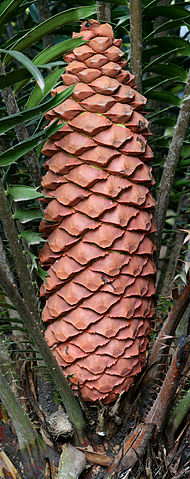 |
| Photo by Muhammad Mahdi Karim, via Wikimedia Commons |
 |
| Photo by Derek Ramsey, at Chanticleer Garden, via Wikimedia Commons |
Persimmon
A Y-chromosome-encoded small RNA acts as a sex determinant in persimmons
Takashi Akagi1,2, Isabelle M. Henry1, Ryutaro Tao2,*, Luca Comai1,*
 |
| Photo by Σ64, via Wikimedia Commons |
Identification of molecular markers for selection of supermale (YY) asparagus plants.
Gebler P, Wolko Å, Knaflewski M.
 |
| Photo by Rasbak, via Wikimedia Commons |
Sex-determining chromosomes and sexual dimorphism: insights from genetic mapping of sex expression in a natural hybrid Fragaria à ananassa subsp. cuneifolia.
Govindarajulu R, Liston A, Ashman TL.
 |
| Photo via Walter Siegmund, via Wikimedia Commons |
Accumulation of interspersed and sex-specific repeats in the non-recombining region of papaya sex chromosomes.
Na JK, Wang J, Ming R.
 |
| Photo by Sakurai Midori, via Wikimedia Commons |
A small XY chromosomal region explains sex determination in wild dioecious V. vinifera and the reversal to hermaphroditism in domesticated grapevines.
Picq S, Santoni S, Lacombe T, Latreille M, Weber A, Ardisson M, Ivorra S, Maghradze D, Arroyo-Garcia R, Chatelet P, This P, Terral JF, Bacilieri R.
 |
| Photo by Bangin, via Wikimedia Commons |
So, yes, plants have sex, and some even have sex chromosomes. Just something to keep in mind as you work towards fulfilling your daily servings of fruits and veggies.
19 Comments
John Harshman · 4 November 2014
Just wondering about the last reference. Do domesticated grapevines have sex chromosomes, or do they have a small sex-determining region (though apparently bigger than a single locus) on a pair of autosomes? For that matter, what's the dividing line between sex chromosomes with pseudo-autosomal regions and autosomes with sex-determining regions?
M. Wilson Sayres · 4 November 2014
Great questions, John.
To my understanding of the paper, domesticated grapevines, as far as we know, do not have whole sex chromosomes, but sex-determining regions. The wild grape ancestor has somewhat differentiated sex chromosomes, and exhibits dioecy (separate male and female plants), whereas the domesticated grapes are hermaphrodites, where flowers have male and female parts. Generally, separate sex chromosomes are only observed in species where separate male and female individuals are common (although this doesn't mean that hermaphrodites cannot also be common, just not exclusive).
The transition between an autosome with a sex determining region, and a sex chromosome can be fuzzy, as with most of biology, but would occur when one of the two chromosomes, the one with the sex-determining allele, starts to be found exclusively in one sex, AND where the sex determining region becomes linked to other genes. Likely these other genes are sexually antagonistic genes (beneficial in one sex, and harmful in the other). Until the sex-determining allele becomes linked to other alleles, there isn't any differentiation between the ancestral autosomes other than the sex-determining region, and so it is not any different that any other allelic variation. Once it becomes linked to other alleles, and starts being inherited in a sex-specific fashion, it is a sex chromosome.
gdavidson418 · 4 November 2014
OMG those plants are shameless.
Glen Davidson
John Harshman · 4 November 2014
I guess the question would be how much of a chromosome pair has to be non-recombining before you decide they're separate chromosomes, i.e. sex chromosomes. How big a pseudo-autosomal fraction can you have before it's just a pair of autosomes?
Joe Felsenstein · 4 November 2014
Jim Thomerson · 4 November 2014
Why do flowering plants have dual fertilization?
Just Bob · 4 November 2014
Henry J · 4 November 2014
M. Wilson Sayres · 5 November 2014
M. Wilson Sayres · 5 November 2014
M. Wilson Sayres · 5 November 2014
M. Wilson Sayres · 5 November 2014
John Harshman · 5 November 2014
M. Wilson Sayres · 5 November 2014
Rikki_Tikki_Taalik · 5 November 2014
ObamaEve!kencareygti · 5 November 2014
And, of course, the seed plants (gymnosperms and angiosperms) are not even all plants. There's also other vascular plants (ferns and horsetails, e.g.), bryophytes (mosses and liverworts), and algae of various sorts. Unlike animals, all of these plants (even the seed plants) have alternating multicellular haploid (gametophyte) and diploid (sporophyte) generations, and the sex determination can apply to the gametophytes as the sporophytes. In some plants (bryophytes, some algae) the haploid gametophyte is the independent freeliving "plant" and the sporophyte is a dependent stage.
And if that's not complicated enough for you, lots of plants with all sorts of life histories have various mating systems on top of the male/female component that control inbreeding, outbreeding, etc.
Never a dull moment for someone interested in plant reproduction! :)
Just Bob · 5 November 2014
M. Wilson Sayres · 6 November 2014
Scott F · 16 November 2014