Best ID Takedown of 2014 - Perhaps Ken Miller's Demolition of "Edge of Evolution"?

Posted 31 December 2014 by

behe-dunce.jpgMichael Behe is very thrilled that a PNAS paper published this year "confirms a key inference I made in 2007 in The Edge of Evolution." The Discovery Institute is also thrilled, enough so to reprint Behe's July 14, 2014 op-ed on ENV as this year's #4 in the top-story countdown. Says Behe, regarding what he describes as "the need for multiple, specific changes in a particular malarial protein (called PfCRT) for the development of resistance to chloroquine" :
... thanks to Summers et al. 2014...One of their conclusions is that a minimum of two specific mutations are indeed required for the protein to be able to transport chloroquine. ... The need for multiple mutations neatly accounts for why the development of spontaneous resistance to chloroquine is an event of extremely low probability -- approximately one in a hundred billion billion (1 in 1020) malarial cell replications -- as the distinguished Oxford University malariologist Nicholas White deduced years ago. The bottom line is that the need for an organism to acquire multiple mutations in some situations before a relevant selectable function appears is now an established experimental fact.

No where does either Discovery Institute piece make any mention of Brown biologist Ken Miller's epic takedown of Behe's new claims of vindication. More below the fold. Miller says
Directly contradicting Behe's central thesis, the PNAS study also showed that once the K76T mutation appears, there are multiple mutational pathways to drug resistance. In most of these, each additional mutation is either neutral or beneficial to the parasite, allowing cumulative natural selection to gradually refine and improve the parasite's ability to tolerate chloroquine. One of those routes involves a total of seven mutations, three neutral and four beneficial, to produce a high level of resistance to the drug. Figure 4, taken from the Summers et al PNAS paper, makes this point in graphic fashion, showing the multiple mutational routes to high levels of transport, which confer resistance to chloroquine.
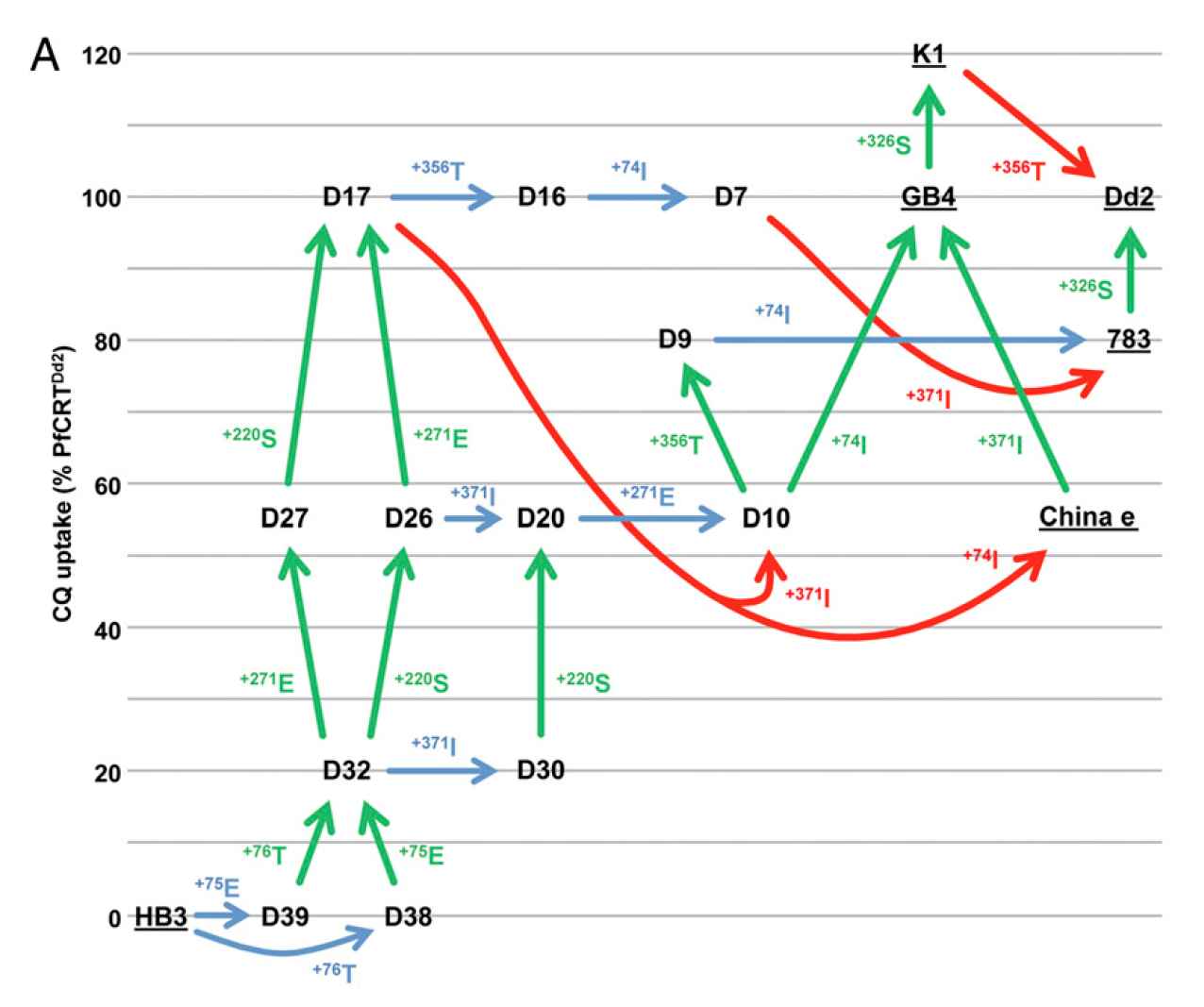
True to form, Miller keeps nailng Behe again and again:
Needless to say, nothing in the PNAS study supports Behe's mistaken view of how new protein binding sites must evolve. Behe insists that each such site must include five or six specific amino acids, which is not correct, and calculates his probabilities by insisting on predetermined results, which unrealistically stacks the deck.
Far from offering vindication, the PNAS paper actually cuts the legs out from under Behe's claims about evolution and the malaria parasite. How could he and his supporters get it so wrong? It may help to know that this is not the first time they've done something like this.
In a 2012 interview with Nature, Thornton expressed weariness with the way in which ID proponents continue to take issue with the clear implications of his work. "I'm sort of bored with them," he told the journal. In truth, I am, too. Time after time, they take work that devastates their key claims, like the PNAS study on drug resistance in malaria, and pretend to their willing adherents that science is trending their way. As it misrepresents one study after another, the ID movement continues on its steady and certain downward slide to irrelevance.
Miller's entire opus is also available as a single PDF file. Discuss.

160 Comments

TomS · 31 December 2014

I never understood how Behe thought that he was making a point by contrasting the strength of nature, including evolution by natural selection, with the weaknesses demonstrated by human-designed drugs. Every time a new designed drug is introduced which shows effectiveness against the malaria parasite, evolution of the parasite makes the drug ineffective. (Isn't it true that the evolution of sickle-cell trait has remained effective?) To me, this is an example of Orgel's Second Law: Evolution is smarter than you are.

Hardly an example of how intelligent design is necessary.

harold · 31 December 2014

This is a favor for science supporters. In my experience what little appeal evolution denial has for the general public is solely based on "humans are special" arguments.

"God creates malaria drug resistance by a miracle, but bothers to use normal molecules for his miracle" has no appeal except as a bizarre dead end obsessive pseudo-legalistic word game for the rare weirdos who post at UD. This type of crap made an initially sympathetic crowd in the Dover courtroom laugh at ID.

DS · 31 December 2014

This has got to be the dumbest thing Behe has ever done and that's saying a lot. He is claiming that resistance cannot evolve. But it has, repeatedly. This is like saying that a bumble bee cannot fly, it is obviously wrong.

Or maybe he trying to say that god intelligently designed and produced the resistant parasites. NIce god you got there Mikey. You better hope this is natural evolution. Then we at least have a chance of intelligently designing effective strategies for dealing with it. But if the magic sky pixie wants millions of people to die for no apparent reason, then we might as well give up and just let them all die. Sure seems like an awfully inefficient way of killing people though. Why not just strike them all dead at once? WHy give them the chance to develop drugs that can save their lives? If Behe is claiming that some god really is behind all this, then he has shown the limits of his god, not evolution.

harold · 31 December 2014

Or maybe he trying to say that god intelligently designed and produced the resistant parasites.
This has to be what he's saying, since he doesn't deny the existence of resistance, nor deny that drugs worked before resistance arose.
But if the magic sky pixie wants millions of people to die for no apparent reason, then we might as well give up and just let them all die. Sure seems like an awfully inefficient way of killing people though. Why not just strike them all dead at once?
An excellent point. It's barely worth engaging Behe's absurd argument at this depth, but, anyway, for amusement... 1) To repeat a point I made above, if resistance is the magical act of a god, why bother with mutations and molecules to begin with? Why not just make the chloroquine magically disappear as soon as the patient ingests it? The FSM could do that with ease. 2) As you note, if this god of Behe's wants all these malaria victims dead, why bother with the whole rigmarole of parasites that humans might or might not be able to successfully defeat? Why not just magically cause the intended victims to experience high fever and organ failure, and die? We just end up at the same old Last Thursdayism impasse - it's either a totally inscrutable god, frequently malign from human perspective, who always behaves exactly in the same way that evolution would act, or it's evolution. However, unlike true Last Thursdayism, Behe can be shown to be wrong. His proposed mechanism for the emergence of malaria drug resistance - "exactly and only two exact mutations, at exactly the same time, and nothing else will work" - is incorrect.

TomS · 31 December 2014

harold said:
Or maybe he trying to say that god intelligently designed and produced the resistant parasites.
This has to be what he's saying, since he doesn't deny the existence of resistance, nor deny that drugs worked before resistance arose.
But if the magic sky pixie wants millions of people to die for no apparent reason, then we might as well give up and just let them all die. Sure seems like an awfully inefficient way of killing people though. Why not just strike them all dead at once?
An excellent point. It's barely worth engaging Behe's absurd argument at this depth, but, anyway, for amusement... 1) To repeat a point I made above, if resistance is the magical act of a god, why bother with mutations and molecules to begin with? Why not just make the chloroquine magically disappear as soon as the patient ingests it? The FSM could do that with ease. 2) As you note, if this god of Behe's wants all these malaria victims dead, why bother with the whole rigmarole of parasites that humans might or might not be able to successfully defeat? Why not just magically cause the intended victims to experience high fever and organ failure, and die? We just end up at the same old Last Thursdayism impasse - it's either a totally inscrutable god, frequently malign from human perspective, who always behaves exactly in the same way that evolution would act, or it's evolution. However, unlike true Last Thursdayism, Behe can be shown to be wrong. His proposed mechanism for the emergence of malaria drug resistance - "exactly and only two exact mutations, at exactly the same time, and nothing else will work" - is incorrect.
Nicholas Malebranche (1638-1715) is remembered as the philosopher who promoted the idea of Occasionalism, that God directly causes things to happen, but acts so that things appear to be following natural laws. Does this sound anything like Behe? It happens to be that M. also brought forth the idea that complex interactions of the organs of the body could not develop piecewise, but had to be created together. And I think that he had the idea that the present form of a living thing was created by God in latent form at the beginning. Would it be interesting to hear whether B. has ever heard of M.?

Just Bob · 31 December 2014

DS said: But if the magic sky pixie wants millions of people to die for no apparent reason, then we might as well give up and just let them all die. Sure seems like an awfully inefficient way of killing people though. Why not just strike them all dead at once? WHy give them the chance to develop drugs that can save their lives?
And that has always been my Prime Objection to the Whole Silly Ark Story: If you're god, and you want a lot of sinners dead, why do you need a flood?

gdavidson418 · 31 December 2014

Well, it's there if there ever is a Dover II, or Scopes V (not sure what the count would be, actually), or whatever they want to call it.

Edging Toward Irrelevance, though? Regarding science, there never was any relevance, and flatly claiming victory for ID whenever the evidence goes (even more) against them is them being about as PR relevant as ever. Still, it's fun to see Behe's whole last book go down the drain, not just for unwarranted speculations and claimed knowledge of God's mind and doings (how did he know where and when design left off anyway, so that he "knew" God didn't design chloroquine resistance?), but for being quite wrong on the facts.

They've got the true believers who'll swallow any nonsense said against "godless evolution," and I guess they're happy to stick with them. Behe's just showing that he can be even more pathetic than he was at Dover. For the tribe, that's proof of loyalty, with the added benefit that "I was wrong" is conveniently off of the table (he seems allergic to it).

Glen Davidson

scienceavenger · 31 December 2014

harold said: "God creates malaria drug resistance by a miracle, but bothers to use normal molecules for his miracle" has no appeal except as a bizarre dead end obsessive pseudo-legalistic word game for the rare weirdos who post at UD. This type of crap made an initially sympathetic crowd in the Dover courtroom laugh at ID.
Vestigial organs gets similar treatment at EN&V. Perhaps we shouldn't be surprised that ID supporters favor legalistic arguments, since it was born of Philip Johnson's legal mind. On a broader point, all one need know about the scientific bent of ID supporters is illustrated by EN&V's comment policy: none allowed.

John Harshman · 31 December 2014

DS said: This has got to be the dumbest thing Behe has ever done and that's saying a lot. He is claiming that resistance cannot evolve. But it has, repeatedly. This is like saying that a bumble bee cannot fly, it is obviously wrong.
How is it possible, after all the discussion here and elsewhere, to continue to fundamentally misunderstand Behe on this point? He didn't say that resistance can't evolve. In fact he uses it as an example of evolution, in fact of the most that evolution can produce. Miller's point is that Behe's idea of how resistance evolved (by exactly two simultaneous mutations, each individually deleterious) is just plain wrong. Once again: Behe thinks that chloroquine resistance did evolve. He's just wrong about the details of the process.

mattdance18 · 31 December 2014

As this sorry episode well indicates, when it comes to evolution, Michael Behe is intellectually dishonest. But then, we've known that since even before Dover. This is merely the most recent example of his penchant for lying.

For sheer dishonesty, no creationist can top Philip Johnson. But Behe comes close.

harold · 31 December 2014

John Harshman said:
DS said: This has got to be the dumbest thing Behe has ever done and that's saying a lot. He is claiming that resistance cannot evolve. But it has, repeatedly. This is like saying that a bumble bee cannot fly, it is obviously wrong.
How is it possible, after all the discussion here and elsewhere, to continue to fundamentally misunderstand Behe on this point? He didn't say that resistance can't evolve. In fact he uses it as an example of evolution, in fact of the most that evolution can produce. Miller's point is that Behe's idea of how resistance evolved (by exactly two simultaneous mutations, each individually deleterious) is just plain wrong. Once again: Behe thinks that chloroquine resistance did evolve. He's just wrong about the details of the process.
I think you are wrong, not through any fault of your own, but because as an honest observer you underestimate the deceptive nature of ID, which often employs an ambivalent language style, in order to seem to be saying one thing to one person, while clearly saying something else, albeit in a somewhat coded way, to another.
The need for multiple mutations neatly accounts for why the development of spontaneous resistance to chloroquine is an event of extremely low probability – approximately one in a hundred billion billion (1 in 1020) malarial cell replications
Granted, there are a huge number of malarial cell replications in the biosphere every second, but the unequivocal goal of someone making this statement is to imply that the resistance could not have arisen through this "low probability" method. Why make a mistake like this about the probability of malarial chloroquine resistance? This isn't an honest mistake. It's a straw man version of scientific explanations for malaria resistance, created to falsely portray such explanations as excessively improbable. I get what you think that Behe says. You think that Behe says "Evolution happens, but it's so weak that it can just barely produce malaria parasite resistance to chloroquine, so how could it ever produce the magnificent human brain blah blah blah". Although if saying that Behe would still be wrong, it is my distinct impression that you are giving Behe far too much credit. First of all too much credit for subtlety of thought. And second of all too much credit for honesty. The simplest way to resolve this would be to ask Behe, but that wouldn't work, because he wouldn't give a straightforward answer, or indeed any answer at all, which to me supports my point here.

mattdance18 · 31 December 2014

John Harshman said: Behe thinks that chloroquine resistance did evolve. He's just wrong about the details of the process.
Uh, right. But aren't a couple of the "details" about which he is incorrect that (a) the evolution of adaptively advantageous biochemical pathways is vanishingly improbable, and that (b) their observable evolution therefore requires direction by a designer? I mean, look, I certainly get that Behe is no AiG-style creationist, that he accepts the ancient age of the earth and even natural selection as an evolutionary mechanism for much adaptation and biodiversity. But at the level of basic biochemistry, he claims that undirected natural selection is insufficient. He's still a creationist; he and YEC's merely differ over where to locate the activity of the designer in their creationist explanations. Miller cites Behe's The Edge of Evolution on part 4 of this year's takedown:
“Now suppose that, in order to acquire some new, useful property, not just one but two new protein-binding sites had to develop. … So, if other things were equal, the likelihood of getting two new binding sites would be what we called in Chapter 3 a ‘double CCC’ — the square of a CCC, or one in ten to the fortieth power. Since that’s more cells than likely have ever existed on earth, such an event would not be expected to have happened by Darwinian processes in the history of the world. .. And the great majority of proteins in the cell work in complexes of six or more. Far beyond that edge." (Behe, 2007, p. 135). [boldface emphasis added by mattdance18]
Behe is pretty clear: "Darwinian processes" won't cut it when it comes to biochemical evolution; only an intelligent designer could account for it. Creationism.

DS · 31 December 2014

It seems to me that Behe is claiming that the probability of resistance evolving is so low that it couldn't happen naturally. But it has evolved multiple times in different species. Therefore his probability calculations are irrelevant. Resistance did evolve, many times, so no matter what he claims evolution cannot do, he has already been proven to be wrong about that. So he could be wrong about anything else he claims evolution cannot do as well.

Even if he is only trying to claim that it is extremely unlikely for resistance to evolve, he has still been proven wrong. Unlikely things happen all the time. Even if his calculations did somehow accurately represent reality, the only possible conclusion would be that there are orders of magnitude more than enough parasites for resistance to evolve in a fairly short period of time. So, even if he refuses to say what his point is, he still loses. His resistance to evolution is futile.

Now if he had a step by step, miracle by miracle account of exactly how the resistance came about by supernatural means, that pathetic level of detail might be something to look at. Until then, all he has is personal incredulity, a specious probability calculation and a fundamentally flawed understanding of biology.

mattdance18 · 31 December 2014

DS said: Until then, all he has is personal incredulity, a specious probability calculation and a fundamentally flawed understanding of biology.
...and a tenured university position teaching biology....

Doc Bill · 31 December 2014

I thought that what Behe wrote in Edge was that resistance required two SIMULTANEOUS mutations and that was beyond the edge of evolution, therefore the malaria plasmodium was designed. Didn't Behe argue as well that SEQUENTIAL mutations were essentially impossible leading again, ta da, to design.

Thus, I was mystified (and still dazed and confused) how a paper which describes a series and multiple pathways of SEQUENTIAL mutations conferring resistance is in any way supportive of his thesis in Edge.

I can only surmise that if you're an IDiot shouting "Victory!" loud enough is all you need to do, because certainly the IDiot minions aren't going to read the paper.

burllamb · 31 December 2014

Good Lord - all these science-y arguments being made! The Discovery Institute laughs at your logic, for it matters not. The people who send the DI money - boatloads and boatloads of green crisp delicious money - don't read your science-y replies. They don't actually understand or even care about the science. And neither does the Discovery Institute.

The Discovery Institute is about all that cabbage, that kale. The Cheddar, the clams, the lettuce, the bread. It's about simoleons, not science; loot, not logic; Benjamins, not biology. It's a multimillion dollar-a-year enterprise with hardly any real expenses, and just a few employees. It's a legal permit to print money, and the more time, effort, and electronic ink you spend attacking it rationally on its scientific merits, the happier, wealthier, and more legitimate-looking do you make its beneficiaries.

Mike Elzinga · 31 December 2014

It seems to me that it is the general structure of the thought processes of ID/creationists that leads them to make such dumb mistakes. They all have a sectarian, preconceived notion of how the world was built and should be working; and every one of them, throughout their entire educations - those that actually got an education - have been systematically bending and breaking scientific concepts and evidence to fit their sectarian world view. It has become locked-in behavior; they simply can't think any other way.

ID/creationists misconceptions have pedagogical implications for those who have the responsibilities for teaching science to the general public. ID/creationist memes are common in our culture because of fifty years of intense socio/political effort on the part of the leaders of the ID/creationist movement. Depending on the part of the US in which one lives, instructors are very likely to encounter them in at least a few of their students.

ID/creationist misconceptions aren't confined to biological evolution - the original motivation for the genesis of the ID/creationist movement back in the 1970s. They now have to get even basic probability and statistics wrong; to say nothing of how they mangle basic physics and chemistry.

But certainly one thing has become clear in the fifty years ID/creationists have been spreading their memes, despite repeated attempts by members of the scientific community to correct them; ID/creationism is dishonest to its core, and the leaders of this movement know it.

TomS · 31 December 2014

It has been a long time since I read "Edge of Evolution".

Does Behe expect the reader to think that all of the changes to the malaria parasite in response to each new human-designed treatment to be "Intelligently Designed" or to have occurred by natural causes (that is, evolution)?

Is the sickle cell trait still effective against malaria? Does Behe expect the reader to think that the sickle cell trait to have evolved, or to be "Intelligently Designed"?

I understand that B. has suggested that modern organisms have had their traits in latent form back to long ago. Would that be the explanation, according to B., for the modern appearance of resistance? That maybe the "Intelligent Designers" anticipated modern human designs of treatments, and designed the original malaria parasites so that they could respond to our treatments?

Is it possible to make a consistent account of B.'s. Is there any account which someone could describe with a straight face?

gdavidson418 · 31 December 2014

On the matter of whether or not Behe thinks chloroquine resistance evolved, there this. Note that Hoppe corrects his claim that Behe thought that chloroquine resistance couldn't evolve, and links to a couple of posts.

Beyond a bit of googling, I wasn't about to enact the labor, since it's baseless BS anyway. Still, no point in making basically incorrect claims about what Behe himself has declared.

Glen Davidson

gdavidson418 · 31 December 2014

This should have been the link, because Hoppe's correction shows at the top here. Still in the previous link, but you have to scroll up to find it. I didn't realize that it had linked to one of the linked comments.

Glen Davidson

Jose Fly · 31 December 2014

I've actually had creationists, in their zeal to oppose evolution no matter what, state that they believe God deliberately designs the biochemical pathways and biological structures pathogens use to inflict disease. IOW, they'd rather believe in a bio-terrorist god than evolution.

Now that's dedication! Or delusion.....

Doc Bill · 31 December 2014

burllamb said: Good Lord - all these science-y arguments being made! The Discovery Institute laughs at your logic, for it matters not. The people who send the DI money - boatloads and boatloads of green crisp delicious money - don't read your science-y replies. They don't actually understand or even care about the science. And neither does the Discovery Institute. The Discovery Institute is about all that cabbage, that kale. The Cheddar, the clams, the lettuce, the bread. It's about simoleons, not science; loot, not logic; Benjamins, not biology. It's a multimillion dollar-a-year enterprise with hardly any real expenses, and just a few employees. It's a legal permit to print money, and the more time, effort, and electronic ink you spend attacking it rationally on its scientific merits, the happier, wealthier, and more legitimate-looking do you make its beneficiaries.
You forgot the gravy train! Tute! Tute! The gravy train has been running slowly these past few years, so the Tooter's started shoveling the old Tent Revival to get the steam up! Not so coy about You-Know-Who, the Designer (tm), why it's the old guy with the white beard and I don't mean Santa. I've been surprised that they've come flat earth, I mean, flat out and admitted they're all creationists but one look at the Ken Hampire tells you there's green in them thar hills, hillbillys and all. That will be the Gerbil on the fiddle and Klinkers on the jug. And a one, and a two ... Whatever it takes to keep that gravy train rolling.

gdavidson418 · 31 December 2014

Doc Bill said:
burllamb said: Good Lord - all these science-y arguments being made! The Discovery Institute laughs at your logic, for it matters not. The people who send the DI money - boatloads and boatloads of green crisp delicious money - don't read your science-y replies. They don't actually understand or even care about the science. And neither does the Discovery Institute. The Discovery Institute is about all that cabbage, that kale. The Cheddar, the clams, the lettuce, the bread. It's about simoleons, not science; loot, not logic; Benjamins, not biology. It's a multimillion dollar-a-year enterprise with hardly any real expenses, and just a few employees. It's a legal permit to print money, and the more time, effort, and electronic ink you spend attacking it rationally on its scientific merits, the happier, wealthier, and more legitimate-looking do you make its beneficiaries.
You forgot the gravy train! Tute! Tute! The gravy train has been running slowly these past few years, so the Tooter's started shoveling the old Tent Revival to get the steam up! Not so coy about You-Know-Who, the Designer (tm), why it's the old guy with the white beard and I don't mean Santa. I've been surprised that they've come flat earth, I mean, flat out and admitted they're all creationists but one look at the Ken Hampire tells you there's green in them thar hills, hillbillys and all. That will be the Gerbil on the fiddle and Klinkers on the jug. And a one, and a two ... Whatever it takes to keep that gravy train rolling.
I think burllamb was describing a gravy boat:
boatloads and boatloads of green crisp delicious money
But they're doing the Designer's work, so it's all good. Seems Designer has to have other people do everything for it, even though once upon a time it made a universe, fine-tuned it, and went through the great effort to make life look undesigned. Probably because it's concerned that the right people get their gravy. Glen Davidson

Carl Drews · 31 December 2014

burllamb said: Good Lord - all these science-y arguments being made! The Discovery Institute laughs at your logic, for it matters not. The people who send the DI money - boatloads and boatloads of green crisp delicious money - don't read your science-y replies. They don't actually understand or even care about the science. And neither does the Discovery Institute. The Discovery Institute is about all that cabbage, that kale. The Cheddar, the clams, the lettuce, the bread. It's about simoleons, not science; loot, not logic; Benjamins, not biology. It's a multimillion dollar-a-year enterprise with hardly any real expenses, and just a few employees. It's a legal permit to print money, and the more time, effort, and electronic ink you spend attacking it rationally on its scientific merits, the happier, wealthier, and more legitimate-looking do you make its beneficiaries.
Overall, I agree with this argument by burllamb. But there are still a small number of people who are interested in scientific rebuttals to the DI and are convinced by them. Keep them coming! Biology and geology are big subjects, and nobody has the expertise to refute every anti-evolution argument that has ever been made. Maybe we can break open the DI's echo chamber around the edges bit by bit .

SLC · 31 December 2014

It is my information that he only adopted ID after he got tenure. Prior to his getting tenure, he was a productive scientist publishing in peer reviewed journals. As to whether his non-tenured sojourn was duplicitous, like Jonathan Wells pre-PhD award position, I don't know.
mattdance18 said:
DS said: Until then, all he has is personal incredulity, a specious probability calculation and a fundamentally flawed understanding of biology.
...and a tenured university position teaching biology....

TomS · 31 December 2014

SLC said: It is my information that he only adopted ID after he got tenure. Prior to his getting tenure, he was a productive scientist publishing in peer reviewed journals. As to whether his non-tenured sojourn was duplicitous, like Jonathan Wells pre-PhD award position, I don't know.
I'd rather not get into personalities on this. The science deniers can do that. Moreover, it's difficult enough for me to understand my own motivations, let alone those of people that I have never met.:) But I believe that B. was promoted to (full) professor in recognition of continuing professional contributions after tenure. This would indicate that he was not just in wait for tenure to blossom.

harold · 31 December 2014

gdavidson418 said: This should have been the link, because Hoppe's correction shows at the top here. Still in the previous link, but you have to scroll up to find it. I didn't realize that it had linked to one of the linked comments. Glen Davidson
Look, I'm all in favor being "fair" and stuff, but there's not point in being taken in by really obvious double talk. Behe gets money by using words that mean, to the people who buy his books, "I'm saying that evolution doesn't happen". Behe knows that Behe gets money by using words that mean, to the people who buy his books, "I'm saying that evolution doesn't happen". Behe talks in a dissembling, ambivalent way, that is immediately understood by the dogs he's whistling at but causes confusion to those who are charmingly naive enough to try, futilely, to figure out "What Behe really believes". But the whole point of the ID scam is disguise things. What Behe believes is that Behe gets money, and gets out of work, by misrepresenting the theory of evolution. Okay, you say, but why bother with this dissembling? Ken Ham is doing pretty well just by preaching YEC. Well, first of all, the DI fellows probably work less for more money than AIG employees, but that's not the point. Remember, they make more than Ken Ham even though ID failed at Dover. They're living large on the consolation prize. If ID had succeeded, if they had gotten "court proof" sectarian science denial bullshit into public school science classes, they'd be making Rush Limbaugh money.

Ron Okimoto · 31 December 2014

http://en.wikipedia.org/wiki/The_Edge_of_Evolution

Wiki seems to indicate that Behe is ambiguous in his intent. It sounds like Behe wants it both ways in terms of evolution or design. Apparently in the book he does claim that the designer is responsible for putting mutations into organisms, but he doesn't seem to be clear on what mutations these are. Behe seems to believe that malarial resistance is some type of edge of evolution. He probably understands that two mutations could occur naturally, and that may be his maximum expected, so his prediction would be that malarial resistance is not due to the designer and that only two mutations would be found to be necessary. This would be Behe's "edge." There would be no reason to crow about the results if this were the case. Behe's reaction to the findings indicates that he thinks that even though two mutations are a possibility that they are so improbable that Design is more probable. Behe had to admit that his own simulation determined that his double mutation was expected to occur in a single generation of the number of organisms found in a reasonable amount of pond mud. He would be claiming that his designer was helping the malarial parasite to continue to be a plague on the designer's human creations. So either way Behe's argument seems to be stupid. Either nature would have been expected to be responsible, or for some reason even though two mutations could occur naturally the designer would have some reason to help the malarial parasite in multiple instances where the same mutations have occurred in different populations.

Pretty much only Behe knows that he meant. Malarial resistance seems to be a null result for ID no matter what interpretation is put forward.

John Harshman · 31 December 2014

I'm fairly depressed that so few people commenting seem to have any idea of what Behe claims. Apparently nobody has actually read Ken Miller's analysis, which should have made everything clear. Chloroquine resistance is Behe's "edge of evolution" precisely because he thinks it's the very most that evolution can ever do. (And this only in a huge population with short generations.) Can't anyone else here read?

It's a "double CC" that he thinks is impossible: two simultaneous events equivalent to the evolution of chloroquine resistance.

Further, what Behe thinks the evolution of resistance entails is two simultaneous mutations, each of which would be deleterious on its own. This he agrees can happen in the Plasmodium population, around once every 20 years. What Miller shows is that Behe's imagined double-mutation mechanism wasn't required and in fact didn't happen, which demolishes his argument.

TomS · 31 December 2014

I think that you underestimate self-deception.

harold · 1 January 2015

John Harshman said: I'm fairly depressed that so few people commenting seem to have any idea of what Behe claims. Apparently nobody has actually read Ken Miller's analysis, which should have made everything clear. Chloroquine resistance is Behe's "edge of evolution" precisely because he thinks it's the very most that evolution can ever do. (And this only in a huge population with short generations.) Can't anyone else here read? It's a "double CC" that he thinks is impossible: two simultaneous events equivalent to the evolution of chloroquine resistance. Further, what Behe thinks the evolution of resistance entails is two simultaneous mutations, each of which would be deleterious on its own. This he agrees can happen in the Plasmodium population, around once every 20 years. What Miller shows is that Behe's imagined double-mutation mechanism wasn't required and in fact didn't happen, which demolishes his argument.
Prove it. Find a direct quote from Behe that says, in unambiguous language, "I concede that malaria chloroquine resistance itself is the result of mutation and natural selection, but I bring this example up to show that such evolutionary events are very rare". Ideally find verifiable quotes of Behe saying that in unambiguous language on more than one occasion. To repeat, Behe himself saying it in unambiguous language that would not be interpreted by a reasonable person as "I'm saying that chloroquine resistance can't evolve, it exists, therefore it's a miracle". Any unambiguous quote will do. Passage from book, quote from interview, even honest transcript of a personal conversation with Behe. He's still wrong if that's his point but I refuse to give him credit for that, if he's really saying "Sure looks it's 'improbable' for chloroquine resistance to have evolved, hahahaha, folks when I say 'improbable' you know what I mean", and you're desperately saying "Oh thank goodness, he only said improbable, he must mean it really happened!", which is what I think is what's happening. Look, it's fairly predictable that malaria parasites will evolve resistance to a simple one drug therapy strategy, and to say anything else is to pander to pure denial. "Sky may be blue but it could be green" is ambivalent bullshit, pandering to blue sky denial, not an "admission that the sky is blue". The sky is blue. The sky is blue. Denying it in weasel words is just a more obnoxious way of denying it than denying it in strong words. Here's the relevant passage from the Ken Miller article, and it supports what everyone else is saying.
Here’s how it works. Let’s accept Behe’s number of 1 in 1020 for the evolution of a complex mutation like his CCC. As he admits, CCC’s have arisen multiple times in the malaria parasite population since the drug was first introduced in 1947. In fact, resistance to the drug appeared in the late 1950s and early 1960s, within just 15 years of its widespread use. So it only took a decade and a half for one of Behe’s CCC’s to emerge in the parasite population. Now, suppose that another drug, equal in effectiveness to chloroquine, were to come into wide use. According to Behe, resistance to both drugs would require two CCCs, and the probability of double resistance arising would be a CCC squared. That’s 1 in 1020 x 1020 or one chance in 1 in 1040. According to Behe’s math, that’s such a large number that we can call it impossible: “…throughout the course of history there would have been slightly fewer than 1040 cells, a bit less than we’d expect to need to get a double CCC. The conclusion, then, is that the odds are slightly against even one double CCC showing up by Darwinian processes in the entire course of life on earth.” (Behe, 2007, p. 63).
Well, right off the bat, malaria parasites are resistant to more drugs than just chloroquine, so that's Behe effectively saying, even by your generous interpretation, that some of that resistance had to be miraculous. But I don't see the part where Behe says "Okay, okay, it happened once". I see the part where he says "And not only is once outrageously 'improbable', but twice is even more crazily 'improbable'". I see the part where he effectively argues that not even two metabolic pathway changes in a lineage of unicellular parasites with short generation spans could ever have evolved in the history of the Earth. That's about as strong a denial of evolution as I can imagine, and clearly implies that most microbe antibiotic resistance must not be due to evolution. So it doesn't make Behe much more right if he actually says "I concede that chloroquine resistance did arise through mutation and natural selection, but mention this to point out that such events should be rare". But I still remain unconvinced that he even says that. Does this matter? Yes it does. Because people need to stop attributing imaginary unambivalent, consistent, and coherent positions to evolution deniers. Behe doesn't give a rat's ass about chloroquine resistance; he probably has access to the resources to do valid research on malaria drug resistance and chooses to write bullcrap creationist books instead. He just wants to say words that make right wing billionaires think he's "disproving" evolution, and give him money for that.

Joel Eissenberg · 1 January 2015

John Harshman said: I'm fairly depressed that so few people commenting seem to have any idea of what Behe claims. Apparently nobody has actually read Ken Miller's analysis, which should have made everything clear. Chloroquine resistance is Behe's "edge of evolution" precisely because he thinks it's the very most that evolution can ever do. (And this only in a huge population with short generations.) Can't anyone else here read? It's a "double CC" that he thinks is impossible: two simultaneous events equivalent to the evolution of chloroquine resistance. Further, what Behe thinks the evolution of resistance entails is two simultaneous mutations, each of which would be deleterious on its own. This he agrees can happen in the Plasmodium population, around once every 20 years. What Miller shows is that Behe's imagined double-mutation mechanism wasn't required and in fact didn't happen, which demolishes his argument.
Thanks for bringing the discussion back to these points. As I read Miller's analysis, I think there is one additional point worth emphasizing. Behe treats the path to chloroquine resistance as a unique solution, whereas the experimental evidence suggest there are multiple paths. His baseball analogy captures Behe's fallacy.

Ron Okimoto · 1 January 2015

John Harshman said: I'm fairly depressed that so few people commenting seem to have any idea of what Behe claims. Apparently nobody has actually read Ken Miller's analysis, which should have made everything clear. Chloroquine resistance is Behe's "edge of evolution" precisely because he thinks it's the very most that evolution can ever do. (And this only in a huge population with short generations.) Can't anyone else here read? It's a "double CC" that he thinks is impossible: two simultaneous events equivalent to the evolution of chloroquine resistance. Further, what Behe thinks the evolution of resistance entails is two simultaneous mutations, each of which would be deleterious on its own. This he agrees can happen in the Plasmodium population, around once every 20 years. What Miller shows is that Behe's imagined double-mutation mechanism wasn't required and in fact didn't happen, which demolishes his argument.
My guess is that Behe pretty much wants to be misinterpreted. As I pointed out it doesn't matter what Behe meant. A double mutation is a null argument either way, whether a double mutation is needed or not. Behe should look into mutations that radically change the phenotype that happen a lot more often than the plasmodium mutation. FGFR3 mutates in humans to the dominant phenotype of achondroplastic dwarfisum. We can count the de novo mutations and they happen around every 14,000 live births. Behe should look at instances like these and try to figure out what the design is. If the designer can control mutation rate of specific positions in a gene to create certain combinations, what is Behe's excuse for the high rate of dwarfism? If the designer isn't controlling the locus why isn't he controlling the locus if he can when he wants to? Why is the designer making a lot of dwarfs and making plasmodium more resistant? http://www.ncbi.nlm.nih.gov/pmc/articles/PMC1801129/ FGFR2 also has a position that changes at a high rate, and can be detected due to dominance of the mutation though it doesn't change as often. This paper looks into the issue. In the FGFR2 instance the designer seems to be tinkering with the paternal gametes (the designer is mutating the father's genes). http://www.pnas.org/content/102/17/6051.full So if all Behe is claiming is that mutations would have to occur at a higher rate than expected he should explain hot spots of mutation and why he doesn't have to figure that into his calculations? Is the designer really directly involved in making a lot of dwarfs? Isn't that a lot better locus to study than looking where he is looking? If the designer can control mutations at specific positions what is the designer doing with FGFR3? In the case of FGFR3 the extremely high rate of mutation seems to be a human phenomenon. If the mutation at that position was occurring at that rate in cats and dogs or chickens and cows we should know it by now, so why isn't that the edge of evolution? Achondroplasitic dwarfism occurs in other animals, but not, that I know of, at the rate of 1 in 14,000 births. Could it be that the designer wants more humans on earth to be dwarf? Does that mean that the dwarf parents that choose to abort normal fetuses are doing the right thing in terms of the desires of the designer? The possible discussion is endless.

harold · 1 January 2015

Ron Okimoto said:
John Harshman said: I'm fairly depressed that so few people commenting seem to have any idea of what Behe claims. Apparently nobody has actually read Ken Miller's analysis, which should have made everything clear. Chloroquine resistance is Behe's "edge of evolution" precisely because he thinks it's the very most that evolution can ever do. (And this only in a huge population with short generations.) Can't anyone else here read? It's a "double CC" that he thinks is impossible: two simultaneous events equivalent to the evolution of chloroquine resistance. Further, what Behe thinks the evolution of resistance entails is two simultaneous mutations, each of which would be deleterious on its own. This he agrees can happen in the Plasmodium population, around once every 20 years. What Miller shows is that Behe's imagined double-mutation mechanism wasn't required and in fact didn't happen, which demolishes his argument.
My guess is that Behe pretty much wants to be misinterpreted. As I pointed out it doesn't matter what Behe meant. A double mutation is a null argument either way, whether a double mutation is needed or not. Behe should look into mutations that radically change the phenotype that happen a lot more often than the plasmodium mutation. FGFR3 mutates in humans to the dominant phenotype of achondroplastic dwarfisum. We can count the de novo mutations and they happen around every 14,000 live births. Behe should look at instances like these and try to figure out what the design is. If the designer can control mutation rate of specific positions in a gene to create certain combinations, what is Behe's excuse for the high rate of dwarfism? If the designer isn't controlling the locus why isn't he controlling the locus if he can when he wants to? Why is the designer making a lot of dwarfs and making plasmodium more resistant? http://www.ncbi.nlm.nih.gov/pmc/articles/PMC1801129/ FGFR2 also has a position that changes at a high rate, and can be detected due to dominance of the mutation though it doesn't change as often. This paper looks into the issue. In the FGFR2 instance the designer seems to be tinkering with the paternal gametes (the designer is mutating the father's genes). http://www.pnas.org/content/102/17/6051.full So if all Behe is claiming is that mutations would have to occur at a higher rate than expected he should explain hot spots of mutation and why he doesn't have to figure that into his calculations? Is the designer really directly involved in making a lot of dwarfs? Isn't that a lot better locus to study than looking where he is looking? If the designer can control mutations at specific positions what is the designer doing with FGFR3? In the case of FGFR3 the extremely high rate of mutation seems to be a human phenomenon. If the mutation at that position was occurring at that rate in cats and dogs or chickens and cows we should know it by now, so why isn't that the edge of evolution? Achondroplasitic dwarfism occurs in other animals, but not, that I know of, at the rate of 1 in 14,000 births. Could it be that the designer wants more humans on earth to be dwarf? Does that mean that the dwarf parents that choose to abort normal fetuses are doing the right thing in terms of the desires of the designer? The possible discussion is endless.
Yes, this is the essence of my point. Behe wants to be misinterpreted. He wants to have his cake and eat it too. Not only that, his reason for wanting it is to advance the cause of political evolution denial. He wants the hard core creationists to read him as saying "evolution is impossible" - which is clearly 100% of the time what he actually is saying. But he wants mainstream scientists to fret, wring their hands, and pace the halls saying "Oh but Michael Behe is so respectable! He 'doesn't deny' the age of the Earth. He works at a mainstream university. Why he isn't the least bit like that awful Ken Ham. I'm sure Behe is really making some wrong but respectable point, based on sincere misunderstanding". But why does Behe want this? Job security? Nope, he's tenured. Money? Nope, he gets more from creationism. So that his mainstream research program won't be associated with his evolution denial? Nope, he doesn't have one. The point of his ambiguity is to put a false "reasonable scientist" face on evolution denial, in order to beguile the general public and help those who scheme to get evolution denial into public schools.

DS · 1 January 2015

Well if Behe wants to do a probability calculation, why doesn't he do one using the multiple pathway model? If he thinks that this paper is evidence in favor of his version of reality, whatever that may be, then why hasn't he learned anything from it? It proves that two simultaneous mutations are not required. It proves that new functions can evolve. It proves that mutations can be beneficial. It proves that sitting around doing fallacious math to try to prove that reality conforms to your preconceptions is a worthless endeavor.

You are really talking out both sides of your ass if you claim that the odds are against something happening even once in the entire history of life on earth and then saying that it could happen in the existing population of one species. And you are just plain lying about it in either case, since it demonstrably happened multiple times in the recent past. At the very least this guy is telling two different lies to two different audiences. No one expects anything different. But crowing about how a paper supports one of your lies when it actually demolishes both of them goes beyond mere dishonesty and duplicity.

DS · 1 January 2015

Actually, multiple times in the very recent past in much smaller subpopulations and in more than one species.

gdavidson418 · 1 January 2015

harold said:
John Harshman said: I'm fairly depressed that so few people commenting seem to have any idea of what Behe claims. Apparently nobody has actually read Ken Miller's analysis, which should have made everything clear. Chloroquine resistance is Behe's "edge of evolution" precisely because he thinks it's the very most that evolution can ever do. (And this only in a huge population with short generations.) Can't anyone else here read? It's a "double CC" that he thinks is impossible: two simultaneous events equivalent to the evolution of chloroquine resistance. Further, what Behe thinks the evolution of resistance entails is two simultaneous mutations, each of which would be deleterious on its own. This he agrees can happen in the Plasmodium population, around once every 20 years. What Miller shows is that Behe's imagined double-mutation mechanism wasn't required and in fact didn't happen, which demolishes his argument.
Prove it. Find a direct quote from Behe that says, in unambiguous language, "I concede that malaria chloroquine resistance itself is the result of mutation and natural selection, but I bring this example up to show that such evolutionary events are very rare". Ideally find verifiable quotes of Behe saying that in unambiguous language on more than one occasion. To repeat, Behe himself saying it in unambiguous language that would not be interpreted by a reasonable person as "I'm saying that chloroquine resistance can't evolve, it exists, therefore it's a miracle". Any unambiguous quote will do. Passage from book, quote from interview, even honest transcript of a personal conversation with Behe.
Edge of Evolution, p. 62:
The development of chloroquine resistance isn't the toughest problem that evolution faces. We know that for certain, because the malarial parasite solved that problem, but hasn't solved others, such as sickle hemoglobin. How much more difficult than a CCC would a challenge have to get before Darwinian evolution would essentially be ineffective, even for simple single-celled creatures such as malaria?
There's the question, how much more difficult than a "CCC" would a challenge be for "Darwinian evolution" to be inadequate, even for P. falciparum? How he "knew" that evolution did it, not Designer, I have no idea, but apparently he did. Apparently Harshman can't read, or he'd know I've always held this position here, but he's self-righteous grumping as all too usual, so I'm clearly not saying this for him. Just because Behe was really unambiguous in the book. Glen Davidson

gdavidson418 · 1 January 2015

For perspective, the Behe quote from p. 62 in my post above is preceded by this on p. 59:
Even though the odds are tremendously stacked against it, P. falciparum was able to develop chloroquine resistance because there are an enormous number of parasitic cells (about a trillion) in an infected patient's body, and about a billion infected people in the world in a year. So the parasite has the population numbers to get around the terrible odds.
Then he argues that it would be much more difficult in other organisms, such as humans, to evolve even a "CCC." That, perhaps, leads to some sense of Behe being ambiguous, because he considers even a "CCC" as not being very likely for humans, or, say, elephants, because of much lower "natural" population sizes. But in the context of his claims, it's not inconsistent (if doubtful on grounds of reality--especially that claim that his two mutations had to be simultaneous), he really thinks that chloroquine resistance could and did evolve in P. falciparum, and a "CCC" could even occur over long time spans in humans or turtles, yet for the rather lower population animals it's getting to be a rather tenuous possibility. Glen Davidson

DS · 1 January 2015

gdavidson418 said:
The development of chloroquine resistance isn't the toughest problem that evolution faces. We know that for certain, because the malarial parasite solved that problem, but hasn't solved others, such as sickle hemoglobin. How much more difficult than a CCC would a challenge have to get before Darwinian evolution would essentially be ineffective, even for simple single-celled creatures such as malaria?
So Behe admits he hasn't found the edge of evolution. The rest is all just him saying that he thinks there is an edge, somewhere. The malaria parasite doesn't have wings, so that might be the edge of evolution. It can't metabolize nylon, so that might be the edge of evolution. Thing is, he must demonstrate not only that it hasn't evolved any particular adaptation, but that it can't, ever, under any circumstances. And he reaches this monumental conclusion by hand waving and personal incredulity. The paper he cites doesn't help him at all. At most it disproves one of his assumptions and invalidates his probability calculation. Look, every real biologist realizes that there are limitations to evolution. Dyson said it best. Evolution id capable of producing all of the diversity of life that we see around us and probably lots more. That doesn't mean that it can produce anything. It doesn't have to. All it has to do is explain what is actually observed, which it does very nicely thank you.

gdavidson418 · 1 January 2015

Look, every real biologist realizes that there are limitations to evolution.
And life is full of those limitations, too, which are not in the least like the limits of design. Behe accepts evolution, because life shows the limits of non-poof evolution, then turns around and claims that it simply has to be due to poof evolution. It's really an inconsistent and idiotic stance. Glen Davidson

gdavidson418 · 1 January 2015

As long as we're on the subject, one thing that always annoyed me about Behe's chloroquine resistance as an "example" is that it appears to require at least two (now there's another problem with Behe's calculations, never has it been shown that only two are needed) on the same gene. Then he uses his calculations where at least two mutations are needed on the same gene to "argue" that any time three or more "simultaneous mutations" are needed ("simultaneous" being from a rectal extraction of his) that the same odds obtain.

Complete BS, because in many cases these would involve mutations on different genes, which sexual reproduction shuffles around using crossing-over and chromosome exchanges. That, presumably, is at least one reason for sexual reproduction, to get around the problem of needing more than one mutation in the same DNA length. I'm not aware of anywhere in his book that he acknowledged that two mutations in different genes would have very different odds of ending up in the same organism than two mutations in the same gene. I'm not saying that only chloroquine resistance needs the two mutations in the same gene, since that would be ridiculous, just that Behe conflates the situation of chloroquine resistance with any and all "simultaneous mutations" (in his prejudicial term), even those where sexual reproduction would assist in bringing two mutational changes into one organism.

Glen davidson

gdavidson418 · 1 January 2015

Then he uses his calculations where at least two mutations are needed on the same gene to “argue” that any time three or more “simultaneous mutations” are needed (“simultaneous” being from a rectal extraction of his) that the same odds obtain.
Oops, well, hardly that. Higher odds against three or more "simultaneous mutations," but using the same numbers for that calculation even if one or more of those "simultaneous mutations" occurs on a different gene. Glen Davidson

gdavidson418 · 1 January 2015

I’m not saying that only chloroquine resistance needs the two mutations in the same gene, since that would be ridiculous, just that Behe conflates the situation of chloroquine resistance with any and all “simultaneous mutations” (in his prejudicial term), even those where sexual reproduction would assist in bringing two mutational changes into one organism.
Of course, if it were true that the mutations had to be simultaneous, sexual reproduction wouldn't be of any help, which might be his excuse. But that they had to be simultaneous was always creationism-serving nonsense supposedly based on the "fact" that alone the mutations were rather detrimental. Even if he'd lucked out and that would have been true for chloroquine existence, though, many mutations that might "team up" via sexual reproduction to be highly beneficial are almost certainly not detrimental alone, or at least not much. What I'm saying is that he had an "out" in his bogus premises to ignore recombination, but certainly that "out" doesn't exist in general in the real world. Glen Davidson

gdavidson418 · 1 January 2015

chloroquine existence
"chloroquine resistance," of course. Glen Davidson

harold · 1 January 2015

gdavidson418 said: For perspective, the Behe quote from p. 62 in my post above is preceded by this on p. 59:
Even though the odds are tremendously stacked against it, P. falciparum was able to develop chloroquine resistance because there are an enormous number of parasitic cells (about a trillion) in an infected patient's body, and about a billion infected people in the world in a year. So the parasite has the population numbers to get around the terrible odds.
Then he argues that it would be much more difficult in other organisms, such as humans, to evolve even a "CCC." That, perhaps, leads to some sense of Behe being ambiguous, because he considers even a "CCC" as not being very likely for humans, or, say, elephants, because of much lower "natural" population sizes. But in the context of his claims, it's not inconsistent (if doubtful on grounds of reality--especially that claim that his two mutations had to be simultaneous), he really thinks that chloroquine resistance could and did evolve in P. falciparum, and a "CCC" could even occur over long time spans in humans or turtles, yet for the rather lower population animals it's getting to be a rather tenuous possibility. Glen Davidson
Okay, thank you, I modify my previous arguments against Behe and concede that John Harshman was right on this narrow point. Rather than saying "chloroquine resistance in malaria didn't evolve", he's merely providing a straw man version of how it did evolve, and then saying "since it was so hard for chloroquine resistance to evolve, according to my straw man version, there basically nothing else can ever evolve". Still pretty ridiculous.

Joel Eissenberg · 1 January 2015

The more I read this thread, the more I find myself wondering whether Behe understands the genetics of populations. There is no such thing as a unique, perfectly adapted "wild type" polypeptide sequence. In the living world, there is extensive polymorphism, with several different isoforms possessing no discernible selective advantage or disadvantage under measurable conditions. The steps between a given coding sequence and a new property may be many or few, depending on which isoform we're talking about. As for "deleterious" polymorphism, Sue Lindquist has published several excellent studies supporting a role for protein chaperones as capacitors for evolution. In her recent PNAS paper, she even provides evidence for chaperones as capacitors for the evolution of chemotherapy resistance in breast tumor cells.

harold · 1 January 2015

Joel Eissenberg said: The more I read this thread, the more I find myself wondering whether Behe understands the genetics of populations. There is no such thing as a unique, perfectly adapted "wild type" polypeptide sequence. In the living world, there is extensive polymorphism, with several different isoforms possessing no discernible selective advantage or disadvantage under measurable conditions. The steps between a given coding sequence and a new property may be many or few, depending on which isoform we're talking about. As for "deleterious" polymorphism, Sue Lindquist has published several excellent studies supporting a role for protein chaperones as capacitors for evolution. In her recent PNAS paper, she even provides evidence for chaperones as capacitors for the evolution of chemotherapy resistance in breast tumor cells.
Denying evolution is a business. Behe has done very well. Now, he may just be lucky. It could be that in a world where evolution denial is regarded the same way as gravity denial, an imaginary identical twin of Behe would still misunderstand the basics of evolution, despite being a trained biochemist. Or it could be that he makes up crap on purpose to enrich himself. Or as I suspect, it's neither. Creationists do not experience "the truth" as regular comment makers here do. Indeed, maybe most people don't. He's literally too biased to actually either tell the truth, or feel dishonest. This is somewhat the same as "not understanding", but it's an emotional issue not an intellectual one. But the bottom line is that there's no way to tell. He's wrong and he gets well paid by wealthy right wingers to keep being wrong. Sincere idiot, charlatan, or merely, as I believe, biased over-privileged egotist, it doesn't really matter.

Robert Byers · 1 January 2015

The best takedown!! ID took down and is presently holding same as any audience should note.
I don't follow these intimates of how many mutations on a head of a pin will rearrange , successfully, enduring reproducing biology.
Yet it is still all about ID thinkers squeezing out the evidence that evolutionary biology demands very coorperating mutations to be going on at the same time to make the glory of complexity and diversity found in biology.
If any errors are made by iD thinkers they still they got the theme right. JUst fine tune the criticism of mutational cohabitants in genetics.

TomS · 1 January 2015

harold said:
Joel Eissenberg said: The more I read this thread, the more I find myself wondering whether Behe understands the genetics of populations. There is no such thing as a unique, perfectly adapted "wild type" polypeptide sequence. In the living world, there is extensive polymorphism, with several different isoforms possessing no discernible selective advantage or disadvantage under measurable conditions. The steps between a given coding sequence and a new property may be many or few, depending on which isoform we're talking about. As for "deleterious" polymorphism, Sue Lindquist has published several excellent studies supporting a role for protein chaperones as capacitors for evolution. In her recent PNAS paper, she even provides evidence for chaperones as capacitors for the evolution of chemotherapy resistance in breast tumor cells.
Denying evolution is a business. Behe has done very well. Now, he may just be lucky. It could be that in a world where evolution denial is regarded the same way as gravity denial, an imaginary identical twin of Behe would still misunderstand the basics of evolution, despite being a trained biochemist. Or it could be that he makes up crap on purpose to enrich himself. Or as I suspect, it's neither. Creationists do not experience "the truth" as regular comment makers here do. Indeed, maybe most people don't. He's literally too biased to actually either tell the truth, or feel dishonest. This is somewhat the same as "not understanding", but it's an emotional issue not an intellectual one. But the bottom line is that there's no way to tell. He's wrong and he gets well paid by wealthy right wingers to keep being wrong. Sincere idiot, charlatan, or merely, as I believe, biased over-privileged egotist, it doesn't really matter.
Why have there not been more? Being an evolution-denier has its rewards. In addition to those that you mention, there are certainly disgruntled researchers would would love to pay back the system which has not given recognition that one's work deserves. There are people who have had personal crises and have found religion. There are teachers who really hate teaching. And there can be people who in all earnestness have thought that they discovered something new, a new paradox in evolution, and have made the mistake of not checking it out with colleagues, and stymied by the slowness of the peer-review process, decide to take a shortcut and find themselves with star status. (Who could resist that?) And it is certainly easy to enter as a star of evolution-denial. Just fit one of the half-a-dozen standard arguments with one's own specialization to make it sound deep. So, why not more?

Ron Okimoto · 1 January 2015

Most people do not have the stomach for being a scam artist.

DS · 1 January 2015

gdavidson418 said: As long as we're on the subject, one thing that always annoyed me about Behe's chloroquine resistance as an "example" is that it appears to require at least two (now there's another problem with Behe's calculations, never has it been shown that only two are needed) on the same gene. Then he uses his calculations where at least two mutations are needed on the same gene to "argue" that any time three or more "simultaneous mutations" are needed ("simultaneous" being from a rectal extraction of his) that the same odds obtain. Complete BS, because in many cases these would involve mutations on different genes, which sexual reproduction shuffles around using crossing-over and chromosome exchanges. That, presumably, is at least one reason for sexual reproduction, to get around the problem of needing more than one mutation in the same DNA length. I'm not aware of anywhere in his book that he acknowledged that two mutations in different genes would have very different odds of ending up in the same organism than two mutations in the same gene. I'm not saying that only chloroquine resistance needs the two mutations in the same gene, since that would be ridiculous, just that Behe conflates the situation of chloroquine resistance with any and all "simultaneous mutations" (in his prejudicial term), even those where sexual reproduction would assist in bringing two mutational changes into one organism. Glen davidson
Of course mutations in the same gene in different organisms can be combined as well. I guess Behe doesn't understand sex either.

John Harshman · 1 January 2015

gdavidson418 said:
John Harshman said: I'm fairly depressed that so few people commenting seem to have any idea of what Behe claims.
Apparently Harshman can't read, or he'd know I've always held this position here, but he's self-righteous grumping as all too usual, so I'm clearly not saying this for him.
I said "so few people". You're one of the few. Why are you complaining about me, when we clearly agree?

Just Bob · 1 January 2015

Robert Byers said: The best takedown!! ID took down and is presently holding same as any audience should note. I don't follow these intimates of how many mutations on a head of a pin will rearrange , successfully, enduring reproducing biology. Yet it is still all about ID thinkers squeezing out the evidence that evolutionary biology demands very coorperating mutations to be going on at the same time to make the glory of complexity and diversity found in biology. If any errors are made by iD thinkers they still they got the theme right. JUst fine tune the criticism of mutational cohabitants in genetics.
Umm... is that English? I have a lot of years of reading behind me, and more than my share of interpreting barely-literate high school students' writing... but damn!

gdavidson418 · 1 January 2015

John Harshman said:
gdavidson418 said:
John Harshman said: I'm fairly depressed that so few people commenting seem to have any idea of what Behe claims.
Apparently Harshman can't read, or he'd know I've always held this position here, but he's self-righteous grumping as all too usual, so I'm clearly not saying this for him.
I said "so few people". You're one of the few. Why are you complaining about me, when we clearly agree?
Can’t anyone else here read?
Don't want to belabor it, but the implication was clear. But whatever, no matter now, I think... Glen Davidson

gdavidson418 · 1 January 2015

Just Bob said:
Robert Byers said: The best takedown!! ID took down and is presently holding same as any audience should note. I don't follow these intimates of how many mutations on a head of a pin will rearrange , successfully, enduring reproducing biology. Yet it is still all about ID thinkers squeezing out the evidence that evolutionary biology demands very coorperating mutations to be going on at the same time to make the glory of complexity and diversity found in biology. If any errors are made by iD thinkers they still they got the theme right. JUst fine tune the criticism of mutational cohabitants in genetics.
Umm... is that English? I have a lot of years of reading behind me, and more than my share of interpreting barely-literate high school students' writing... but damn!
Ah ha, but no one can rebut it. Make no sense, and the lack of a meaningful response to said gibberish feels like a win to some. Glen Davidson

Dave Luckett · 2 January 2015

Mr Thomas would no doubt prefer comments on Byers to be taken to the Bathroom Wall.

AltairIV · 2 January 2015

TomS said: So, why not more?
Some possible reasons... 1) Because it's a niche market? There's only so much demand for sciency-sounding denialism. The primary target market consists of religious fundamentalists, after all, who are in general not known for their scientific literacy or interest. 2) It's not really as easy as it looks? Evolution denialism may be easier than being a real scientist, but it does take a certain kind of clever and dissembling mind, one capable of looking at what science really says, then twisting it to appear to say pretty much the opposite. It also requires carefully tailoring the message to several different audiences, to the general public, to government officials, to the scientific community, and to your own supporters. Not to mention, for the Behe type of denier at least, the real inverse correlation between education and non-religiosity. The just aren't that many people who are able to work their way up to PhD level (instead of just buying one from a diploma mill), while keeping their initial faith intact. 3) Ethics? Since this kind of denialism is pretty much pure propaganda, I think, believe it or not, that few people have the kind of mindset necessary to be that deceptive on such a consistent basis. Sure most of it probably involves some sort of Morton's Demon style self-deception, but there's probably still a deep part of the psyche that's capable of feeling uneasy about making a career out of such work. 4) The pressure? How many, even of the most faithful, can withstand the stigma and frankly whithering level of criticism that professional deniers have to constantly endure? How many are willing to accept being marginalized in their workplaces, like Behe, or being forced to hop from one insignificant seminary to another like Dembski? Denialism may be a relatively easy way to make a living, but it's not a particularly rewarding career choice. This is just a few possibilities off the top of my head. I imagine that some combination of these and others are at work.

Tristan Miller · 2 January 2015

Dennis Jones opines on FB:
This is the commentary Behe made in which Miller responded to, http://www.evolutionnews.org/2014/07/show_me_the_num088041.html. There are several problems with Miller's criticisms. Never once in his career did he ever actually successfully refute Behe. We have shown for 5 years now on this board that Miller has time and time again repeatedly made an idiot out of himself working nothing but rhetoric, red herrings, and strawman arguments. As one can plainly see from Behe's comments, the point Behe made was that the transition requires a mutation that has a 1 in 10²° probability of occurring. No one ever disputed that the full transition would require sequential mutations. The problem is that one of the mutations in the sequence is an astronomical hurdle. That was the point Behe made that as you can plainly see is being ignored by his critics.

eric · 2 January 2015

Tristan Miller said: Dennis Jones opines on FB:
...As one can plainly see from Behe's comments, the point Behe made was that the transition requires a mutation that has a 1 in 10²° probability of occurring. No one ever disputed that the full transition would require sequential mutations. The problem is that one of the mutations in the sequence is an astronomical hurdle.
This point was addressed as far back as the Kitzmiller case. There Behe made the claim that a 1 in 10E16 probabliity of occurring was a problem for evolution, when he knew that there were more than that number of bacteria in a single ton of soil (see the Day 12 morning testimony; search for 'soil'). So here, for 1 in 10E20 we have a thousand tons of soil needed... okay, still not a problem for evolution on earth. We have more than a thousand tons of soil on earth. Its also worth pointing out that Behe's models only consider the mechanism of point mutation. He admits this (again, see the same testimony, seach for 'possible pathways'). He does not consider the mechanisms of recombination or insertion/deletion when calculating a probability of mutation. So it's a lower bounds on the probabilty, not a true estimate. Last but not least, Behe's calculations ignore exaptation (see same testimony; search for 'exaptation' to get the entire argument, or 'actually quantified' to get the critical part of Behe's testimony where he admits he doesn't put it in his models). IOW, he assumes that any single mutation needed for a system that required multiple mutations has no fitness value outside of that system. This will reduce the probability of it propagating through a population and, will again have the effect of making his probability calculation more of a lower bounds than a true estimate. So, to summarize: 10E20 not a big deal, and based on the way Behe calculates things, almost certainly an over-estimate of improbability anyway.

DS · 2 January 2015

"The bottom line is that the need for an organism to acquire multiple mutations in some situations before a relevant selectable function appears is now an established experimental fact."

Excuse me, but that fact was established long ago. For example, the Lenski experiments demonstrate the importance of historical contingency. Now why do you suppose they did't cite that paper as evidence that their hypothesis was correct? Oh wait, that's because evolution actually worked, even in a small; population in the laboratory. Funny thing, resistance actually evolved in the malaria parasites as well. I guess they haven't discovered the edge of evolution after all, just the edge of their own knowledge.

harold · 2 January 2015

AltairIV said:
TomS said: So, why not more?
Some possible reasons... 1) Because it's a niche market? There's only so much demand for sciency-sounding denialism. The primary target market consists of religious fundamentalists, after all, who are in general not known for their scientific literacy or interest. 2) It's not really as easy as it looks? Evolution denialism may be easier than being a real scientist, but it does take a certain kind of clever and dissembling mind, one capable of looking at what science really says, then twisting it to appear to say pretty much the opposite. It also requires carefully tailoring the message to several different audiences, to the general public, to government officials, to the scientific community, and to your own supporters. Not to mention, for the Behe type of denier at least, the real inverse correlation between education and non-religiosity. The just aren't that many people who are able to work their way up to PhD level (instead of just buying one from a diploma mill), while keeping their initial faith intact. 3) Ethics? Since this kind of denialism is pretty much pure propaganda, I think, believe it or not, that few people have the kind of mindset necessary to be that deceptive on such a consistent basis. Sure most of it probably involves some sort of Morton's Demon style self-deception, but there's probably still a deep part of the psyche that's capable of feeling uneasy about making a career out of such work. 4) The pressure? How many, even of the most faithful, can withstand the stigma and frankly whithering level of criticism that professional deniers have to constantly endure? How many are willing to accept being marginalized in their workplaces, like Behe, or being forced to hop from one insignificant seminary to another like Dembski? Denialism may be a relatively easy way to make a living, but it's not a particularly rewarding career choice. This is just a few possibilities off the top of my head. I imagine that some combination of these and others are at work.
I agree with all of these and add one. Virtually everyone who gets a scientific education does it because they enjoy studying science. There are examples of people dishonestly forcing themselves through a science degree solely for the purpose of giving their own science denial ostensibly more credibility. Jonathon Wells, for example. But that's fairly rare. There are examples of people being raised creationist and stubbornly sticking to it despite a science degree - Lisle is a classic - but that's rare too. Scientific education tends to reduce science denial. There are examples of people getting a scientific education - usually in an applied field - and then later having a "conversion" experience to a science denying religious fanatic sect, and becoming creationists. That's surprisingly rare, too. What Behe has done - bother to get a PhD and a good faculty job, and then begin writing anti-science crap that is beloved by right wing billionaires but rejected by the scientific community - takes a fairly special mind. Almost all the minds that can do it well are already DI fellows. There's plenty of unethical behavior in science, as in all other fields of human endeavor. Probably a lot less in science than most, but plenty. But it usually consists of unethical behavior to promote oneself as a mainstream scientist, such as faking plausible results or stealing the good ideas of others. The sheer dissembling inconsistency and hypocrisy of what Behe does takes a special type of talent. This applies to a number of other fields as well. Getting mainstream credentials like a PhD or law degree and then become a dissembling right wing propagandist pays very well. It isn't magic - you have to be able to get the PhD or law degree. It's probably helpful to be a white male, as well. Essentially all DI fellows are, for example, with a few rare white women, about whom one rarely hears, as the only exceptions I know of. But a guy like Luskin makes six figures a year plus great benefits for a monthly column or whatever the hell he actually does. It's far better pay for far less work than practicing his profession in the normal way. But people have an "identity". They study science because they want to be part of science. The "Hahahahaha I can make a million bucks a year by saying that everything I studied for all those years is false" trick isn't easy for a human to pull off. Most psychopaths have nowhere near the patience for a PhD and most non-psychopaths just can't be that "fluid" in their identity.

harold · 2 January 2015

Can’t anyone else here read?
I'd bet good money that I can read English as well as John Harshman. The nitpick about Behe's exact dissembling words has been cleared up. John Harshman was right. Although I am far more familiar with Behe's writings than most, the particular brief passage in which Behe rather quickly and surreptitiously admits that chloroquine resistance evolved (in the asinine context of using a straw man version of how it evolved to deny almost all other examples of evolution) wasn't at my fingertips. Citing sources is always beneficial. I stand by the broader point that Behe uses a deliberately ambiguous style. That is, in fact, the very hallmark of ID. ID primarily differentiates itself from Creation Science by being more ambiguous. That was suppose to make it "court proof" for use in public schools.

mattdance18 · 2 January 2015

harold said: I modify my previous arguments against Behe and concede that John Harshman was right on this narrow point.
Indeed. But who cares? Behe is still arbitrarily, and in total disregard of statistics and population genetics, setting up claims about this or that not being able to evolve. So truly, so what if Behe thinks Plasmodium "evolved" resistance to chloroquine? He also thinks that humans share a common ancestor with chimpanzees -- and so ******* what? His argument allowing for the evolution of chloroquine resistance is crap from top to bottom, completely undermined by his utterly bogus pseudo-maths. And his claims about chimps and humans are similarly garbage, insofar as he pretty clearly doesn't allow for evolution much past the family or order grouping -- e.g. his refusal to grant that mesonychids might be related to whales and the like. Giving Behe credit for narrow points is a little like acknowledging that a broken clock is still right twice a day. The clock still needs fixing, so let's not lose the forest for the trees. (I don't think you have lost the forest for the trees, I just don't really see the point in certain posters pedantically trying to win on some narrow points when those points are in practice so narrow as to be irrelevant to the big picture.)

TomS · 2 January 2015

I wonder whether maverick scientists receive discreet overtures from the ID-ers. "Your contributions to science will receive the recognition that they deserve ...".

stevaroni · 2 January 2015

TomS said: I wonder whether maverick scientists receive discreet overtures from the ID-ers. "Your contributions to science will receive the recognition that they deserve ...".
Indeed they will. And the recognition they deserve is "This guy is full of shit". Witness the statement the Lehigh University Biology department feels it needs to include on the schools website. And if Lehigh finally gets fed up with him and shows him the long overdue pavement, I suspect that other schools will... recognize... that maybe they don't need a biology professor that doesn't seem to actually understand biology.

harold · 2 January 2015

TomS said: I wonder whether maverick scientists receive discreet overtures from the ID-ers. "Your contributions to science will receive the recognition that they deserve ...".
Possible. There can be no doubt that Behe observed the controversies leading up to Edwards and timed a book saying "I'm a 'real' scientist and I 'doubt evolution' in just the ambiguous language you may be looking for" perfectly. Whether he's just very good at sleazy self-promotion, or maybe met creationists at cocktail parties, is hard to say. He's not a member of a fundamentalist church, but could be a Republican. You go to a fund-raiser, you meet Phillip Johnson doing a national unofficial tour, you get talking...far from impossible.
And if Lehigh finally gets fed up with him and shows him the long overdue pavement
One of the ironic benefits of peddling crap is that it protects him from being fired. He's tenured, so pushing him out for work quality is very hard anyway. But he has a guaranteed lawsuit claiming the Lehigh wrongly dismissed him for his maverick views, if they ever try to get rid of him for anything. Not a guaranteed win, but a guaranteed circus that makes Lehigh look bad and spend a lot of money. Far cheaper to pay him a tenured full professor's salary to do almost nothing, and dissociate yourself from him in legally riskless ways.

John Harshman · 2 January 2015

The main point I'm trying to establish here is that when confronting Behe's bogus arguments it is important to confront the bogus arguments he actually makes rather than bogus arguments you might imagine he might make.

harold · 2 January 2015

John Harshman said: The main point I'm trying to establish here is that when confronting Behe's bogus arguments it is important to confront the bogus arguments he actually makes rather than bogus arguments you might imagine he might make.
And that is a valid point. The rest of us have noted that Behe's deliberate ambiguity may make this challenging.

Ron Okimoto · 3 January 2015

AltairIV said:
TomS said: So, why not more?
Some possible reasons... 1) Because it's a niche market? There's only so much demand for sciency-sounding denialism. The primary target market consists of religious fundamentalists, after all, who are in general not known for their scientific literacy or interest. 2) It's not really as easy as it looks? Evolution denialism may be easier than being a real scientist, but it does take a certain kind of clever and dissembling mind, one capable of looking at what science really says, then twisting it to appear to say pretty much the opposite. It also requires carefully tailoring the message to several different audiences, to the general public, to government officials, to the scientific community, and to your own supporters. Not to mention, for the Behe type of denier at least, the real inverse correlation between education and non-religiosity. The just aren't that many people who are able to work their way up to PhD level (instead of just buying one from a diploma mill), while keeping their initial faith intact. 3) Ethics? Since this kind of denialism is pretty much pure propaganda, I think, believe it or not, that few people have the kind of mindset necessary to be that deceptive on such a consistent basis. Sure most of it probably involves some sort of Morton's Demon style self-deception, but there's probably still a deep part of the psyche that's capable of feeling uneasy about making a career out of such work. 4) The pressure? How many, even of the most faithful, can withstand the stigma and frankly whithering level of criticism that professional deniers have to constantly endure? How many are willing to accept being marginalized in their workplaces, like Behe, or being forced to hop from one insignificant seminary to another like Dembski? Denialism may be a relatively easy way to make a living, but it's not a particularly rewarding career choice. This is just a few possibilities off the top of my head. I imagine that some combination of these and others are at work.
I went over to the Discovery Institute and looked up their Senior fellows list. More than half of them are retired or do not have other employment. When was the last time that Wells had another job? Only 3 scientists have university positions with an equal number of historians and one lawyer. What do these guys get out of being IDiots? They do write IDiot books, and that can be a living. Denton came back for some reason after leaving when the other fellows gave his second book a bad review. I recall that he left when his second book came out and the other fellows didn't like it. Somewhere there is a joint review by several other fellows where they had to bend over backwards to try to find something good to say about the book while trying to down play the aspects of the book that they didn't like. Why would anyone come back to an organization that never came up with the ID science and is currently running a stupid bait and switch scam on their own creationist support base? These are the guys that are currently giving the rubes a switch scam that doesn't even mention that ID ever existed. Sternberg seems to have left science and joined the IDiots several years ago. What does the Discovery Institute pay these guys? The tax form that the someone put up only lists around $700,000 in salaries with about an equal amount to "research" or fellowships. Just Science and culture has a director and associate director (Meyer and West with no other steady jobs) and they list 8 staffers. Do they pay guys like Klinghoffer by the word for their evolution news junk? My guess is that some of these guys aren't getting much out of the ID scam financially. I don't know what is enough for some people. I recall that the Discovery Institute used to have something up about fellowships available for from $40,000 to $60,000 dollars around the turn of the century and I don't know what it is today.

DS · 3 January 2015

John Harshman said: The main point I'm trying to establish here is that when confronting Behe's bogus arguments it is important to confront the bogus arguments he actually makes rather than bogus arguments you might imagine he might make.
Absolutely agree. But Behe is the one who is being ambiguous. He is the one who is talking out of both sides of his mouth. He is the one who is trying to disguise his true beliefs. This should be pointed out every time he is taken to task for his nonsense. It needs to be emphasized that he actually believes that things evolve, despite the reality that most of his followers ignore that fact. It needs to be rubbed in his face that he is not a real scientist any more, but is now just aping scientific behavior in order to gain pseudo respectability in a field that isn not his speciality. This is why the Dover trial was so great. He couldn't hide from the real scientists who demonstrated what a charlatan he has become. We should grill him in this manner every time he spouts his nonsense. Maybe some day somebody will get the idea that he is more of a liability than an asset to the religious movement that adores him so much. After all, if you publish an entire book called The Edge of Evolution and don't have any idea what that is, you should rightly be criticized.

John Harshman · 3 January 2015

DS said:
John Harshman said: The main point I'm trying to establish here is that when confronting Behe's bogus arguments it is important to confront the bogus arguments he actually makes rather than bogus arguments you might imagine he might make.
Absolutely agree. But Behe is the one who is being ambiguous. He is the one who is talking out of both sides of his mouth. He is the one who is trying to disguise his true beliefs.
You absolutely agree, but then you go on to avoid the point. Behe is among the least ambiguous of IDiots (which, granted, is a low bar). And you have been, up to this point, attacking him for something he very clearly didn't say, and which in fact directly contradicts a main theme of The Edge of Evolution. The ambiguity lies elsewhere.

harold · 3 January 2015

And you have been, up to this point, attacking him for something he very clearly didn’t say, and which in fact directly contradicts a main theme of The Edge of Evolution. The ambiguity lies elsewhere.
I agree but not with the "very clearly part". I actually considered making a "Scumbag Behe" meme. "Makes up a ridiculous, 'improbable' straw man version of how chloroquine resistance evolved." "Expects you to understand that he 'isn't really denying' that chloroquine resistance evolved". Except if you're a creationist, when it's - "Puts one line in the same book where he wrongly calls chloroquine resistance 'improbable', stating that he 'isn't really' denying that it evolved". "Expects you to overlook that line and assume that he is denying it evolved".

harold · 3 January 2015

harold said:
And you have been, up to this point, attacking him for something he very clearly didn’t say, and which in fact directly contradicts a main theme of The Edge of Evolution. The ambiguity lies elsewhere.
I agree but not with the "very clearly part". I actually considered making a "Scumbag Behe" meme. "Makes up a ridiculous, 'improbable' straw man version of how chloroquine resistance evolved." "Expects you to understand that he 'isn't really denying' that chloroquine resistance evolved". Except if you're a creationist, when it's - "Puts one line in the same book where he wrongly calls chloroquine resistance 'improbable', stating that he 'isn't really' denying that it evolved". "Expects you to overlook that line and assume that he is denying it evolved".
I agree with John Harshman that we should critique Behe accurately. I don't agree that "Okay, okay, chloroquine resistance was 'highly improbable' but it evolved but basically nothing else does because...wrong probability calculation".... Is all that different from "Whatever example didn't evolve because...wrong probability calculation". Bottom line it's just the old tornado/junk yard/747 straw man, gussied up with "I 'admit' that a bicycle was once produced a tornado going through a junk yard but that just proves even more that nothing else evolved". Really not that original. And inaccurate about bicycles.

harold · 3 January 2015

However, I will forgo direct jokes about the designer magically creating chloroquine resistance in the future.

John Harshman · 3 January 2015

Harold, I'm assuming you haven't read the book. True?

mattdance18 · 3 January 2015

John Harshman said: The main point I'm trying to establish here is that when confronting Behe's bogus arguments it is important to confront the bogus arguments he actually makes rather than bogus arguments you might imagine he might make.
And the main point I'm trying to establish is that not only Behe's arguments for what evolution can't do, but also his arguments for what it can, are "bogus." His entire perspective on evolution is flawed from the ground up, so I don't much care that he says "The malaria parasite evolved chloroquine resistance" or "Humans and chimpanzees share a common ancestor." These sorts of statements are "justified" with the same sort of pseudo-science grasp of statistics and population genetics that he uses to "justify" his claims about evolution's edge. It's all crap, and and it's all crap for the same reason. Harold's point about the tornado-in-a-junkyard is really quite great. Arguing that tornados can't make airplanes by whirling through junkyards but then "conceding" that they can make bicycles is hardly a concession worth getting happy about. If I may make a different analogy, Behe is like a kid who copies the answers to a math assignment and then doesn't show the work: yes, he might say a couple things that are correct, but he exhibits no understanding of the underlying principles, rendering even the correct answers nothing but arbitrary. So yes, I get that Behe thinks chloroquine resistance evolved. Yes, I get that he believes in common descent between humans and chimps. But who cares? His arguments for these points (in many cases, mere assertions of them) are every bit as flawed as his arguments against others. I mean, seriously, even a whole bunch of young-earthers like Ken Ham -- even Robert Byers, here on these pages! -- believe that organisms "adapt" to their circumstances, within their kinds. How is Behe saying anything different in principle? He's just a biochemical baraminologist.

mattdance18 · 3 January 2015

harold said: I don't agree that "Okay, okay, chloroquine resistance was 'highly improbable' but it evolved but basically nothing else does because...wrong probability calculation".... Is all that different from "Whatever example didn't evolve because...wrong probability calculation".
Exactly. It's wrong probability calculations all the way down.

TomS · 3 January 2015

mattdance18 said:
harold said: I don't agree that "Okay, okay, chloroquine resistance was 'highly improbable' but it evolved but basically nothing else does because...wrong probability calculation".... Is all that different from "Whatever example didn't evolve because...wrong probability calculation".
Exactly. It's wrong probability calculations all the way down.
It's been a long time since I read "Edge". Does B. make probability calculations (wrong or right) concerning "design", so that they can be contrasted with the probabilities that he offers concerning "evolution"? It would be an obvious thing to expect, if one is saying that A fails test X, to show that B passes the same test.

Scott F · 3 January 2015

TomS said: It's been a long time since I read "Edge". Does B. make probability calculations (wrong or right) concerning "design", so that they can be contrasted with the probabilities that he offers concerning "evolution"? It would be an obvious thing to expect, if one is saying that A fails test X, to show that B passes the same test.
Excellent point. When has an IDiot ever shown a mathematical "model" for the "design" "process", let alone a "simple" probability calculation of detecting "design"? In fact, where does Behe even come up with his 1020 number in the first place? Even that seems pretty arbitrary.

Robert Byers · 3 January 2015

This comment has been moved to The Bathroom Wall.

John Harshman · 4 January 2015

Scott F said: In fact, where does Behe even come up with his 1020 number in the first place? Even that seems pretty arbitrary.
I believe it comes from the rough probability of a mutation at any particular site being 10^-10 per cell generation combined with the assumption that two specific, simultaneous mutations are necessary to evolve chloroquine resistance.

harold · 4 January 2015

John Harshman said: Harold, I'm assuming you haven't read the book. True?
A common creationist argument is that you can't criticize their reasoning unless you have read every single word they have written. And then they write the same thing over and over again, in a volume that is very difficult to read. The idea of writing the same wrong logical constructions over and over again and arguing that they can't be critiqued because the critic hasn't read every repetition is childish. For a good everyday example of this check out the UD website, where, even though critical feedback is already banned, some of the accounts post Tolstoy-sized blabbering comments over and over again, in an effort to delude themselves that their ideas must be right if no-one can keep up. I read "Darwin's Black Box", but no, I have not slogged through an original ID book since Dover. I rely on forums like this to summarize them for me. There is virtually no difference between the logic of the two books. In "Darwin", Behe sets up a routine creationist straw man version of evolution (essentially "It all had to happen simultaneously"). The psychologically minded will note that this is actually a projection of what creationists themselves do claim happened, projected onto scientists. Behe uses the semi-original language "irreducibly complex" in the book but is just recycling the old "A 747 isn't created by a tornado passing through a junk yard" argument. He argues that systems that he deems irreducibly complex can only emerge if all parts emerge simultaneously. That is a very fair paraphrase. In "Edge" he does almost exactly the same thing. Now he uses fake probability language instead of the words "irreducibly complex". It's all the same. "If a bunch of exact things had to happen simultaneously, gee, that must mean evolution is impossible and it had to be magic". As an optional step, multiply very small numbers together and make some irrelevant statement about probability. I've noted many times how amazingly easy it is to boil ID/creationist crap down to a very small number of invalid constructons. "It all had to happen at once, now I'll show you that's impossible without magic" is one of those constructions that is repeated over and over again. Here's a quote from Evolution News and Views, from a FAVORABLE review of Behe.
The critics were wrong from the outset. Behe's argument in The Edge of Evolution didn't depend on whether chloroquine resistance arose in a stepwise manner, or only after multiple mutations accumulated. His argument was based upon an empirically observed data point from public health studies which found that chloroquine resistance arose in about 1 in every 1020 organisms. He had a strong citation for this empirical observation: Nicholas White, "Antimalarial Drug Resistance," Journal of Clinical Investigation, Vol. 113: 1084-1092 (2004). He called the mutations (whatever they were) that caused chloroquine resistance a "chloroquine complexity cluster" or CCC. Whatever molecular mechanisms may be behind a CCC, empirical data showed that 1020 cells are required in order to produce one. Behe pointed out that if a trait required the molecular equivalent of two CCC's before providing any advantage, then that would pose major problems for Darwinian evolution. It's a simple calculation. Behe observed that if 10^20 organisms were required to obtain one CCC, then the square of that amount -- 1040 organisms -- would be required to evolve a trait that required two CCC's before providing any advantage. However, as Behe observed, a total of only 1040 organisms have lived on Earth over the entire history of the planet
This is from a favorable review of Behe. The word "simultaneous" isn't directly stated here, but the words "a trait that required two CCC's before providing any advantage" is equivalent. The not very hidden straw man claims here are that "traits that don't provide any advantage disappear immediately", and "all systems are built up of traits that didn't provide any advantage until they came together". What Behe's calculation actually proves, correctly, is that if there are two mutations, each of which is immediately fatal in isolation, each of which has a frequency of 10^20 per replication, and which are beneficial in combination, that combination can only occur, on average, in every 10^40 replications. That's perfectly true, but totally irrelevant and trivial.

harold · 4 January 2015

TomS said:
mattdance18 said:
harold said: I don't agree that "Okay, okay, chloroquine resistance was 'highly improbable' but it evolved but basically nothing else does because...wrong probability calculation".... Is all that different from "Whatever example didn't evolve because...wrong probability calculation".
Exactly. It's wrong probability calculations all the way down.
It's been a long time since I read "Edge". Does B. make probability calculations (wrong or right) concerning "design", so that they can be contrasted with the probabilities that he offers concerning "evolution"? It would be an obvious thing to expect, if one is saying that A fails test X, to show that B passes the same test.
I've noted before that "creation science" made some positive claims, but ID literally cannot. It's very easy to see why when you realize that ID is just a dissembling way to disguise "creation science" claims. If ID makes a true positive claim that strongly contradicts YEC creation science, that makes ID pointless to those who fund it. (Please don't be fooled by "could have" language. If ideologues claim that the sky is green and a panderer dissembles that the sky "could" be blue, that's pandering to the ideologues. The sky is absolutely blue.) If ID makes a positive claim that is compatible with YEC creation science, that destroys the dissembling, disguising function of ID. So they can only ever squawk on and on that "evolution is impossible" and can never make positive claims.

Ron Okimoto · 4 January 2015

harold said:
TomS said:
mattdance18 said:
harold said: I don't agree that "Okay, okay, chloroquine resistance was 'highly improbable' but it evolved but basically nothing else does because...wrong probability calculation".... Is all that different from "Whatever example didn't evolve because...wrong probability calculation".
Exactly. It's wrong probability calculations all the way down.
It's been a long time since I read "Edge". Does B. make probability calculations (wrong or right) concerning "design", so that they can be contrasted with the probabilities that he offers concerning "evolution"? It would be an obvious thing to expect, if one is saying that A fails test X, to show that B passes the same test.
I've noted before that "creation science" made some positive claims, but ID literally cannot. It's very easy to see why when you realize that ID is just a dissembling way to disguise "creation science" claims. If ID makes a true positive claim that strongly contradicts YEC creation science, that makes ID pointless to those who fund it. (Please don't be fooled by "could have" language. If ideologues claim that the sky is green and a panderer dissembles that the sky "could" be blue, that's pandering to the ideologues. The sky is absolutely blue.) If ID makes a positive claim that is compatible with YEC creation science, that destroys the dissembling, disguising function of ID. So they can only ever squawk on and on that "evolution is impossible" and can never make positive claims.
When you look into the history of the ID creationist scam their primary goal was to not make the same mistakes as the scientific creationists that came before them. It is obvious that some of them were scientific creationists (still are?). One thing that they had to avoid were the scientifically testable claims of the scientific creationists. The Discovery Institute ID perps are belligerent in their adherence to their claims that they are not interested in discussing the IDiot notions that are already testable by science. If they were doing real science they would deal with the concepts that they are able to deal with and build off what they learn from that. The fact that the IDiots refuse to get rid of the dead wood that would allow them to refine their intelligent design model should tell any rational person that they are not interested in doing real science. They are trying to build a scientific theory that would replace biological evolution, and they refuse to address essential aspects such as the age of the earth and even things like the relative order of the design events. These creationist notions are testable and have been tested by science already. We have a basic order of creation of life forms and we have an estimate of the age of the earth and observable universe. So why do the ID perps refuse to address that part of their model? There is absolutely no competent scientists that would conclude that you could develop a theory to replace biological evolution without considering the time frame and order of the evolution of life on earth. So why haven't the ID perps addressed what they should be able to address with current scientific knowledge and by doing their own experiments to replicate the results? It is obvious that the goal of the ID perps was to never do any real science. All their propositions have been purposely untestable at this time. They refuse to put up any testable propositions and actually test them. When Behe's IC notions were shown to be pretty much bogus what did Behe do? In his response to his critics at the turn of the century he made sure that his type of IC was impossible to test scientifically. He claimed that something called "well matched" was an important aspect of IC, but he never provided a means to measure well matched so that no one could say if he was wrong or right. He made stupid claims that the number of unselected steps in the evolution of the flagellum made flagellum IC, but he could not count these unselected steps nor could he tell anyone what they were. In Dover these aspects of the IC stupidity was called falsified by Judge Jones, but he really meant that their relevance could not be determined and they simply made IC a nonsense untestable issue. The ID perps are very careful to not do any real science. None of their junk is scientifically testable and they make sure to keep it that way. It is obvious that they could put up and test some important IDiot notions that would help them build a scientific theory to compete with biological evolution, but they refuse to do real science. The simple reason that they refuse to do the important science that they can already do is because ID was just a creationist scam from the beginning. There was no intent to do any real science. Scientific creationism had already told them that doing real science was a dead end for IDiot creationists like themselves.

John Harshman · 4 January 2015

harold said:
John Harshman said: Harold, I'm assuming you haven't read the book. True?
A common creationist argument is that you can't criticize their reasoning unless you have read every single word they have written. And then they write the same thing over and over again, in a volume that is very difficult to read. The idea of writing the same wrong logical constructions over and over again and arguing that they can't be critiqued because the critic hasn't read every repetition is childish. For a good everyday example of this check out the UD website, where, even though critical feedback is already banned, some of the accounts post Tolstoy-sized blabbering comments over and over again, in an effort to delude themselves that their ideas must be right if no-one can keep up. I read "Darwin's Black Box", but no, I have not slogged through an original ID book since Dover. I rely on forums like this to summarize them for me. There is virtually no difference between the logic of the two books. In "Darwin", Behe sets up a routine creationist straw man version of evolution (essentially "It all had to happen simultaneously"). The psychologically minded will note that this is actually a projection of what creationists themselves do claim happened, projected onto scientists. Behe uses the semi-original language "irreducibly complex" in the book but is just recycling the old "A 747 isn't created by a tornado passing through a junk yard" argument. He argues that systems that he deems irreducibly complex can only emerge if all parts emerge simultaneously. That is a very fair paraphrase. In "Edge" he does almost exactly the same thing. Now he uses fake probability language instead of the words "irreducibly complex". It's all the same. "If a bunch of exact things had to happen simultaneously, gee, that must mean evolution is impossible and it had to be magic". As an optional step, multiply very small numbers together and make some irrelevant statement about probability. I've noted many times how amazingly easy it is to boil ID/creationist crap down to a very small number of invalid constructons. "It all had to happen at once, now I'll show you that's impossible without magic" is one of those constructions that is repeated over and over again. Here's a quote from Evolution News and Views, from a FAVORABLE review of Behe.
The critics were wrong from the outset. Behe's argument in The Edge of Evolution didn't depend on whether chloroquine resistance arose in a stepwise manner, or only after multiple mutations accumulated. His argument was based upon an empirically observed data point from public health studies which found that chloroquine resistance arose in about 1 in every 1020 organisms. He had a strong citation for this empirical observation: Nicholas White, "Antimalarial Drug Resistance," Journal of Clinical Investigation, Vol. 113: 1084-1092 (2004). He called the mutations (whatever they were) that caused chloroquine resistance a "chloroquine complexity cluster" or CCC. Whatever molecular mechanisms may be behind a CCC, empirical data showed that 1020 cells are required in order to produce one. Behe pointed out that if a trait required the molecular equivalent of two CCC's before providing any advantage, then that would pose major problems for Darwinian evolution. It's a simple calculation. Behe observed that if 10^20 organisms were required to obtain one CCC, then the square of that amount -- 1040 organisms -- would be required to evolve a trait that required two CCC's before providing any advantage. However, as Behe observed, a total of only 1040 organisms have lived on Earth over the entire history of the planet
This is from a favorable review of Behe. The word "simultaneous" isn't directly stated here, but the words "a trait that required two CCC's before providing any advantage" is equivalent. The not very hidden straw man claims here are that "traits that don't provide any advantage disappear immediately", and "all systems are built up of traits that didn't provide any advantage until they came together". What Behe's calculation actually proves, correctly, is that if there are two mutations, each of which is immediately fatal in isolation, each of which has a frequency of 10^20 per replication, and which are beneficial in combination, that combination can only occur, on average, in every 10^40 replications. That's perfectly true, but totally irrelevant and trivial.
That's a very longwinded way of replying "no". So you know what Behe said only from reading snippets quoted elsewhere. No problem; so do I. I'll just point out that that snippet clearly says that chloroquine resistance evolved naturally and is within what Behe thinks are the boundaries of evolution. And it's your contrary claims that I've been attacking all along. You have been trying to defend your misconception by claiming it makes no difference, and that Behe is wrong about so much else that it doesn't matter whether you get his claims right. I disagree. Yes, his arguments are bogus. All I ask is that you correctly understand his bogus argument before criticizing it. It's true you don't have to read the whole book to do that as long as you read something that correctly summarizes his claim. Miller's takedown does just that. There's also quite a bit of discussion on Sandwalk that would help.

harold · 4 January 2015

John Harshman said -
You have been trying to defend your misconception by claiming it makes no difference, and that Behe is wrong about so much else that it doesn’t matter whether you get his claims right. I disagree.
Wow, what bullshit. Designer knows how many times I've said that I now that I agree that he doesn't claim that chloroquine reistance didn't evolve. Jesus Christ, what do you want? You just won't take "we admit you were right about that" for an answer. Actually, I learned something in this thread that you don't seem to know. Apparently Behe's number for the frequency of chloroquine resistance came from a legitimate source. Again, though, it's what he does with the number that is incorrect.
Yes, his arguments are bogus. All I ask is that you correctly understand his bogus argument before criticizing it.
You seem to be the one who doesn't understand Behe's arguments, at least if you disagree with me about what they are. They're all always variants of "for this to evolve all the parts had to appear simultaneously, that's impossible, therefore no evolution". That's as true of Edge of Evolution as of anything else he has done, chloroquine or no chloroquine. Remember, as I demonstrated above, if you disagree with me that this is Behe's argument, you also disagree with his supporters are Evolution News and Views. Because they agree with me that this is Behe's argument. It's just that they find it convincing.
It’s true you don’t have to read the whole book to do that as long as you read something that correctly summarizes his claim. Miller’s takedown does just that. There’s also quite a bit of discussion on Sandwalk that would help.
Until Behe makes a claim that is not just a variant of "in my straw man version of evolution some system has to come together all at once, that would be impossible, therefore evolution is impossible", I know pretty much all I need to know about him. He's been making that claim with minor variations of the details for about twenty years now and I don't expect him to stop. My paraphrase of his claims is accurate. You made a point about his specific statement about chloroquine, I asked you to prove it, Glen Davidson kindly did that for you, so I conceded, and still do, that you were right about that. And that we shouldn't falsely claim that Behe says the designer created chloroquine by a miracle, because Behe doesn't make that specific claim. However, all of this arguments against biological evolution simply seem to be arguments that things have to happen simultaneously, therefore impossible. But as I have demonstrated before, I am willing to admit when I am wrong. We've been through the chloroquine thing a million times now. Moving on, do you have an example of Behe making an argument against evolution that doesn't fit my description? Please either post such an example, or post a comment saying "no, Harold, I don't, your general summary of Behe's arguments is spot on".

Mike Elzinga · 4 January 2015

Before Edwards vs. Aguillard, the "scientific" creationists argued, "What good is a half a wing?"

After Edwards vs. Aguillard, the reconstituted ID/creationists argued, "What good is a half a molecule?"

Rather than learn the real science, they just tried to get around the law by word-gaming.

AltairIV · 4 January 2015

Ron Okimoto said: What do these guys get out of being IDiots? They do write IDiot books, and that can be a living.
I think it would be a mistake to assume that money is the only motivation involved in choosing this "career path". I don't doubt that most of them really are true believers and feel a duty to promote what they view as the "truth". The fact that it can also be lucrative for the right kind of person may be just icing on the cake. Another potential motivator probably comes from having higher social status among the groups that they self-identify with. They can be big fish in their own small pond.
Ron Okimoto said: My guess is that some of these guys aren't getting much out of the ID scam financially. I don't know what is enough for some people. I recall that the Discovery Institute used to have something up about fellowships available for from $40,000 to $60,000 dollars around the turn of the century and I don't know what it is today.
I'm sure you're right. Perhaps we could add "it doesn't really pay all that much" to my list, although we can also see it as just the logical effect of #1 (lack of demand). Except for a handful of "superstars", there just isn't enough money floating around to support a large number of them. The rank and file have to accept more meager pickings. Still, it's probably enough for some, considering the non-monetary motivations I just mentioned. There also appear to be a handful of people who come into it from the other direction; who start out as serious professionals, but who later become religious (or more intensely so) and start passionately advocating for their faith. Being smart and educated certainly isn't a guaranteed defense against becoming a crank, after all. The specific example I'm thinking of is John C. Sanford, who appears to have descended into full-blown YEC at just about the time he reached retirement age. I don't know how active he is in his denialism, but I highly doubt that money is a big motivator for him.

AltairIV · 4 January 2015

If I may also put my 2¢ into the Behe debate (which is probably more than its worth) ...

I can't claim to know anything more about what Behe says than what I've read in these blogs, but the impression I get is that he's simply playing the micro-/macro- evolution angle for all that it's worth. I mean "The Edge Of Evolution" is a dead giveaway, isn't it?

This means that he can play both sides with impunity. When the changes are small, and/or the evidence for the evolution of something is impossible to deny, he can state that it's natural, "micro" evolution, but whenever he can spin the numbers in a way to cast doubt, it goes "over the edge" and becomes impossible without some form of intelligent intervention (hint, hint, wink, wink). And best of all, he can simply place the line wherever it is most useful for him at the moment.

So yes, Behe's whole shtick is that he can accept that some things "evolve", while still casting doubt on evolution as a whole.

harold · 5 January 2015

John Harshman -

Apologies if my last comment is a bit frustrated in tone.

YOU WERE RIGHT that Behe does not claim that chloroquine resistance did not evolve.

To put those words in Behe's mouth is wrong.

I think what may be frustrating you is that you don't see a comment that just says that.

Even this one won't be "pure". I stand by everything I said about Behe in this thread, except that I retract any suggestion that Behe says that particular resistance didn't evolve.

However, yes, you were clearly right about that. Having read the Miller piece, I should not have made that error in the first place. Basically, I was biased by the desire to see Behe look extra foolish.

Frank J · 5 January 2015

But he wants mainstream scientists to fret, wring their hands, and pace the halls saying “Oh but Michael Behe is so respectable! He ‘doesn’t deny’ the age of the Earth. He works at a mainstream university. Why he isn’t the least bit like that awful Ken Ham. I’m sure Behe is really making some wrong but respectable point, based on sincere misunderstanding”.

— Harold
That's where I'm routinely misinterpreted (though I think at least you and TomS get where I'm coming from). Probably no one "advertises" Behe's consistent 20+ year acceptance of the age of the Earth and common descent more than I do. But it's not only not to give him slack, but specifically to show how unrespectable it makes him. Almost, repeat almost, to the point of making Ham look like the respectable one in contrast. Ham at least admits (sort of) that some book overrules any inconvenient evidence, thus undermining the whole "scientific" creationism strategy (YEC and OEC varieties). ID peddlers, from the former YEC-peddlers who wrote "Pandas" to former mainstream evolutionists like Behe, all must have seen that coming in the 80s (Behe started making noise around 1990), independently of any trouble from the court cases. At the very least they all realized that there's simply no evidence for a young-earth or independent origin (from nonliving matter or "nothing") of many "kinds." But their culture war came first, and they needed some common ground - the big tent - if they were to get anywhere. These word games - designed to impress "true believers" and fence-sitters, and get critics to have internal debates over what IDers "really mean" - or worse, what they "personally believe" (which no one knows anyway) - are all they have left. And like it or not (I certainly don't) they have been quite effective with it (outside of courts at least) for decades. In a previous comment TomS appears to be giving Behe the benefit of Hanlon's Razor. He may be 100% correct on that. But we just don't know, and Behe, has a lot of incentive to act more self-deceived than he really is.

John Harshman · 5 January 2015

harold said: John Harshman - Apologies if my last comment is a bit frustrated in tone. YOU WERE RIGHT that Behe does not claim that chloroquine resistance did not evolve. To put those words in Behe's mouth is wrong. I think what may be frustrating you is that you don't see a comment that just says that. Even this one won't be "pure". I stand by everything I said about Behe in this thread, except that I retract any suggestion that Behe says that particular resistance didn't evolve. However, yes, you were clearly right about that. Having read the Miller piece, I should not have made that error in the first place. Basically, I was biased by the desire to see Behe look extra foolish.
Thanks for that clearing of the air. I saw your bringing up of all Behe's real problems as trying to excuse your original false claims. I hope we can agree that there's really no need to make Behe look extra foolish, as his real arguments are foolish enough. Sometimes we get into an "us vs. them" mode in which it's easy for the real argument to disappear, and that's counterproductive. And a firm understanding of the opponent's position (admittedly, sometimes hard to get given the weaselly nature of most IDiots) is an essential first step in refuting him.

TomS · 5 January 2015

John Harshman said:
harold said: John Harshman - Apologies if my last comment is a bit frustrated in tone. YOU WERE RIGHT that Behe does not claim that chloroquine resistance did not evolve. To put those words in Behe's mouth is wrong. I think what may be frustrating you is that you don't see a comment that just says that. Even this one won't be "pure". I stand by everything I said about Behe in this thread, except that I retract any suggestion that Behe says that particular resistance didn't evolve. However, yes, you were clearly right about that. Having read the Miller piece, I should not have made that error in the first place. Basically, I was biased by the desire to see Behe look extra foolish.
Thanks for that clearing of the air. I saw your bringing up of all Behe's real problems as trying to excuse your original false claims. I hope we can agree that there's really no need to make Behe look extra foolish, as his real arguments are foolish enough. Sometimes we get into an "us vs. them" mode in which it's easy for the real argument to disappear, and that's counterproductive. And a firm understanding of the opponent's position (admittedly, sometimes hard to get given the weaselly nature of most IDiots) is an essential first step in refuting him.
I understand that scientists feel a need to respond to scientific mistakes by the creationists. But I wish that it could be made clear to the non-scientific audience that this is not a "scientific controversy", something "deep" being "discussed". No matter what is being said, the evolution deniers do not offer any suggestion for doubting that common descent is involved in accounting for the variety of life, let alone that anyone has an alternative hypothesis (short of "something is somehow making things look like like common descent"). As far as what interpretation of "Edge", I note that the idea that the Intelligent Design is active in countering human attempts in combatting malaria ought to be an embarrassment. Far worse than any mistakes in science. Are we to expect preaching that treatment of malaria is counter to the Will of God?

John Harshman · 5 January 2015

TomS said: As far as what interpretation of "Edge", I note that the idea that the Intelligent Design is active in countering human attempts in combatting malaria ought to be an embarrassment. Far worse than any mistakes in science. Are we to expect preaching that treatment of malaria is counter to the Will of God?
Possibly from some IDiots, but not from Behe. Again, Behe thinks that resistance to malaria evolved naturally in malaria populations. (On the other hand, he appears to think that various other features of the malaria parasite are specifically designed, so the designer is a nasty fellow.)

TomS · 5 January 2015

John Harshman said:
TomS said: As far as what interpretation of "Edge", I note that the idea that the Intelligent Design is active in countering human attempts in combatting malaria ought to be an embarrassment. Far worse than any mistakes in science. Are we to expect preaching that treatment of malaria is counter to the Will of God?
Possibly from some IDiots, but not from Behe. Again, Behe thinks that resistance to malaria evolved naturally in malaria populations. (On the other hand, he appears to think that various other features of the malaria parasite are specifically designed, so the designer is a nasty fellow.)
Yes, human resistance to malaria evolved naturally, and Behe agrees with that. Yes, malarial resistance to chloroquine evolved naturally (and chloroquine was designed by humans), and Behe seems to agree with that. But, what about the malarial resistance to other human-designed drugs? Whatever scientific mistakes that Behe makes in discussing that, he is on the horns of a dilemma: If he says that it evolves, that is an obvious problem; if he says that it is designed, then humans are acting counter to the Design. (I don't bring up the nastiness of the designer, because there is a standard answer: that we do not know what God intends. But we can see that humans are doing things which call for divine attention. We shouldn't be doing things like that.)

lclane2 · 5 January 2015

Behe has never grasped cumulative selection. He treats mutation as if it's like organic synthesis.

Frank J · 6 January 2015

lclane2 said: Behe has never grasped cumulative selection. He treats mutation as if it's like organic synthesis.
Having conducted many multistep syntheses in the 70s and 80s, I can appreciate that. The steps run in sequence, with progressively lower yields. I can recall my own paranoia on a few occasions that some other "designer" might be interfering with my "design" to purposely give me "unnaturally" low yields. Before I learned that "design" arguments are worthless at best, I learned that they are first and foremost seductive. In the absence of any evidence that Behe has a serious learning disorder or mental illness, I see no reason to conclude that Behe's reaction was anything like mine. When I had those fleeting paranoid thoughts I knew almost nothing about the fascinating cellular chemistry behind evolution. Behe instead has been eating, drinking and sleeping evolution, at least during his free time over 20+ years, if not during his work in biochemistry. At the very least he totally understands "series vs. parallel" and how it alone undermines most of his claims. The argument that he's "never grasped" it could be true, of course, but I give it a lower probability than him having discovered an "edge" of evolution, which is about zero.

harold · 6 January 2015

lclane2 said: Behe has never grasped cumulative selection. He treats mutation as if it's like organic synthesis.
1) Great analogy. 2) This is not something restricted to Behe. This is one of the most basic ways that all ID/creationists misrepresent evolution. I said this several times above. They argue that "a whole bunch of exact things had to happen at once, and that's impossible". There are numerous variations of this, and they make up a huge fraction of YEC claims, and probably over half of ID claims. They can all be summarized in the same way. "I claim that for this to evolve a bunch of stuff had to happen exactly at once, therefore it didn't evolve". 3) It's very obvious why YEC types make this argument. YEC actually does openly say that all living things were created at once in their present form. That is their model; a bunch of stuff happened all at once, and that was possible because of magic. They project their own belief onto scientists. They claim that scientists use the same model they do, except with scientists taking away the magic part. But scientists don't use the same model they do. When more weasel-y, dissembling ID types use the same "it's impossible that it all came together at once by random chance" argument, they reveal that either they are cribbing old arguments from "creation science" and dressing them up in bullshittier language, or that their own conceptions of how evolution works are the same as those of more overt YEC supporters, or both.

Frank J · 7 January 2015

This is one of the most basic ways that all ID/creationists misrepresent evolution.

— harold
I'm so glad you said "misrepresent." If I may temporarily borrow ID/creationist language, that they misrepresent evolution is a fact, but the more (unfortunately) common claim that they "misunderstand" it is "only a theory." Meaning that it's just a wild guess with no evidence to back it up. And in the case of ID peddlers, if not most YEC peddlers, probably wrong. As for the IDers apparent hope that the audience will infer "all at once," that does on the surface suggest greater similarity of with YEC peddlers than with that of the (lately seldom-heard-from) OECs, who endorse periodic creation events over billions of years. In fact Behe's own tentative position (mentioned briefly, and only once to my knowledge, way back in 1996) was that the single "blessed event" occurred ~4 billion years ago, in a cell ancestral to humans, broccoli and bacteria. Nothing close to anything YECs or OEC would ever concede. But again, that's not to defend him in any way, but only to show in how much disarray the entire anti-evolution movement is, and to what lengths they will go to cover it up.

Frank J · 7 January 2015

They argue that “a whole bunch of exact things had to happen at once, and that’s impossible”.

— harold
Note that at least the big names in the ID movement, like Behe and Dembski, know just where and when to subtly substitute "impossible" with "improbable," to best help their case, at least to fool the less technical reader. It's a double benefit for them, in that some refutations from critics who spot the bait-and-switch are so technical that I can barely follow them, let alone the intended reader. Catchy sound bites of incredulity almost always win against a solid refutation that takes a big investment of time and attention to truly appreciate.

harold · 7 January 2015

Frank J said:

They argue that “a whole bunch of exact things had to happen at once, and that’s impossible”.

— harold
Note that at least the big names in the ID movement, like Behe and Dembski, know just where and when to subtly substitute "impossible" with "improbable," to best help their case, at least to fool the less technical reader. It's a double benefit for them, in that some refutations from critics who spot the bait-and-switch are so technical that I can barely follow them, let alone the intended reader. Catchy sound bites of incredulity almost always win against a solid refutation that takes a big investment of time and attention to truly appreciate.
Although Dembski has made reference incorrectly to the "definition of impossible"; referring to events with a probability of less that some small number, I think usually 10^-30. Of course, that's actually a mis-representation of the applications, usually in engineering, that use that approximation. First of all it would be that probability of ever happening, not of happening in a single trial. Second of all, it's an approximation for applied sciences. The definition of impossible is "probability = 0". The sheer sterility of this crap is amazing. It's logically equivalent to me making up some straw man scenario for the construction of the Empire State Building, declaring my straw man to be "improbable", declaring or implying "improbable" to mean "impossible", and then declaring that the Empire State Building was created by magic and I've just proven that all evidence to the contrary can be ignored. The uselessness and stupidity are mind-boggling.

TomS · 7 January 2015

harold said:
Frank J said:

They argue that “a whole bunch of exact things had to happen at once, and that’s impossible”.

— harold
Note that at least the big names in the ID movement, like Behe and Dembski, know just where and when to subtly substitute "impossible" with "improbable," to best help their case, at least to fool the less technical reader. It's a double benefit for them, in that some refutations from critics who spot the bait-and-switch are so technical that I can barely follow them, let alone the intended reader. Catchy sound bites of incredulity almost always win against a solid refutation that takes a big investment of time and attention to truly appreciate.
Although Dembski has made reference incorrectly to the "definition of impossible"; referring to events with a probability of less that some small number, I think usually 10^-30. Of course, that's actually a mis-representation of the applications, usually in engineering, that use that approximation. First of all it would be that probability of ever happening, not of happening in a single trial. Second of all, it's an approximation for applied sciences. The definition of impossible is "probability = 0". The sheer sterility of this crap is amazing. It's logically equivalent to me making up some straw man scenario for the construction of the Empire State Building, declaring my straw man to be "improbable", declaring or implying "improbable" to mean "impossible", and then declaring that the Empire State Building was created by magic and I've just proven that all evidence to the contrary can be ignored. The uselessness and stupidity are mind-boggling.
In mathematics, there are the concepts of almost never and similar terms ("almost nowhere", "asymptotically almost", and the opposites "almost surely" ...) which refer to probability=0, which are different from impossible. This might not have any physical importance. Anyway, these "probability calculations" are never accompanied, for comparison, with the probability that unconstrained "designers" would choose the designated outcome. (My estimate of that probability is zero.) The mathematics has all the appearances of being irrelevant trimming only serving to draw attention away from a thoroughly flawed argument.

Mike Elzinga · 7 January 2015

TomS said: The mathematics has all the appearances of being irrelevant trimming only serving to draw attention away from a thoroughly flawed argument.
Richard Feynman was once asked what few sentences about physics he would preserve if all knowledge of science were nearly wiped out. He came up with some very succinct statements that carried the essence of all we know in physics. I have been trying to boil down ID/creationist assertions and "arguments" to their most basic essence. In fact, I think most of their crap can be summarized in fairly succinct and pithy sentences that reveal the sheer stupidity of ID/creationism with considerable humor. For example, there has been quite a bit of discussion about Dembski's notions of the probability of something happening given some hypothesis about science not being able to explain something. He has changed his definitions over the years; but what I find most disingenuous about his "calculations" is the sheer idiocy (IDiocy?) of his assertions buried in a mountain of words and pseudo "advance" mathematics. The heart of his "argument" is a simple notion taken from high school AP probability and statistics; namely, that the average number of occurrences of an event of probability p in N trials is Np. He asserts the typical ID/creationist mantra that says essentially that an ideal gas of inert objects won't come together to produce a specified assembly in the history of the universe. This notion he inherited from Henry Morris. If he left the math alone, the silliness of his argument is obvious to just about anyone familiar with elementary probability. He wants to assert that such a specified event could not have happened in the history of the universe. So he grabs from the abstract of a paper by Seth Lloyd in Physical Review Letters an estimated number of logical operations required by a computer to simulate the current universe. The logarithm to base two of that number turns out to be about 500; i.e, N = 2 500. So Dembski just has to fudge the probability, p, such that Np is less than 1. That is very easy to do; all one has to do is specify something to a sufficient precision that does the trick for an ideal gas of inert objects. But then Dembski takes the negative logarithm to base two of that probability and shows it to be less than -500. Now, high school level math using logarithms shows that log2Np = log2N + log2p. If Dembski can make that less than zero, he "proves" something couldn't have happened in the history of the universe, given that his ID/creationist pseudoscience can't explain it. To make his "argument" seem "advanced and at the frontiers of science, all Dembski has to do is call the logarithm to base 2 of something "information;" in fact "Complex Specified Information" - note the capital letters - because it is about something specified to occur according to how he says it must occur. So, a short, pithy sentence that summarizes all of Dembski's years of "scholarship" would be:

N = 2 500, p is less than 2 -500, therefore intelligent design.

The pure meaninglessness of the assertion can't be explained by anything meaningful. All Dembski - or any other ID/creationist for that matter - has is mountains of obfuscation burying a stupid assertion. This could get to be a lot of fun.

harold · 8 January 2015

TomS said:
harold said:
Frank J said:

They argue that “a whole bunch of exact things had to happen at once, and that’s impossible”.

— harold
Note that at least the big names in the ID movement, like Behe and Dembski, know just where and when to subtly substitute "impossible" with "improbable," to best help their case, at least to fool the less technical reader. It's a double benefit for them, in that some refutations from critics who spot the bait-and-switch are so technical that I can barely follow them, let alone the intended reader. Catchy sound bites of incredulity almost always win against a solid refutation that takes a big investment of time and attention to truly appreciate.
Although Dembski has made reference incorrectly to the "definition of impossible"; referring to events with a probability of less that some small number, I think usually 10^-30. Of course, that's actually a mis-representation of the applications, usually in engineering, that use that approximation. First of all it would be that probability of ever happening, not of happening in a single trial. Second of all, it's an approximation for applied sciences. The definition of impossible is "probability = 0". The sheer sterility of this crap is amazing. It's logically equivalent to me making up some straw man scenario for the construction of the Empire State Building, declaring my straw man to be "improbable", declaring or implying "improbable" to mean "impossible", and then declaring that the Empire State Building was created by magic and I've just proven that all evidence to the contrary can be ignored. The uselessness and stupidity are mind-boggling.
In mathematics, there are the concepts of almost never and similar terms ("almost nowhere", "asymptotically almost", and the opposites "almost surely" ...) which refer to probability=0, which are different from impossible. This might not have any physical importance. Anyway, these "probability calculations" are never accompanied, for comparison, with the probability that unconstrained "designers" would choose the designated outcome. (My estimate of that probability is zero.) The mathematics has all the appearances of being irrelevant trimming only serving to draw attention away from a thoroughly flawed argument.
I assume you're talking about limits here. Or maybe about use of the approximately symbol in math. I'm no mathematician but I do have a bit of mildly advanced training in probability and statistics. P(n) = 0 is extremely common in both math and real life. The convention of stating that a small number approximately equals zero is often useful, even in pure math, where it can find use in proofs and derivations. But even so, implying that 2^-500 "equals" zero is false. It most certainly does not. 2^-500 x 2^500 = 1, whereas 0 x 2^500 = 0, for example. For numerous applications, even in pure math, it is reasonable to say that 2^-500 is approximately zero. However, as you noted above, Dembski doesn't assign a probability to the existence of his designer. What if I say it's 2^-1000? Or 0? Then even an event with a probability of 2^-500 is more probable. But the much more important point is that he is assigning probabilities to ridiculous straw man scenarios to begin with. His calculations are correct in a sterile, pedantic sense, but totally irrelevant.

Frank J · 8 January 2015

He asserts the typical ID/creationist mantra that says essentially that an ideal gas of inert objects won’t come together to produce a specified assembly in the history of the universe.

— Mike Elzinga
In fact one of the first bells that went of in my mind when first reading ID nonsense in the 90s was the implicit assumption that matter behaved like ideal gases, which we - and that includes IDers - know ain't so. But if they know that's nonsense, and certainly biochemist Behe does, they still need to use bogus math and word games, if only to maximize the probability that the refutation will be too technical to compete with their misleading sound bites to the intended audience (and again I mean nonscientists, mostly not pre-committed to denying evolution).

TomS · 8 January 2015

The mathematical concepts qualified with almost are discussed in Wikipedia articles. The idea that something has a probability 0 (or 1) is not the same as it being impossible (or certain). It is based on the measure of the set. For example, the probability of a real number being an integer is 0. Wikipedia uses the example of the probability of a dart thrown at a target will hit a particular point being 0. Yet the dart will hit one point. So, wherever a dart hit, it was almost impossible. (They don't take into account that the target and the dart are not infinitely divisible. There are only a finite number of atoms. The atoms are in thermal motion. Let alone quantum effects.)
It is difficult to think that a person could earn a Ph.D. in mathematics without coming across the distinction between "impossible" and "probability 0".

Henry J · 8 January 2015

But if you're randomly selecting a point from an infinity of points, doesn't the probability need to be expressed in a form that allows infinitesimals in the value?

Mike Elzinga · 8 January 2015

Frank J said:

He asserts the typical ID/creationist mantra that says essentially that an ideal gas of inert objects won’t come together to produce a specified assembly in the history of the universe.

— Mike Elzinga
In fact one of the first bells that went of in my mind when first reading ID nonsense in the 90s was the implicit assumption that matter behaved like ideal gases, which we - and that includes IDers - know ain't so. But if they know that's nonsense, and certainly biochemist Behe does, they still need to use bogus math and word games, if only to maximize the probability that the refutation will be too technical to compete with their misleading sound bites to the intended audience (and again I mean nonscientists, mostly not pre-committed to denying evolution).
I had the same feeling when encountering the arguments of Henry Morris and Duane Gish; surely these "PhD" characters should know better. The assertions were clearly taunts at the scientific community to debate them on public stages. Unfortunately the rank-and-file of the ID/creationist movement believes the crap. How does a PhD in mathematics, e.g., Granville Sewell, by his own admission, spend over 12 years of his life trying to prove physicists don’t understand the implications of the second law of thermodynamics? The Dunning-Kruger syndrome must be pretty strong with some of these ID/creationist characters. Sewell makes a big deal of the colloquial term "entropy compensation" which means only that a decrease in entropy in a system is offset by an even greater increase in the entropy of the surrounding environment. Which reminds me of a short, pithy sentence I think I mentioned some time ago summarizing Granville Sewell's 12 years of "intense scholarship:"

If you open the door to a room full of junk, a computer won't self-assemble; therefore intelligent design.

That sentence is very similar to a quote by Duane Gish who said something approximately like:

If you put a mouse in a thermos bottle, seal it up and put it on the shelf for a million years, when you open it up, a cat won't come out; therefore no evolution.

Then there is David L. Abel.

Spontaneous Molecular Chaos can't jump the Cybernetic Gap; therefore intelligent design.

The mind boggles.

Mike Elzinga · 8 January 2015

Henry J said: But if you're randomly selecting a point from an infinity of points, doesn't the probability need to be expressed in a form that allows infinitesimals in the value?
Probabilities in continuous distributions are always expressed in terms of infinitesimal intervals. In this case we use a probability density function, p(x) - i.e., the probability per unit interval (or area, or volume, or hypersphere) - to express the probability, p(x)dx; which is the probability that an event occurs within the interval of width dx. The important property of p(x) is that the integral of this from minus infinity to plus infinity must be 1.

Karen S. · 8 January 2015

And for 2015, the DI is doing even more wonderful work! Here's a great
takedown of an ID "paper" by scientist Jennifer Raff, who has a blog called "Violent Metaphors." It seems that the Disco Tute's Casey Luskin challenged her to take an ID research paper as seriously as she would any other scientific paper. 2015 is off to a great start for the ID movement!

Frank J · 8 January 2015

So, a short, pithy sentence that summarizes all of Dembski’s years of “scholarship” would be: N = 2 500, p is less than 2 -500, therefore intelligent design.

— Mike Elzinga
“Scholarship” that was completed no later than 1998, with everything in subsequent years devoted to selling it, instead of taking the next step, as any real scientist would. In this case, simply stating and testing what the designer did, where when and how. The part we all agree is testable, regardless of our position on “design.” In fact the only well-cited record I know of anyone even asking about that essential next step came a full 4 years later. Not only did Dembski not attempt it, before or after that challenge, he replied to it insisting that it’s not “ID’s task.” To put that astonishing admission in perspective, consider another equally astonishing one he made just a year earlier – that ID can accommodate all the results of “Darwinism.” Everyone please take a few minutes to let that sink in. Now let’s switch to another DI “scholar,” Behe, and assume (I prefer “pretend”) that he actually believes his “edge” math, and/or his earlier IC arguments. Wouldn’t that give him the research opportunity of a lifetime? Here we have potentially countless biochemical systems that he determined not to be the result of boring old “RM + NS.” Before one even gets to the “mechanistic stories” with their “pathetic level of detail,” there’s all sorts of new findings to be published on the whats, wheres, whens, etc. How many different IC flagella are here? In Behe’s case, the general history of life would change little (~4 billion years, the first ~3 billion in the water, branching phylogenies, etc.), at least in terms of what’s important to most people, but countless details would change, revolutionizing everything in biology. And here’s the little secret that almost no non-biologist knows – every other evolutionary biologist, including atheists, would be thrilled. Before anyone says that NSF won’t fund ID, that’s not what I’m saying. This is not “ID research” – that part was done by 1998, remember? Lehigh certainly gives Behe some money – and facilities, and grad students - to do exploratory research. And nothing stops the DI from supplementing that or letting him use their “Biologic Institute” facilities. If any of that research is successful, NSF money will be flowing like crazy. Now stretch the imagination a bit more. Let’s assume (I prefer “pretend”) that some other DI Fellows disagree with Behe’s conclusion of common descent. They now have an entirely different set of research opportunities. Such as to show that the many “discontinuities” did not occur “in vivo” but required many separate origin-of-life events. They too would start by specifying, or at least proposing and testing, when the lineages originated (& where, in the water? dust? outer space?). And from what I have heard, some DI Fellows apparently disagree with Behe and mainstream science on the age of life, and by extension all those “game-changing” events, by at least 5 orders of magnitude! There you have at least 3 independent lines of research, each so psyched to beat the internal competition, they won’t waste a second worrying about “Darwinism.” Unless they know we’re right.

gnome de net · 8 January 2015

Karen S. said: And for 2015, the DI is doing even more wonderful work! Here's a great takedown of an ID "paper" by scientist Jennifer Raff, who has a blog called "Violent Metaphors." It seems that the Disco Tute's Casey Luskin challenged her to take an ID research paper as seriously as she would any other scientific paper. 2015 is off to a great start for the ID movement!
Although the takedown was published September, 2013, there is a comment today by the author of the criticized "paper" as well as a response by Ms. Raff. Time to get the popcorn.

Mike Elzinga · 8 January 2015

Karen S. said: And for 2015, the DI is doing even more wonderful work! Here's a great takedown of an ID "paper" by scientist Jennifer Raff, who has a blog called "Violent Metaphors." It seems that the Disco Tute's Casey Luskin challenged her to take an ID research paper as seriously as she would any other scientific paper. 2015 is off to a great start for the ID movement!
It's a very nice take-down. She even zeros in on one of the most consistent characteristics of ID/creationist paper writing; namely, the buried assertions that are just handed off as though we are to accept them as given. Most ID/creationists can create dozens of these within the first few paragraphs of a paper, and then keep sprinkling them in throughout the rest of the paper. They even make up words and "principles" as they go. They figure that if they can bury these assertions with enough words, nobody will notice - certainly their audiences don't notice. It's the written form of the Gish Gallop.

Mike Elzinga · 8 January 2015

Frank J said: In fact the only well-cited record I know of anyone even asking about that essential next step came a full 4 years later. Not only did Dembski not attempt it, before or after that challenge, he replied to it insisting that it’s not “ID’s task.”
This, in particular, is one of the most important indicators of faux science; the inability to even imagine how to operationalize one's "theories," and then lay out a research program, build the equipment, and get into the lab and do the grunt-work. All of us who have spent our careers in science do this kind of stuff routinely; even theorists link themselves to experimental groups and participate in the process. The fact that no ID/creationist can bring himself to lay out a research program, put the experimental handles on any phenomena to be observed, specify the kind of equipment needed, specify the timeline, manpower, and budget requirements, and then set up the lab and do the experiments in full light of day, speaks volumes about ID/creationist primary objectives. Those objectives have always been, from the beginning, socio/political action and propaganda.

Karen S. · 8 January 2015

Usually Jennifer Raff goes after the anti-vax folks. She has a good facebook page. Any pseudo-science is fair game.

Karen S. · 8 January 2015

Although the takedown was published September, 2013, there is a comment today by the author of the criticized “paper” as well as a response by Ms. Raff.
Not that they would have new material every year. That's the defining feature of pseudo-science--no progress.

Mike Elzinga · 8 January 2015

Karen S. said:
Although the takedown was published September, 2013, there is a comment today by the author of the criticized “paper” as well as a response by Ms. Raff.
Not that they would have new material every year. That's the defining feature of pseudo-science--no progress.
They just soak their crying towels in new whine each year.

gnome de net · 9 January 2015

Karen S. said:
Although the takedown was published September, 2013, there is a comment today by the author of the criticized “paper” as well as a response by Ms. Raff.
Not that they would have new material every year. That's the defining feature of pseudo-science--no progress.
Coincidence that the author should comment on the same day that you post a link here at PT to his criticized "paper"?

harold · 9 January 2015

TomS -
The idea that something has a probability 0 (or 1) is not the same as it being impossible (or certain).
This is true in a narrow sense. The concept of probability zero is a mathematical one. It does not have any other exactly equivalent in the English language except "p = 0". However, it is a quite analogous to what we call impossible. Probability is 100% math. In my personal experience, people who are good at verbal reasoning tend to do well at understanding probability, and people who are otherwise gifted at math but lack verbal reasoning tend to be frustrated by it. So there may be an overlap with verbal reasoning in the brain. But it is pure math.
It is based on the measure of the set.
Yes, using set theory to demonstrate probability is always something that will happen on day one of the most basic Probability 101 course offered anywhere, or be found at the front of any basic book about probability. Sets really clarify the concepts to most students.
For example, the probability of a real number being an integer is 0. Wikipedia uses the example of the probability of a dart thrown at a target will hit a particular point being 0. Yet the dart will hit one point. So, wherever a dart hit, it was almost impossible.
What you are talking about is an extremely important concept. You are talking about a difference between a discrete distribution and a continuous distribution. When sampling from a continuous distribution you are always sampling an interval. You can never sample an exact point. Let's use some physical examples to roughly analogize that situation, while understanding that "continuous distribution" is a mathematical concept. Putting aside quantum theory, how can you say the dart hit a single point? The tip of the dart has some thickness. I can always subdivide the interval that the dart hit. All we can say is that what is between certain boundaries was either hit by the dart or what not. Measuring someone's height is another example. Pretend it is constant and we can measure it as exactly as we like. How can we ever measure it so precisely that we can know that another level of precision would not matter? However, discrete distributions are the opposite. We can use physical analogies to illustrate this concept as well. Imagine a perfectly shuffled pack of cards, with all 52 present. What is the probability that if you draw one, it will be the ace of spades? 1/52. There is no chance of drawing "something between the ace and king of spades". In the continuous distribution you always sample an interval, and in the discrete you always sample a point. Probability was more or less invented for discrete distributions that occur in gambling. The binomial distribution was discovered early on. But as soon as calculus was invented, that made continuous distributions much easier to work with mathematically, than discrete distributions. (If they had had computers in the seventeenth century this might have been less of an issue.) The normal distribution was invented early in the eighteenth century. There is a strong tendency in math to find continuous approximations to the discrete distributions, because continuous is much easier to manipulate mathematically (if you are good at calculus).
(They don't take into account that the target and the dart are not infinitely divisible. There are only a finite number of atoms. The atoms are in thermal motion. Let alone quantum effects.)
One could argue that according to quantum physics, the universe is ultimately a discrete distribution. However, discrete distributions typically approach some continuous distribution. An easy one to understand is that the binomial (which is basically the same as the multinomial) becomes more and more like the normal, as you gather more data points.
It is difficult to think that a person could earn a Ph.D. in mathematics without coming across the distinction between "impossible" and "probability 0".
Yes, Dembski, like other ID types, is guilty of two major errors. The first is creating straw man versions of evolution. But it is also true that he deliberately confuses his audience about probability, implying that some arbitrary low probability means "absolutely impossible", which is silly.

TomS · 9 January 2015

harold said: Yes, Dembski, like other ID types, is guilty of two major errors. The first is creating straw man versions of evolution. But it is also true that he deliberately confuses his audience about probability, implying that some arbitrary low probability means "absolutely impossible", which is silly.
And I must confess that I am contributing to the cause of obfuscating by bringing up a minor point. There are any of the details of probability that he glosses over that one is tempted to say that they are deliberate ways of distracting from the important failures. One being that there is the straw man version of evolution. The other is that there is no alternative to evolution. And it's even worse than that, that they cannot even mount an attack on the straw man, and they cannot even offer an alternative to the straw man! For that, they have to resort to mathematical blunders!

Frank J · 10 January 2015

The fact that no ID/creationist can bring himself to lay out a research program, put the experimental handles on any phenomena to be observed, specify the kind of equipment needed, specify the timeline, manpower, and budget requirements, and then set up the lab and do the experiments in full light of day, speaks volumes about ID/creationist primary objectives. Those objectives have always been, from the beginning, socio/political action and propaganda.

— Mike Elzinga
Right, but how many people know that? Almost no one on the street. But you know that DI sure does. My frustration is not with them - they know they have no other option - but with why it took 4 years (6 years if you count Behe's 1996 "figuring it all out") for a well-cited example of someone asking about that crucial next step. The challenger effectively even give Dembski the last word (albeit one very incriminating)? I didn't even discover the "bait" quote until 2006 when I wrote this obvious reply. Ironically that makes makes us just like the DI in one embarrassing respect. Their job was done in 1998, but they are stuck there, constantly "selling" it. Meanwhile our job - the one of establishing that ID (and all the replacement scams) was not science but "socio/political action and propaganda" - was done in 2005 (Dec. 20 to be exact). But we have another job. One that does not even need to mention religion or fundamentalism, and can simply ignore the 20-30% that won't accept evolution under any circumstances. Your anecdotal experience are probably more impressive than mine, but when I do ask people who seem to have "some problems" with evolution - all due to the misleading sound bites that permeate daily conversation and replace what little was learned in school - to give some thought to "what happened when" they almost all come away accepting evolution.

Rolf · 10 January 2015

Just Bob said:
Umm... is that English?
Looks not much like;) Jumbled language is a sure sign of jumbled thinking.

Rolf · 10 January 2015

Maybe we should be more aware of the effect of religious bias. Isn't that what we find reflected in the statistics:
link

Frank J · 10 January 2015

Rolf said: Maybe we should be more aware of the effect of religious bias. Isn't that what we find reflected in the statistics: link
Is there anyone above high school age that is not already fully aware of the religious bias? Take some random people on the street and ask what kind of people deny evolution. Then ask if they heard of "Kitzmiller v. Dover," let alone if they say a few paragraphs on "breathtaking inanity."

harold · 10 January 2015

TomS said:
harold said: Yes, Dembski, like other ID types, is guilty of two major errors. The first is creating straw man versions of evolution. But it is also true that he deliberately confuses his audience about probability, implying that some arbitrary low probability means "absolutely impossible", which is silly.
And I must confess that I am contributing to the cause of obfuscating by bringing up a minor point. There are any of the details of probability that he glosses over that one is tempted to say that they are deliberate ways of distracting from the important failures. One being that there is the straw man version of evolution. The other is that there is no alternative to evolution. And it's even worse than that, that they cannot even mount an attack on the straw man, and they cannot even offer an alternative to the straw man! For that, they have to resort to mathematical blunders!
Yes, this has bugged the crap out of me since I first discovered ID/creationism. The way to argue against a scientific position is to - 1) Correctly and fairly state the position you are arguing against. 2) Correctly show how what you are arguing against is at odds with the evidence. This is enough on its own, but it's even better to suggest an alternative, and that's what ID/creationists claim to do. So... 3) Show how your explanation better explains the existing data and 4) Propose a test that will demonstrate that your explanation is better than what you are arguing against. A thought experiment will do if a physical experiment really cant' be done. If you don't get step "1)" right, it's all over right there, so the minute a fake straw man version of evolution enters the picture you know that they are either deliberately lying or deluded. Both YEC and ID always fail at step "1)". Of course, they could partly redeem themselves by suggesting an alternate testable explanation that explains the data equally well (not a Last Thursday miracle explanation, since those are useless and an infinite number of them can always be invented). Then I'd have to say "the case for evolution by mutation, natural selection, and drift is good, but hey, you did show that such and such could also explain the data. We may need a test to see if one really is better". However, they never do that either. YEC does make predictions - data should support an earth less than 10,000 years old and so on. YEC can easily be ruled out by the evidence. ID makes no predictions at all. They won't even say how it's supposed to work. Literally all they do, over and over again, is set up a straw man version of evolution, attack it, and declare "couldn't have been evolution because I just attacked a straw man, must have been ID by default". One tactic you will notice I did not mention is taking something that is supported by multiple independent well-documented sources of data, and trying to go through every single piece of supporting evidence and discredit it. But this is the extent of creationist efforts (and again, these actual efforts are usually associated with YEC not ID). "Peppered moth coloring isn't really altered in population frequency by natural selection". As it turns out, yes it is. But what if it wasn't? That wouldn't mean that every piece of scientific evidence for everything is invalid.

Frank J · 10 January 2015

From the link in Rolf’s comment:

The researchers cite a 2005 study finding that 78 percent of adults agreed that plants and animals had evolved from other organisms. In the same study, 62 percent also believed that God created humans without any evolutionary development.

Note that that means that only 22% think that no life evolved from other organisms. And other polls show that a slight majority of even that 22% concede that life may be billions of years old. IOW, only ~22% insist on some version of literal Genesis, and mostly not the media’s favorite one (heliocentric YEC). The recent BioLogos poll shows that strict YECs (helio and geo?) are only 8%. Speaking of the helio/geo “debate” several polls suggest that there are more geocentrists than YECs. Most are certainly also evolution-deniers, but not necessarily. As with the denial of old earth, common descent and evolution, the cause is a mix of “refusal to admit” and horrendous science literacy. Back to that 62%. It’s higher than the 40-45% from that endlessly-cited Gallup one, but that may be because it includes those who think “humans were created in their present form” but not “in the last 10,000 years.” Question wording is crucial, especially when most people answer without thinking it through; I have seen other polls that sharply illustrate the massive confusion on this topic. The real problem with “religion” is this: Most of the religions to which the 62%, 40-45%, the 22%, and even the 8% belong, have publicly conceded evolution. These people don’t just deny science, they disagree with their their own religion. And I contend, mostly because they simply haven't given it 5 minutes' thought. Consider this: The other day I took an online science quiz. Basic stuff that every high school senior should know. I got all 13 correct – and this is important - not because of what I learned in school decades ago or at work, but because of personal interest. My 10th grade daughter got 11, which is better than 75% of the 1000 people age 18+ that were surveyed. 15% did worse than the average by just guessing! But there was one encouraging note, the great majority in all demographics answered correctly that continents have been moving for “millions of years.” The group that got it most correct, at 87%, was age 18-29. Another quote from the link in Rolf’s comment:

Fewer than half of American adults can provide a minimal definition of DNA, the authors add.

Frank J · 10 January 2015

To clarify the quiz "guessing average." Had the 1000 respondents all guessed (mix of T/F and multiple choice), the mean would have been ~5. The actual was only ~8.

harold · 10 January 2015

Back to that 62%. It’s higher than the 40-45% from that endlessly-cited Gallup one, but that may be because it includes those who think “humans were created in their present form” but not “in the last 10,000 years.” Question wording is crucial, especially when most people answer without thinking it through; I have seen other polls that sharply illustrate the massive confusion on this topic.
From the perspective of direct attacks on science education, those are all coming from the 22% who deny that plants or anything else evolved. What Rolf doesn't understand is that Americans are not religious, but there is a cultural bias against "disagreeing with religion". On the liberal side, the civil rights movement had religious overtones and liberals don't want to insult someone else's religion. On the conservative side, authoritarian fundamentalists are part of the team. We recently discussed a poll that pinned people down with "are you really sure" questions. That is the only way you're going to get the truth out of Americans. Now me, personally, I couldn't care less if some guy who's never heard of ID, Dembski, Ken Ham, the DI, or AiG, squirms around and pretends that he "isn't sure" that humans evolved in a poll, either because he's a liberal afraid of offending Native American Spirituality or a conservative who feels obliged to pander to right wing religious authoritarians. But if that does bother you, pin them down with "are you absolutely sure" type questions.

Frank J · 10 January 2015

1) Correctly and fairly state the position you are arguing against. 2) Correctly show how what you are arguing against is at odds with the evidence. This is enough on its own, but it’s even better to suggest an alternative, and that’s what ID/creationists claim to do. So…

— harold
IDers don't always claim to have an alternative. Sometimes, specifically in the "replacement scams that don't mention that ID ever existed" (hat tip to Ron O) they leave that to the audience, with the excuse that "falsifying" the existing theory is "enough on its own." They shrewdly figure that the intended audience will not figure out that that is at best back to "I don't know," which is no help at all to anyone's favorite childhood fairy tale. But more importantly, IDers try to have it both ways, they do and don't have an alternative. The alternative is at once mutually exclusive with "Darwinism," and merely "subsumes" it. All word games. All part of the scam.

YEC does make predictions - data should support an earth less than 10,000 years old and so on. YEC can easily be ruled out by the evidence. ID makes no predictions at all.

— harold
If there were the slightest credible data to support a young earth, YECs would continue to do what they're doing, and "fail at 1," if only because their prior commitment to Genesis demands it. But IDers would not bother to keep failing at 1 and 2. Like evolutionary biologists, the OECs and common-descent-accepters at the DI would be tickled pick with the opportunity to develop an exciting, radically new theory. And they'd have no problem at all teaching it in public schools. They know they don't need to mention a "designer." Nearly every 8th grader knows already to infer that part, whether they personally believe a designer exists or not. But not only do IDers constantly keep returning to 1 and 2, and failing, despite being constantly corrected in a way that most 8th graders can understand and concede, when they do make a rare, half-hearted attempt at stating an alternative, it concedes to evolution the very parts that matter most to their intended audience, namely that humans do, or at least "may," share common ancestors with other species.

Frank J · 10 January 2015

From the perspective of direct attacks on science education, those are all coming from the 22% who deny that plants or anything else evolved.

— harold
Depends on what you mean by "evolved." Behe may have admitted that chloroquine resistance evolved, but apparently believes (or pretends to believe) that countless changes in the ~4 billion year biological continuum are not due to "evolution." So I could see him voting with the 22% on that basis. Dembski too played that word game. He has never specifically denied common descent, but once said that he doubts that humans "evolved" from common ancestors. He also said that there is no evidence of a global flood, and plenty of evidence of billions of years of life, but made it clear that he'd rather the "masses" believe the former than the latter. But I digress. I suspect you are referring not to Behe or other DI folk, but to the politicians and other activists they scammed. Most of them never gave 5 minutes' thought beyond the misleading sound bites (self-censorship, anyone?), so it's possible that most would mindlessly vote with the 22%, or at least the 62%. Many may be Omphalists, believing some YEC or OEC story despite conceding that there's no evidence. But even among those rubes (another hat tip to Ron O) I suspect that many, if not most, do not personally deny evolution but are "faking it for the cause." I'm convinced that Santorum and Jindal are.

Frank J · 10 January 2015

But if that does bother you, pin them down with “are you absolutely sure” type questions.

— harold
Sorry for multiple comments, I'm on a rare roll. I almost agreed, but then thought that, technically, I'm not "absolutely sure" of evolution either, at least not in a "mathematical proof" sense. The best I can say is that evidence I have seen overwhelmingly supports it, and I have not seen any evidence for an alternate explanation, and I have observed (1) decades of increasingly vague and half-hearted defenses of several mutually-contradictory conceivable alternatives, and (2) a concurrent increase in "don't ask, don't tell what happened when. Questions need to refer not so much to absolute certainty, but to whether one thinks the evidence supports evolution, or if not, which specific alternative, of at least 2-3 options, so that every respondent can see that Genesis-literalists have as many fundamental disagreements (not necessarily vocalized of course) among themselves as with mainstream science. Other questions need to ask whether they think that the ~99.9% of scientists who accept evolution are "conspiring," "bullied," "biased," etc. Same for the major religions that conceded evolution. It shouldn't be too hard to separate the scammed from the Omphalists. The ones in-on-the-scam are trickier. They'll either lie or just not take the poll.

Mike Elzinga · 10 January 2015

Frank J said:

The fact that no ID/creationist can bring himself to lay out a research program, put the experimental handles on any phenomena to be observed, specify the kind of equipment needed, specify the timeline, manpower, and budget requirements, and then set up the lab and do the experiments in full light of day, speaks volumes about ID/creationist primary objectives. Those objectives have always been, from the beginning, socio/political action and propaganda.

— Mike Elzinga
Right, but how many people know that? Almost no one on the street. But you know that DI sure does. My frustration is not with them - they know they have no other option - but with why it took 4 years (6 years if you count Behe's 1996 "figuring it all out") for a well-cited example of someone asking about that crucial next step. The challenger effectively even give Dembski the last word (albeit one very incriminating)? I didn't even discover the "bait" quote until 2006 when I wrote this obvious reply.
The folks in the street aren't passing themselves off as experts; and many people do acknowledge that they were "bad" in science and math. Yet the ID/creationist leaders have been abusing the letters after their names to declare themselves experts in all areas of science when in fact their understanding of basic science and math concepts is sloppy at best. I have certainly dug into ID/creationist writings and tried to analyze their misconceptions and misrepresentations; but, compared to the bulk of my career, that has actually occupied a very tiny slice of my time over the years. Their "material" isn't all that hard to analyze once one gets familiar with and cuts through all their obfuscations directly into the miniscule core of their evidence-free assertions. Most of my career was in research. I spent only about 16 years in full-time teaching, and most of that was by postponing retirement to work with extremely bright high school students who easily outshined the graduate and undergraduate students I have taught at university and in industry - and that is no exaggeration; some of my former female students, even as seniors in high school, were tutoring seniors and graduate students in advanced calculus and differential equations at a nearby university. In that respect, I was lucky and a bit spoiled to have had an opportunity to work with such students land in my lap; but that doesn't mean I am unfamiliar with the problems of science and math education at the secondary and college/university levels. All during my time in research I maintained my membership in the America Association of Physics Teachers and attended most of the major regional and national meetings. I also spent a fair amount of time -mostly outside of my normal working hours - as an educational, computer, and lab technology consultant for physics and math teachers in a in a number of regional public school districts. There have been some very significant improvements in math and science education since the 1960s. However, as you allude to, there are extremely persistent societal problems that block the educational paths of far too many students. Local and national politics is primarily responsible for failing to address many of these problems because our politics is essentially viewed by too many politicians as a zero-sum game rather than a rational attack on societal issues that have been festering for many decades. Things like pseudoscience are opportunistic and feed on societal problems.

Frank J · 10 January 2015

The folks in the street aren’t passing themselves off as experts; and many people do acknowledge that they were “bad” in science and math.

— Mike Elzinga
And as you know, in the US at least even brag about it. But as Ken Miller noted in "Only a Theory," there's that typically American "stand up to experts" (I forget his phrasing, and pardon the McLeroy version) mentality. Which in general is a good thing: with enough hard work, almost anyone can challenge a Nobel laureate and become one. Problem is that most people think they can skip the hard work part, and just second-guess. And have all sorts of snake oil peddlers pretending to be on their side as "underdogs" (Acai berries anyone?). Call me old-fashioned, but when I don't understand something in math and science I at least tentatively defer to those who do understand it, and have the most to gain by debunking the explanation favored by the great majority in their field. Especially when they are the ones running the tests, while the minority that peddles "alternatives" go out of their way to avoid testing. I think the great majority is capable of thinking that way - Pope John Paul II did not know much science, but recognized the "convergence, neither sought not fabricated" that he used to describe the evidence for evolution, and almost certainly recognized that anti-evolution activists not only don't have it, but deliberately avoided it. Another American quirk is, as Harold noted, even for liberals, a "cultural bias against disagreeing with religion." This may be related to, or even part of, the same "underdog" thing that Miller noted. But what most people don't realize, despite being fully capable, is that the religions they most enable with that attitude are the very ones that Benjamin Franklin warned about:

When a Religion is good, I conceive that it will support itself; and, when it cannot support itself, and God does not take care to support, so that its Professors are oblig’d to call for the help of the Civil Power, it is a sign, I apprehend, of its being a bad one.

Note, I may "pick on" fellow Americans but only because I care about our country.

TomS · 10 January 2015

I think that we should expect something out of people who are suggesting that there is something fatally flawed in evolutionary biology.

Some of this is what we expect of people who are speaking in public about any subject, whether it's science or anything else.

Some are peculiar to science.

I think that if one is going to suggest that the standard approach to a topic is fatally flawed, that one ought to have the outlines of a replacement. It seems to be a standard that is universally accepted. People who say that Shakespeare didn't write "Hamlet" always have a suggestion for who did write it. UFO-logists have some ideas of what they really are. There are those people who think that they have something to offer about Elvis being alive. In the more serious cases, Copernicus felt the need to work out an alternative theory. It was generally known that there were difficulties with Ptolomy's model, but that was not enough. Likewise, the phlogiston theory or ether-wave theory of light or caloric.

It seems to be taken for granted that the "reigning paradigm" is going to have some difficulties. Whether in science or history or music or literature. And the "rebels" take it upon themselves to make an alternative.

To the best of my knowledge, no one has made an alternative suggestion to the basic idea that there is a great deal of common descent within the world of life on Earth. I'm not going to count variations on the Omphalos Hypothesis, that things just happen to look like they have evolved over vast stretches of time.

To me, this is the number one problem shared among YEC, OEC, ID. It was pointed out in the 19th century. And ID is the worst violator. Almost as if the proponents of ID realized the depth and rigor and obviousness of the the evolutionary account for the variety of life, and how much work it would be to mount a challenge. (It would be a digression to remark on the causes of lack of a demand for an alternative. And digressions are the bane of the support for evolutionary biology.)

:Lacking an alternative, all that can be done is to attack evolutionary biology. But the only attacks that anyone can think of are:
1) There are genuine puzzles about the "details" or the "fringes".
2) There are simply denial about vast amounts of human knowledge. "Were you there?" This is unwitting testimony to the overwhelming evidence and logic for evolutionary biology - that the only way to respond to it is nihilism, solipsism, cynicism.
3) The straw man version of evolution
4) Personal attacks on the morals of those who accept evolutionary biology.

IMHO, as bad as are the attacks on evolutionary biology, to respond to them can be a distraction from the primary fault: What is the alternative?

TomS · 10 January 2015

Am I absolutely sure about common descent in the world of life?

I am not an expert on biology, science, or anything else.

The most I can do is to go along with the experts insofar as they make sense to me.

And there are some ideas that are so much integrated in an understanding of the world that they, to me, pass the standard, "Nothing in such-and-such makes sense except in the light of thus-and-so."

I would count a few of the really important ones as: (1) atomic theory of matter (2) heliocentric model of the Solar System (3) common descent as an explanation of variety of life (4) plate tectonics over deep time (5) germ theory of infectious disease.

Among those ideas, the one that I am closest to having direct experience of the evidence is common descent.

To be a little romantic about things, I look at some of the vast effort over ages of dedicated persons and I feel an obligation not to let their sacrifices go to waste (and I count also the lifetimes of those who went off on what are now recognized as dead ends).

That expresses, as best I can, how confident I am in common descent.

Frank J · 10 January 2015

I think that if one is going to suggest that the standard approach to a topic is fatally flawed, that one ought to have the outlines of a replacement. It seems to be a standard that is universally accepted."

— TomS
Even if you give the IDers the benefit of the doubt (which means ignoring for the moment that they constantly try to have it both ways) that all they are doing is "falsifying" evolution, and bringing us back to "we don't know," which is legitimate, if not "universally accepted," the fact - of which they are fully aware - is that replacements, several famous mutually-contradictory ones, have already been proposed. So pretending they don't exist means that they likely find them at least as unconvincing as they find (or pretend to find) evolution. They can't refute them, because that would risk peace in the big tent (though I suspect not much, even tentative science-deniers are surprisingly compartmentalized). But more importantly they can't support them, because they know the evidence is not there.

harold · 11 January 2015

Frank J said:

I think that if one is going to suggest that the standard approach to a topic is fatally flawed, that one ought to have the outlines of a replacement. It seems to be a standard that is universally accepted."

— TomS
Even if you give the IDers the benefit of the doubt (which means ignoring for the moment that they constantly try to have it both ways) that all they are doing is "falsifying" evolution, and bringing us back to "we don't know," which is legitimate, if not "universally accepted," the fact - of which they are fully aware - is that replacements, several famous mutually-contradictory ones, have already been proposed. So pretending they don't exist means that they likely find them at least as unconvincing as they find (or pretend to find) evolution. They can't refute them, because that would risk peace in the big tent (though I suspect not much, even tentative science-deniers are surprisingly compartmentalized). But more importantly they can't support them, because they know the evidence is not there.
I will add a couple of points here. By definition it isn't "intelligent design" unless an "intelligent designer" is at least implied. "Falsifying evolution" is only acceptable because of the implied false dichotomy. Polls - it is empirically the hard core 22% who are ideologues (that's the national percentage, remember that it's higher in some places) who have pushed evolution denial in public school, in Kansas, Dover, Ohio, Texas, etc. Freshwater is a member of this group. This is the empirical, physical fact. This is who does it. Another empirical fact is that when evolution deniers known to be evolution deniers have been in a school board election anywhere they have lost. They sneak in but get voted out when discovered. I'm not making this up, these are the empirical facts.I ID weasels are secretly, or not so secretly, working for and supporting that 22%, but the Dissembling Snouted ID Weasel is a very rare animal. That 62% you worry about are indeed poorly informed but have never heard of either the DI or AiG. In my personal empirical experience, ID arguments actually cause the 62% to support science more (because they perceive the same transparent stupidity we do and science looks good by comparison). People who claim to find ID convincing were committed anti-science ideologues BEFORE they heard of ID. I realize you say you briefly thought there was something to it but "briefly" is the key word.

TomS · 11 January 2015

harold said:
Frank J said:

I think that if one is going to suggest that the standard approach to a topic is fatally flawed, that one ought to have the outlines of a replacement. It seems to be a standard that is universally accepted."

— TomS
Even if you give the IDers the benefit of the doubt (which means ignoring for the moment that they constantly try to have it both ways) that all they are doing is "falsifying" evolution, and bringing us back to "we don't know," which is legitimate, if not "universally accepted," the fact - of which they are fully aware - is that replacements, several famous mutually-contradictory ones, have already been proposed. So pretending they don't exist means that they likely find them at least as unconvincing as they find (or pretend to find) evolution. They can't refute them, because that would risk peace in the big tent (though I suspect not much, even tentative science-deniers are surprisingly compartmentalized). But more importantly they can't support them, because they know the evidence is not there.
I will add a couple of points here. By definition it isn't "intelligent design" unless an "intelligent designer" is at least implied. "Falsifying evolution" is only acceptable because of the implied false dichotomy.
"Pure" ID doesn't need "intelligent designer(s)". If it doesn't need materials and methods and goals and space and time and production ... If it doesn't need construction crews! Construction crews are much more needed than designers. One can make all sorts of designs and have it come to naught if there is no implementation, obtaining the materials, scheduling, etc. ID just sloughs off all those "details", so it might as well do without any "itelligent designer(s)", whatever they are or whatever they do.
Polls - it is empirically the hard core 22% who are ideologues (that's the national percentage, remember that it's higher in some places) who have pushed evolution denial in public school, in Kansas, Dover, Ohio, Texas, etc. Freshwater is a member of this group. This is the empirical, physical fact. This is who does it. Another empirical fact is that when evolution deniers known to be evolution deniers have been in a school board election anywhere they have lost. They sneak in but get voted out when discovered. I'm not making this up, these are the empirical facts.I ID weasels are secretly, or not so secretly, working for and supporting that 22%, but the Dissembling Snouted ID Weasel is a very rare animal. That 62% you worry about are indeed poorly informed but have never heard of either the DI or AiG. In my personal empirical experience, ID arguments actually cause the 62% to support science more (because they perceive the same transparent stupidity we do and science looks good by comparison). People who claim to find ID convincing were committed anti-science ideologues BEFORE they heard of ID. I realize you say you briefly thought there was something to it but "briefly" is the key word.
Good point.

Frank J · 11 January 2015

Polls - it is empirically the hard core 22% who are ideologues...

— Harold
You may be right, but recall the wording of the question from which that 22% came. First, it's subtracted from the 78, and assumes that there's no "I don't know" option, If there is, the "no" is < 22%. Second, it's certainly reasonable to assume that all the professional activists, as well as the politicians and teachers who do their dirty work, will insist - if not necessarily personally believe - that something special "sometime" happened with respect to our species. But most don't care about other plants and animals, just as they don't care whether it all happened over 1000s or billions of years. Which only means that many who will find no problem siding with the 78% in an anonymous poll, will nevertheless pander to the 22% when it counts. All the while at least as aware as we are that the 22% doesn't need any pandering. The children of the 22%, as well as most children of those who pander to them are mostly already homeschooled, or in fundamentalists schools. Beyond any pandering, they - and I mean the trained politicians and teacher as well as the professional activists - are help-bent on trying to fool as much of the 78& as they can. ID weasels are secretly, or not so secretly... Let's see, it's 99% as "not so secretly" as possible, and 1% an occasional denial sound bite so pathetic that no one buys it, not the politicians and teachers they have scammed, not the general public, and certainly not critics who sound as absurd as IDers when they suggest that IDers are "hiding" anything other than a private acceptance of evolution. The Wedge document was leaked 16 years ago, and IDers denied none of it. Can we ever put that to bed and move on?

In my personal empirical experience, ID arguments actually cause the 62% to support science more (because they perceive the same transparent stupidity we do and science looks good by comparison).

— Harold
I have no reason to deny that, and even some personal anecdotes supporting it. But a small % of that 62%, and even of the remaining 38%, go the other way, and become activists, sympathetic to, if not personally believing the same origins account as, the 22%.

bigdakine · 13 January 2015

John Harshman said:
TomS said: As far as what interpretation of "Edge", I note that the idea that the Intelligent Design is active in countering human attempts in combatting malaria ought to be an embarrassment. Far worse than any mistakes in science. Are we to expect preaching that treatment of malaria is counter to the Will of God?
Possibly from some IDiots, but not from Behe. Again, Behe thinks that resistance to malaria evolved naturally in malaria populations. (On the other hand, he appears to think that various other features of the malaria parasite are specifically designed, so the designer is a nasty fellow.)
One wonders if all of these designers working at cross-purposes is an issue that IDiots bother to think about.

Frank J · 13 January 2015

One wonders if all of these designers working at cross-purposes is an issue that IDiots bother to think about.

— bigdakine
Sure they do, and probably have a well-rehearsed non-answer. One that will reassure any fence-sitter that might be listening on the rare occasion that a critic will bring it up. As for the committed deniers in the audience, they have already reconciled that the designer they infer allows (causes?) painful human death and suffering, yet still can't bear to think that the same designer might do something as horrible as having Timmy and Lassie share common ancestors.

TomS · 13 January 2015

bigdakine said: One wonders if all of these designers working at cross-purposes is an issue that IDiots bother to think about.
If I were arguing the ID case, I'd just say that ID does not have anything to say about such details. The fact that a sword is designed does not contradict that a shield is designed. I do wonder what an ID supporter would have to say about "necessity is the mother of invention". What about those things which were in need of attention by designer(s)? ffffffffffffffffffffffffffffffffffffffffffffffffffffffffffffffrrrrrrrrrrrrrrrrrrrrrrrrrrrrrrrrrrrrrrrrrrrrrrrrrrrrrrrrrrrrrrrrrrrrrrrrrrrrrrrrrrrrrrrrrrrrrrrrrrrrrrrrrrrrrrrrrrrrrrrrrrrrrrrrrrrrrrrrrrrrrrrrrrrrrrrrrrrrrrrrrrrrrrrrrrrrrrrrrrrrrrrrrrrrrrrrrrrrrrrrrrrrrrrrrrrrrrrrrrrrrrrrrrrrrrrrrrrrrrrrrrrrrrrrrrrrrrrrrrrrrrrrrrrrrrrrrrrrrrrrrrrrr

FL · 14 January 2015

Just in case it hasn't already been presented in this forum, permit me to offer Panda readers a link to Dr. Behe's response to Miller's so-called "takedown." http://www.evolutionnews.org/2015/01/kenneth_miller092691.html

Miller's reading of Summers et al. is seriously mistaken. Sadly, a person who can't accurately report the results of a paper makes for an unreliable guide. I urge everyone who has sufficient background to read at least the disputed parts of Summers et al. Determine for yourself which account is correct.

Think it over, Pandas. FL

phhht · 14 January 2015

FL said:

I urge everyone who has sufficient background to read at least the disputed parts of Summers et al. Determine for yourself which account is correct.

Been there, Flawd. Done that. Behe is wrong. Miller is right. You, on the other hand, don't have what it takes to comprehend either the original paper, Behe's specious claims, or Miller's takedown. All you can do is whine.

Mike Elzinga · 14 January 2015

A one sentence summary of Behe's life's work:

"The bacterial flagellum is like a mouse trap, I don’t read the scientific literature, and I can't imagine how it came to be; therefore it is "Irreducibly Complex" and must have been intelligently designed."

DS · 14 January 2015

FL said: Just in case it hasn't already been presented in this forum, permit me to offer Panda readers a link to Dr. Behe's response to Miller's so-called "takedown." http://www.evolutionnews.org/2015/01/kenneth_miller092691.html

Miller's reading of Summers et al. is seriously mistaken. Sadly, a person who can't accurately report the results of a paper makes for an unreliable guide. I urge everyone who has sufficient background to read at least the disputed parts of Summers et al. Determine for yourself which account is correct.

Think it over, Pandas. FL
This is just plain bullshit. All he does is ask for a quantitative analysis of the probability of resistance evolving. Why? If he admits that it evolved, why does he need such an analysis? What is the point? And if he wants such an analysis so badly, why not do it himself? The figure describing the possible pathways is right there at the top of the thread. Perhaps he realizes that doing a realistic calculation will blow his fake crap out of the water. Once again, Floyd falls for the cheap con artist routine because he wants to believe the nonsense so badly. For shame Floyd, for shame.

Frank J · 15 January 2015

Once again, Floyd falls for the cheap con artist routine because he wants to believe the nonsense so badly. For shame Floyd, for shame.

— DS
It's especially pathetic because the one that he desperately wants to believe (Behe) concedes ~4 billion years of common descent, while I'm told he (FL) is some sort of young-earther. Call me Huntsman crazy, but if I thought there was evidence that earth (& its life) was only 1000s of years old, I would find the Behe-Miller debate 100% irrelevant. As I would the fact that ~99% of devout theist biologists who did "decide for themselves" would find Miller's account correct.

Tristan Miller · 16 January 2015

Behe has posted a response to Miller's reply here

Mike Elzinga · 16 January 2015

Tristan Miller said: Behe has posted a response to Miller's reply here
You don't have to read very far into Behe's response to notice that he doesn't keep up with the science any longer. Here is what he says:

Here Miller's mistake helps us to see the bad effects of the lack of quantitative rigor. He exclaims that there is not just one pathway from partial to full chloroquine resistance, there are "several mutational routes." His italics indicate that he thinks this is very important. But a moment's quantitative thought shows that the number of pathways makes precious little practical difference. Suppose you were given a choice of a billion trillion roads to travel, but were told that only one of them led to safety; the others all led to certain death. You would likely feel pretty pessimistic about your chances. But suppose someone came along to tell you that there are actually several paths -- in fact, five of them! So your odds of finding a safe path home have jumped from one in a billion trillion to five in a billion trillion. Feeling better? I didn't think so.

Miller is correct; and Behe doesn't understand anything about what Miller knows about multiple mutational routes. Behe has slipped several decades behind the scientific community as a result of his obsessive/compulsive preoccupation with "irreducible complexity" and ID/creationism. There is a fairly well-understood concept in molecular evolution that is being referred to by biologists as genotype networks; namely a phenotype can be the result of a number of different - sometimes thousands - of different genotypes. The most recent popularization of this notion is in Andreas Wagner's recent book, Arrival of the Fittest. But the idea isn't new to biology. Organic chemists have known for well over a century now that the behavior of an organic molecule is more frequently determined by its structure and not by the specific atoms occupying specific locations in that structure.

mattdance18 · 16 January 2015

Wow, Behe is an intellectually lazy asshole. And wow, Floyd is gullible. The lazy asshole doubles down on his lazily reached conclusion -- it's the same bullshit Miller already refuted -- then projectively accuses his opponent of being the insufficiently rigorous thinker... and Floyd falls for it.

Bravo, Floyd! You're an idiot.

Frank J · 19 January 2015

C'mon now. Behe fully understands Miller's math, and even if he hasn't kept up with the science, understands it at least well enough to know that Miller is not making stuff up. But he is so invested in peddling evolution denial that he has no choice but to sound like he doesn't understand it. As a "lawyer" hell-bent on promoting unreasonable doubt, he is anything but "intellectually lazy."

sciencedefeated · 23 January 2015

Here is a place where an ID-defender argues with a biology person about the Behe/Miller exchange. Perhaps people here are eager to participate:
http://bilbos1.blogspot.com/2015/01/behes-latest-replies-to-miller.html

Cheers,
NS

Mike Elzinga · 23 January 2015

There is no way anybody is going to argue probabilities of molecular assemblies or mutations based on the pseudo mathematics of ID/creationism.

One has to have some inkling of the work that got the 2013 Nobel Prize in chemistry in order to understand probabilities of molecular assemblies. And even then, one has to know something about the environments in which specific molecular assemblies evolved and mutated.

As long as Behe remains locked up in ID/creationist thinking about biomolecules, his assessments of any scientific evidence about their evolution is irrelevant. Behe is a has been at best; but more likely a never was.

TomS · 23 January 2015

Mike Elzinga said: There is no way anybody is going to argue probabilities of molecular assemblies or mutations based on the pseudo mathematics of ID/creationism. One has to have some inkling of the work that got the 2013 Nobel Prize in chemistry in order to understand probabilities of molecular assemblies. And even then, one has to know something about the environments in which specific molecular assemblies evolved and mutated. As long as Behe remains locked up in ID/creationist thinking about biomolecules, his assessments of any scientific evidence about their evolution is irrelevant. Behe is a has been at best; but more likely a never was.
I realize how pointless it is to expect a reasonable reaction from an evolution-denier, but can one not point out in response to the "calculation of probabilities" that a similar calculation proceeding from ID produces smaller numbers? The introduction of an agency which is able to do more than natural agency means that the probability of a specified outcome is less. The way of increasing the probability is to limit the possible outcomes. For example, to show that certain molecular configurations are ruled out. In the case of agency capable of an infinity of things, if not exactly omnipotent agency: not constrained by mere human knowledge of their purposes, methods, and opportunities - the calculation produces 1/infinity = 0 (zero) probability!

Mike Elzinga · 23 January 2015

TomS said: I realize how pointless it is to expect a reasonable reaction from an evolution-denier, but can one not point out in response to the "calculation of probabilities" that a similar calculation proceeding from ID produces smaller numbers?
I think the problem with arguing from ID/creationist type calculations is that one has allowed an ID/creationist to drag them onto ID/creationist territory and argue with their misconceptions and misrepresentations of scientific concepts. That is what they want; publicity and "legitimacy." It makes it seem as though they have a point when, in fact, they are talking gibberish. My own approach, especially during the times I was giving talks on this stuff, was to use the occasion to educate the public and students about the real science. ID/creationism is just plain wrong at the even the high school level. Nobody in science uses ID/creationist concepts or calculates in the way ID/creationists do; and the public needs to know this. One can use various types of calculations as descriptive differences among molecular assemblies; however, that tells absolutely nothing about the physical and chemical probabilities of any particular assembly. For that, one has to know a lot more about the physics, the stoichiometry, the environment in which molecules are immersed, and the energy levels that are available. You don't get at that with log2Np and calling it "information." And, don't forget; when Dembski stole a number, N, from the abstract of a Physical Review paper by Seth Lloyd, he apparently didn't notice that that calculation was for a universe in which life already exists. When you dig right down to the core of ID/creationist "mathematics," the pain of it is like getting hit in the head with a hammer; it is actually that stupid.

sciencedefeated · 24 January 2015

Is everyone busy reading the discussion in the link I posted?

Dave Luckett · 24 January 2015

sciencedefeated said: Is everyone busy reading the discussion in the link I posted?
What, you mean some blogger's opinion that Behe beat Miller in an argument? It took but a moment, and was very nearly worth the investment. But not quite.

Keelyn · 24 January 2015

sciencedefeated said: Is everyone busy reading the discussion in the link I posted?
Translation: I'm trying hard to promote my blog here. Is anyone taking the bait?

sciencedefeated · 24 January 2015

What, you mean some blogger's opinion that Behe beat Miller in an argument? It took but a moment, and was very nearly worth the investment. But not quite.
No - I mean the comments! A biology graduate student offers a defense of Miller.

Sylvilagus · 24 January 2015

sciencedefeated said:
What, you mean some blogger's opinion that Behe beat Miller in an argument? It took but a moment, and was very nearly worth the investment. But not quite.
No - I mean the comments! A biology graduate student offers a defense of Miller.
Waste of time. The grad student's defense is accurate, but only needed because that Bilbo character just can't understand the real issues. It's painful to trudge through that blogger's consistent difficulty with basic comprehension. He also, like so many of his ilk, insists on arguing over the most insane and superficial aspects of the "debate" while totally ignoring, for not grasping, the real issues, no matter how clearly they are explained to him. Reminds me of the whole ID nonsense around the Weasel program.