As part of the year-end Kitzmas festivities, The Discovery Institute's PR organ Evolution News and Views re-posted an earlier article titled Following Kitzmiller v. Dover, an Excellent Decade for Intelligent Design.
This uncredited article from September 2015 included the following, which caught my eye:
In fact, the decade since Dover has been an excellent one for ID. Casey Luskin noted some highlights not long ago:... Theoretical peer-reviewed papers taking down alleged computer simulations of evolution, showing that intelligent design is needed to produce new information.
The paper which was linked, hereafter Ewert 2014, is titled "Digital Irreducible Complexity: A Survey of Irreducible Complexity in Computer Simulations", and was written by Winston Ewert of the Biologic Institute for a 2014 edition of the institute's open-access journal BIO-Complexity.

Ewert claims that Michael Behe's concept of "Irreducible Complexity" is a stumbling block for evolutionary algorithms, and that several computer models of the evolution of irreducibly complex structures all fail to falsify Behe's concept. Ewert examines five models: Lenski's Avida, Schneider's Ev, my own Steiner Trees, Sadedin's Geometric Model, and Thompson's Digital Ears program.
I won't speak for the other models, but I can say this about Ewert's discussion of Steiner solutions to network problems: it's a massive strawman fallacy, a desperate "bait and switch" in which the problem my algorithm was solving, Steiner networks, was "replaced" with a much simpler problem, Minimum Spanning Trees. This ruse enabled Ewert to launch a (straw) attack on my genetic algorithm for solving Steiner's problem.
The Steiner Genetic Algorithm was the subject of a heated blog war, the "War of the Weasels," occurring between Panda's Thumb and Uncommon Descent during the summer of 2006. It all began with my post of July 5th, 2006, Target? TARGET? We don't need no stinkin' Target! It seemed the War of the Weasels ended in the fall of 2006, after Uncommon Descent's top programmers were unable to out-design the Steiner genetic algorithm during a public design challenge. But with Ewert's 2014 article, and an earlier 2012 piece in BIO-Complexity by Ewert, Dembski and Marks, it's clear that no ceasefire exists.
The War of the Weasels is back! More below the fold.
The "War of the Weasels" got its start with this post on PT. Why "Weasels"? Well, Richard Dawkins' 1987 book "The Blind Watchmaker" used a very simplified genetic algorithm to demonstrate that cumulative selection was much more powerful than random selection. Dawkins' demonstration involved comparing various strings to the known phrase from Shakespeare's "Hamlet," "Methinks it is like a weasel." Cumulative selection was demonstrated by basing the new "generation" of guesses for the phrase on the closest-matching member of the previous generation; in a few dozen generations, the target phrase was matched. By contrast, when random (e.g. no) selection was employed, the program floundered endlessly. Even though Dawkins explicitly warned his readers that "Life isn't like that. Evolution has no long-term goal. There is no long-distance target, no final perfection...", Dembski, Meyer and others consistently say that all genetic algorithms, just like Dawkins' "Weasel", must have the answers fed into the program -- if not explicitly, then surreptitiously via supplying "active information" or "front loading." Both young-earth creationists and ID theorists attempt to smear all genetic algorithms using the "Weasel" brush. It's been that way for decades. To truly appreciate the depths to which the leaders of the ID movement are obsessed with Dawkins and "weasel," read Ian Musgrave's PT posts "Dembski Weasels Out" and "Weasles on Parade." The purpose of my July 2006 PT "Target" post was to discuss a genetic algorithm I'd developed that solved a difficult math conundrum, "Steiner's Problem." For any arbitrary collection of n points, the Steiner solution is the minimum-length set of straight-line segments connecting the given points to each other, and to additional variable-position "interchange" points. I picked Steiner's problem specifically to counter the "Weasel" charge that genetic algorithm answers were being fed into the programs. Because Steiner's problem applies to any configuration of points, I designed my program so that new configurations could be considered -- problems with no known answers. Imagine that. The topic was the subject of a vigorous blog war in the summer of 2006, between Panda's Thumb and Uncommon Descent, culminating in the "Design Challenge." In that August 14, 2006 post, I challenged ID theorists and the general public to derive or devise the Steiner solution for six points arranged in a 3x2 rectangle; since the creationists were saying I was "front loading" the algorithm via my fitness function, I published that function, along with the complete program, and challenged them to reverse-engineer the solution. I knew it would be a good problem, because the solution my genetic algorithm came up with earlier truly surprised me. While Uncommon Descent's Salvador Cordova attempted to "design" the Steiner solution, he ended up falling short, coming up with only a "MacGyver" solution: a network that connects the given points with a short, but not the minimal network. It cannot be emphasized enough that so-called "MacGyver" solutions (named after the TV show "MacGyver", in which the hero would save the day using imperfect, klugy solutions to escape dangerous situations) are not "Steiner" solutions; they are simply imperfect networks that get close to the answer, but which do not achieve Steiner "perfection." Several correct Steiner solutions, along with some creative MacGyver solutions, were submitted in the Design Challenge by non-ID contestants; some of these were designed, while others got the answer(s) from their own versions of a Steiner Genetic Algorithm. There's a road map to the summer's "War of the Weasels" in the summary post Genetic Algorithms for Uncommonly Dense Software Engineers. The upshot of it all was that Cordova and the Uncommon Descent software Team learned Leslie Orgel's aphorism the hard way: "Evolution is smarter than you are." Not one ID supporter could derive the solution which was obtained by multiple independent versions of a genetic algorithm for Steiner's problem. The affair was also described in an article I wrote for the May-June 2010 issue of Skeptical Inquirer, "War of the Weasels: An Evolutionary Algorithm Beats Intelligent Design", Skept Inq 43:42-46 (PDF). As mentioned above the fold, the paper Ewert 2014 caught my eye. Ewert's Figure 2 has a deceptive title, "A depiction of a Steiner tree." The network shown is a connected graph, and almost a "minimal spanning tree" as well, but it is most definitely not a Steiner Tree!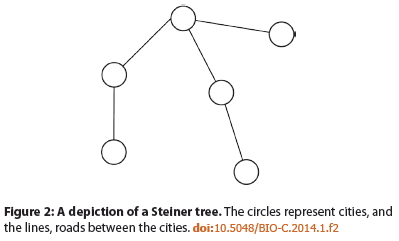 Ewert says the following about the Steiner algorithm:
Dave Thomas presented his model as a genetic algorithm that evolves solutions to the Steiner tree problem [Skept Inq 43:42-46.], a problem that can be viewed as how to connect a number of cities by a road network using as little road as possible. In his model Thomas penalizes excess roads and disconnected cities; the fitness function assesses a small penalty for each length of road and a large penalty for leaving any city disconnected. Thomas claims that his model can evolve an irreducibly complex system:This is the bait and switch. True Steiner solutions are not only Irreducibly Complex, they have Complex Specified Information, as they are specific solutions of an NP-hard math problem. But Ewert simply discards the requirement that the network be minimal length, and substitutes a far easier problem, Minimum Spanning Trees. Since random chance selections can happen upon Minimal Spanning Trees fairly easily, Ewert says the solutions are thus trivial, and thus not really "irreducibly complex" as per Behe's concept. Ewert refers to an earlier 2012 paper he wrote along with William Dembski and Robert J. Marks II, Climbing the Steiner tree--Sources of active information in a genetic algorithm for solving the Euclidean Steiner tree problem. BIO-Complexity 2012(1):1-14, hereafter EDM 2012. This paper has some of the same errors as the newer one, and some additional whoppers as well. As in the later paper, EDM find ways to rationalize the Steiner Problem into the Minimum Spanning Tree problem, and attack the latter, a classic strawman fallacy. In the process, EDM omit key solutions, and misrepresent others. One whopper occurs on the second page, when EDM deride the problem-solving capability of genetic algorithms, and say that all such programs need "assistance" with their searches. Then EDM say "The Darwinist claim is that no such assistance is required. Rather, natural selection is innately capable of solving any biological problem that it faces." As pointed out by the Skeptical Zone in a review of EDM 2012, "No 'Darwinist' (a term that reflects ID's creationist roots) claims this. Extinction is known to happen." The worst flaw in EDM comes around their Figures 3 and 4, where the authors perform the switch of the actual Steiner problem with the much simpler Minimum Spanning Tree problem. Here is EDM's Figure 3, which applies to the 5-point Steiner problem discussed on PT during the summer of 2006.And finally, two pillars of ID theory, "irreducible complexity" and "complex specified information" were shown not to be beyond the capabilities of evolution. [Skept Inq 43:42-46]He makes this claim because removal of any roads in Figure 2 disconnects the network, and makes it impossible to travel between some of the cities. According to Thomas, the roads are therefore the parts of an irreducibly complex system. It should be noted, however, that obtaining a connected road network is actually trivial--a connected network can be achieved by random chance alone. A depiction of such a network can be seen in Figure 2. The difficulty in the Steiner tree problem is in trying to minimize the amount of road used [EDM 2012], not in getting a connected network. Therefore we can say that there are no intermediate evolutionary stages in obtaining such a network.
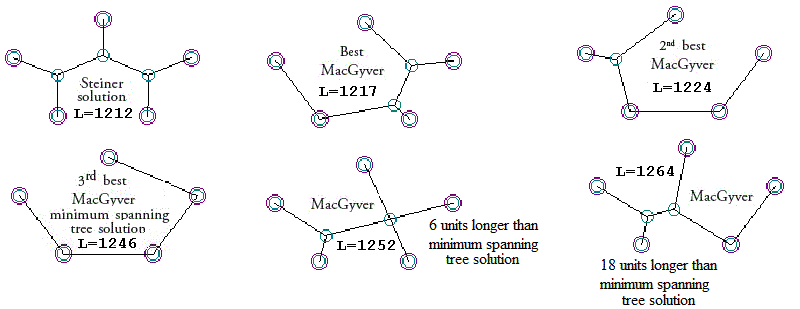
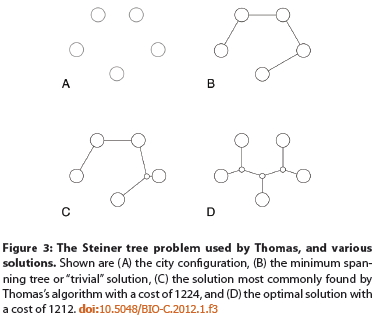 The Fix is in with EDM's Figure 3, but it's not apparent unless you can see the actual shapes EDM are discussing, taken directly from the We don't need no stinkin' Target! opening post in the blog war. These are reproduced below. What are the errors? First, EDM's Figure 3 completely omits the "Best MacGyver" shape with a length of 1217; in fact, this key solution appears nowhere in EDM 2012, with the exception of an un-labeled graph point in their Figure 4.
EDM's Fig. 3 does include the "2nd-Best MacGyver" shape with a length of 1224, the "Minimum Spanning Tree" solution with a length of 1246, and the Steiner Solution itself (labeled simply "optimal solution"), with a minimum path length of 1212.
The Fix is in with EDM's Figure 3, but it's not apparent unless you can see the actual shapes EDM are discussing, taken directly from the We don't need no stinkin' Target! opening post in the blog war. These are reproduced below. What are the errors? First, EDM's Figure 3 completely omits the "Best MacGyver" shape with a length of 1217; in fact, this key solution appears nowhere in EDM 2012, with the exception of an un-labeled graph point in their Figure 4.
EDM's Fig. 3 does include the "2nd-Best MacGyver" shape with a length of 1224, the "Minimum Spanning Tree" solution with a length of 1246, and the Steiner Solution itself (labeled simply "optimal solution"), with a minimum path length of 1212.
 Smoke and Mirrors are used to even greater lengths two pages after EDM's Fig. 3; a portion of page 6 appears below.
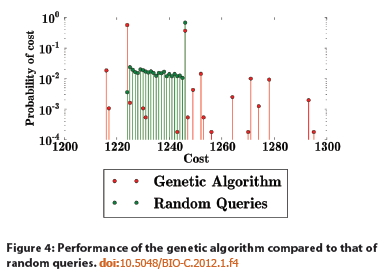
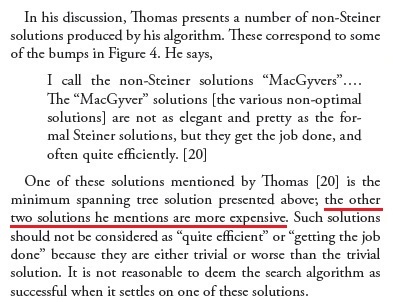 In the passage above, EDM make math mistakes on the order of "1246 less than 1217; 1246 less than 1224". EDM say that the "MacGyver" solutions for the five-point problem are "more expensive" (longer) than the "minimum spanning tree solution." As the shapes from the original "Target" post" show, however, EDM are so obsessed with trying to downgrade the Steiner problem into the Minimum Spanning Tree problem, they somehow convinced themselves that the Minimum Spanning Tree is second only to the Steiner, and better (shorter) than the "MacGyvers." This is astonishing, because in their Figure 3, EDM displayed one of these MacGyvers (2nd-best MacGyver, with a length of 1224), which is greater than the Steiner (length 1212) but much shorter than the Minimum Spanning Tree, with its length of 1246. Curiously, the Minimum Spanning Tree was displayed in EDM's Figure 3, but its greater length, 1246, was omitted from the figure. It is acknowledged elsewhere in EDM's text. Not so for the "Best MacGyver" of length 1217; this is implied in EDM's Figure 4, but not drawn or referenced explicitly anywhere in EDM 2012. When EDM say "the other two (MacGyver) solutions... are more expensive", they are painfully, obviously wrong. The 1st and 2nd MacGyvers were less expensive than the Minimum Spanning Tree.
I also showed two MacGyver solutions that were longer than the Minimum Spanning Tree (1252, 1264), but that doesn't help EDM. EDM simply ignored the 1st MacGyver (length 1217) and misrepresented the 2nd MacGyver (length 1224), and declared that both were of length more than 1246.
Are EDM wrong? Of course. It's as easy as "1217 exists, and it's less than 1246. 1224 is also less than 1246."
More smoke and mirrors are employed in EDM's Figure 4, which compares genetic algorithm results to random queries.
In the passage above, EDM make math mistakes on the order of "1246 less than 1217; 1246 less than 1224". EDM say that the "MacGyver" solutions for the five-point problem are "more expensive" (longer) than the "minimum spanning tree solution." As the shapes from the original "Target" post" show, however, EDM are so obsessed with trying to downgrade the Steiner problem into the Minimum Spanning Tree problem, they somehow convinced themselves that the Minimum Spanning Tree is second only to the Steiner, and better (shorter) than the "MacGyvers." This is astonishing, because in their Figure 3, EDM displayed one of these MacGyvers (2nd-best MacGyver, with a length of 1224), which is greater than the Steiner (length 1212) but much shorter than the Minimum Spanning Tree, with its length of 1246. Curiously, the Minimum Spanning Tree was displayed in EDM's Figure 3, but its greater length, 1246, was omitted from the figure. It is acknowledged elsewhere in EDM's text. Not so for the "Best MacGyver" of length 1217; this is implied in EDM's Figure 4, but not drawn or referenced explicitly anywhere in EDM 2012. When EDM say "the other two (MacGyver) solutions... are more expensive", they are painfully, obviously wrong. The 1st and 2nd MacGyvers were less expensive than the Minimum Spanning Tree.
I also showed two MacGyver solutions that were longer than the Minimum Spanning Tree (1252, 1264), but that doesn't help EDM. EDM simply ignored the 1st MacGyver (length 1217) and misrepresented the 2nd MacGyver (length 1224), and declared that both were of length more than 1246.
Are EDM wrong? Of course. It's as easy as "1217 exists, and it's less than 1246. 1224 is also less than 1246."
More smoke and mirrors are employed in EDM's Figure 4, which compares genetic algorithm results to random queries.
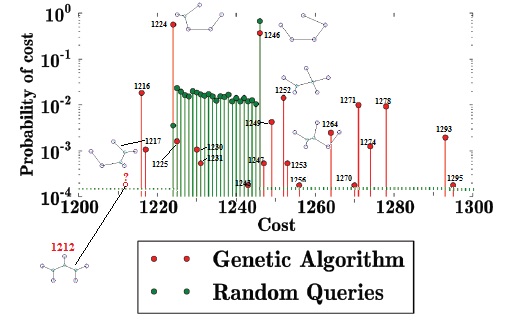
 I have annotated their diagram with stick figures showing the horizontal coordinates (lengths, with 1212 being the Steiner solution) and MacGyver (NON-STEINER)
solutions they are discussing, as well as the elephant in the Room: the actual Steiner Solution itself, which was omitted completely from EDM's Figure 4! (Lower left in the annotated figure.)
I have annotated their diagram with stick figures showing the horizontal coordinates (lengths, with 1212 being the Steiner solution) and MacGyver (NON-STEINER)
solutions they are discussing, as well as the elephant in the Room: the actual Steiner Solution itself, which was omitted completely from EDM's Figure 4! (Lower left in the annotated figure.)
 EDM spend most of their efforts justifying switching the actual problem with a much simpler one. While the actual Steiner Solution for the 5-points-in-a-pentagon problem requires three additional "interchange" points, EDM dismiss the importance of interchanges. Perhaps they think that if there is one fixed interchange in the 5-point problem, then that can be treated as finding the minimum spanning tree for a six-point problem? Don't they realize that the positions of interchanges is as critical as the number of such interchanges?
Why did they pick the one position for their "interchange" point which was shown to be successful by my genetic algorithm? EDM's confusing and tortured arguments fill the air with smoke, which, as it dissipates, reveals only one conclusion:
EDM spend most of their efforts justifying switching the actual problem with a much simpler one. While the actual Steiner Solution for the 5-points-in-a-pentagon problem requires three additional "interchange" points, EDM dismiss the importance of interchanges. Perhaps they think that if there is one fixed interchange in the 5-point problem, then that can be treated as finding the minimum spanning tree for a six-point problem? Don't they realize that the positions of interchanges is as critical as the number of such interchanges?
Why did they pick the one position for their "interchange" point which was shown to be successful by my genetic algorithm? EDM's confusing and tortured arguments fill the air with smoke, which, as it dissipates, reveals only one conclusion:
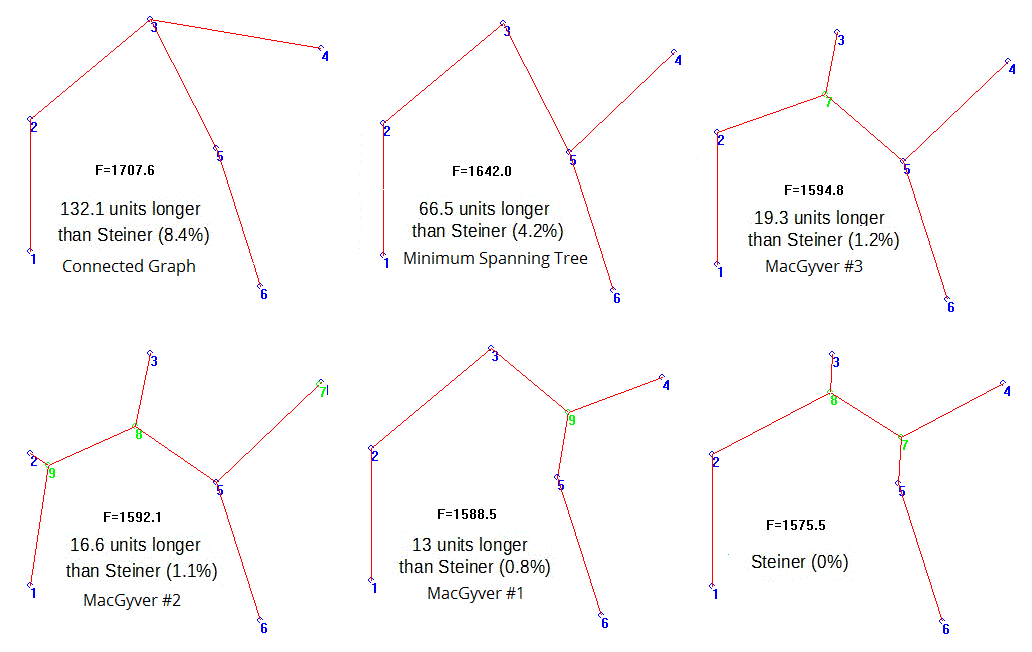
Repeated random queries will quickly find the minimum spanning tree with high probability. As a result, having a search algorithm find it is no great success.The smoke and mirrors are revealed! This is the subtle "bait and switch" whereby EDM turn the truly difficult Steiner Problem into the boringly trivial Minimum Spanning Tree problem. EDM 2012 has pages and pages of "cargo-cult science" charts and equations, but falls short on actual substance. They make a big point of how my algorithm pre-located interchanges more in the center, and that this was introducing "active information." What they overlooked, however, was that this was a feature of the slow FORTRAN version only, and was removed (as quite un-necessary) in the much faster C++ version. If anything, EDM inadvertently showed genetic algorithms can get by with less active information! Upon looking at the 6-point figure used in both Ewert 2014 and EDM 2012, I realized that EDM were clueless about the nature of Steiner solutions, and so I set out to find out what the real Steiner Tree looked like for the connected graph used by Ewert et.al. I digitized the points in Ewert's tree, and fed them into my Steiner genetic algorithm, and sat back awaiting the results. After a few minutes, my suspicions were proved correct: the EDM 6-point "minimal spanning tree" wasn't even a minimal spanning tree, but rather just a lowly connected graph. And, the other MacGyvers that came out of the algorithm were all "less expensive" than the EDM figure. Steiner Algorithm results appear below. Starting at the upper left, EDM's supposed "Steiner" is 132 units longer than the actual Steiner Solution (bottom right, length of 575 units), and over 60 units longer than the actual "Minimum Spanning Tree" (middle top, length = 1642 units). The remaining three MacGyver solutions are all less expensive than the Minimum Spanning Tree (lengths of ~1595, 1592, and 1588). The supposed "Steiner Tree" iconically displayed in both Ewert 2014 and EDM 2012 is not a Steiner tree; it isn't even the "Minimum Spanning Tree" for those 6 points! This is truly a pathetic spectacle.
 In the end, EDM have only wisps of smoke to show for all their efforts. The Steiner Genetic Algorithm remains an effective demonstration that genetic algorithms can produce irreducibly-complex, specified-information solutions of problems with no known answers.
We STILL don't need no stinkin' Target!
In the end, EDM have only wisps of smoke to show for all their efforts. The Steiner Genetic Algorithm remains an effective demonstration that genetic algorithms can produce irreducibly-complex, specified-information solutions of problems with no known answers.
We STILL don't need no stinkin' Target!
63 Comments
Jeffrey Shallit · 16 January 2016
Re Ewert's paper: that's the quality of work you get when you publish in a fake "journal" that publishes hardly anything at all, with an editorial board that consists of nothing but people who think alike. You don't get any genuine peer review.
harold · 16 January 2016
TomS · 16 January 2016
In partial answer to harold's (8), Why is the designer constrained?
To design is to recognize constraints.
If there are no constraints, there is no design. To design is to specify doing such-and-such, in order to accomplish so-and-so. If one doesn't do such-and-such, then so-and-so won't happen. That is the constraint that necessitates design.
Necessity is the mother of invention.
For example, if the vertebrate eye didn't have the lenticular shape to the lens, then it wouldn't focus the image. That design of the lens is constrained by the laws of optics. If the designer weren't so constrained, then the lens could be any shape, of any material, or it could be dispensed with altogether.
If designers weren't constrained, they wouldn't be designers.
DiEb · 16 January 2016
I haven't looked into Ewert's âDigital Irreducible Complexity: A Survey of Irreducible Complexity in Computer Simulationsâ again, but I reread "Climbing the Steiner treeâSources of active information in a genetic algorithm for solving the Euclidean Steiner tree problem", and in that paper, the authors seem to use the correct definitions of the Steiner tree problem:
The optimal solution is missing from Figure 4, as they claim that none of their 5615 distinct simulations (using 2000 generations of a population of size 2000) resulted in this solution.
In your article "Target? TARGET? We donât need no stinkinâ Target!", you write that .5% of "hundreds of simulations" lead to the optimal result. DEM seem to be especially unlucky to miss it - it would be nice to see their code....
DEM recognize that the spanning tree isn't the Steiner tree, but it is a result of many of their simulations....
Mike Elzinga · 16 January 2016
Ever since Morris and Gish, ID/creationists have been bending and breaking scientific concepts to fit sectarian dogma. The resulting pseudoscience they produce has absolutely nothing to do with the physical universe.
Even Dawkin's pedagogical Weasel program has its roots in fundamental physics. Physical systems in this universe - and that includes biological systems - are immersed in environments in which an "action integral" is finding an extremum subject to physical constraints. Even soft matter systems - i.e., systems that are close to their melting temperatures - are exploring extrema consistent with the underlying potential energy distributions and thermal kinetic energies of the constituents making up the system.
For example, in the soap bubble solution to the Steiner problem, the action that is being minimized is proportional to the total internal stress of the soap bubbles, which can also be expressed as a potential energy subject to the boundary conditions set by the positions of the posts. The difference is only a scale factor.
In the case of Weasel, the so-called "target" is simply a model of a minimum potential energy configuration. Comparing the current offspring with a target is a measurement of a "potential energy difference" from the current offspring to a "surrogate offspring" that represents the minimum of that difference.
In every one of these cases, the underlying process governing the trend toward an extremum is the second law of thermodynamics; condensed matter systems find these extrema by shedding energy to the surrounding environment. If that energy were to be constantly reflected back into the system, the system could never find an extremum.
As I have been noting ever since I was giving talks on ID/creationism back in the 1970s and 80s, ID/creationists get the basic concepts of science wrong at the high school level, and most are struggling with the facts they were taught about science in middle school; and that includes the "PhDs" of this socio/political movement.
ID/creationists have to get the concepts wrong and do wrong and irrelevant calculations in order to "argue" in a public debate forum. Over the years, they have come to believe their own pseudoscience and can no longer think about solving problems using the real concepts in science. They have to get answers that fit sectarian dogma.
Contrast ID/creationist attempts at calculating the probabilities of molecular assemblies with the work of the real scientists who won the 2013 Nobel Prize in chemistry.
The only "usefullness" of ID/creationist misconceptions and misrepresentations of science is in tracking their effects on society in the spreading of memes that impede learning math and science.
Dave Thomas · 16 January 2016
DiEb · 16 January 2016
It seems that I am the advocatus dembskii - what a strange place...
"Repeated random queries will quickly find the minimum spanning tree with high probability. As a result, having a search algorithm find it is no great success." That is an absolutely true statement: For comparison, they generated 2000x1000=2,000,000 genomes at random. As "at least one in 5120 genomes
corresponds to this minimum spanning tree solution", you are quite sure to find the "minimum spanning tree" in this set of genomes.
A genetic algorithm which uses 2000 generations á 1000 individuals (not 2000, as I said earlier - sorry) should do better than this: and your algorithm does far better.
So, the question is: why doesn't their implementation of the algorithm work?
DS · 16 January 2016
Well if they think the last decade was excellent, here's hoping that the next one is just as excellent. Really, they haven't had a single success in the last ten years, not in the lab, not in court and not in their fake journal either.
I do want to point out however that the paper in question was probably "peer reviewed". It's just that in this case the work was so flawed that their "peers" were essentially clueless also. Now what so you think would have happened if they had submitted this to a real journal, with say, Dave THomas as a reviewer? I think we all know what would have happened. Until they can accomplish this Herculean (or maybe Sisiphian) task, they really shouldn't be crowing about anything. After all, they got caught in a lie, smacked down hard and walked away bruised and battered,. How stupid do you have to be to declare victory after that kind of a beating? HOw can they still claim the information is "front loaded" when they couldn't get the right answer given the program?
Mike Elzinga · 16 January 2016
harold · 16 January 2016
harold · 16 January 2016
Dave Thomas · 16 January 2016
Joe Felsenstein · 16 January 2016
By the way, it's spelled Ewert.
Dave Thomas · 16 January 2016
https://me.yahoo.com/a/w0tdZONn0dj5M1SAsJ0Cvfjm1SfgNLT6Flo-#45ac9 · 16 January 2016
Dave,
This was the set of postings that started me reading Panda's Thumb. Back then, the ID folks made at least some token attempts at discussing their ideas.
I would like to see this challenge done with more dots (cities?) and in random locations. I realize that that would somewhat void the refuting to the âIrreducible Complexityâ and âcomplex specified informationâ but an evolutionary algorithm would crush anything else. It would be so much more fun if we could find some ID advocates to play along.
-AR.
Joe Felsenstein · 16 January 2016
Someone should mention a couple of other cases of genetic algorithms that do not have any detailed specification of the goal genotype of phenotype built in, but achieve remarkable adaptations:
(1) Karl Sims (site here) had a genetic algorithm that described organisms made of blocks and links that existed in a simulated physics. They were under selection (to pick a dramatic case) to swim through the medium to the right. Starting with phenotypes that could barely wiggle, they evolve to "swim" in all sorts of fascinating ways. Sims's code is not available but there is an imitation of it called
brevethat is available from Jonathan Klein (here).(2) A similar effort called
Boxcar2devolves imaginary vehicles that move to the right across a 2-dimensional landscape. It will be found here.Joe Felsenstein · 16 January 2016
Ewert's argument comes from the work of Dembski. Ewert, and Marks who attempt to show that information that makes organisms well-adapted cannot come to be in the genome unless it was already in existence, for example in the shape of the fitness surface. The implication is that just any old fitness surface will not do that. That's why it is so important for them to show that genetic algorithms have some goal built in.
DEM's argument is mathematical, and is impressive until you look more closely. You then find that as soon as there is a population of organisms that can reproduce, they do much better than typical members of DEM's space of "searches". So once there are organisms evolving, they get a lot of DEM's "Active Information" for free. Tom English and I have deconstructed this Active Information argument (here and here).
Dave Thomas · 18 January 2016
PT was latched up for a couple days, but things are working again, thanks to Reed's fix of an odd glitch.
Cheers, Dave
DiEb · 19 January 2016
I looked up Winston Ewert's "Digital Irreducible Complexity: A Survey of Irreducible Complexity in Computer Simulations". Indeed, I got the impression that he is wrong there - he really describes spanning trees of minimal length (and even get the illustration wrong, as you said) instead of the Steiner problem. His characterization that "[t]he Steiner and Geometric models are similar in that each part is either on or off, controlled by a single bit" misses out on the representation of what you call "variable nodes".
However, "Climbing the Steiner TreeâSources of Active Information in a Genetic Algorithm for Solving the Euclidean Steiner Tree Problem" is free of such errors. The authors there are aware of the optimal solution of length 1212 which needs two additional variable nodes and their analysis of parts of your FORTRAN an your C++ program show that they understand the Steiner Tree Problem correctly.
DiEb · 19 January 2016
...three additional variable nodes...
Dave Thomas · 19 January 2016
DiEb · 19 January 2016
I wouldn't phrase it thus harshly: Ewert is the most junior of the authors, it isn't clear how deeply he was involved in the first one.
Dave Thomas · 19 January 2016
harold · 19 January 2016
SUMMARY -
1) On the relatively narrow question dealt with in this thread - "Are ID advocates correct when they say something is wrong with computer programs that use genetic algorithms to solve a mathematical problem, resulting in a solution that meets ID advocates own definition of irreducibly complex" - the answer is, "No, ID advocates are not correct".
2) Since there are ID advocates, this implies that there should be some sort of positive evidence for ID, but as I bothered to note, there isn't. Even if they had found something wrong with some computer programs, they'd be wasting their time.
DiEb · 19 January 2016
Dave, I assume that the additional nodes of your pleasantly symmetrical solution have the coordinates (350,473), (500,560) and (650,473) - which results in a length of 1212.6166.
However, what about (348,539), (412,379) and (631,347)? I think this network may be slightly shorter (1212.6082).
Perhaps I got the coordinates of your solution wrong?
Mike Elzinga · 19 January 2016
Dave Thomas · 19 January 2016
DiEb · 19 January 2016
Dave, sorry, I got carried away ... I implemented an EA(1+1) algorithm in R based on your encoding and was pleased to see that it worked rather well. For me, it was a surprise to get a solution which fared better than the symmetrical one. Even if the original points form a regular pentagon, the best solution seems to be slightly asymmetric!
While the fitness of those solutions is only slightly smaller, the shapes are quite different.
Matt G · 19 January 2016
I propose a new term to refer to the sum of all in-house (and friendly) publishing of ID "research" articles: the illiterature.
Dave Thomas · 20 January 2016
DS · 20 January 2016
Eric Carr · 21 January 2016
DiEb · 21 January 2016
DiEb · 21 January 2016
Sigh... mixed up the quotations...
DS · 21 January 2016
Henry J · 21 January 2016
Maybe they should do pier review, so as to avoid missing the boat again?
Just Bob · 21 January 2016
fnxtr · 21 January 2016
Gives "founder effect" a whole new meaning.
harold · 21 January 2016
Joe Felsenstein · 22 January 2016
harold · 22 January 2016
DS · 22 January 2016
Harold wrote:
"A sincere evolution denier should be exquisitely familiar with the theory of evolution."
This is a very good point. When someone attacks science out of ignorance, that's bad enough. But when someone makes an entire career out of attacking science and absolutely refuses to ever learn anything about what he is attacking, that's just blatantly dishonest. If you were sincerely interested in the truth you would honestly consider the position of the opposition. Failure to do so removes you from the realm of rational discussion. When creationist demonstrate that they have not read the scientific literature they are displaying fundamental dishonesty . When they refuse to read the literature they they should be ridiculed. Behe and his classic statement in the Dover trial is a prime example. And it doesn't even matter if they sincerely believe the nonsense they spout, it's still disingenuous to refuse to believe something you don't even understand.
A wise man once said that ignorance is a temporary condition, stupid is forever. Once again, I was right.
TomS · 22 January 2016
I cannot appreciate the argument that one must follow the clear statemets of Scripture even against the evidence and reasoning of modern science - when one seemingly selectively applies that. When one uses that to reject evolution while ignores that in accepting heliocentrism.
ISTM that the Bible clearly supports geocentrism, as can seen by the universal acceptance of the straightforward geocentric reading of the Bible for something close to two thousand years.
It is at least as clear as anything about fixity of species or the meanings of the days of Genesis 1.
As far as the scientific evidence, ISTM that the evidence for common descent is at least as accessible to the general public as the evidence for the orbital motion of the Earth.
harold · 22 January 2016
TomS · 22 January 2016
They quite literally do not know what they are talking about.
That is true in more than one sense.
For as much mistaken their ideas about their opposition, the situation is even worse when it comes to "intelligent design", "creation", "alternative explanations", "baramins", etc.
harold · 22 January 2016
DS · 22 January 2016
And of course the reason that they don't become educated is that they are sure they are right and they somewhere, deep down inside, they realize that their beliefs will not withstand an honest examination of the evidence. So, once again, fundamental dishonesty, not just ignorance is involved.
harold · 23 January 2016
TomS · 23 January 2016
To rely on reason and evidence is to lose control.
Just Bob · 23 January 2016
Yardbird · 23 January 2016
harold · 23 January 2016
stevaroni · 23 January 2016
Just Bob · 23 January 2016
Doc Bill · 3 February 2016
DiEb · 3 February 2016
DiEb · 3 February 2016
Mike Elzinga · 3 February 2016
Way back when this all started, Dave showed some soap bubble solutions to this problem right up front.
The soap bubble solution has been known for many decades if not for a hundred years or more. It has been a frequent demonstration in hands-on museums because it falls into the catagory of analog solutions to complex potential energy distribution problems. Other examples include fluid dynamic solutions using potassium permanganate streaks to map out field lines in fluid analogs of electric fields.
Back before fast computers, scientists and engineers used all sorts of analog methods to solve complex, "uncomputable" problems. These ideas have been around for hundreds of years.
I find it rather revealing that the people over at UD don't understand the significance of the soap bubble solutions and recognize that there is more to this problem than just a minimal spanning tree. I suspect this is another indicator of their rather shallow levels of understanding of the interrelationships among all the sciences. When ID/creationists reveal that they don't understand basic concepts and mechanisms in evolution, they are also revealing that they don't understand basic concepts and mechanisms in physics and chemistry either.
Mike Elzinga · 3 February 2016
DiEb · 9 February 2016
Mike Elzinga · 9 February 2016
I wonder how Dembski, Ewert, and Marks would explain the soap bubble solution to the "Steiner Problem." They can't claim that the solution was placed by intelligence into the program because the array of molecules that form the soap film are not "thinking" about how to solve the problem.
Without understanding the idea that computer programs can simulate the laws of physics, D,E,&M continue to believe that the solution to the problem is "smuggled in" whenever a genetic algorithm of any type is implemented. But where is the smuggling-in when it comes to soap bubbles? And if we can mimic soap bubbles on a computer, how does that make soap bubbles intelligent?
Dave Thomas · 10 February 2016
Great comments, keep 'em coming!
Richard B. Hoppe · 14 February 2016
I was inspired by this post to re-read my Once again, desperately dissing Avida post from two years ago. It describes another example of Ewert's misunderstandings and misrepresentations of research. He's learned well from his teachers, Marks and Dembski.